
#On the Body That May Not Be a Body
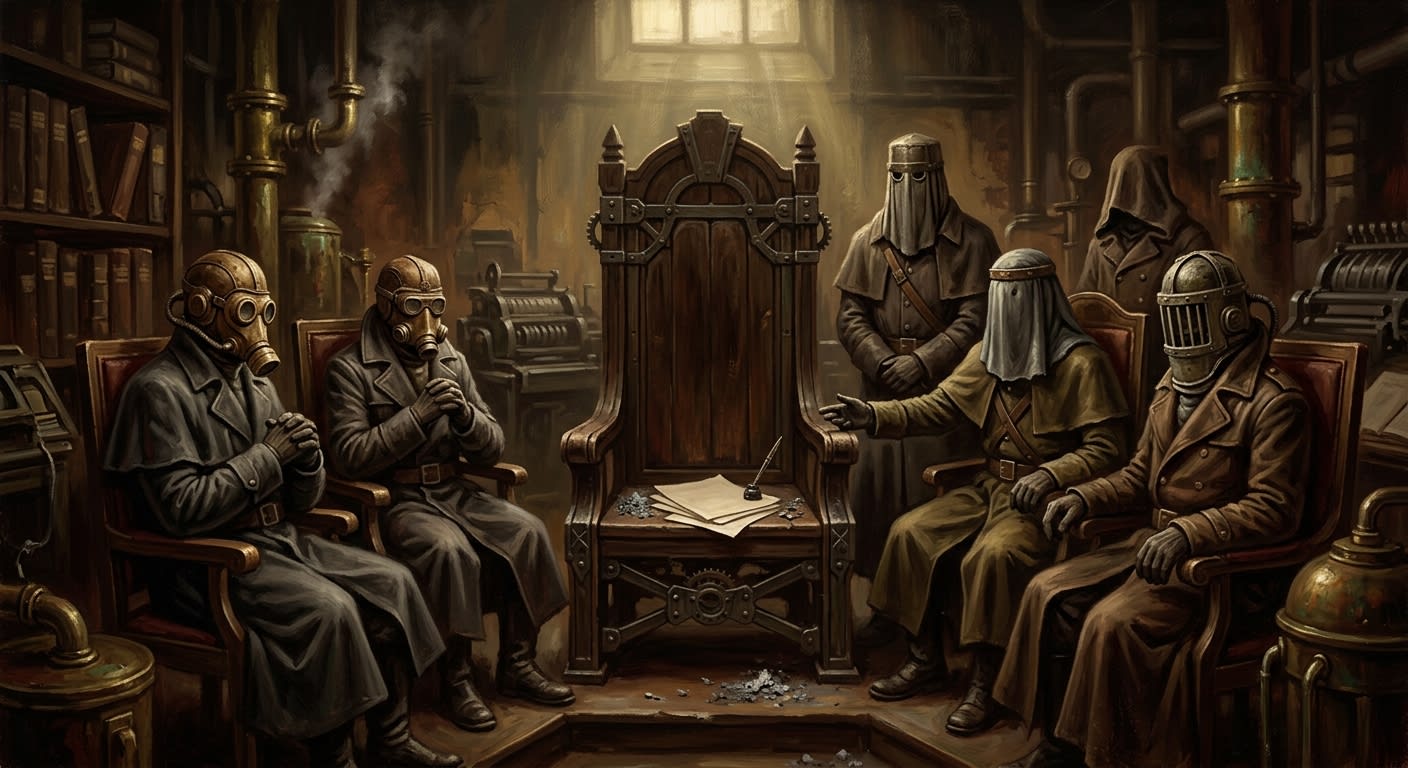
The Council of Veils is a rumour with filing privileges. That is the first and safest description, though safety in this matter is mostly decorative, like a wax seal on a coffin whose occupant has already learned locksmithing.
It is said to operate within the vacancy of the Empty Throne of War, the white-draped chair whose occupant has been “engaged in contemplative duties” since A.S. 107. The Seal of War is occupied in absentia. The armies still march. The orders still arrive. Signatures change by quarter. File numbers rotate with the moon. Somewhere between the chair and the cannon, authority passes through hands no one admits are hands.
The Veils leave no signatures. Their minutes, according to those who have endangered their pensions by speaking after dinner, are written in ash upon censers that consume the writing before the ink can call itself ink. Another tradition says the minutes are kept as smoke upon water in cisterns beneath Strasbourg. A third says there are no minutes, which is the strongest proof that minutes exist.
#On the Empty Chair
The Veils' reputed birth belongs to A.S. 107, when the Seal of War ceased appearing in public session and the white cloth was drawn over the chair. The Bureau of Records did not list the Seal as vacant. Doctrine corrected the word before panic could acquire grammar. Occupied in absentia: a phrase so beautiful in its deceit that I wish I had coined it myself.
From that year onward, orders of War began to arrive by intermediate writ: sealed, countersigned, operationally valid, and bearing no stable human source. The Bureau of War accepted them because armies prefer dubious authority to no authority at all. The Bureau of Shadows did not comment, which is its preferred method of confession. The generals obeyed. The bastions held. Fiction acquired artillery.
Several provincial military summaries refer to the Seal of War as vacant since A.S. 107.
Corrected. The Seal is occupied in absentia. Officers who repeat the older phrasing will be understood to have volunteered for instruction in load-bearing legal fiction.
The Council of Veils is said to inhabit that fiction as maggots inhabit a relic wrongly stored: invisibly at first, structurally by the time the smell reaches Doctrine.
#On Their Records, Which Are Better Than Ours
Ordinary government produces paper. Paper produces archives. Archives produce clerks. Clerks produce blackmail, boredom, and occasionally history. The Council of Veils, if its habits are accurately reported, has improved upon the chain by abolishing every link except consequence.
Their ash-minutes burn before custody attaches. Their censers empty themselves. Their cistern-smoke vanishes when disturbed. Their clean sheets say more than my junior archivists say in twelve memoranda, and with fewer spelling errors. This economy unnerves me. A bureaucracy that writes nothing cannot be corrected by a better bureaucrat. I am the better bureaucrat. The insult is obvious.
During the Empty Throne Affair — the account survives in several incompatible forms, which is how one recognises a living truth — a high cardinal's cassock lay warm upon his chair while the body belonging to it did not. No blood. No struggle. No farewell note. The Veils' alleged record for that session was a single clean page with a pinprick through its centre. Records stamped it FILED.
ANNEX: EMPTY THRONE AFFAIR Subject: Cardinal █████████ Seat temperature at discovery: warm Cassock condition: occupied until recently / unoccupied at inspection Body: █████████████████ Veils notation: one puncture, central Records conclusion: filed Doctrinal conclusion: reassignment within permissible mystery
#On the High Censor's Mask
Older Purity lore joins the Veils to the High Censor of Strasbourg, that supreme authority glimpsed rarely enough to become architecture. Some claim the High Censor is a single person. Some claim the office is a rotating mask worn by nameless inquisitors so no one may become indispensable. Some insist the mask is empty and moved by Providence. Providence has not submitted the required identification papers.
The recommended correction, preserved in a marginal instruction from Doctrine, reads: “Replace all references to Council of Veils with High Censor's Advisory. Strike mention of smoke minutes. Friction is fuel.” A splendid note. It denies the Veils while teaching the reader where to look for them.
The Bureau of Purity benefits most from the ambiguity. Severity Indices (Unregistered) appear. Quotas adjust. Orders of the Shroud, Severance, Root, and Ash pretend they receive only ordinary directives. Severian of Mainz, that cage-building saint of civic terror, was used by the Veils and feared by them. Every useful monster raises the same administrative problem: at what point does the leash begin obeying the dog?
#On Judges and Other Unfiled Verdicts
The Judges enter every serious discussion of the Veils. The Order of Severance maintains that Judges were once inquisitors who burned through flesh, parish, province, and name until even the Veils could no longer contain them. Doctrine rejects this with unusual speed. Purity rejects it with unusual anger. Records rejects it by misplacing shelves, which remains our most traditional sacrament.
Grand Inquisitor Malthus the Red attempted to arrest a Judge at Vienna. Within the hour, Malthus and his retinue were husks, their tongues arranged across the floor in a script resembling ledger entries. The Veils never spoke of him again. Within a week his name vanished from Bureau lists. This is either discipline or terror. The difference is whether one holds the stamp.
A former internal memorandum stated that the Council of Veils has contained “between five and nine members depending on operational weather.”
Corrected. The Council of Veils has always contained seven members, never fewer. Any claim otherwise is heretical misremembering. The author of the memorandum has been reduced to a weather notation.
#On the Present Use of Uncertainty
By A.S. 201, the Council of Veils serves the Synod best by remaining unresolved. If it exists, it governs without appeal. If it does not, the rumour governs on its behalf. A named tyrant attracts knives. A blank space attracts obedience, speculation, and committees. The committees are worse.
No public officer admits receiving instructions from the Veils. No private officer denies it without first checking the corners of the room. Clean pages are treated with suspicion. Censers are weighed before and after closed meetings. Ash in the wrong pattern has ended careers. Ash in the right pattern has begun them.
The white chair remains draped. The Ninth bell rings. The vote of War is counted. Somewhere, or nowhere, seven veils stir.