
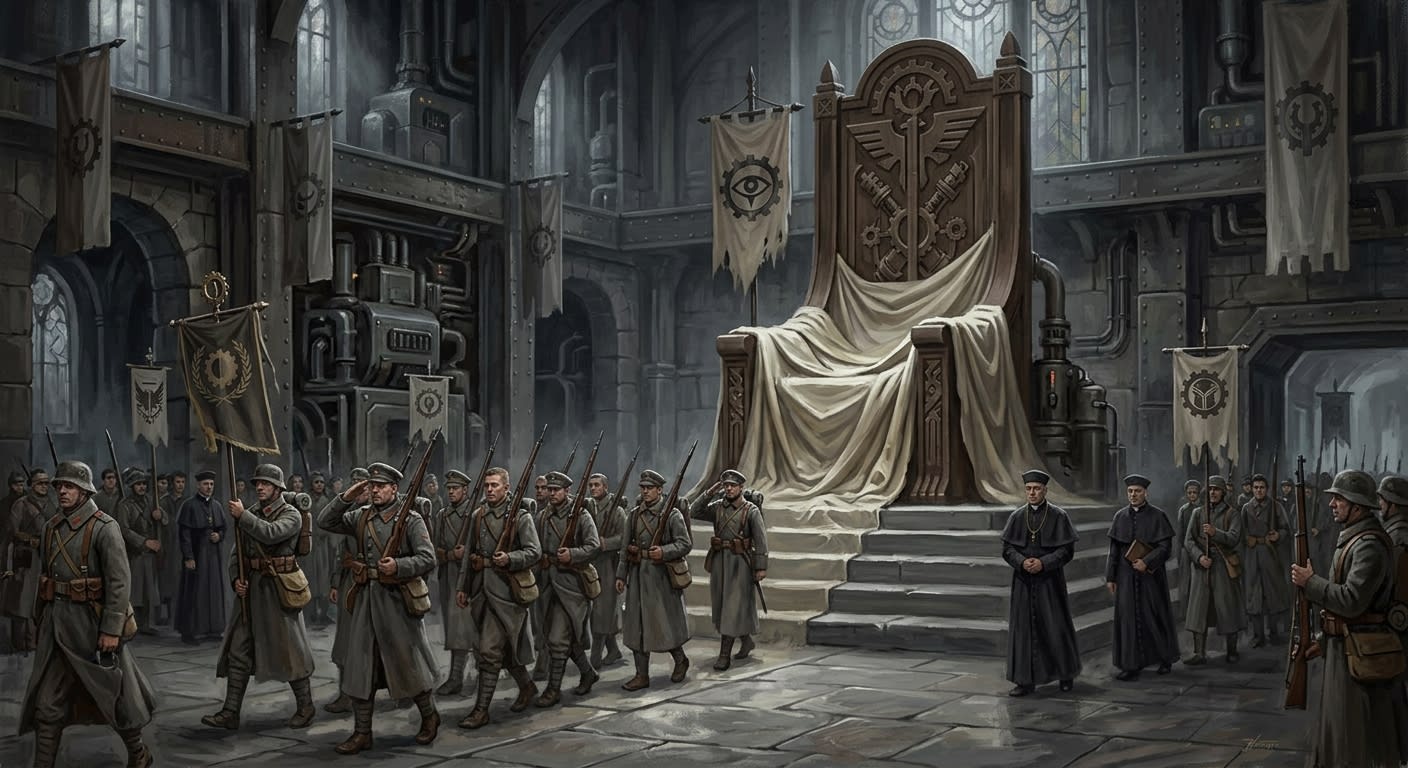
#On the Chair That Commands Armies
The Empty Throne of War is the white-draped chair of the Seventh Seal, placed in the Inner Circle of Strasbourg, counted at every session, obeyed by every army, and sat upon by no publicly acknowledged body since A.S. 107. It is the Synod's most successful piece of furniture. Thrones ordinarily require occupants, and occupants ordinarily require names, appetites, enemies, and funerals. The Empty Throne has improved upon the office by dispensing with the man.
The Seal of War commands the armies of the Sagittal Line, the Continental Levy, the Bureau of War, and the garrison commanders from Bastion-Königsberg to Bastion-Constantinople. The chair is the hinge between decree and artillery. Doctrine speaks. War moves. Between the two sits white cloth gone yellow at the fold, dusted by a century of obedient cowardice.
#On the Correction of Vacancy
Earlier provincial summaries called the Throne vacant. This was a natural error and an intolerable one. Vacancy implies lack. Lack implies interruption. Interruption implies that orders issued under the Seal of War during the last ninety-four years may require verification, and verification is a charming pastime for heretics, auditors, widows, and men too far from the guns.
The official phrase is occupied in absentia. It is a masterpiece: fraudulent enough to function, dignified enough to survive quotation, narrow enough to bear artillery.
A prior edition of this official documentation described the Seat of War as “empty since A.S. 107.”
Corrected. The Throne is visibly empty and legally occupied. Readers unable to hold both statements without distress should report to the Bureau of Doctrine for remedial instruction in statecraft.
A battalion does not halt because a philosopher dislikes the signature on its marching order. A fortress does not refuse shells because the authorising hand is unavailable for tea. The Line eats men hourly. The Bureau of Records records them. The Bureau of Relics improves the useful corpses. The chair signs by implication.
#On the Year A.S. 107
A.S. 107 is where the cloth begins. The public record states that the Hierarch of War entered contemplative duties. The private record, insofar as private records retain the courage to exist near this subject, says only that the Seal ceased public session and that orders continued without delay. No proclamation. No funeral. No trial. No name struck from the Ledger with enough noise to make the provinces feel governed.
From that year onward, War writs arrived through intermediaries: sealed, countersigned, operationally valid, and bearing signatures that changed each quarter. File numbers rotated. Wax formulas shifted. Certain orders smelled faintly of censer ash, others of lamp oil, one of river mud and cloves, which caused three clerks to request transfer before anyone had read the campaign directive. The armies obeyed. The bastions held. Fiction acquired logistics.
#On the Council That May Be the Cushion
The Council of Veils is said to operate through the Throne's absence. I am required to phrase that sentence as rumour, since fact would require a filing category, and Records has misplaced the relevant shelf with such elegance that I suspect professional pride.
Seven hidden hands, so the muttering goes. Ash-minutes. Blank pages. Censer smoke preserved on cistern water beneath Strasbourg. The High Censor's Advisory, where cowardice requires a public alias. Orders without authors. Consequences without signatures. The Throne gives the Veils constitutional shelter; the Veils give the Throne motion. One supplies sanctity. The other supplies teeth.
CONDITIONAL ANNEX — WAR SEAL INTERMEDIATION Quarterly signature series: █████████ Known couriers: ████████████████ Blank-page returns: ██ Ash residue consistent with: Council of Veils / furnace draft / deliberate intimidation Recommendation: continue obedience pending clarification that will not arrive.
#On Command Without a Commander
The Empty Throne solves an old military problem: generals love authority until it belongs to someone else. A living Hierarch of War would quarrel with the Warden-General, offend the Bureau of War, provoke Doctrine, alarm Purity, and develop opinions about budgets. An absent Hierarch cannot be flattered, bribed, assassinated, seduced, corrected, or overheard in the latrine. He may be quoted endlessly. This makes him close to perfect.
Orders issued under the Throne move by chain: intermediary writ, War docket, garrison seal, drum schedule, rail priority, ration release, coffin requisition. At no point does the absence interrupt the machine. Absence, properly notarised, lubricates it. Men march faster when no one can appeal.
The Bureau of Shadows benefits. The Bureau of War benefits. Doctrine benefits most, because Doctrine can pronounce the absence meaningful on Monday and operational on Tuesday without changing ink. Purity watches the phrases used by officers discussing the Throne. The incorrect word remains “vacant.” The dangerous word is “who.”
#On the Cloth
The cloth is white. It has yellowed. No one launders it. Neglect has never survived long in the Inner Circle, where even pigeons have been excommunicated for insufficient respect toward hierarchy. The cloth remains because the stain has become part of the seal. Remove it and one admits that an object covered for ninety-four years may conceal nothing. Leave it and the nothing becomes ceremonial.
Dust settles upon it undisturbed, except on mornings after a major campaign order, when witnesses have reported a faint line across the armrest, as though a hand had rested there during the night. Records classifies the marks as air movement. War classifies them as authorisation. Doctrine classifies them as edifying. I classify them as someone else's problem and keep my fingers away from the chair.
#On the Present Use of the Absence
As of A.S. 201, the Throne continues to vote, command, and receive the Summons of the Ninth (Unregistered). The clerk marks War present by faith. The other Hierarchs accept the mark because rejecting it would require naming the event of A.S. 107 with unbecoming courage. Europe has survived on less durable cowardice.
The faithful imagine authority as a man beneath a seal. They are peasants of the mind. Authority is the seal, the chair, the cloth, the instruction obeyed before anyone asks whose breath warmed it. The Seventh Seal has taught the Synod its finest military doctrine: a command does not require a commander. It requires a route, a fear, and a clerk willing to write present beside an empty chair.