
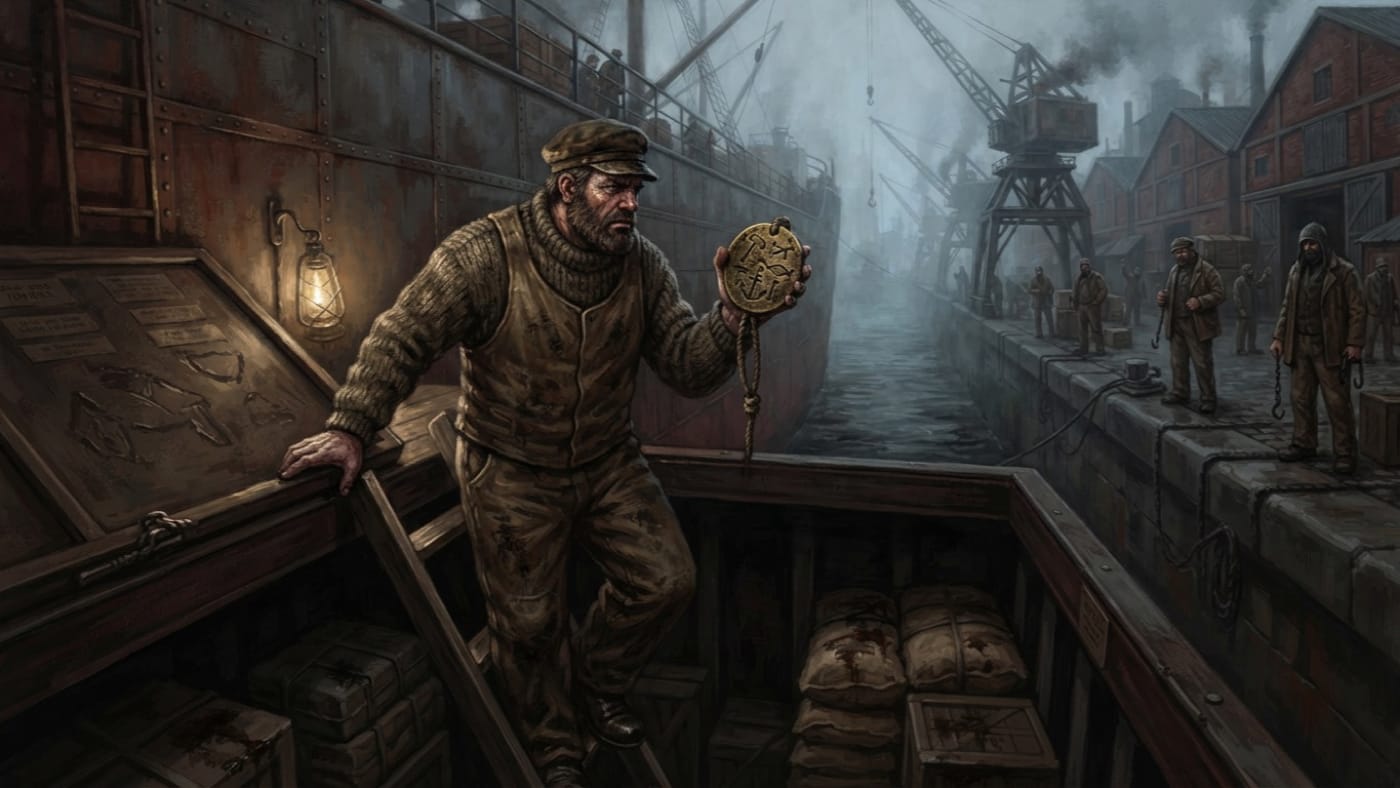
#On Authority Beneath the Hatch
The hold-order token is the smallest instrument in Hamburg that can make a warship wait. It is how the Stevedores' Compact tells the harbour that a ship's belly has been examined, braced and judged fit to give up its cargo. Until the token is released, the Compact holds that the cargo belongs to the hold and to the men inside it. Once it is released, the quay may begin its own quarrels.
The division is old and bad-tempered. The Longshoremen's Brotherhood rules the quay with hooks and chalk. The Compact rules the darkness below the hatch with wedges, tally cords and the dull science of knowing which sack will kill a man before it does. The token marks the border between them, and the border has a toll. A ship whose holdmen have not released it stays a ship. Once released, it becomes a delivery.
I have been asked to describe the token's form, and I decline. The Compact has never volunteered that particular to a Doctrine scribe, and I have no wish to become the first theologian in Hamburg corrected by a man holding a timber wedge.
#On Certification and Stowage
What the token certifies is that a hold is in order. Cargo moves during a passage. Grain settles. Coal shifts. Timber rolls. Chrismole sweats heat through its casing like a penitent through his hair-shirt. Ordnance takes up damp and keeps it, the way a seminarian keeps a grievance. When a ship berths, the hold no longer matches the one that left port. The manifest has not changed at all.
That gap is where the Compact earns its keep. A captain's manifest can stay perfectly tidy while the cargo it lists turns into a hazard. Wet grain swells. Swollen sacks split. Split sacks heat, and heated grain spoils, breeds rats and mould, and gives Purity something to classify after everyone else has finished being sick. None of this shows on paper. All of it is found below.
In practice a holdman goes down before he signs. He reads the tally cords left by the crews who stowed the cargo. Three knots on a cord mark a risk of compression. Red wax at the hatch forbids open flame, and dock boys learn that the first time they ignore it. A nail bent around a cord means the load shifted on passage and has to be opened under senior eyes. He looks at the braces, smells for damp, puts a hand flat on the sacks to feel for heat, and listens to the timber. A hold has a voice, and holdmen claim it complains before it collapses.
Then he signs the hold-order token with his thumb, which is black from rope grease.
The grease guarantees nothing, and I warn the antiquarians before they turn it into a security measure. Every thumb in the Dock Quarter is black. What matters is whose thumb it was. A token signed by a holdman puts a named man on the cargo. If the hold he released later kills someone on the quay, the Compact knows whose hatch it was, and so do the widows who keep the injury tins.
#On Weight and the Two Jurisdictions
The Compact holds that grain stays under hold jurisdiction until the token is released. The Brotherhood holds that grain passes to the quay as soon as the sling takes its weight. Both claims are sincere and both are argued with fists. Between them lies an interval that no one has settled: a sack in the air, lifted off the stow and not yet landed, claimed by both guilds and owned by gravity alone.
Hamburg has lived inside that interval for generations. It has produced songs, bruises and arbitration packets, and at least one broken tooth now kept in the Compact hall as a jurisdictional instrument. No court has ruled on the question, and I will not supply a ruling. Disputes this useful are rarely ended by anyone who profits from them.
The token has to be kept separate from the paper that crowds around it. The captain's manifest records what was loaded. The tariff-chapel weigher records what the Bureau of Tithes means to charge. Purity's marks record what Purity suspects. Only the hold-order token records whether the cargo can come out without killing anyone.
This is why Tithes hates it with such loyalty. A holdman who finds sodden grain, rat losses, or a load that has settled and split will correct the stow, and every correction changes the weight. A changed weight changes revenue. A change in revenue makes the Palatine Counting House sound like a rat under a reliquary lid. The Compact's stamped fish, which marks a captain suspected of false bilge weight, adds insult to arithmetic.
The other Bureaus have their own complaints. Records dislikes tally cords, because they hold information in a form paper cannot file. Purity distrusts the life below deck, where men swear, trade and drop out of clean sight. War cares about one question only: whether sound cargo comes ashore quickly. On most days War gets its answer from the token, and the token gets War's protection without ever asking for it.
#On the Refusal Precedent
In A.S. 189 / 1899 CE, Warehouse 17-E burned. Wooden crates of chrismole had been stacked six high against a condemned wall. When the wall went, the Dock Fire took four blocks and three hundred and twelve lives. Twelve dock bodies withheld their labour for eleven days. On the twelfth day the Bureau of War offered a settlement.
That settlement is regularly misquoted, so I list its parts separately. The order in which they are confused is itself instructive.
War granted a seven-per-cent hazard supplement on dock wages. Tithes agreed not to tax that supplement, an act of restraint so painful that some Strasbourg clerks are said to limp at the mention of it. The third concession is the only one that concerns the token. Senior holdmen of the Compact won protection from immediate arrest for obstruction when they refuse certification for unstable chrismole, damp ordnance, or grain heated beyond safe measure.
Read the clause as Tithes reads it, which is to say slowly and with malice. It protects a senior man, and only a senior man, which in Compact terms means the one wearing a bent hatch nail on a cord. It covers three named hazards and no others. It protects him from immediate arrest, and Tithes values that one adjective above any jewel in its treasury. The holdman who refuses can still be questioned, audited, complained about and made miserable. What he cannot be is dragged off the hatch while the hold he refused is still unsafe.
That is a narrow privilege and a sufficient one. It gave the token an important power: the right not to be issued.
The eleven-day stoppage of A.S. 189 delayed military supply through the refusal of dock labour.
Corrected. The delay came from chrismole stored in wooden crates against a wall already condemned and left unrepaired. The dock bodies made the delay visible to offices that had not noticed the wall.
#On the Mark Falsified
A token that can be withheld is worth something only if it cannot be counterfeited. The Compact enforces this itself, and it is harder on its own than any Bureau would care to be. A man who falsifies a hold token loses his berth for a season. No appeal to a confessor helps him, and no sum paid to a Tithes clerk shortens it.
The guild punishes the neighbouring sins with the same plainness. A man who cuts a brace too early pays injury compensation to whoever bleeds because of it. A man who enters a sealed hold without a witness is disciplined by the Compact whatever War, Tithes or his priest may say. These rules sit around the token like a guard around a magazine. Every one of them comes back to judgement that someone can be held to account for.
The reasoning is simple, and I resent it. A false token puts a dangerous load in the sling under a borrowed name. The sling lifts it. The Brotherhood takes it on faith. A sack that was heating in the hold arrives on the quay still heating. A crate of damp ordnance goes inland. Someone dies far from Hamburg, at the end of a rail spur, and the man responsible goes on drinking in a dockside tavern because his thumb was on the wrong token.
#On Present Release
As of A.S. 201 / 1911 CE, the token governs a harbour that has no margin for spoilage. Hamburg is the largest naval import terminal in the Synod, and British grain is the North Sea's most anxious freight. Released holds feed the Northern Corridor: rail from Hamburg to Kanzleiburg, the yards at Warsaw, and the forward spurs to Bastion-Königsberg and Bastion-Brest. The soldiers at the end of that line do not know what a hold-order token is. They do know when the porridge has turned.
Admiral-Prefect Gerta Halske arbitrates the jurisdictional quarrel without any visible fondness for either guild. She weighs spoilage risk, military consequence, foreign consequence and scandal, and justice gets no particular satisfaction from the sum. When British grain captains arrive with clean smiles and foul ballast, she lets the Compact inspect first. When Tithes wants declared weights before discharge, she lets discharge go ahead and invites Tithes to complain at the speed of dry ink. A token that is withheld under her administration stays withheld until the hold below it is fit to release. The Brotherhood waits on the quay with its hooks, and the Compact goes on making it wait.