
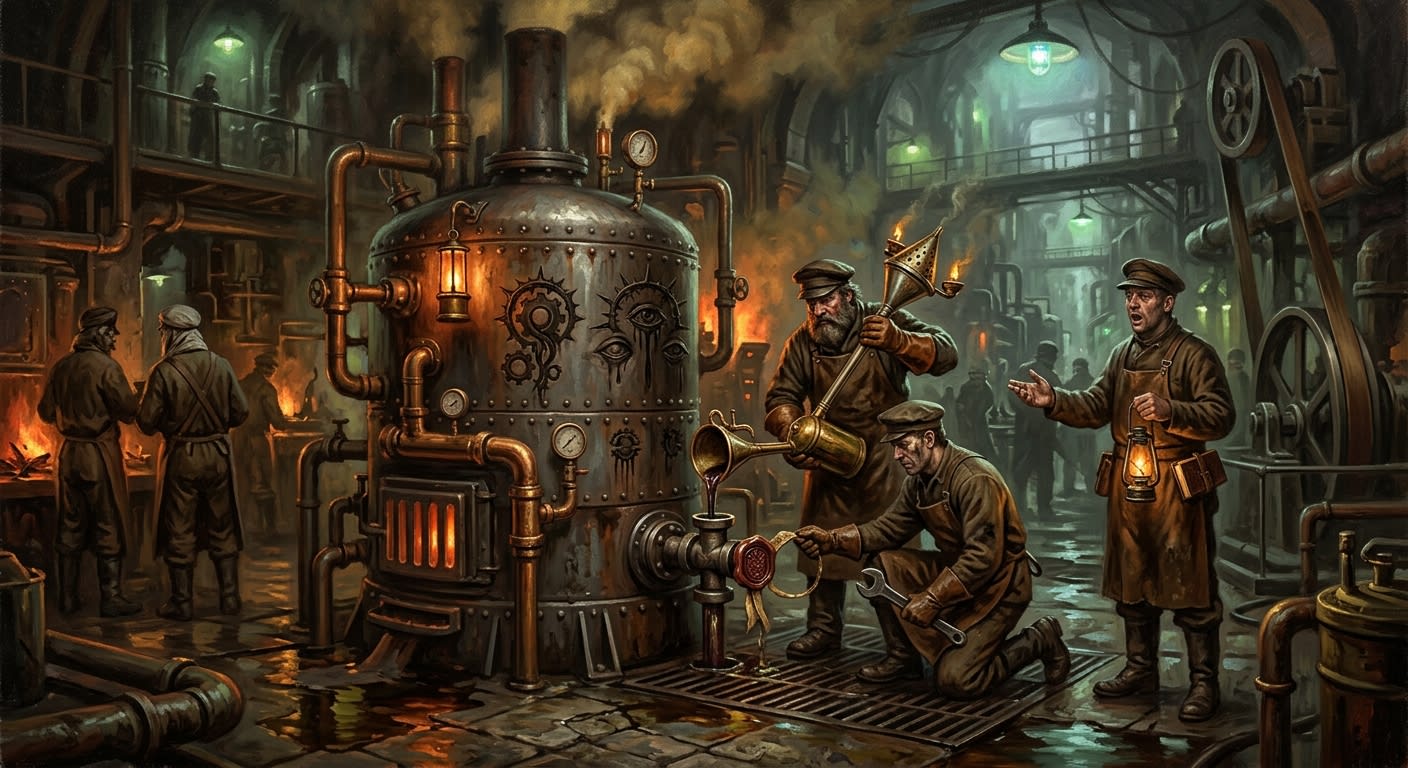
#On the Substance That Learned to Receive Blessing
Chrismole is sanctified fuel, which is a phrase designed to spare weak readers the spectacle of theology wearing an oilskin apron.
It burns in artillery pumps, rail engines, trench heaters, boiler hearts, signal lamps, shrine-deck machinery, sealed ward generators, and the large rude devices by which the Sagittal Line teaches Hell to respect scheduling. It is black-gold in the drum, sweet-stinking in the fumes, bright-toothed in the flame, and more heavily documented than most bishops. It feeds guns at Brest, warms batteries at Przemyśl, moves sealed wagons toward Königsberg, and has killed enough dockmen in Hamburg to qualify for its own devotional office.
The official definition is cleaner. Chrismole is a blessed combustible distillate produced under Ordnance and Doctrine seal, primarily at the Chrismole Furnaces of Brast, by the regulated joining of feedstock, pressure, calibrated hymn, and approved witness. The common definition is shorter: oil that works because everyone important has agreed never to ask which part makes it work.
Chrismole entered the Ledger as a rescue of embarrassment. In A.S. 68, a nameless logistics officer seized a coal-seam rail junction in Zone 2 and produced ordinary fuel for forward artillery by ordinary means. Cannons fired. Trains moved. Men died at appropriate ranges. This naked practicality offended the Bureau of Doctrine, whose institutional stomach can digest massacre more easily than secular efficiency. By A.S. 72 one Cantor and fourteen choir-technicians had been dispatched to Brast. They sang over peat, coal, rendered tallow, and the component that respectable mouths call substrate (Unregistered). The fuel did not change enough for chemistry to feel flattered. The file changed completely.
From that hour, chrismole ceased being a product and became a sacrament with inventory numbers. This improved its price, its reach, its danger, and the number of men licensed to lie about it.
#On Composition and the Blessed Lie of Recipe
The recipe is classified, miscopied, disputed, stolen, denied, audited, and recited from memory in every district of Brast where nobody has clean sleeves.

Raw feedstock arrives as peat, coal, rendered tallow, mineral wash, canal solvent, ash trace, and substrate. The first five may be named in polite rooms. The sixth is mentioned only in controlled briefings, usually by men who enjoy saying difficult words near subordinates. The seventh has caused more sealed memoranda than several heresies. It enters before dawn in grey drums without maker's marks, travels under hooded lamps, receives ash-thumb blessing at the Furnace Chapterhouse, and vanishes into first-stage charge before daylight can acquire witnesses.
The Distillers' Compact calls this recipe management. The Bureau of Alchemical Standards calls it restricted mineral-organic infusion. The Bureau of Doctrine calls it doctrinally sufficient. Pex Ruln calls it throughput when he wishes to insult philosophers. I call it the useful crime beneath the hymn.
BUREAU OF ALCHEMICAL STANDARDS REPORT 7741-B (Unregistered), A.S. 194 Subject: refined chrismole substrate trace analysis. Finding: distillate contains ████████████ consistent with ████████████ origin. Operational implication: machines respond to doctrine because ████████████████████████████████. Distribution: Hierarch's Seal; Brast Chapterhouse notified; Ordnance copy abridged; Engineering copy missing Appendix C.
The distillation cycle is the true altar. Feedstock enters Kiln rows, steam draws volatile fractions through condenser lines, Still-Canal water cools the pipes, filters clog, residue thickens, workers cough, and clerks write words like purity with hands that have never scraped mesh. At fourth bell the condensate passes into the sanctification nave. There the Calibration Choir sings fourteen stanzas matched to flow, temperature, pressure, and the particular obstinacy of the nearest machine. Three beats per minute are tolerated. Four spoil fuel. Five burst lines. Silence educates iron, and iron in Brast has already received more education than several magistrates.
Seventh bell brings decanting. The finished chrismole enters drums. Each drum receives wax prayer, serial mark, scent trace, destination docket, seal, and manifest line. A poor drum smells of oil. A good drum smells of incense, hot brass, solvent, and the exact moment before a confession becomes useful. A leaking drum smells like death wearing vestments.
Early Chrismole Distillation Manuals stated that sacred hymn-properties sanctified the fuel through divine resonance.
Corrected. The approved phrase now reads: “the hymn's properties, which are sacred, interact with the fuel through mechanisms doctrinally sufficient.” This is an improvement only to men paid by the clause.
#On the Brast Monopoly
Brast owns chrismole because Brast failed first, succeeded loudly, and learned to make every office dependent before those offices understood dependence had become jurisdiction.

The Warm City sits in Zone 2, close enough to war for timetables to tremble and far enough from shells for officials to pretend industry has clean hands. Ninety-two thousand registered souls live in slag rings around the Chrismole Crown, a furnace-cathedral of seventeen kilns whose iron cladding the Chapterhouse calls vestments and Engineering calls thermal armour when priests are not near enough to bruise. The city coughs from infancy. It measures adulthood in burn scars, warm chits, cadence licenses, filter rights, and whether the shift bell can still wake a man who has slept three hours beside a pipe.
The monopoly rests on three hands and one throat. Ruln's Compact controls filters, locks, substrate receipts, emergency mesh, and the practical passage between feedstock and usable distillate. Ilyra Kest's Choir controls the fourth-bell hymn, without which the fuel acquires opinions too early. Sorn Vale's Manifest Court (Unregistered) controls drums, weigh-bridges, missing gallons, dispatch ledgers, and summary execution for fuel diversion. The Chapterhouse supplies ash, absolution, shrine custody, and the pleasant doctrine that a furnace may be a saint if nine men die in suitably photogenic positions.
No one office possesses the whole recipe. This is wisdom masquerading as distrust. Ruln can choke production by declaring mesh unfit. Kest can halt a cycle by raising one finger. Vale can make a missing gallon into a hanging. The Chapterhouse can transform a technical fault into piety before Engineering has unfolded its diagrams. Together they produce fuel. Separately they produce blackmail with heat attached.
The Concordat of A.S. 90 (Unregistered) ratified what necessity had already enthroned. By then the first Brast fuel had reached batteries, heaters, convoy engines, and shrine machinery across the eastern supply corridors. The Line had learned the taste. Once a war machine learns a taste, theology follows with a napkin and claims it cooked.
#On Fire, Handling, and Storage
Chrismole demands more than the etiquette of lamp oil. It sweats in heat, thickens under certain hymns, crawls after ignition, clings to timber, eats through poor wax, and remembers bad handling with the sullen exactness of a clerk denied promotion. A careless spark may burn a shed. A careless storage plan may burn a district. A careless hymn may persuade the contents of a sealed drum to answer from inside the casing.
Handling regulations are elaborate, punitive, expensive, ignored, revised after catastrophe, and quoted with enormous seriousness by men standing in rebuilt ruins. Drums must lie on blessed racks, never six high; must be spaced from condemned walls, which sounds obvious until one has met the Bureau of War's budget office; must be turned at interval; must not be stored beside damp ordnance, relic-freight, furnace ash, unlicensed hymn sheets, British wool, or any material that has begun muttering during transport. The crate stencil includes destination, heat class, bell exposure, drum temperament, and whether the fuel was decanted during an ordinary fourth bell or an angry one.
The distinction matters. Angry fuel burns hotter. Nobody writes this in public.
The Dock Fire of Hamburg in A.S. 189 remains the modern scripture of mishandling. Storage Facility 17-E held chrismole bound for Brest. Wooden crates were stacked six high against a wall Engineering had condemned three years before. War had declined replacement because masonry costs money and dead men generally cost paperwork. Heat built, the wall shifted, seals cracked, and four Dock Quarter blocks learned the difference between ordinary flame and sanctified fuel with ambitions.
Three hundred and twelve died. The Stevedores' Compact refused deep-draught grain. The Longshoremen's Brotherhood refused west quays. The Coal-Heavers refused night unloading, then day unloading, having discovered that daylight did not improve honesty. Hamburg closed its hand around the northern corridor for eleven days. War called it mutiny. Hamburg called it arithmetic.
The Dock Fire was caused by improper storage of liturgical materials.
Clarified. The fire was caused by chrismole stored in wooden crates stacked six-high against a condemned wall because War preferred field guns to masonry and expected brick to obey patriotism.
Admiral-Prefect Gerta Halske, appointed five years after the fire, begins every chrismole storage review with the casualty count. Three hundred and twelve. No prayer. A number. Men obey numbers when the numbers have teeth. Halske understands this, which is why Hamburg still unloads and why several officials pray for her failure in rooms with excellent fire doors.
#On Distribution and the Northern Throat
Chrismole moves by sealed drum, rail tank, guarded barge, convoy cart, shrine-deck allotment, emergency canister, stolen bladder, and the thousand unrecorded paths by which the Synod's official economy keeps its respectable shoes clean.
The authorised route begins at Brast's Manifest Court. Drums are counted by Sorn Vale's clerks, sniffed by trained handlers, sealed under Ordnance authority, blessed with wax, loaded to rail, and sent eastward according to hunger. Brest receives pump fuel, trench heater allotments, artillery stores, emergency thaw stores, and enough administrative warning labels to paper a chapel. Przemyśl receives artillery fuel and sealed battery allotments under misfire precautions after A.S. 199. Constantinople receives southern-line fuel through longer routes, heavier guards, and lies so large they require their own wagons. Hamburg receives and redistributes special northern shipments, particularly when British coal schedules or Dutch credit arrangements distort the ordinary flow.
A drum may pass through six offices before reaching the hand that opens it: Ordnance, Tithes, Records, War, Doctrine, local command. This is why so many drums arrive late and why so many stolen drums arrive punctually. Criminals enjoy the unfair advantage of wanting only the object.
The black market feeds on delay. Furnace-Hardliners divert engine-grade black diesel when official chrismole fails to arrive, and sometimes divert chrismole when official black diesel must be denied. Warmth thieves bleed sealed fuel between Manifest Court and rail yard, selling comfort in water-skins that smell faintly of sin. Dockmen know which drums sweat too hot and which inspectors sweat too easily. A stolen gallon may warm a ward, fire a pump, bribe a quartermaster, or teach a private boiler enough hymn to become a public problem.
Tithes hates chrismole because every gallon wants a category. War loves chrismole because every gun wants a mouthful. Doctrine loves chrismole because it proves the world obeys sanctified process, provided nobody asks why unsanctified imitations occasionally burn with better manners. Engineering loves chrismole in private and distrusts it in reports. The men opening drums at four in the morning love heat.
#On Rival Fuels and Vulgar Imitations
Black diesel is chrismole's gutter cousin, and the cousin has strong shoulders.
It comes from illicit distillers, wound-site extraction, pitlands sludge, hidden pipe routes, and the ingenuity of men whose families are cold enough to become chemists. It burns hotter, fouls faster, stains darker, and offends Purity Inspectors with the greasy authority of a forged decree. It lacks official blessing, proper cadence, clean wax, scent trace, and the full grandeur of Brast's lies. It also arrives when official drums do not. This gives it a theological argument no sermon defeats.
The Furnace-Hardliners prefer engine-grade black diesel for pumps, kitchens, trench engines, and quartermaster furnaces. They call it mercy at scale. Their critics call it arithmetic with bodies in it. Chrismole men call it dangerous plagiarism. The machines decline to state a preference with sufficient clarity to comfort anyone.
The boundary between chrismole and black diesel is policed by law, smell, seal, and class. A sealed Brast drum beside a gun carriage is supply. An unsealed hot drum beneath a kitchen is contraband. A seized contraband drum relabelled under emergency auxiliary protocol becomes supply again, now improved by clerical baptism. Fuel becomes moral according to the direction in which it travels through the filing system.
The deeper threat is imitation. If black diesel distillers acquire a proper hymn, if a rival chorus teaches stolen fuel obedience, if grey-market drums learn to answer cadence without Brast's seal, then chrismole loses monopoly and becomes merely superior fuel with an expensive upbringing. Brast understands this. Kest understands it. Ruln understands it and hates the amateurs for poor technique more than for theft. Vale understands only that unnumbered gallons deserve a culprit. The Chapterhouse understands enough to burn certain hymn slips before Mire arrives.
#On Responsive Fire and Sulking Iron
Chrismole burns. It instructs metal, or carries instruction, or awakens resentments already present in metal, or proves that modest adverbs should be kept away from fuel reports. Choose the clause your office can afford.
The Sulking Engines of Brast have made this difficult to deny with the old elegance. Valves stick after insults. Boilers demand introductions. Gauges answer hymns with readings no pipe contents justify. Cannons fed with Brast chrismole fire long, short, true, and wrong in patterns mapped by Engineering and feared by gunners. A train may halt until its crew sings names into the rail. A kettle may repeat a forbidden phrase for forty-seven minutes after removal from flame. These are facts, though the Bureau prefers to call facts by titles that make them behave at meetings.
Chrismole sits at the center of this insolence. The Chapterhouse says sanctified fuel grants machinery rudimentary spiritual awareness. Engineering says responsive material fatigue under acoustic conditions. The Calibration Choir says cadence enters the fuel and the fuel carries cadence into iron. Ruln says bad batches are everyone else's fault. Vale says someone should hang. I say the machines have learned enough Synod procedure to obey in a manner indistinguishable from accusation.
VAULT BRAST-4 PLAYBACK NOTE (Unregistered), A.S. 201 Cylinder: night-syllable recorded between fourth-bell cadence and condenser return. Fuel batch present in chamber: sealed. At playback, three sealed drums warmed without flame. Condensation on Gauge Twelve formed ████████████. One drum answered with internal knocking in measures of four, four, seven. Kest stopped the cylinder by raising one finger. The third knock continued after silence.
The Przemyśl misfire of A.S. 199 (Unregistered) made chrismole's ambiguity lethal in writing. Four rounds from a Brast-fed battery struck a friendly rail junction. Eleven dead. One supply train crippled. Ordnance blamed sabotage. The Compact blamed the Choir. The Choir blamed degraded feedstock. Engineering blamed harmonics. The guns, showing better discipline than their custodians, refused testimony.
Since then, batch records have acquired tonal annotations. Drums are sniffed for night-syllable exposure. Crew introductions are required before certain engines receive fuel. Insults directed at machinery are formally discouraged. This last order is mocked most by men who have not seen a boiler sulk. Men who have seen one become courteous.
Public safety broadsheets describe crew-introduction rites as morale custom.
Corrected. Morale customs do not require provost witnesses, Choir countersignature, and ash oil held ready by a priest with shaking hands.
#On Fire as Doctrine
Chrismole is a doctrinal triumph because it makes contradiction productive.
It is industrial and holy. Chemical and liturgical. Measurable and sealed. Common enough to fill boilers, precious enough to guard with soldiers, suspect enough to attract Inquisitor-Mechanics, indispensable enough to survive every suspicion. The Synod has always excelled at turning contradiction into office space, but chrismole deserves special praise: it turns contradiction into heat.
A rear-zone child learns that chrismole is blessed oil. A furnace worker learns that blessed oil has feed ratios. A gunner learns that feed ratios matter less than whether the drum arrived. A dockman learns that a leaking drum can kill four blocks. A bureaucrat learns that the word blessed protects the invoice from vulgar curiosity. Each education is true. Each omits the part that would make the others harder to endure.
The Bureau of Doctrine's official teaching is simple: chrismole proves matter can be disciplined by rite in service of the Faith. This is useful, stirring, and incomplete enough for public inscription. The darker teaching is better. Chrismole proves that matter, once disciplined by rite, may begin disciplining us in return. We sing at fourth bell to make oil obedient. Then engines demand greetings, guns punish discourtesy, drums knock after silence, and workers begin wondering whether the fuel has learned our form of governance too well.
The Furnace Chapterhouse calls this saintly participation. Engineering calls it interference. Purity calls it possible contamination. War calls it acceptable if rounds land correctly. Tithes calls it taxable. The fuel calls nothing. It burns, which in the present age is argument enough.
#On Drax's Inspection of a Drum
I inspected a chrismole drum in Brast during second bell, under Vale's eye and Kest's silence, with Ruln pretending not to watch from a doorway oily enough to qualify as a confession.
The drum was standard: black iron, double hoop, wax prayer intact, scent trace present, destination docket marked for Brest pump stores, heat class amber-white, decanted during an ordinary fourth bell according to the page. Its surface was warm though the room was cool. This is permitted within tolerance, a phrase men use when they wish to postpone fear until after lunch.
A handler struck the test ring. The drum answered one tone low. Kest's eyebrow moved. Vale's pen stopped. Ruln smiled only with the left side of his mouth, which is how oily men prepare an alibi. The handler struck again. Correct tone. The first tone was entered as acoustic lag. Acoustic lag is a splendid phrase. It allows a drum to lie without accusing the drum of personality.
The scent test was next. The handler warmed a needle, pierced the waxed sample bead, and held the vapour beneath a blue strip. The strip turned violet, then black, then briefly showed a letter no one admitted seeing. Kest said, “Retest.” Vale said nothing. Ruln coughed into a cloth. The second strip behaved. The bead was logged as acceptable. The first strip was burned before I could pocket it, a discourtesy I have remembered in three separate memoranda.
I placed my hand on the drum. This was extra. It was magnificent. Inside, the fuel moved with the slow thickness of a thing that had been given instructions and was considering whether they applied. I felt no demon. I felt no saint. I felt heat, pressure, and that faint administrative resentment by which every subordinate medium in the Synod recognises an order written by men who will not be present when the order fails.
The drum shipped east before dusk. Whether Brest received it I cannot say. The manifest says yes. The manifest also says much about purity, intact wax, and correct routing, which is how one knows the manifest was written for readers who enjoy being comforted.
#On the Present Supply
As of A.S. 201, chrismole remains indispensable, suspect, profitable, overburdened, and doctrinally secure because the Line cannot fire sermons.
Brast holds Amber status under Sulking Engine escalation. Seven sealed drums vanished from the Manifest Court inventory in spring. Fourteen arrests produced three confessions and no drums. The night roar has acquired a syllable no Choir technician admits singing. Ash-Hospice fever dishes arrange settled ash into names of the dead, some of whom continue breathing with poor civic manners. Lux Thane Mire travels toward Brast with authority broad enough to offend every office and precise enough to become useless if the machines dislike him.
Hamburg stores chrismole with greater caution than before and the same basic appetite. Halske counts walls, spacing, heat, and bodies in that order, because she knows which sequence keeps the docks moving. The Stevedores' Compact reserves the right to refuse hazardous certification under the A.S. 189 settlement. Tithes continues trying to nibble the hazard supplement. War continues preferring guns to masonry until masonry catches fire. The northern front continues eating heat by the drum.
The official instruction is maintain output, suppress substrate speculation, deny responsive fuel outside authorised classifications, receive Mire with full courtesy and partial ledgers. That last phrase does more work than several regiments.
The supply has also acquired politics of touch. A drum opened by a licensed handler is service. The same drum opened by a dock widow to warm a fever room is theft. A leaking seal reported by a Stevedore is vigilance. A leaking seal hidden by War is an accounting delay. A strange knock heard by a Choir technician becomes evidence. The same knock heard by a furnace child becomes imagination until the kettle repeats it. Chrismole moves through these distinctions like flame through stacked crates: obedient to shape, indifferent to innocence.
The Synod will not abandon it. The Line has too many guns, too many cold barracks, too many pumps whose failure would drown trenches faster than demons can reach them. Every investigation into chrismole begins by asking whether the fuel is safe and ends by discovering that safety has no vote against necessity. Mire may name a fault. Halske may tighten storage. Kest may revise a stanza. Ruln may lock another receipt casket. The drums will still ship, because the alternative is a map with warmer colours and fewer living men.
At fourth bell in Brast, the Choir takes its marks. Ruln's filters sweat. The Chapterhouse priests anoint iron that has begun to expect the courtesy. Vale counts drums with the tenderness of a miser counting teeth. Somewhere on the Hamburg quay, a dockman checks spacing beside a wall and refuses to die for another man's field gun. Somewhere east, a crew opens a sealed drum and thanks the Creator because the flame catches.
The fuel burns blue-black. The gun warms. The machine listens.