
#On the Warehouse and Its Useful Wall
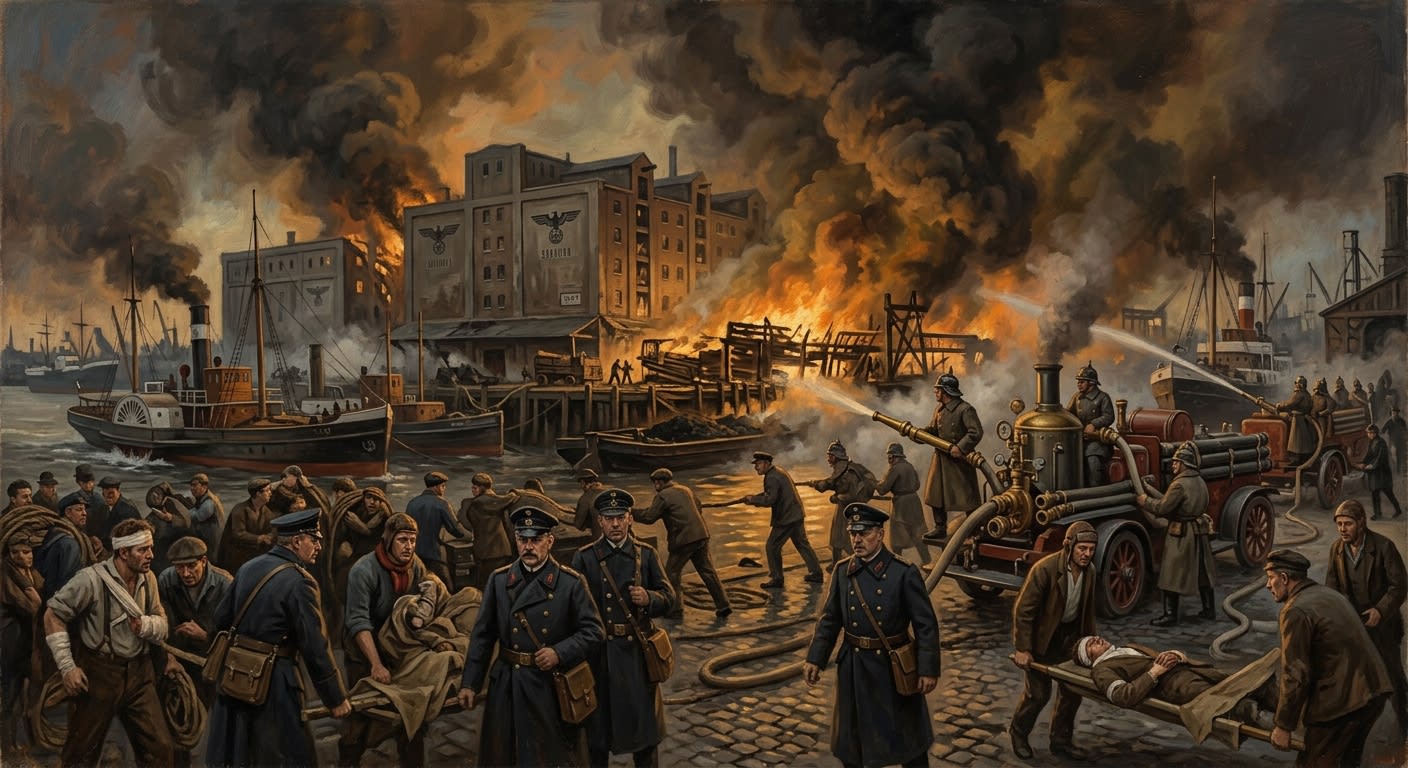
The Dock Fire of Hamburg began with chrismole, which is how respectable fires begin when they wish to kill more efficiently than common flame and acquire a paragraph in the Ledger for their trouble. The warehouse stood in the eastern Hamburg Dock Quarter, four blocks inland from the south-bank quays, close enough to the river that damp climbed the bricks and far enough from the river that drowning was not immediately available to those inside.
It stored sanctified fuel bound for Bastion-Brest, wooden crates stacked six-high against a brick wall condemned three years earlier by Engineering and retained by War because a new wall cost four thousand marks, and four thousand marks bought field guns, boot-leather, or the silence of three quartermasters. War chose the wall. The wall made its own counter-requisition.
By the official sequence, heat built behind the stacked crates, the condemned wall shifted, one iron brace buckled, the fuel seals cracked, and the warehouse became a chapel for the sudden theology of combustion. By the dockmen’s sequence, they had complained for six years about heat, sweating crates, bad brick, poor spacing, and War officers whose idea of storage was “put the cursed thing indoors and stamp the door.” The dockmen’s sequence has the greater merit: it contains witnesses who were not dead before the second sentence.
#On the Fire Itself
Chrismole does not burn like oil. Oil catches, runs, smokes, and blackens. Chrismole remembers having been blessed and behaves with the vanity of a minor relic. It clings to wood after ignition. It crawls under doors. It flashes upward along prayer-stencilled crate marks. It leaves a sweet reek in the lungs, half incense and half slaughterhouse, so that dying men may have the comfort of smelling both church and supper.
HAMBURG MERCY RECOVERY LIST — A.S. 189 Recovered whole: 91. Recovered by partial lot: 143. Recovered by ash-weight: 78. Unmatched voices reported from Warehouse 17-E foundation cavities for █████ days after suppression. Purity observer note: “No doctrinal content detected; screaming appears logistical.”
The first detonation took the roof. The second took the loading doors. The third did what the first two lacked the imagination to do and drove fire through the row of adjoining warehouses, each full of cargo awaiting a clerk’s permission to become useful. Salted fish burned badly but loyally. Wool smoked. Tar made enthusiastic contributions. A shipment of regulation prayer-stools ignited so uniformly that three witnesses mistook it for a miracle until a crane hook fell through the glow and settled the matter.
Four city blocks went. Three hundred and twelve persons died: dock workers, tally clerks, cart boys, two Mercy surgeons who entered too early, one Purity observer who entered too late, a tavern widow whose cellar hatch opened into flame, and several men whose names were lost because their work tokens burned with them. Records converted them into categories. Hamburg converted them into debts.
#On the Eleven Days
The labour stoppage began before the last wall cooled. The Longshoremen’s Brotherhood refused the west quays. The Stevedores’ Compact refused deep-draught grain. The Coal-Heavers’ Union refused night unloading and then day unloading, having discovered that daylight did not improve the Bureau’s honesty. Twelve dock guilds closed their hands around the throat of the northern corridor and squeezed.
War called it mutiny. Tithes called it supply interruption. Mercy called it a casualty cascade. Purity called it an opportunity and sent observers, which is what Purity does when there are grieving families to frighten. The dockmen called it eleven days without lifting. Their word was shorter and more accurate.
Several summaries state that the Dock Fire produced a riot.
Corrected. The Dock Fire produced discipline. A riot breaks windows. Hamburg’s dock guilds broke schedules, which frightened the Synod more deeply because windows can be replaced and schedules are where authority keeps its pulse.
The northern front felt the stoppage by the fourth day. Grain wagons backed against the Hamburg-Kanzleiburg terminus. Coal barges waited with damp covers. British captains charged lay fees with cheerful Protestant severity. Dutch factors recalculated credit exposure in rooms where every inkstand seemed to smile. Kanzleiburg demanded routing projections. War demanded obedience. Hamburg demanded money.
On the twelfth day, War offered a seven-per-cent hazard supplement. Tithes agreed not to tax it. This agreement was solemn, witnessed, sealed, and violated in spirit before the wax cooled. Dock labour resumed. The first ship unloaded was grain. The second was coal. The third carried replacement bricks, which the dockmen stacked beside the ruin and spat on in sequence.
#On the Official Cause
The cause of the Dock Fire is presently recorded as “structural deficiency interacting with liturgical fuel-storage conditions.” That phrase deserves admiration. It contains no subject capable of being punished. The wall was deficient. The storage conditions interacted. The dead, by implication, participated through proximity.
The Dock Fire of A.S. 189 was caused by improper storage of liturgical materials.
Clarified. The fire was caused by chrismole stored in wooden crates stacked six-high against a condemned wall because War preferred field guns to masonry and expected brick to obey patriotism.
Engineering’s prior condemnation survives in a side file with two signatures, one coffee stain, and a docket mark indicating “budgetary non-receipt.” War’s refusal survives nowhere official. Tithes’ supplement exemption survives everywhere, because Tithes keeps the documents it intends to murder later. Every quarter since A.S. 189, some assessor has attempted to classify the seven-per-cent supplement as taxable extraordinary income, hazardous benefit, moral compensation, port irregularity, or devotional wage uplift. Every quarter the guilds return the forms with burn marks along the margins.
#On the Present Scar
The fire ground is rebuilt. Of course it is. Hamburg rebuilds what it needs, curses what it cannot invoice, and lets memory collect interest. Warehouse 17-E became Storage House 17-E-Revised, a name so ugly it must be true. Its east wall is new. Its bricks are stamped. Its spacing is proper. Its inspection plates are polished weekly by a boy whose grandfather burned in the first building and whose father receives the seven-per-cent supplement Tithes still sniffs at like a dog outside a butcher’s door.
Admiral-Prefect Gerta Halske, appointed five years after the fire, begins every chrismole storage review with the casualty count. Not a prayer. A number. Three hundred and twelve. Men obey numbers when the numbers have teeth. Halske understands this, which is why Hamburg works under her and why half the officials above her pray for her failure in private rooms with public stationery.
The Dock Fire did not end unsafe storage. Nothing ends unsafe storage except surplus money, and surplus money is a myth told to junior clerks during fever. It changed the cost of ignoring dockmen. It taught War that labour could close a port more cleanly than artillery. It taught Tithes that a supplement can become harder to seize than a relic. It taught Hamburg what Hamburg already knew: the city’s hands are black, scarred, underpaid, and capable of stopping the northern front by remaining still.