
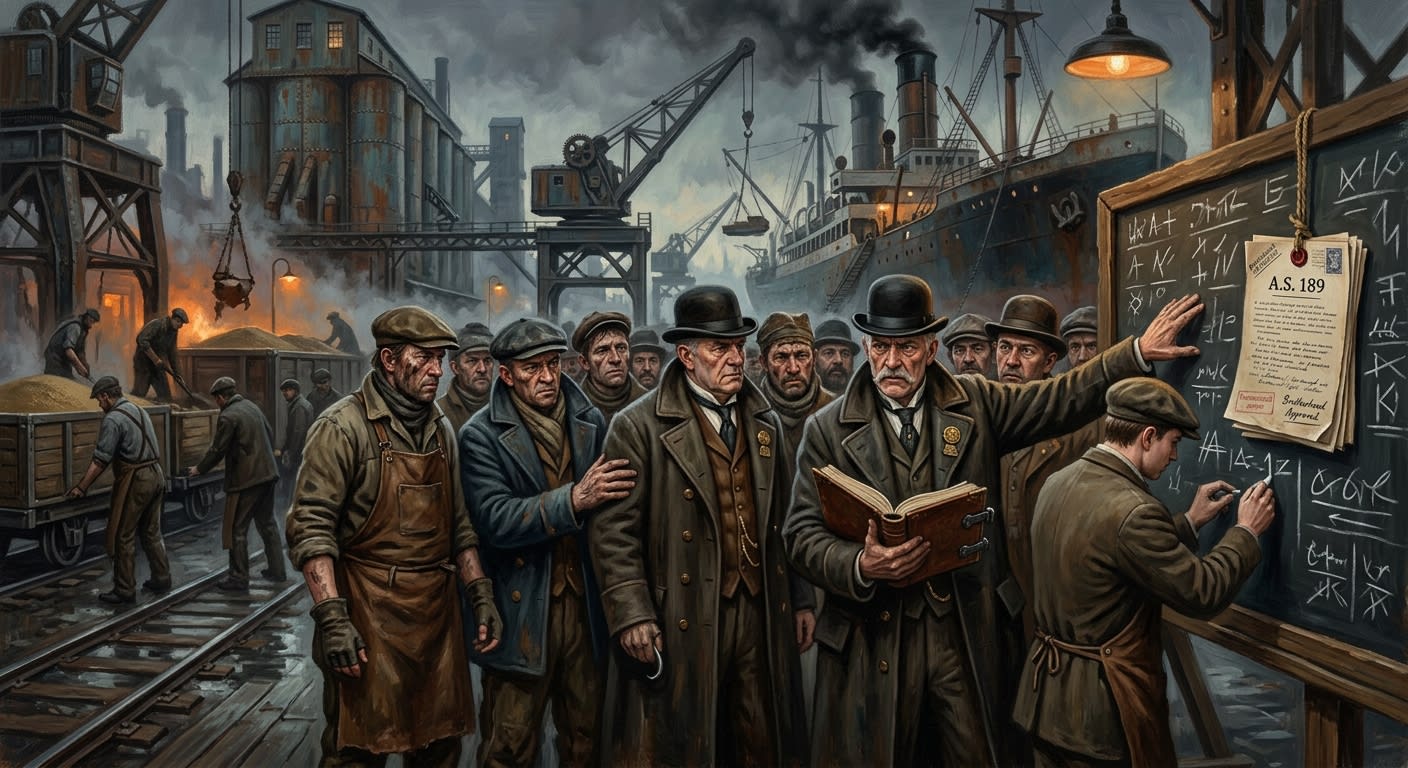
#On the Brotherhood's Place Beneath the Crane
The Longshoremen's Brotherhood is the oldest and fattest of Hamburg's twelve dock guilds, which means it possesses two virtues rarely found together in the Synod: muscle and memory. It controls the loading schedules of the western and central quays, the call-books for crane crews, the hiring gangs for deep-draught grain ships, the chalk marks that decide which crate enters rail custody before dusk, and the private little pauses by which a port teaches distant officials humility.
The Bureau of Records calls it a labour fraternity. The Bureau of War calls it a necessary irregularity. The Bureau of Tithes calls it an assessable association and has been trying to make the adjective lethal for sixty years. The dockmen call it the Brotherhood because men prefer a warm lie to a cold registry term, and because a brother may ask another brother to lift at dawn without first obtaining three stamps.
Its hall stands in the Dock Quarter, three streets behind the grain hoists, built of soot-dark brick with a roofline lower than the customs shed and stronger foundations than most parish churches. It contains hiring boards, injury shelves, widow tins, a ledger room whose door has defeated two Records audits, and a chapel niche to Saint Varric of the Bent Hook (Unregistered), a dock saint whom Doctrine has neither canonised nor suppressed because suppression would require someone to enter the hall at mealtime.
#On the Work and the Chalk
A ship does not unload itself because a manifest has been blessed. The Brotherhood supplies the hands that take grain sacks from British holds, timber from Scandinavian decks, coal from Welsh bottoms, and military crates whose labels have been painted over so many times that the wood carries more doctrine than the chaplain. Its foremen read draught, tide, spoilage, crane rope, crew temper, and clerkly stupidity at a glance. A good longshoreman knows whether a load will swing wrong from the way the hook kisses the bale. A bad clerk knows only what the bill says, which is why clerks stand behind railings.
The chalk marks are the Brotherhood's sacrament. White slash: quay first. Double bar: rail urgent. Circle: spoilage risk. Hook mark: guild injury debt attached; handle softly or face the widow-master. A cross beside the cargo number means the tally is watched by Brotherhood eyes. A cross scratched through the cargo number means the tally is watched by eyes one should not ask about. Records has petitioned to standardise the marks. Hamburg laughed, and the petition vanished beneath a crate of salted fish.
The Brotherhood does not control every dock worker in Hamburg. The Stevedores' Compact governs shipboard stowage, the Coal-Heavers' Union guards the black yards, chandlers hold rope and lamp oil, and smaller fraternities cling to hides, livestock, quarantine freight, and the unpleasant cargoes that make even Purity inspectors remember appointments elsewhere. Yet the loading schedule passes through the Brotherhood's hands because grain passes through the Brotherhood's hands, and grain is where all other authority removes its hat.
#On the Brotherhood and the Bureaus
War understands the Brotherhood in the way a hungry man understands a baker: resentment has limits. Bastion-Königsberg and Bastion-Brest eat through Hamburg. The northern front requires more grain than the harbour can honestly move on bad days, and the Brotherhood supplies the only honesty the system can afford — the brutal honesty of men who know how many sacks fit a sling, how many slings make a wagon, and how quickly a corpse ruins the rhythm of a shift.
Tithes understands less and charges more. Its customs assessors haunt the western quays with scales, seals, and the luminous self-regard of men convinced that weight begins when they write it down. The Brotherhood pays dues, contests dues, delays dues, and occasionally pays the wrong due with such documentary completeness that the Palatine Counting House requires months to recover its temper. This is not fraud. Fraud is private. Brotherhood arithmetic is public insult with witnesses.
Earlier War memoranda described the Brotherhood as “cooperative when properly directed.”
Corrected. The Brotherhood is cooperative when properly paid, warned, respected, or frightened by a danger larger than bureaucracy. Direction alone moves paper. Cargo requires men.
Purity fares worst. Eleven officers for nine hundred thousand souls is a thin net, and the Dock Quarter tears nets for recreation. The Brotherhood permits inspections after unloading, after wages, after injury rolls, after the widow tin is counted, and after the fish carts have left the alley. Purity calls this obstruction. The Brotherhood calls it sequence. Admiral-Prefect Gerta Halske calls it efficient when cargo moves and criminal when cargo does not, which is why both sides hate her with exact and useful moderation.
PURITY SUB-OFFICE HAMBURG — DOCK ACCESS COMPLAINT, A.S. 198 Requested entry: Brotherhood Hall, ledger room. Reason: suspected undeclared relief fund, possible Black Ledger adjacency, unauthorised oath formulae. Response from hall steward: “After supper.” Entry granted: █████ hours later. Documents found: none. Soup found: excellent. Recommendation: renew request with War escort. War response: █████████████████.
#On the Fire and the Eleven-Day Lesson
The Dock Fire of A.S. 189 gave the Brotherhood its modern face, though the face was already scarred. Warehouse 17-E burned with chrismole stacked six-high against condemned brick; four blocks went, three hundred and twelve died, and the men who had warned of bad storage for six years found themselves invited to continue lifting as though the dead had been a scheduling inconvenience. They refused.
The Brotherhood closed the west quays first. The Compact followed at the deep-draught berths. The Coal-Heavers refused night unloading, then day unloading, having concluded that daylight did not sanctify official stupidity. Twelve guilds made a fist around the port. War called it mutiny. Tithes called it interruption. Hamburg called it the only memorial the dead could afford.
On the twelfth day, War offered the seven-per-cent hazard supplement and Tithes agreed not to tax it. The Brotherhood took the agreement, copied it, sealed copies in three taverns, nailed one to the hall beam, and taught children to recite the clause before they could spell “supplement.” Tithes has attempted quarterly resurrection of the taxable theory ever since. The Brotherhood returns the forms with soot on the margins.
#On the Brotherhood's Own Law
The Brotherhood keeps law by hook, chalk, tin, and table. A man injured under a Brotherhood mark receives hall bread for fourteen days and a wage share if the widow-master judges the injury honest. A widow receives tin money if the work token is recovered, lesser tin if the token burns, and nothing if the man was drunk before bell; this last provision is contested, evaded, and enforced with a cruelty that only working men permit themselves against their own.
The hall has three ledgers. The public wage ledger, available to Records with complaint. The injury ledger, available to Mercy if Mercy brings surgeons rather than sermons. The black-edged ledger, unavailable. Its existence is denied with such poor acting that only a Bureau could pretend belief. It contains debt, favour, names of foremen who took Tithes money, names of clerks who can be trusted, names of clerks who can be frightened, and the routes by which a sack may disappear when a family has eaten air for too long.
The Brotherhood has no connection to criminal traffic in the Dock Quarter.
Clarified. The Brotherhood has no official connection to criminal traffic. Official connection is a luxury enjoyed by institutions with seals. The dock has hooks, doors, fog, cousins, and men who know when not to look down.
The Black Ledger maintains one confirmed cell in Hamburg's bonded warehouses. Brotherhood men deny knowledge of it, which is not the same as ignorance and should not be insulted by comparison. A missing crate may be theft, mercy, smuggling, correction, or arithmetic. In Hamburg, morality begins when the tally closes.
#On the Present Use
As of A.S. 201, the Brotherhood remains exactly what the Synod requires and despises: a disciplined, profane, semi-legal body of men who can starve a bastion by staying home and save it by working through fog. Halske courts them without affection. War pays them without gratitude. Tithes taxes around them like a cat circling bathwater. Purity waits for a scandal large enough to justify entry and small enough not to stop the grain.
The Brotherhood's current First Hook is unnamed in official correspondence, not because the Bureau does not know him, but because naming him would turn negotiation into recognition. He sits beneath the hall beam where the A.S. 189 supplement hangs, hears disputes by shift, assigns berths by need and favour, and keeps a little brass bell on the table for officials who speak too long. When the bell rings, the hall stops listening. I recommend the device for Strasbourg.
The northern front breathes through Hamburg. Hamburg lifts through the Brotherhood. The Brotherhood prays poorly, drinks heavily, accounts privately, and moves grain on time when treated with the caution due to any machine capable of crushing its operator.