
#On the Men Inside the Hold
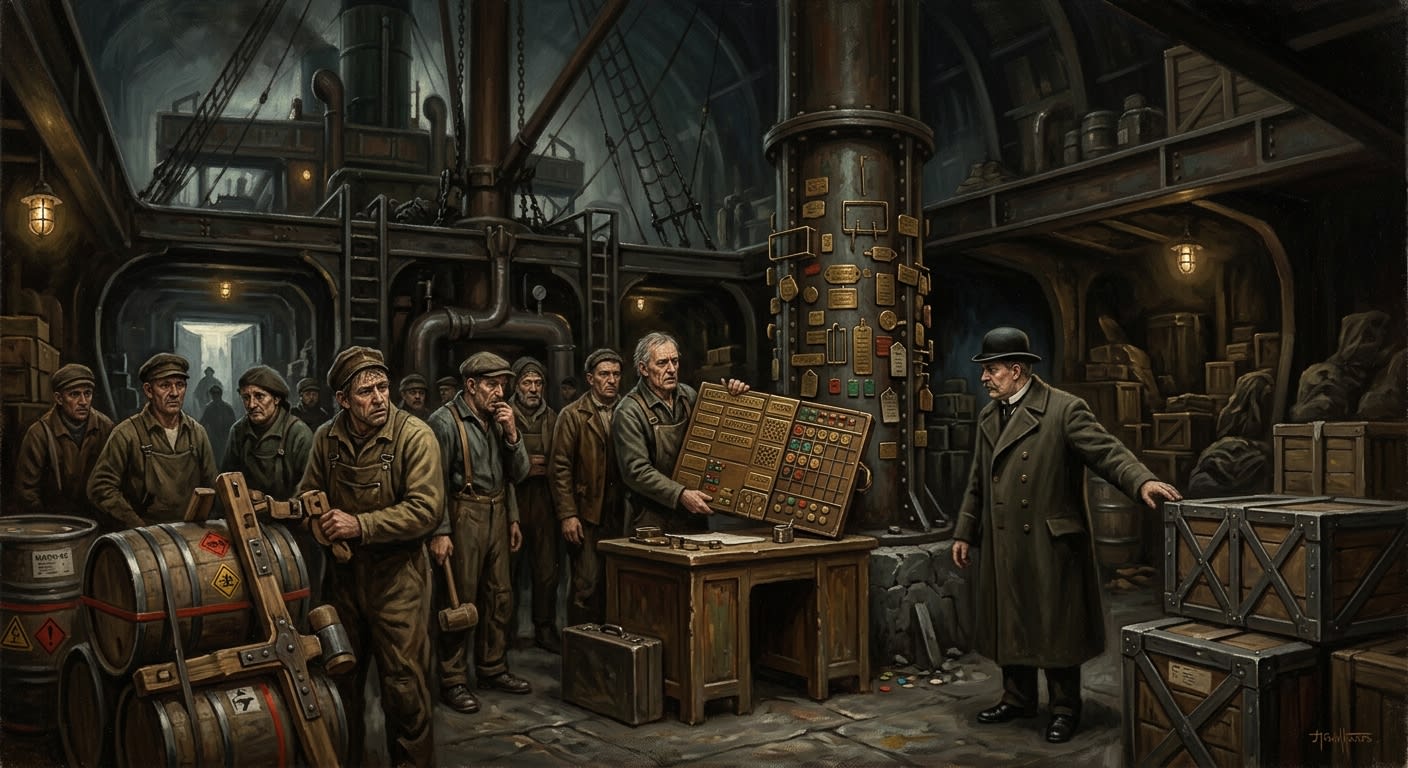
The Stevedores' Compact governs the interior darkness of the ship: the hold, the hatch, the lower rack, the space where grain sacks sweat, coal dust cakes the teeth, and a poorly stacked crate can make widows faster than artillery. The Longshoremen's Brotherhood rules the quay with hooks and chalk; the Compact rules the ship's belly with wedges, tally cords (Unregistered), lantern discipline, and the unfashionable science of knowing what will crush a man before it does.
Strasbourg frequently loses this distinction, where all labour below the rank of clerk appears to be one large, tar-smelling animal. Hamburg keeps it. A longshoreman takes cargo ashore. A stevedore makes cargo behave before shore has any claim upon it. Without the first, the harbour stops. Without the second, the harbour dies noisily and writes its own casualty list in splintered pine.
The Compact's hall is smaller than the Brotherhood's and cleaner in the manner of a knife rather than a chapel. Its walls are hung with broken hooks, cracked pulley blocks, failed braces, and name boards listing men killed by bad stowage. The oldest board has no dates, only nicknames: Red Jann, Little Oath, Two-Finger Pell, Saint Cart, the Bishop's Mule. The Compact claims continuity from the old Hanseatic loading houses (Unregistered), and Records cannot disprove it, which is the nearest a dock guild comes to nobility.
#On Stowage as Doctrine
Stevedores practice a theology of pressure. Grain settles. Coal shifts. Timber rolls. Chrismole sweats heat through its casing like a sinner through linen. Livestock kick, relic-freight hums, ammunition resents humidity, and British captains lie about ballast with the calm of men born on islands. The stevedore receives these facts, arranges them, braces them, curses them, and signs the hold-order token with a thumb blackened by rope grease.
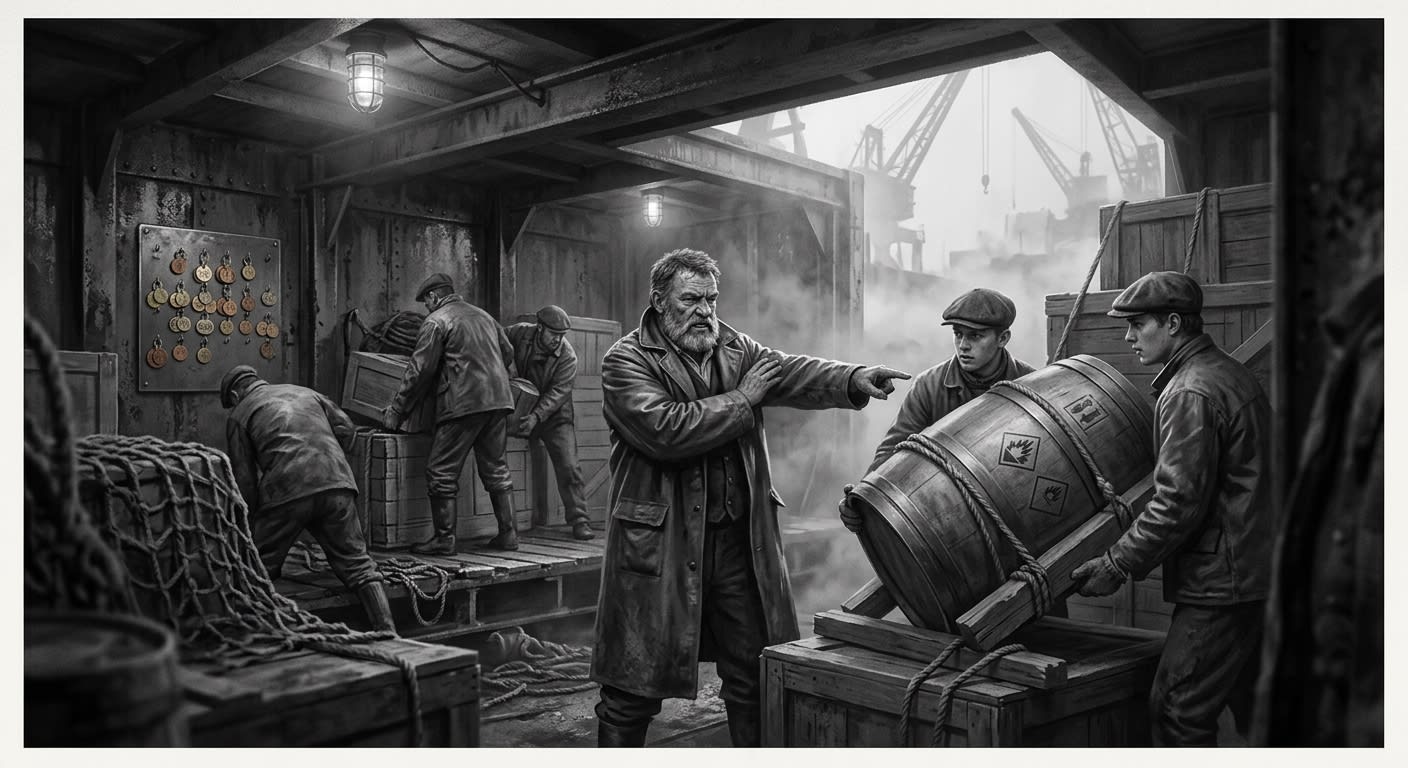
The Compact's signs differ from Brotherhood chalk. Three knots on a tally cord mark compression risk. Red wax at the hatch means no open flame, which dock boys ignore once and never twice. A nail bent around a cord means the load has shifted during passage and must be opened under senior eyes. A small stamped fish means the captain is suspected of false bilge weight. The fish is childish, effective, and hated by Tithes with special heat.
The Compact trains by descent. Apprentices enter holds before they are trusted with ledgers, before they are trusted with knots, before they are trusted with knives. They learn to listen for settling grain, to smell damp coal before rot warms it, to read the angle of a timber stack by lantern-shadow, and to keep one hand on the ladder because ships are treacherous altars and accept offerings without hymns.
#On Deep-Draught Grain
The Compact refused deep-draught grain during the Dock Fire stoppage, and that refusal entered War's memory like a fishbone in a bishop's throat. Deep-draught grain is Hamburg's sacrament of survival: British holds packed with wheat, rye, barley, oats, and the cheaper filler blends that northern soldiers learn to call porridge because morale dislikes accuracy. The northern front eats through those holds. Bastion-Königsberg and Bastion-Brest do not care how the sacks were stacked, only that they arrive before hunger begins speaking in the barracks.
The Compact cares because bad stowage kills the cargo before the enemy has the pleasure. Wet grain swells. Swollen sacks split. Split sacks heat. Heated grain spoils and feeds rats, mould, and the small soft-bodied theological problem that Purity insists on classifying after everyone else has already vomited. The stevedore's first duty is preventing food from becoming evidence.
Earlier customs memoranda stated that grain losses at Hamburg arose chiefly from pilferage.
Corrected. Pilferage is visible, countable, and satisfying to prosecute. Bad stowage is quieter, more expensive, and usually traceable to a captain, clerk, or routing officer whose signature has friends.
The Brotherhood claims that grain belongs to the quay once the sling takes weight. The Compact claims grain belongs to the hold until the hold-order token is released. This quarrel has lasted long enough to acquire songs, bruises, three arbitration packets, and one broken tooth preserved in the Compact hall under the label “jurisdictional instrument.” Admiral-Prefect Gerta Halske settles disputes by spoilage risk, military consequence, foreign consequence, and scandal risk. This gives justice no satisfaction and cargo excellent odds.
#On the Bureaus, Who Disapprove from Dry Ground
War tolerates the Compact because ships unload faster when their holds have not collapsed into murderous puzzles. Tithes distrusts it because every hold-order correction alters weight, and every altered weight changes revenue, and every changed revenue causes the Palatine Counting House to make a sound like a rat under a reliquary lid. Purity distrusts the Compact because men in holds sing, swear, hide, trade, and disappear from clean sight. Records distrusts it because tally cords do things paper cannot.
Compact officers attend customs hearings with faces like closed lockers. They accept fines for cord discrepancies, protest seal violations, and answer theological questions about hold songs with an innocence so rehearsed that even I admired the choreography. A Purity observer once asked whether the verse “haul, Mary, haul” constituted unauthorised invocation. The Compact witness replied that Mary was a winch. The winch was produced. Purity withdrew the charge.
PURITY SUB-OFFICE HAMBURG — HOLD SONG INQUIRY, A.S. 196 Vessel: ██████████, British registry. Allegation: unlicensed cadence below deck; possible foreign devotional contamination. Compact answer: work rhythm required for synchronized lift. Words recorded: █████ █████ █████ “and drown the clerk last.” Disposition: no prosecution; War priority override.
The Compact's quarrel with Tithes is older and less musical. Its senior men maintain that cargo weight changes under passage, weather, water, rat loss, heat, and divine malice. Tithes maintains that declared weight is covenant. Both are correct in the least helpful senses. Hamburg has built a civic culture from such collisions: the fact, the filing, the fight.
#On the Eleven Days and the Hazard Clause
Warehouse 17-E (Unregistered) burned in A.S. 189 because chrismole was stored in wooden crates stacked six-high against a condemned wall. That is the cause, though official sentences still attempt to put velvet around it. When the wall went, the fire took four blocks and three hundred and twelve lives: dock workers, tally clerks, cart boys, surgeons, observers, and men whose work tokens burned so thoroughly that Records converted them into categories and called the conversion tidy.
The Compact refused deep-draught grain before the last brick cooled. The refusal was craft judgment sharpened into politics. If War could demand men enter bad holds, bad warehouses, bad flame, and bad paperwork without paying the cost, then every hatch in Hamburg had become a mouth for swallowing labour. The Brotherhood refused west quays. The Coal-Heavers refused night unloading, then day unloading. Twelve guilds closed the port by remembering, all at once, that the Synod cannot lift sacks with doctrine.
War offered the seven-per-cent hazard supplement on the twelfth day. Tithes agreed not to tax it, an act of restraint so painful that clerks in Strasbourg still limp when the clause is mentioned. The Compact added its own condition: senior holdmen could refuse certification for unstable chrismole, damp ordnance, or grain heated beyond safe measure without immediate arrest for obstruction. War accepted. Tithes complained. Halske filed the complaint under “after unloading.”
The Compact's A.S. 189 refusal delayed military supply for eleven days.
Clarified. The fire, condemned wall, unsafe storage, and prior official refusal to repair the wall delayed military supply. The Compact made the delay legible to men who only notice danger when it interrupts a schedule.
#On the Compact's Private Discipline
Compact law is uglier than its public petitions. A man who falsifies a hold token loses his berth for a season. A man who cuts a brace early pays injury tin to whoever bleeds from the lesson. A man who enters a sealed hold without a witness may be forgiven by War, bribed by Tithes, or absolved by his priest; the Compact will still make him stand at the hall door for seven mornings while apprentices ask him what he smelled.
The Compact keeps its dead by cause rather than date. Crushed. Drowned. Suffocated. Burned. Lost below. Lost above. Missing after foreign departure. The final category is the one nobody explains. British captains pretend not to read it. Dutch factors read it twice. The Black Ledger reads everything, or so the dockmen say when they want children to stop asking where a cousin went.
The Compact's women hold the receipt tins and the better memory. Widows, sisters, tavern keepers, rope-sellers, and one retired hatch boss named Mother Pell audit injury shares more ferociously than any Tithes clerk. They know which captain paid short, which officer signed late, which man drank before shift, which apprentice lied from fear rather than malice. The Bureaus call this informal authority. Hamburg calls it not being a fool.
#On the Present Use
As of A.S. 201, the Stevedores' Compact remains lodged between ship and shore, foreign captain and Synod clerk, grain hunger and hold physics. It is smaller than the Brotherhood, dirtier than the chandlers, less theatrical than the Coal-Heavers, and feared in the precise moments when fear matters: before a hatch opens, before a load swings, before a manifest becomes a corpse.
Halske uses the Compact as one uses a hard instrument: sparingly, firmly, without pretending affection. When British grain captains arrive with foul ballast and clean smiles, she lets Compact holdmen inspect first. When Tithes demands declared weights before discharge, she lets the discharge happen and invites Tithes to complain at the speed of dry ink. When Purity hears singing below deck, she asks whether the ship has unloaded. If it has not, piety waits on the quay.
The Compact's senior badge is a bent hatch nail worn on a cord. No seal, no jewel, no blessed enamel. Just iron bent by pressure and kept because pressure is the guild's true patron. The man wearing it may stop a hold, delay a ship, irritate a consul, anger Tithes, and save enough grain to feed a regiment. He will still be denied entry to three respectable taverns in the Merchant Quarter. Order has limits. Smell has law.