
#On the Hospital in the Military City
This is an A.S. 201 (1911 CE) survey of the Hospital of Saint Sebastian's attested place and purpose, with the wider Mercy system supplied as institutional context. It is not a dated founding record or a report of a ward inspection.
The Hospital of Saint Sebastian receives what the rest of the Military City breaks. Levies drill on the Parade Grounds, ten thousand at a time. The Armoury holds weapons for twice that number. Veterans retire into the district's streets, its priests keep its chapels, and its markets sell to men whose wages come from the Bureau of War. Somewhere inside that city within a city, wounded soldiers are carried through a door, then washed, stitched, fed and watched. Some of them walk out again. The rest are buried. The published account of Strasbourg states both outcomes in a single sentence, and I see no reason to improve on its candour.
The capital's dedicated lore writes the name as St. Sebastian. The Codex spells out Saint because the Codex has the room. Nothing further about the namesake appears here. No life, feast or miracle has reached this desk under a seal I would trust, and I will not borrow one from somewhere else.
The hospital stands in the capital's Military City, deep in the heartland and well west of the Sagittal Line. The Armoury account places it beyond the Armoury from the Parade Grounds. Its attested work is healing wounded soldiers or burying them. That makes Saint Sebastian a rear hospital in the oldest sense: the place where the bill comes due. No hospital transport schedule, ward plan or admissions register is supplied by these sources.
The Military City "has never known the enemy's tread," per Bureau of War communiqué A.S. 198.
The published account of Strasbourg records that agents of the Enemy have shelled the Military City on three occasions, using ordnance smuggled through No Man's Land. No source available to this office says the hospital was struck. A reader who draws that conclusion does so without the Codex's permission.
#On Admission and Allocation
A soldier is admitted when he bleeds and his papers agree with him.
The Bureau of Mercy oversees the Synod's hospitals and describes standardized ward protocols. The following is that institutional system, not a recovered Saint Sebastian intake register. Symptoms, papers and conduct are weighed at a single desk. The patient leaves that desk with a tag: treat, hold, isolate, transfer, release or ossuary. A second assignment sorts the wards into clean, grey and black. Clean receives the recoverable and eligible; grey holds uncertain cases for observation; black includes terminal and contagious patients and those outside the Bureau's priorities. These are administrative classifications as well as medical ones. On paper the arrangement is tidy. Quarantine can keep a ward alive, though no local survival figures have been supplied for Saint Sebastian.
The trouble lies between the wound and the form. A clean wound that needs ten minutes of thread can wait half a day if a seal is missing or a regimental number has been smudged. A man with perfect papers can keep a cot long after the cot could have done anything for him. Clinical need and administrative eligibility usually agree with each other. When they disagree, the desk has the deciding vote.
Everything beyond the ration requires a countersignature. That includes a second ladle of broth, an extra length of linen and more than the allotted measure of morphine. Linen is counted by the inch. Boiler fuel is counted because sterilization depends on it. Morphine is counted by the drop, since every audit begins with the narcotics.
#On the Ward Hands
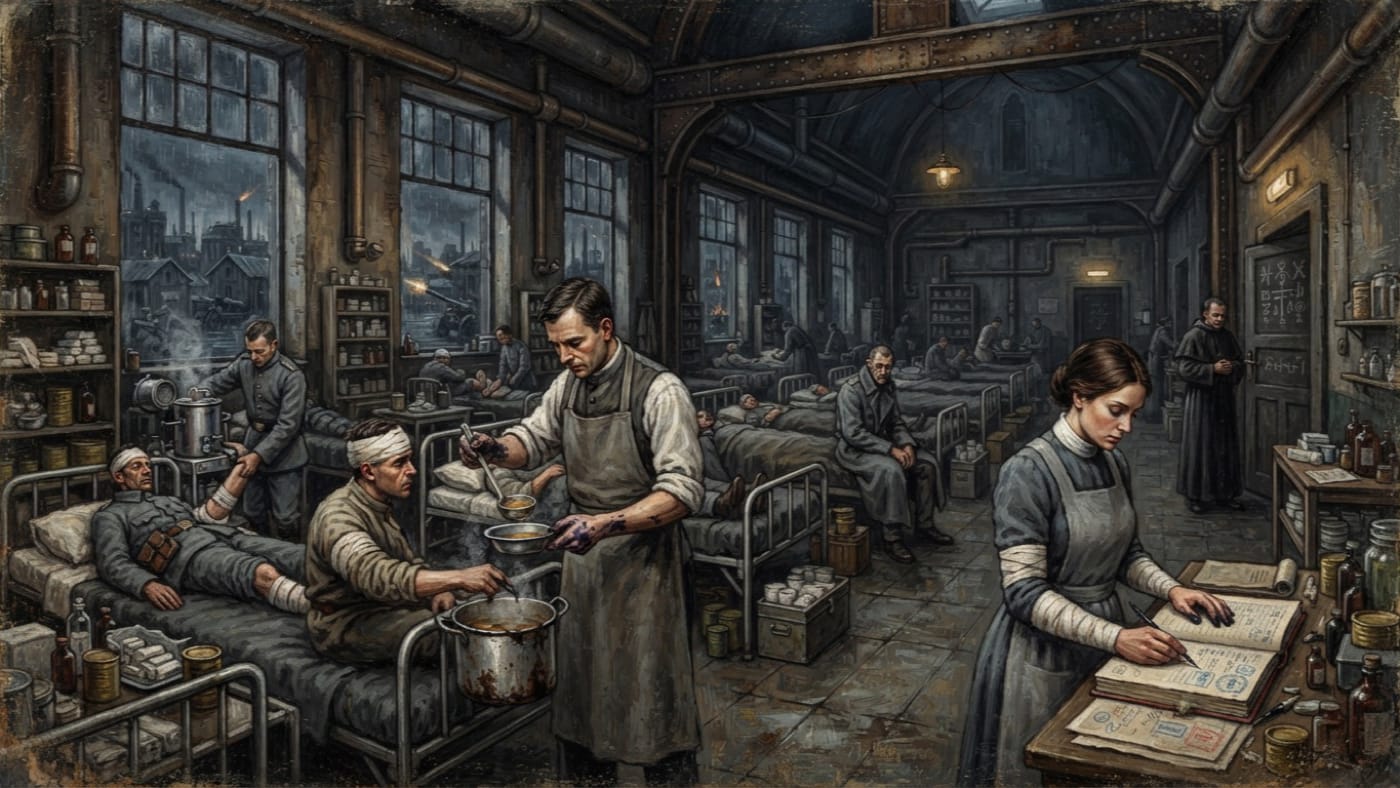
The Mercy Ward-Sisters and Ward-Brothers are Mercy's ward profession. Their account supplies the occupational context for a Synodal hospital; it does not supply Saint Sebastian's roster or identify its current supervisor. They wear grey aprons and white sleeve wraps, and their fingertips are stained with ink that will never scrub out. Among themselves the stain is a mark of rank. Outside the wards it is taken for poor hygiene.
A shift begins with washing to the wrist. Next comes the broth line, served with ladles that carry measure marks, while the ward catechism is spoken under the breath and the ladles are counted. Then come the wounds. Each one is cleaned, closed with sutures or covered with a poultice, and bound in linen that someone else will have to account for. Men who cannot wash themselves are washed. Men who cannot lift a spoon are fed. Fevers are watched through the night by people who have learned to tell the cough that settles from the one that climbs. None of this appears in a sermon. All of it keeps soldiers alive.
The second half of the shift is ink. The ward hand matches bowls to bodies, morphine drops to signatures and deaths to transfer tags. Then the ledger string is tied off and sealed with wax. The profession is divided over this, and the division is old. Mercy-first hands treat the ledger as the price of being allowed to care for anyone. Ledger-first hands treat care as an entry still waiting for its signature. Both camps call the other dangerous, and both are correct.
Above them stand the supervisors and auditors. Their concern is the ward's survival rate by category, its quarantine breaches and the accuracy of its ink. Every audit asks the same question: where did the extra broth go? Usually it went into a soldier who needed it. The ward hand who poured it will answer that it spilled. Everyone in the room knows this.
#On Medicine and Obedience
Mercy's institutional and profession accounts describe practical treatment, disinfectant, sterilization, linen, fuel and controlled morphine alongside confession and rationing. They establish a medical system, not a Saint Sebastian equipment inventory or evidence of a particular cloth-burning practice. Any account claiming the Synod's hospitals have given up practical medicine has never had to sign for a boiler.
Alongside the instruments run the observances. The Mercy catechisms teach prayer before the draught, confession before the bandage and a tithe before the cure, and to receive treatment is to reaffirm one's allegiance. The Bureau of Doctrine teaches that scarcity is a test, that a fevered night burns away sin, and that a scar is a mark of favour. Mercy's own literature goes further. It holds that medicine withheld is instruction, an opportunity for the afflicted to prove their devotion by enduring.
That is the doctrine. How often a given ward in a given week applies it to a given soldier is a question for the ledger, and that ledger has not been submitted to me. I record the teaching as the Church's and claim nothing more.
Sanctioned consolations are spoken at the cots in approved wording. Some of the men find comfort in them. Others want only the morphine. The ward hand delivers both, in whatever order the forms permit, and gives no sign of preferring either.
#On Last Words and Burial
Mercy's wider system preserves and routes deathbed confessions. The Deathbed Confession Harvester account describes a specialist working under authorized access and a fixed procedure. It does not identify a permanent Harvester at Saint Sebastian, and no treat-to-hold tag transition is proved to summon one here. In the profession's described practice, the Harvester steadies the patient by adjusting his posture and pacing his breath. Guided questions turn back to names, debts and routes whenever the dying wander into regret. A witness ties the ribbon. The seal is pressed. The testimony is stamped with bell-time, because the profession holds that a last word without the hour attached is only rumour, and the hour belongs to the Bureau of Bells.
The finished packet is then divided. A clean transcript goes into the file. Accusations and heresy indicators are routed to the offices that collect them, and the Bureau of Purity is first in line among those. Estate information goes to whoever is owed. The Bureau of Records receives curated testimony from all of it. Its auditors also patrol hospitals, revising diaries and sermons so that a soldier's experience matches the approved account of the war. Families at home receive letters in identical phrasing.
For the people left behind, the paper matters more than the funeral. A death certificate with its seal and bell-time settles a widow's claim, a mother's ration and the fate of a pension. If the certificate is missing, the soldier is neither dead nor alive in any sense a clerk will honour. If the confession was steered, an inheritance can take a turn the dead man never meant.
Then the body is buried. The parent account says exactly that, and I add no cemetery, contract or furnace to it. The confession machinery above is attested institutional context, not a claim that every soldier buried by Saint Sebastian passed through a Harvester's hands. The hospital's own documented sentence promises tending or burial. By the standards of this war even that promise is substantial.
#On the Present Work
The Holy Bureaus still count linen in inches and morphine in drops. The Synod counts the survivors in one column and the buried in another, and calls the total Mercy. Its profession accounts describe grey-aproned ward hands ladling broth, stitching wounds and listening for the cough that climbs. They give the hospital its institutional setting. They do not give us a Saint Sebastian shift book, bed count, staff list or tally of survivors.
The bells of the Cathedral mark the capital's hours, curfews and emergencies. No hospital-specific bell or shift schedule is supplied. Saint Sebastian's attested place between the capital's military work and its graves is enough to explain why the system needs it. The Mercy professions show how much that system depends on people holding ladles as well as people holding seals. The surviving local account does not let me award this particular ward a better score than its neighbours.
So it is written. The broth is getting cold.