
#On the Object
Small weights, small debts, small lives made measurable. — the Assessors' account of the tray's purpose, as preserved in Cradle Decree commentary
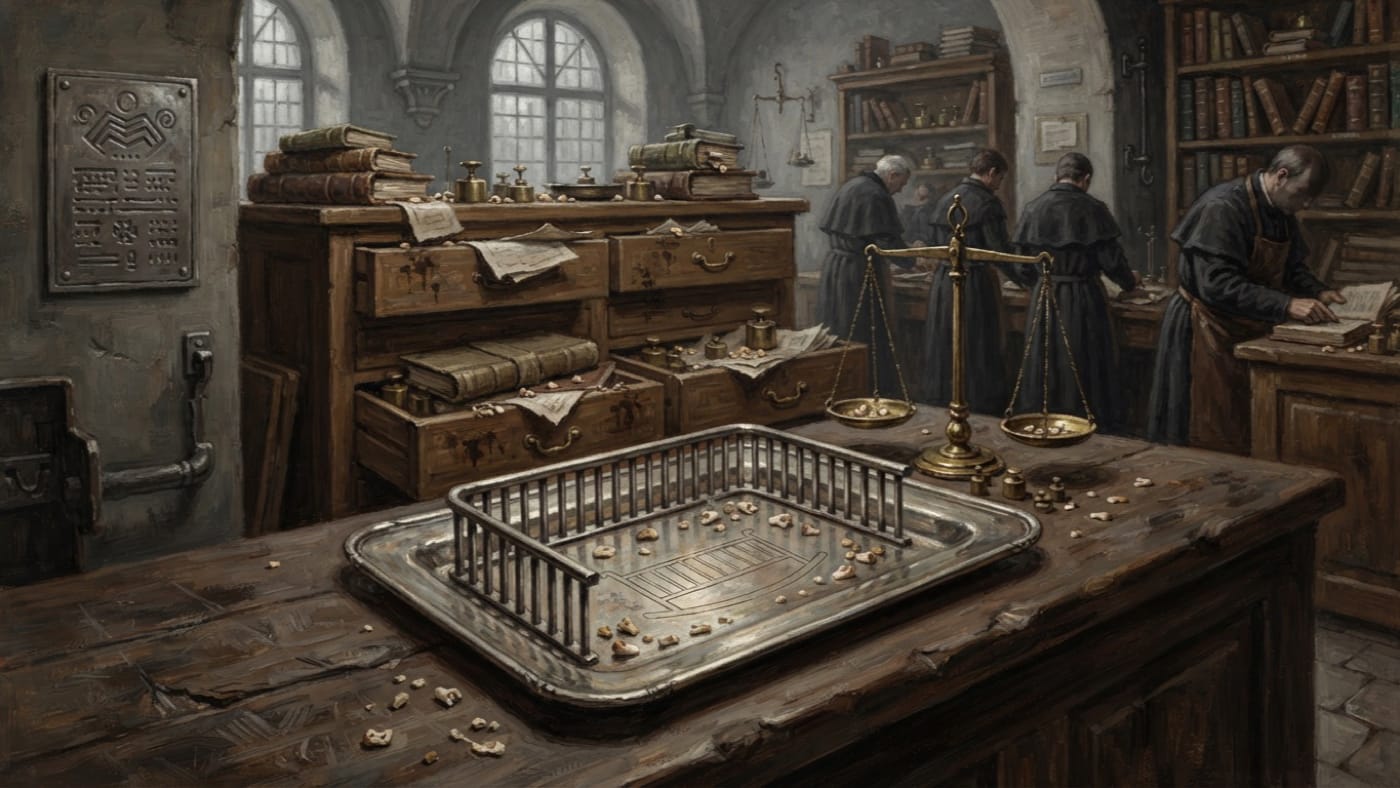
The infant-tooth tray is a shallow silver dish kept in the weigh-chapels of the Palatine Counting House in Strasbourg, where the Bureau of Tithes keeps its scales, its ledgers and its conscience. The conscience is kept in a drawer that sticks. The tray is too shallow to hold soup, and nobody ever asked it to. Its work is to receive the first teeth of children whose households owe the Synod for their existence, and it does that work with the composure of all silver that has never been hungry.
#On the Origin
The tray belongs to the Cradle Decree, promulgated in A.S. 157 (1867 CE) in the famine-year, when Tithes ruled that a confirmed pregnancy was a debt with a heartbeat. Once a midwife or medical clerk signed the notice, the household owed dues on the child's projected ration consumption. Birth added nothing to the account except volume.
Arrears followed with the punctuality of the canonical hours. Households that could pay in salt, coin, goods or labour tokens paid. Households that could not were entered as owing, and an entry made in Tithes ink outlives the people it describes. The Tithe Assessor folded the Cradle charge into the household's Burden Index, and the Index rose. Families learned that a child can fall into debt before it can sit up.
The tray came after A.S. 157. The Bureau has never published a closer date, and I will not invent one for it. Doctrine certifies what has been sealed, and it does not do Tithes' filing. It is enough to say that once the Decree had turned infants into obligations, someone in the Counting House needed a vessel dignified enough to hold whatever could be taken from them.
#On the Silver Tray
The documented particulars are few. It is silver. It is shallow. A cradle is engraved on its floor.
That is everything the commentary records. Anyone who wants the weight, the assay mark, the maker or the workshop must petition Tithes, which denies that the tray was ever procured and so cannot be expected to remember who made it.
The cradle is what matters. Its rails run in close upright strokes from head to foot, cut with the evenness of an engraver paid by the line. I read them as prison bars, because they look like prison bars, and because I have served long enough in institutions whose ornament admits what their statutes deny. No order records that the engraver meant anything of the kind. The engraver's intention is not on file. My reading is, now, and I have set my seal to it.
In the weigh-chapel the tray sits beside the widow's black penny and the famine spoon. Nobody arranged them as an exhibit. They share a chapel because they share a trade: the penny prices widowhood, the spoon prices hunger, and the tray prices infancy. Sitting together proves nothing about manufacture, date or a common commission. Tithes would be delighted if I claimed otherwise, because then it could correct me.
#On Calibration
Tithes calls the tray ceremonial. In Tithes usage, a ceremonial object is one whose purpose must never be written down. It answers to no inventory column and needs no maintenance schedule, and when it is denied it can be denied with a clear conscience, since ceremony was never procured in the first place. It was observed.
The Assessors give a plainer account. They say the tray trained the hand. Anyone who has stood at a Tithes bench knows the clack of the pans, the brine-washed fingers and the three taps on the beam at the start of a shift. An Assessor spends a career learning to feel the difference between full measure and a pinch short, between an honest penny and a clipped one. The Assessors' phrase for the tray is small weights, small debts, small lives made measurable. It is the more honest of the two accounts, which is why Tithes prefers the other.
No table of tooth weights has ever crossed my desk. I have seen no tolerance schedule and no syllabus explaining what the hand was supposed to learn or how a pupil was judged to have learned it. Whether a first tooth makes a reliable standard is a question for natural philosophers, and they are seldom invited into the weigh-chapel. I suspect the answer is no. I also suspect the Assessors do not care. Precision was never the point of the lesson.
The lesson was the tray itself, a polished floor on which a child's body appears in pieces small enough to be reckoned. A clerk trained on salt learns to count salt. A clerk trained on infant teeth learns that nothing in a household is too small, too new or too intimate to be entered in the ledger. Receipts follow from that, and so do arrears marks and, eventually, promotion.
#On the Teeth Offered Against Arrears
The controversy did not start in the chapel. It started in households.
Several families, deep in Cradle arrears, began offering their children's extracted first teeth as collateral against the debt. The commentary does not say how the teeth left the children's mouths, and I see no reason to improve on its silence. A household three seasons behind, with an Index climbing and a Route Assessor due on a known day, will offer whatever the Bureau has shown it values. The Bureau had shown it valued teeth. The households could read a tray as well as anyone.
The Lore Book records a second practice that must not be merged with the first: Assessors confiscating infants' first teeth as "preemptive dues." In one practice the household offers, and in the other the Assessor takes. Both run down the same gutter, but the records keep them apart and so shall I. Neither practice reaches back to the pregnancy assessment itself. The Decree charges for the unborn. The teeth come later, when there is a child with something to lose.
The Bureau of Relics objected. Relics exists to establish where sacred matter came from and to authenticate it, and it took exception to infant teeth being used as calibration tokens once families had begun pledging them against debt. Its objection, as recorded, concerned that use, and it made no finding about sanctity.
Tithes answered that collateralisation proved the Decree had entered public understanding. I have read that answer several times and still admire it, the way I admire a well-made gallows. A mother who pledges her child's tooth against a Cradle charge has understood the Decree perfectly. Tithes was right, and that was the obscenity of it.
Relics then withdrew its objection and asked for a receipt for the teeth already taken.
No record I have seen says whether the receipt was issued, what it listed, or whether any tooth passed into Relics' custody. Nor does any record establish a rate of exchange, a register of pledged teeth or a general right to offer them. The households' practice was a practice. A desperate mother does not need a statute to tell her what the Bureau will accept.
#On Procurement and Denial
Three Archons have denied trays whose acquisition orders they had signed. I give no names. The denials were made separately, and I will not stage them as a single hearing for the reader's convenience. Archons sign a great deal, and memory is a burden of office they are permitted to put down.
Of the denials, one is dated and quoted.
An Archonate statement of A.S. 172 (1882 CE) denied that infant-tooth trays were ever procured for Bureau use.
Corrected against acquisition order T-157-44, which carries three district seals and the countersignature of the Palatine chapel steward. The order is cited from Cradle Decree commentary and has not been independently examined by this office. The statement was never withdrawn, and it is still quoted.
The order number begins with 157. The commentary says the tray came after 157. I record both and reconcile neither. A number is a filing convention until someone proves it is a date, and nobody has proved anything. Readers who want the two figures made to agree should apply to a clerk with more imagination and fewer seals to lose.
What is certain is that three districts set their seals to the purchase, and the steward responsible for the chapel's furniture countersigned it. Once the trays had arrived and been used, and once Relics had asked for its receipt, the Archonate announced that no trays had ever been bought. Tithes has always held that the trays were ceremonial. Doctrine has always held that ceremony requires an invoice.
#On Present Custody
As of A.S. 201 (1911 CE), the year of this survey, the trays remain in drawers. They are kept for practical reasons, and they come out when practice requires. The A.S. 172 denial remains in circulation for the comfort of anyone who prefers it. The two have never been made to answer each other, and the Counting House sees no reason why they should.
I have no current inventory of how many trays survive, and no inspection has been made under my seal. The Assessors go on keeping their hands in, and the Cradle Decree stays in force. Whatever lessons the tray once taught, the Bureau has evidently learned them, and so have the households along the Widow Route and beyond, who learned the same lesson the Widow's Pennies taught their mothers. Ask the Bureau about the trays and it will deny buying them. Ask an Assessor and they will point you to the drawer.