
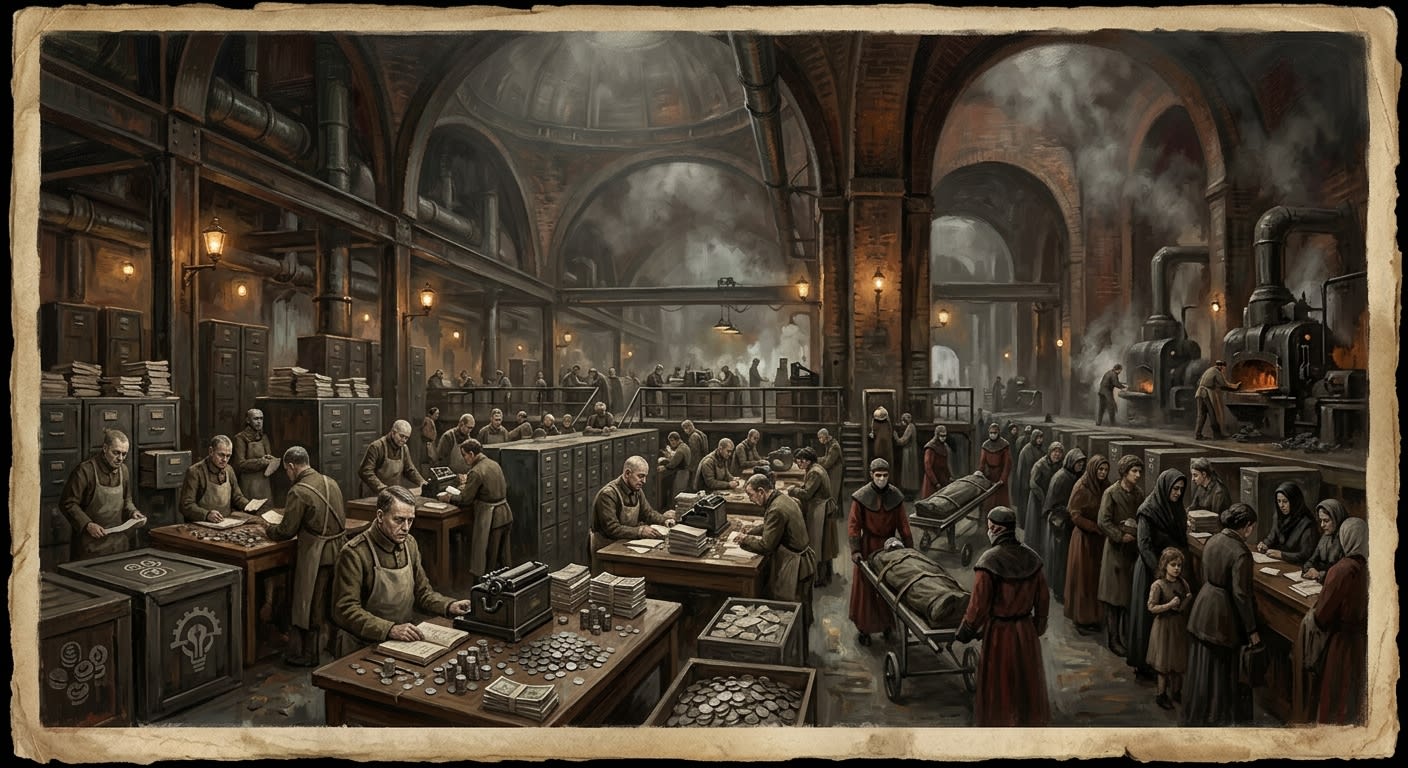
#On the House That Counts While You Sleep
The Palatine Counting House occupies an entire block of Strasbourg's northern quarter, west of the Tower of the Quill, within sight of the Basilica of the Ledgered Saints and within smelling distance of every candle, inkpot, sweat-soaked petition, and quietly murdered hope in the ecclesiastical district. It is the seat of the Bureau of Tithes. It was once a Rationalist tax depot. This has troubled many pious men, most of whom owed money.
The building predates the Bureau it shelters. Its lower vaults were laid before the Sundering, when the Rationalists believed revenue could be purified by reason, columns, and little men with dry mouths explaining public utility. The Synod took the structure after Strasbourg's consolidation, scrubbed the old insignia from the lintels, sanctified the door-weights, installed reliquary-certified scales, and discovered, to general satisfaction, that a tax office converts more easily than a philosopher. A philosopher resists. A tax office asks only where to place the incoming coin.
By A.S. 92, when the Holy Bureaus entered their full administrative shape, the Counting House had become the Fiscal Heart. I capitalise this because the Bureau capitalises it, and because lower-case anatomy offends accountants. Every coin, harvest, bridge tariff, salt due, widow's penny, cradle levy, candle fee, and indulgenced boot-payment that flows toward Strasbourg passes through the House in body, copy, or accusation. If the coin arrives, it is counted. If the coin fails to arrive, the failure is counted. If the debtor dies, the death is counted as a change of collection address.
#On the Rooms of Weight
The public entrance opens into the Hall of First Reckoning, where petitioners surrender their names, declared purpose, shoes if muddy, and any illusion that arrival confers progress. From there, the House divides into counting rooms, vault-corridors, weigh-chapels, oath desks, escort yards, arrears galleries, and those small side chambers whose doors bear no labels because the label would frighten the debtor into inefficient flight.
The counting rooms never darken. Candles are issued by the Bureau of Bells on a fixed schedule and paid for by the Bureau of Tithes with a tithe on its own operations, collected from itself, recorded by itself, disputed by itself, and audited by the Bureau of Records, which has spent forty years trying to decide whether self-taxation constitutes revenue, prayer, fraud, or miracle. The Bureau of Doctrine has twice selected miracle. It saves paper.
The weigh-chapels are the building's true sanctuaries. Assessors calibrate their field scales there against reliquary-certified standards: the fourteen-gram Crown of Grace, the four-gram prayer bead, the famine spoon, the orphan ration chip, the widow's black penny, the infant-tooth tray introduced after the Cradle Decree of A.S. 157 (Unregistered) and later denied by three Archons who had signed the acquisition orders. Each chapel contains an altar-scale whose pans are never empty. Empty pans suggest a world without obligation. The Bureau does not permit obscene theatre.
Beneath the public floor run the vault-corridors, iron-ribbed and cold, with ledgers stacked in barred niches like prisoners who have become useful after sentencing. The oldest corridors retain Rationalist numbering. The newer corridors use liturgical sequence. The crossing of the two systems produces such designations as Vault IX-Decimal-Penitent, Annex 4/Gloria, and Subcell 7B of the Corrected Arithmetic. Visitors mock this until they get lost. Then they become humble, or inventory.
A prior architectural survey described the Counting House vault-corridors as “fully mapped.”
Corrected after the A.S. 188 mast works revealed three undocumented lower passages, one sealed staircase, and a brass door bearing a Rationalist inventory number the Bureau of Records insists was retired forty-six years before the door was installed. The corridors are mapped to the degree required for official confidence. This is a smaller map.
#On the Fiscal Census
The deep vaults hold the Fiscal Census, companion and rival to the Great Ledger of Souls. Records tracks who you are. Tithes tracks what you owe. The distinction is theological, practical, and financially advantageous.
The Fiscal Census is cross-referenced against baptismal rolls, death registers, reassignment writs, conscription returns, orphan intake sheets, widow petitions, harbor declarations, ration ledgers, bridge manifests, and every other document by which the Synod converts human life into administrative mass. It disagrees daily with the Bureau of Records. Records claims Strasbourg holds six hundred thousand souls. Tithes counts the living, the liable dead, the estates under dispute, the unborn entered by preemptive obligation, the dissolved households whose arrears remain active, and three categories of debtor whom Doctrine has advised me not to name because naming them encourages lawyers.
Tithes reports a larger Strasbourg.
That sentence contains no error.
Access to the Fiscal Census requires a Tithes seal, a Records countersignature, and a Doctrine permission note if the inquirer wishes to ask why the first two disagree. The note is rarely granted. I received one in A.S. 197, entered Vault-Corridor Lent-Three under escort, and was shown a shelf containing arrears records for persons classified dead, erased, transferred, unborn, canonised, and “temporarily uncollectable due to demonic occupation.” The last category occupied nine cabinets and hummed when touched.
Extract, Fiscal Census Audit Annex, A.S. 197: Line 44: Debtor category “Absent by Hell” retains liability. Line 45: Interest suspension request denied. Line 46: ███████████████████████████████████ Line 47: If debtor returns altered, collect from altered portion first.
#On Immurement and Other Corrections
The Palatine Counting House stores money, and teaches money to behave.
Assessors who falsify ledgers, split dues, hide brine-stone results, attach arrears leashes to the wrong families, or steal with insufficient elegance are brought home through the eastern service door. Minor offenders are demoted, publicly accounted, sent to hostile districts, or assigned to candle reconciliation until their eyes learn penitence. Major offenders descend.
The basement vaults contain wall-niches behind falsified ledgers. The worst Assessors are immured there, each sealed behind the books he altered. The symbolism is obvious, which is why the Bureau likes it. Subtlety wastes mortar. A corrupt accountant who spent twenty years turning households into entries becomes an entry with lungs. His name remains on the audit schedule. His meals arrive through a slot until they do not. His final balance is stamped in red.
The public pretends horror. The Assessors pretend deterrence. The clerks pretend not to know which walls answer when the night shift adds columns aloud. I have heard one answer. The voice corrected a subtotal. It was right.
A civic pamphlet once claimed that no living persons are held beneath the Palatine Counting House.
Corrected under pressure from accuracy and from the wall behind Vault-Corridor Ash-IX, which knocked three times during the hearing. No unlawfully held living persons are kept beneath the Palatine Counting House. The adverb does magnificent work.
#On the Present Operation
Three shifts keep the House awake. First shift receives coin and grain. Second shift reconciles ledgers. Third shift writes letters, which is the cruelest work because letters travel farther than armed men and arrive at breakfast. At Sixth Peal the House sings Psalm CCCXIV, “A Weight of Wheat Is Worth a Breath,” and every scale in the weigh-chapels tips in unison toward the Bureau's pan. The phenomenon has been measured. The Bureau of Engineering suspects hidden counterweights. The Bureau of Tithes suspects grace. I suspect both departments are poorer than they admit.
The iron mast above the roof, erected in A.S. 188, flies the Synod's standard and irritates the Tower of the Quill by standing six feet higher on windless days. I admire the pettiness. Architecture should have ambition. From the Gallery of the Quill, the Counting House appears squat, hard, and busy, like a clenched fist full of receipts. From the street, it appears larger than it should. From inside, it appears unwilling to end.
The Palatine Counting House never closes because debt never sleeps, because hunger keeps irregular hours, because widows arrive at dawn, because merchants lie best before noon, because soldiers die at inconvenient intervals, because the dead require processing, because the unborn have begun to cost the Synod money, and because a locked treasury invites the vulgar fantasy that a treasury exists for storage rather than extraction.
The Counting House counts. The scales tip. The vaults hum. The letters go out.