
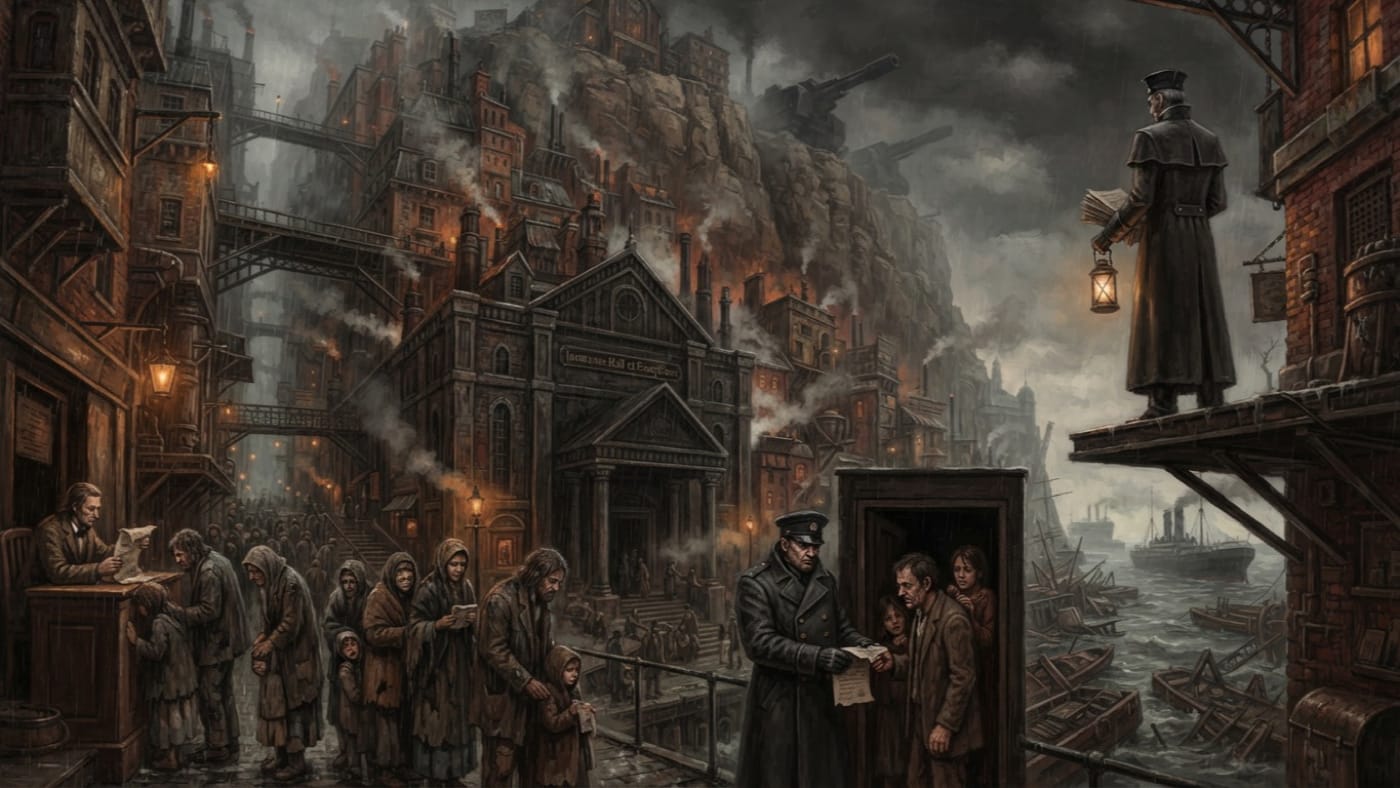
#On the Courts and Their Jurisdiction
The Insurance Courts of Saffron Bastion are the civil tribunals where the port brings its wreckage once the bodies have been counted, or once someone has decided they need not be. They sit in the district that bears their name, above the salvage auctions and below the cliff guns, in rooms that smell of parchment, incense and old blood. Judges hear claims. Scribes draft writs. Enforcers carry liens to doors that have usually guessed already. In public, the office exists to secure fairness after disaster. The widow is compensated. Shipper and salvor go to arbitration. The harbour recovers in good order, when otherwise it would settle its accounts with gaff-hooks.
Saffron divides its terrors by subject. The Quarantine Tribunal judges lungs and doctrine. Harbor Marshal Command, under Canon-Marshal Veyra Sable, holds the berths and the guns. Prefect Halden Greaves of the Quarantine Prefecture holds the health passes and the yards. The Quay Chapterhouse seals manifests. The Insurance Courts keep the ledger that tells each of these offices what its catastrophe was worth.
Their most visible officer is Writ-Lector Odrin Vale. His leverage is the disaster writ, and his instrument is the citizen's fear of being ruined by paper. He smiles when storms arrive. His ink smells of iodine. The Bureau file holds nothing more worth repeating. I have read it twice in hope.
#On Recovery and Establishment
Saffron was a harbour of losses long before it became a harbour of claims. Surveyors arrived in A.S. 68. The fortification designation followed in A.S. 72, and with it the port's dependence on lamps, which the Lanternline Chandlers' Lodge has invoiced ever since. The Brine Fever Winter of A.S. 112 gave the port its Prefecture, its saffron flags and its first registered undercity. None of this needed a court. Whoever reached a wreck first salvaged it. Damaged cargo was argued over in taverns. Ruined households were ruined without documentation.
The Insurance Courts were established in A.S. 134, twenty-two years after the fever, to stabilise recovery. The need was real. A pilgrim port loses hulls, cargo, rope, berths and men every season. A merchant who cannot recover a spoiled consignment stops sailing to Saffron, and a widow who cannot recover her husband's wage stops eating. Arbitration was supposed to turn those losses into settlements before they turned into feuds.
The files I have been shown contain no charter text and name no founder. The Courts enter the record fully robed and already hearing claims, as institutions prefer.
#On Writs, Liens and Exceptions
The ordinary machinery is dull, and Saffron hides its sharpest parts in dull machinery.
A household or shipper files a claim. The Court arbitrates between claimant, carrier, salvor and anyone else with a seal in the matter. A disaster writ then issues, granting compensation, settling the salvage or allocating the loss. The writ is tradable. A widow who cannot wait for payment sells hers at a discount to a man who can wait. Such men are plentiful, and Saffron has grown a market in insurance-writ futures, where citizens bet on disasters that have not yet arrived. The Bureau calls this speculation. Low Nets calls it praying for weather.
The lien is the Court's second sacrament. Some owe the Courts directly. Some are debtors whose creditor has bought their writ. Some are families whose repairs were advanced against compensation. Any of them may find a lien attached to their future wages. In Saffron the lien notice is as common a form as the fever log and the dues invoice, and street speech calls the seizure a "storm recovery adjustment." The Hall of Exceptions has settled matters by lien so thoroughly that the docks call it execution.
Above both sits the storm exception. In a crisis the Courts may declare an exception that overrides ordinary law. Rights are suspended, contracts set aside and claims rearranged while the water is still in the streets. These exceptions issue from the Insurance Hall of Exceptions. Its rooms burn incense against the smell of wet petitioners, and its cabinets keep templates.
Templates. I record the word carefully. Templates for disasters.
#On Catastrophe Prepared in Advance
The scandal that now follows the Courts is a matter of sequence. Within the last few years, pre-signed storm exceptions have been found dated before the storms they excused. Purity's preparatory abstract asks about one Insurance Court exception dated days before its event. Saffron would most like left unasked whether this was house habit or one clerk's appetite.
The interests line up with indecent neatness. The Prefecture wants stricter lockdowns. The Courts want looser rules, because looser rules produce incidents and incidents produce fees. The two offices argue the point in real memoranda and then cooperate at the waterline, which the Demon-Lure lanes supply:
- A lureline worked under controlled conditions produces losses, and the Prefecture classifies them as marine incidents.
- Marine incidents produce claims.
- Exception writs finance quarantine operations.
- Quarantine holds supply replacement labour for the dead.
- Salvage, liens and repair contracts follow in good order.
The Gilt-Knives salvage cartel profits from wrecks, staged or merely disputed. The Ropehand Compact answers with slow strikes, and the Courts can price those too.
Every lure begins with a lamp, and the lamps belong to the Lanternline. The Courts can squeeze the Lodge by delaying payment, and the Lodge can answer with shortages and nights of chosen gloom. Lantern shortages have coincided with writs that needed fog. The street says the Courts pay the chandlers to make prewritten disasters look plausible. I file that as street truth. In Saffron, about half of a street truth survives an audit.
The Courts also have a payment connection to the captain of Cliff Battery Twelve. The record shows the money. It does not show that any particular discharge was bought, and it gives Vale no command over the guns. During Lantern Compliance Action 44-K in A.S. 198, an Insurance Court observer stood inside a marked firing line and delayed the battery. The extract does not say who sent him.
COASTAL REGISTRY INTERNAL CROSS-LINK — LOW NETS / A.S. 198 Pattern shift authorised by ████████████. Recorded civilian loss: marine incident, tide surge. Replacement labor drawn from: Quarantine Hold Yard C. Insurance recovery: storm exception pre-dated by █ days.
#On the Claimant and the Witness
Low Nets bears the arithmetic. Its households lose the men, receive the writs, sell the writs and carry the liens, and the holding yards draw the replacements from Low Nets as well. A worker held in quarantine cannot testify, petition or accuse an officer except through Prefecture channels. He can be absent from his labour, present on a compensation list and unavailable to contradict either. The Courts did not invent the hold. They have learned to read its calendar.
Saffron produces a peculiar domestic occasion. A compensation writ arrives for a body nobody has found, and the family must decide whether to eat or to mourn. Some widows were paid by writ and now pray for storms. I would condemn them more freely if I had ever been hungry in Saffron.
The Brine Choir sings at failed claims, at deaths, at fever clearances and at payments for absent bodies. It also spoils the Courts' estimates. Its counter-patterns can reduce losses the Courts have already priced, and Writ-Lector Vale has recorded lower claims after nights when the Choir was allowed to work. The Choir is rumoured to plan a mass lure-calling, which its cantors deny in three unsynchronised voices, and to the Courts that sounds like future exception business. No office competent to explain the Choir's method has done so.
The official account of the A.S. 199 South-Pier Incident credited the survival of six men to "corrected lantern pressure."
Amended under sealed addendum, A.S. 200. Brine Choir participation is confirmed. Survival counts used in later loss estimates are to be read accordingly. The arrests stand.
#On the Pending Audit
Canon-Inquisitor Silex Marrow of the Bureau of Purity has authority to compare Insurance Court writs against Lanternline pattern books and quarantine holds. His method is sequence. He wants to know which document was signed, which lamp moved, which custody changed hands and which claim was paid, and in what order. His comparison set covers:
- the Lodge's oil-loss ledgers
- the Courts' storm exceptions
- movements through Hold Yard C
- vacancies in Low Nets housing
- the depression logs of Battery Twelve
The Courts are badly built for this question. A writ is a dated instrument, and its whole value lies in the date. It cannot afterwards plead that it was written in a panic.
Saffron has prepared its usual welcome: clerks coached to weep and call fraud a misunderstanding, decoy forgeries, apprentices fattened for sacrifice. Vale has offered papers. He has always had papers.
As of A.S. 201 the audit is still pending. No verdict has been issued, and Vale has not been arrested. The Hall of Exceptions still hears claims at midday, after the seals and before the salvage auctions. The Bureau of Doctrine still describes the matter as civil.