
#On the Classification
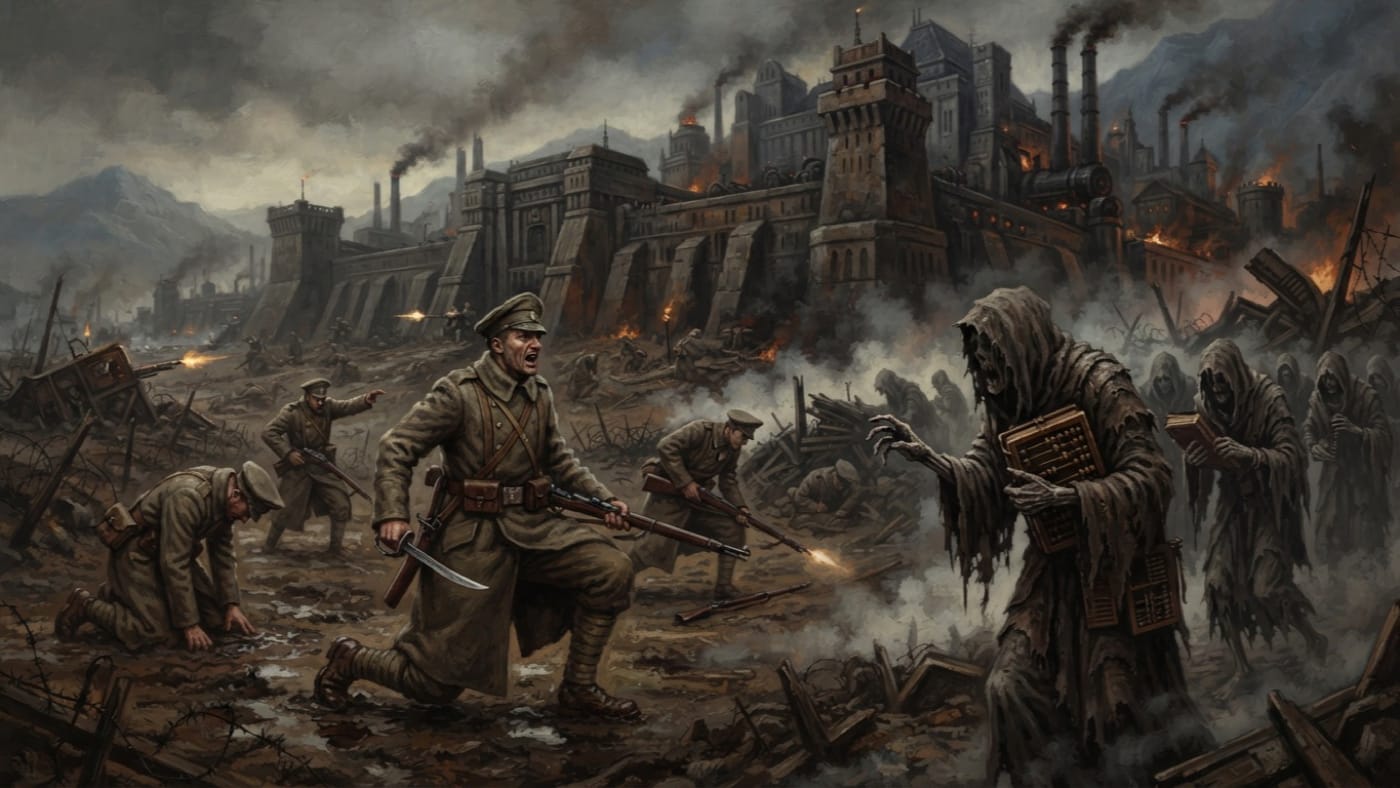
A soldier on the Sibiu approaches sets his feet and lifts his sword to strike. The sword does not rise. In every account the Bureau holds, his arm hangs at his side and refuses an order he is still giving it. He has not surrendered, and his intention has not wavered. By his own report and the report of the men beside him, he still means to kill the thing in front of him. He simply cannot lift his hand to do it.
That is the whole phenomenon as the frontline experiences it. Everything after that is classification.
The Bureau of Doctrine has named the cadence it holds responsible the Inverse Litany. I want to be exact about what the name contains. It contains a sound, which is a crooked, muttered rhythm rising from the support chanters of Velmora's host. It does not contain the words. Doctrine holds no transcription and no notation. It has no settled language for the thing, no count of verses, no tempo, and no record of when a recitation begins or ends. There is nothing a clerk could set before a choir or a tribunal. The Bureau has named a thing it has heard many times and never once had in its hands. This is customary. Half the registers of the Church were opened on the same terms, and most of them are still open.
#On the Chanters
The Litany belongs to the Debt-Binders. The troop register lists them as support chanters in Velmora's field host and calls them crooked. Witnesses agree on that adjective and on very little else: height, face and dress vary with the witness, the range and the weather. I print no uniform for them because the record supplies none. I make no claim about what they were before they were Debt-Binders, because the record is silent on that as well.
They must not be confused with the Ten Thousand Keys. That cult's five ranks are the Debtors, Creditors, Assessors, Ledger-Keepers and Inheritors, and they do their work in counting houses and notaries' parlours, not in the line of battle. Debt-Binder is not a sixth rank. No record in the Bureau's keeping makes every cultist with a ledger a reciter of the Litany.
Soldiers meet the chanters at Bastion-Sibiu. The bastion is a fortified Saxon citadel behind the wall of the Transylvanian Alps, and it holds the passes of the Line's middle sector. Most of Sibiu's war is paperwork. Velmora's gold comes up out of the veins beneath those mountains and buys quartermasters and toll-keepers along three supply corridors. The garrison intercepts more corrupted convoys than it repels assaults, and a Sibiu soldier is audited more often than he is shot at. When an assault does come, the Debt-Binders come with it. A man who has spent the month checking manifests for false ink then finds that the enemy has brought its paperwork onto the field.
#On Invisible Restraint
The register records three effects. A man stumbles. A man bows. A man's arm will not lift his weapon. The register does not record them in any order. Some accounts have the stumble without the bow, and some have the failed arm with neither. The Bureau holds no proof that one effect leads to another, no measured distance at which the cadence takes hold, and no evidence that every soldier who hears it is affected. Anyone who tells you the Litany works in stages, has a range in yards, or takes every man within it is selling a pamphlet.
The chains are invisible. That word belongs to the oldest description in the troop register, and the reports confirm it in the worst possible way. Nobody sees a link. Nobody feels the weight. A soldier standing within earshot of the muttering reports nothing wrong with his body at all. He discovers the restraint only when he tries to act against Velmora's host, and the body he has trusted since infancy declines the instruction.
There lies the particular cruelty of the thing. A man who never resists never learns he has been bound. The restraint is revealed only by the attempt to fight. Courage is what exposes it.
The bow troubles the chaplains most. A soldier's knees fold and his head goes down, and from twenty paces it looks like reverence. The men around him know he did not intend it. He knows it too. On the parade ground he would be flogged for sloppiness. Here he is filed as a casualty.
#On Obligation and Choice
In the Velmora entry I wrote that the soldier's arm "has been repossessed." I stand by the word as Doctrine's word. It is an interpretation and should be read as one. Repossession is a creditor's act: collateral is reclaimed under the terms of a debt. The word fits the Covetous Serpent, who converts love, loyalty and time into entries on a balance sheet. But it is a word, and nobody has produced a contract that shows a legal claim on a limb.
The settled teaching of the Church sits beside it. The Great Deceiver and his generals may tempt, deceive, threaten and reward. They may chain a body in the territories they hold. They cannot take a man's choice, and no pact they write binds a will that refuses it. A pact may feel binding. The feeling is the weapon.
Any honest account of the Litany has to carry both teachings at once. The soldier's will is intact. He chose to strike, he says so, and his comrades saw him try. Something between that choice and the muscle failed. The record does not say whether the cadence acts on the flesh, the nerve, the joint, or on some obligation laid on the body that Doctrine has not yet found in any ledger. The Bureau has drawn conclusions on less evidence. I decline to do it here, in my own hand.
What the reports never contain is a soldier who has stopped wanting to fight. On that point the theology and the field agree, and it is the only point on which they do.
Earlier editions of this Codex classified Velmora's primary sorcery as "cursed coinage."
The Velmora entry carries the correction, and it is repeated here: the classification is Contract Theurgy. It matters to this file for a practical reason. A soldier who believes the danger lives in coins will empty his pockets before facing a Debt-Binder and consider himself solvent. No record shows that the Inverse Litany takes any interest in his purse. No record shows that it needs his signature either. Correcting a name has not told us how the curse works.
#On the Sibiu Record
In A.S. 194 (1904 CE), a Debt-Binder was captured at Bastion-Sibiu. It spoke fluent Synodal Latin. It offered to settle out of court. The Bureau of Purity burned it. The ashes arranged themselves into a receipt.
Those five sentences are everything the published record holds. I add nothing to them, and I have refused several offers to add things.
Consider what Purity destroyed. It was a chanter of the Inverse Litany, held in Synod custody, able to speak, and offering to negotiate. It was the nearest the Bureau of Doctrine has ever come to the text it named. Doctrine was not consulted before the burning. The Latin was conversational, so it tells us the captive could talk, not what language it chanted in. The receipt acknowledged a transaction, but nobody recorded what had been paid, who paid it, or whether the account was closed. The garrison's own afflicted men did not report their arms restored afterwards, and I will not invent a recovery to give the anecdote a happier ending.
#On Countermeasures
The Synod has measures against Velmora. It has none proven against this chant.
The Bureau of Records keeps contract readers to search agreements for buried clauses. That may protect a quartermaster at a table. It does nothing for a rifleman in a pass who never signed anything. The Bureau of Tithes promotes the tithe as inoculation, on the theory that a man who gives freely cannot be bought. Whether it works is unclear, and Tithes has an interest in the answer. The Debt Tribunals can annul a contract once demonic origin is proven, and they succeed roughly once a decade. The Value Fast, decreed in A.S. 199 (1909 CE), puts personal property into communal custody for fourteen days. Velmora's agents have learned the schedule and arrive during it with generous terms. Some take the Mark of Poverty and give up ownership entirely. The Church respects the vow but does not teach that a purse is a sin or that an empty hand is a saved one, and the Bureau of War cannot field an army of mendicants.
None of these has been tested against the Inverse Litany. The record does not say whether a tithed man, a fasting man or a destitute man is spared. It does not say whether killing the chanter frees the arm. It records no counter-hymn, no protective relic and no posture that keeps the body obedient. I have been offered all of these by enterprising chaplains. I have filed them under Hearsay.
#The Disposition
The classification stands. Doctrine names a cadence it cannot transcribe, attributes it to chanters it cannot fully describe, and explains its effect in a vocabulary of collection that the Church's own teaching on choice will not let it make literal. The symptoms are attested. The mechanism remains open.
The single specimen able to speak was burned, and it left a receipt that nobody can read as settling any debt the Synod knows of. The file remains open under Doctrine's seal. Purity has been invoiced for the loss.