
#On the Designation
This is the commissioned Codex survey of the Iron Corridor as it is held in A.S. 201. Its scope is narrow by order. The Iron Corridor is a restricted designation for the fourteenth, fifteenth and sixteenth trench sectors of the Carpathian Gates. That is three sectors. It is not a pass, a road, a supply network or a checkpoint, though careless cartographers have at various times made it into each of these.
The distinction is practical. The Gates are the fortified pass system: saddles, snow galleries, reliquary roads, pass-forts and road-locks, the whole grinding funnel of stone. The Arch of Saint Harrowglass is a checkpoint, shrine and ossuary on the Harrowglass approach, with its own register, its own patron and its own bad temper. The Iron Corridor is a stretch of trench inside the first, reached by roads that pass beneath the second. A clerk who confuses them will requisition shovels for a shrine and confession hooks for a firing step, and the Bureau of War will pay for both.
Earlier cartography labelled the whole Carpathian pass "Iron Corridor."
Corrected. Iron Corridor refers to trench sectors 14–16 only. The pass is the Carpathian Gates. The name never grew to fit the mountain. The mountain was briefly shrunk to fit the name, and it has been returned to its proper size.
#On the Ground Around the Trenches
The Gates lie in Zone 4, the middle mountain portion of the Sagittal Line. The Line runs north to south from Bastion-Königsberg on the Baltic to Bastion-Constantinople at the Bosphorus. In the Carpathians it stops being a matter of marsh and river and becomes a matter of rock. Bastion-Przemyśl guards the western Carpathian passes. Bastion-Sibiu holds the Southern Carpathian wall farther down the spine. East of Przemyśl the highlands are under the pressure of Atheron, who crowns every ridge he takes with a spire. That pressure belongs to the region, and it gives him no claim on these three sectors.
The Gates lie in that mountain country, and sectors 14–16 lie within the Gates. That is the address. The perimeter belongs to the restricted sheets.
The Carpathian Gates serve as the northern hinge of the Sagittal Line.
Corrected. The Gates are the middle mountain hinge. The northern anchor is Königsberg, which has the Baltic for company and needs no help from the Carpathians.
The ground here is confinement. The older lore calls the Gates less a pass than a scar, a funnel between jagged teeth of stone where the eastern wind arrives screaming scripture backward. Trenches cut into such ground do not sprawl. The mountain tells them where to go, and the mountain has opinions.
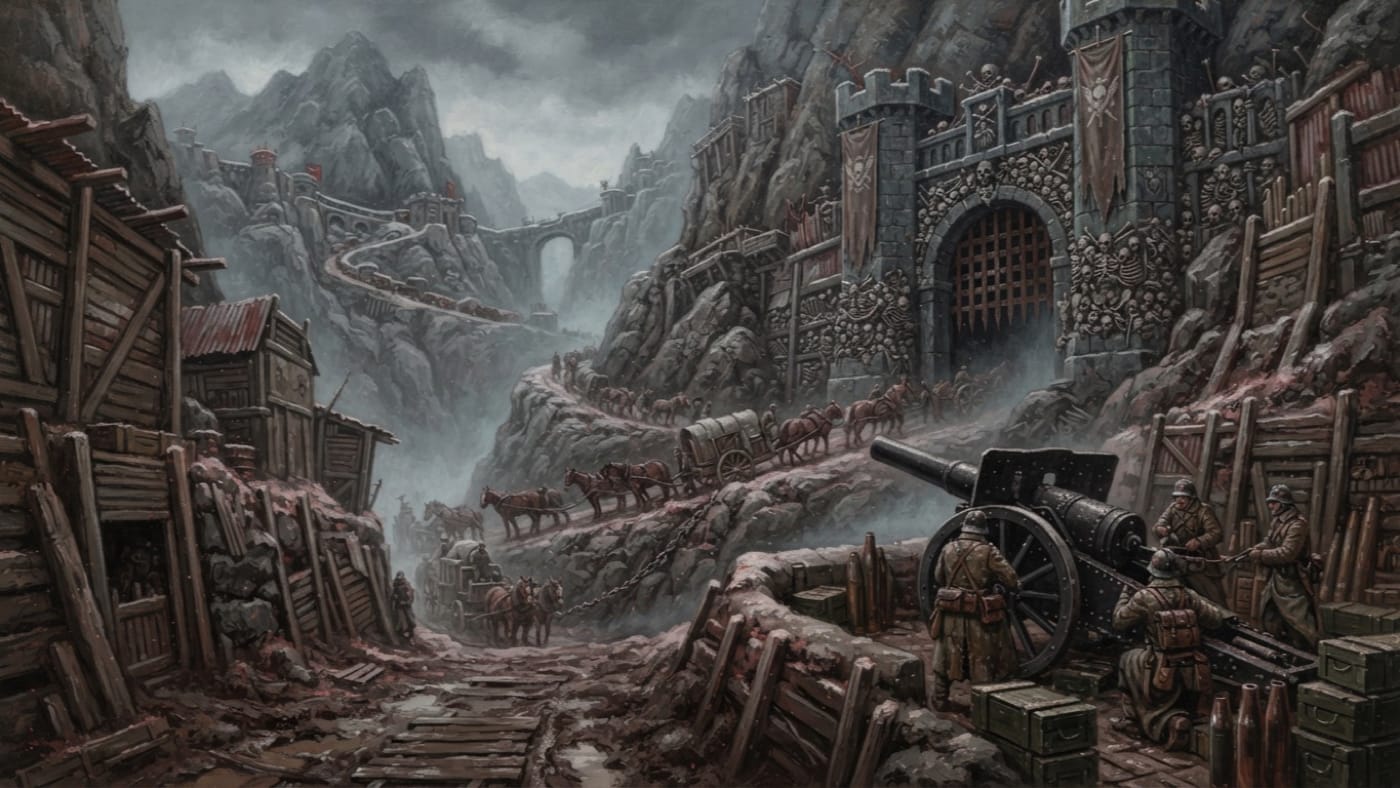
The surrounding works form a palimpsest that no single century would sign. Roman stone lies under medieval shrine masonry. Ossuary bastions mortared with plague-bones lean against concrete slabs, and into those slabs the Bureau has set reliquary chains thicker than a man's torso. Pilgrim banners hang beside black cannon muzzles, so the approach looks like a cathedral that has taken up artillery as a second vocation. These materials describe the Gates. No survey has divided them among the three sectors, and this one will not pretend otherwise. Whoever wishes to know which sector has the Roman stone may go and kick it.
#On Freight and the Approach
Before the Sundering the Gates carried salt, cattle and iron. That was trade, and it is the history of the pass. The Ledger does not say whether anyone called any part of it the Iron Corridor in those years, and the coincidence of cargo and name proves nothing. A mule called Bishop has never been consecrated.
After the Sundering the traffic changed its liturgy. Reliquary artillery is now dragged up the approaches by chain, and the wheels cut grooves into the bones of centuries. Supply lines crawl through the fortified approaches like veins. The Inquisitors of the Bureau of Purity watch them and burn wagons suspected of taint without troubling the evidence for an opinion. On the Harrowglass approach, the columns bound for the high sectors make a fixed procession. Artillery teams strain on the chains. Ration wagons smell of horse-sweat and tallow. Pilgrim companies carry banners stiff with ice. Condemned labour details have been told that forward work is penitence.
Where each column goes after the approach is the business of the Bureau of War and its route sheets. This survey states only the relationship: the roads feed the high sectors of the Gates, and the Iron Corridor is among the trenches the Gates contain. It does not follow that every wagon crosses 14, 15 and 16 in order, like a penitent telling beads.
All of this must be kept apart from the Carpathian Corridor. That is the rail-road-mule transfer system feeding Przemyśl and Sibiu from the rearward yards. It uses rail where there is gauge, road where there is no gauge, and mules where there is no road. It is a network across a mountain range. The Iron Corridor is three trench sectors inside one pass. The two names share a noun and nothing else. A quartermaster who sends Corridor freight to the wrong Corridor will discover the difference at altitude.
#On the Harrowglass Threshold
Columns entering the Gates first pass beneath the Arch of Saint Harrowglass, an edifice of fused skulls where the old trade-road meets the newer trench-road. It is filed as an ossuary checkpoint, a sanctioned shrine and a site of acoustic judgement. Doctrine holds that its skullwork rings hollow when a coward walks beneath it. It appears here because no one reaches the high sectors by that approach without being inspected first. A survey of the trenches that left out the gate in front of them would be negligent.
The Arch has its own entry under its own patron, Saint Harrowglass. Its manual, standing orders, wardens and dead are recorded there. The reader may go to it. Most columns have no choice.
What matters to this survey is jurisdiction. Inspection happens at the Arch, and the trenches begin beyond it. A man cleared beneath the span has satisfied the shrine. He has not yet arrived anywhere in particular, and the Iron Corridor will not be impressed by his paperwork.
Popular lore names a rival patron for the Gates: Saint Niklaus of Cluj, who is said to have burned himself in the archway to halt Wrath's vanguard. The Bureau of Records holds that both accounts are true when spoken in Strasbourg and false when spoken anywhere else. Neither saint has been assigned to the trenches. I will not hand them a sector each to settle the quarrel.
#On Reports from the Snow
The trenches of the Gates produce testimony the way other ground produces turnips. Soldiers speak of the Stained Blizzard: snow falling red, as if the sky had been bled, crusting rifles and turning bread to iron. Others swear the drifts hide mirror-men, files of soldiers who march in lockstep until the watcher blinks and finds their faces are his own, eyeless and smiling. Artillery officers report that shells fired eastward vanish in flight and turn up months later embedded in masonry far to the west. Some accounts name the walls of Strasbourg.
All of these are reports from the Gates. None of the depositions consulted for this survey places a particular red snowfall, a particular mirror-man or a particular shell in sector 14, 15 or 16. The Codex will not move a ghost to suit a heading.
The institutional readings compete, and none of them is final. Records files the wandering shells as clerical anomalies. The offices that concern themselves with weather and sin have each offered an account of the red snow, and the accounts disagree, which is how offices remain funded. The soldier, who has to eat the iron bread, holds a simpler view that I decline to print.
#On the Present Register
As of A.S. 201, the Iron Corridor is what the Ledger says it is: a restricted designation for trench sectors 14 through 16 of the Carpathian Gates. It is reached by the roads that pass beneath the Arch of Saint Harrowglass, and it is separate from the Carpathian Corridor that feeds the bastions from the rear. The pass keeps its name and the Arch keeps its skulls. The Iron Corridor keeps three numbers and nothing more.
Anyone requiring more than three numbers may apply in writing to an office that will not answer.