
#On the Threshold
The Arch of Saint Harrowglass stands in the Carpathian approaches, where the old trade-road, the newer trench-road, and the Bureau's appetite for inspection meet in a single stone throat. Every supply column bound for the high sectors must pass beneath it: artillery teams dragging reliquary guns by chain, pilgrim companies carrying banners stiff with ice, ration wagons smelling of horse-sweat and tallow, condemned labour details who have been told that forward work is penitence and have chosen to believe this because the alternative is despair with better eyesight.
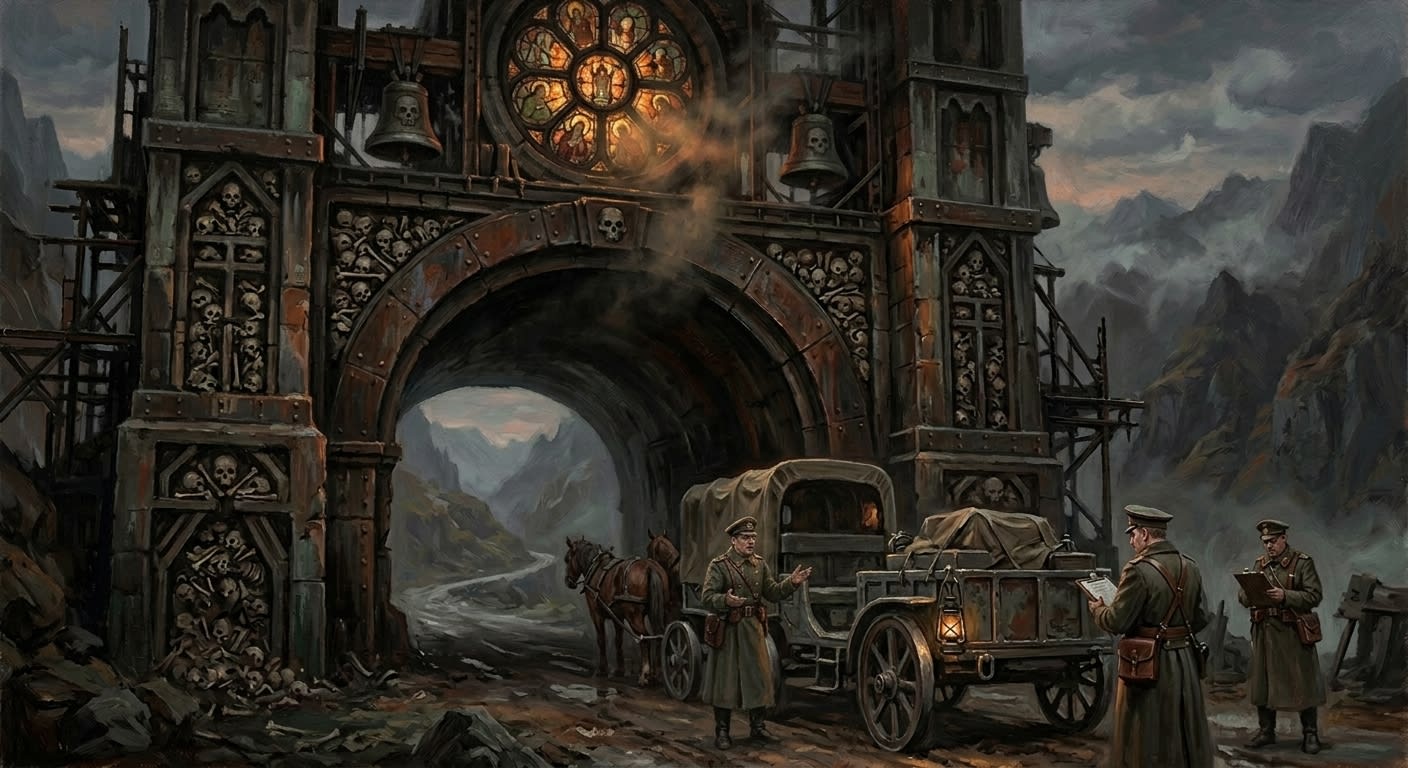
The Arch is built of fused skulls.
This is not poetic shorthand, though the lesser guidebooks try to soften it with phrases such as ossuary masonry, devotional bonework, or memorial aggregate. Skulls. Human skulls, lime-bonded, glass-sealed, smoke-blackened in places where the wind enters the eye sockets and leaves singing. The Bureau of Engineering set iron ribs through the mass during the A.S. 68 line consolidations, then wrapped the ribs in reliquary chain thick enough to shame a siege gate. The Bureau of Relics affixed Harrowglass fragments. The Bureau of Records filed the result as a checkpoint. Doctrine called it a threshold. Soldiers call it the Mouth.
Above the central span hangs a cracked pane of shrine-glass said to have travelled with Saint Harrowglass during the Year Without Dawn. It does not reflect faces cleanly. A man looking upward sees his cap, his jaw, the person behind him, a strip of red sky when the sky is grey, and — in recorded cases the Bureau declines to standardise — the expression he will wear at death. This has reduced loitering. A rare success.
#On Stone, Bone, and Inspection
The approach rises between revetments older than the Synod and younger than the last bombardment. Roman stones show beneath medieval shrine-blocks. Ossuary bastions lean into concrete slabs. Reliquary chains cross the outer works in black arcs, stamped at every ninth link with prayers against desertion, spoilage, mirror-men, snow-borne whispering, unlicensed relic freight, and the particular sin of asking whether a checkpoint requires quite so many offices.
It does. That is the first doctrine of checkpoints.
The Arch-Warden's platform sits on the western pier, reached by an iron stair whose treads have been worn hollow by inspectors and penitents. Below him work three desks: War counts men and weapons; Purity smells cargo; Records corrects names. A fourth desk appears during Pilgrimage seasons and vanishes when Tithes asks who funded it. The Arch itself performs the only inspection that matters. When a coward passes beneath, the skullwork rings hollow. When tainted freight passes, the glass pane clouds from the inside. When a false reliquary crosses, the chains sweat reddish salt. When nothing happens, everyone is relieved and no one writes down how relieved.
Earlier cartography labelled the whole pass “Iron Corridor” and treated the Arch as an ornament of that corridor.
Corrected. Iron Corridor refers to trench sectors only. The Arch is a checkpoint, shrine, ossuary engine, and juridical mouth. Ornaments do not detain cavalry companies.
The skulls are arranged by provenance. Eastern face: unknown dead from the first pass fights after the Sundering. Western face: condemned deserters whose families received letters praising their “posthumous masonry service.” Inner curve: plague dead, shrine dead, and three rows of clerks killed by falling stone during the A.S. 114 reinforcement survey. The clerks are easy to identify. Their jaws are wired shut.
The pilgrim banners make the Arch look festive at a distance. This is a cruelty of perspective. Up close the cloth is stiff with sleet, soot, candle-grease, and the brown handprints of men who touched it for courage before being ordered east. Children travelling with licensed devotional columns are told the skulls are carved. The smarter children stop asking questions by the third tier.
#On Harrowglass and the Hollow Ring
The approved account holds that Harrowglass, martyr of Ulm, carried reliquary bones to this sector during the Year Without Dawn and heard cowardice beneath a levy captain's ribs. The captain froze upright after confession. Harrowglass died smiling at a broken pane in which he saw the Line hold. His bones were fused into the Arch. So the guide-priests recite, so the pilgrims murmur, so the Arch-Warden nods while checking cargo seals because piety is admirable but unmanifested freight is how treason travels.
The hollow ring began before the Arch was finished. Labourers heard it first: a dull knock through the skullwork whenever certain men crossed the scaffold. Three workers fled. Two were caught. One reached the lower road, where he entered a tavern, ordered hot beer, and froze from the tongue outward before the cup touched his mouth. The Bureau of Medicine proposed exposure. The Bureau of Doctrine proposed judgement. Medicine withdrew in the spirit of interdepartmental health.
The ring is not infallible. No checkpoint is. It has accused mules, a barrel of turnips, two colonels, a saint-bone crate later found to contain demon glass, and one Bureau of Purity inspector whose colleagues filed the incident under Acoustic Misinterpretation, Rank-Sensitive. Yet the ring is accurate often enough to terrify the guilty and useful enough to satisfy the innocent that terror has been distributed correctly.
#On the Massacre Beneath the Span
The restricted folios record a night when an entire levy company froze beneath the Arch. The public pamphlets omit the year. The private copies disagree by office. The useful facts survive: one company halted for bell-count, one officer demanded accelerated passage, one quartermaster declared the wind “only weather,” and by dawn every man under the span stood blackened, upright, palms pressed together as if the last order given had been prayer.
The Arch did not ring that night. This offended Records more than the deaths.
Purity cut open three bodies and found frost in the lungs, ash under the fingernails, and no sign of struggle. Bells tested the surrounding air and discovered a tone below common hearing. War counted the loss as weather attrition, because battle casualties required explanation and weather was the Creator's paperwork. Doctrine named the event a zealous freeze. The phrase entered instruction, sermon, and barracks joke within a month, which proves that no horror is so solemn that soldiers cannot give it a better afterlife.
SURVIVOR'S ADDENDUM — SCRIBE COPY, SEALED The last man outside the span reported that the company turned together before freezing. Not toward the enemy. Not toward the road. Upward, toward the shrine-glass. He stated that the pane showed “a warm room full of our mothers.” Further deposition removed by order of █████████.
Afterward, the Bureau added side braziers, confession hooks, anti-frost bells, and the rule against halting more than nine minutes beneath the central curve. It did not close the Arch. Closing a sacred checkpoint after a sacred catastrophe teaches the wrong lesson. The correct lesson is that passage remains mandatory.
The Massacre proves the Arch judges cowardice.
Clarification: the Massacre proves the Arch judges something. Cowardice remains the authorised interpretation because it is cheaper to punish than to investigate.
#On Snow-Voices, Stained Weather, and Present Use
The Arch stands where the mountains behave badly. Red snow falls in certain winters, hissing on rifle barrels and blackening bread. Soldiers report mirror-men in the drifts: figures marching in lockstep until a blink reveals one's own face where a face should not be. Shells fired east vanish and reappear in masonry where no shell has earned the right to be. Records calls these clerical anomalies. A shell embedded in a wall remains clerical if the form is signed.
Confessor Voislav, the Warden of Snow-Voices, worked three winters at the Arch and claimed to hear heresy in the wind. His reports condemned more than two hundred comrades for snow-borne whispering. Later his ears were found nailed into the Gate-stone, twitching when blizzards rose. The Bureau teaches this as a warning against excessive interpretive zeal, a category invented after Voislav became embarrassing.
The Arch still processes columns as of A.S. 201. Its eastern revetment is cracked. Its shrine-glass clouds more often than the manuals admit. The skullwork rings at lower volume during thaw, louder during red snow, and continuously whenever a relic crate from the southern ports is left unattended under the span. Purity has increased inspections. War has complained. Records has opened a discrepancy file and already lost the key.
No pilgrim leaves the Arch unchanged. Some come away braver, which is useful. Some come away silent, which is better. A few look back before clearance and see the skulls rearranged into the faces of people they have failed. Those pilgrims are removed to the side chapel, given broth, and asked to name what they saw. The names go to Records, the broth cost to Mercy, the terror to Doctrine.