
#On the Hinge of Stone
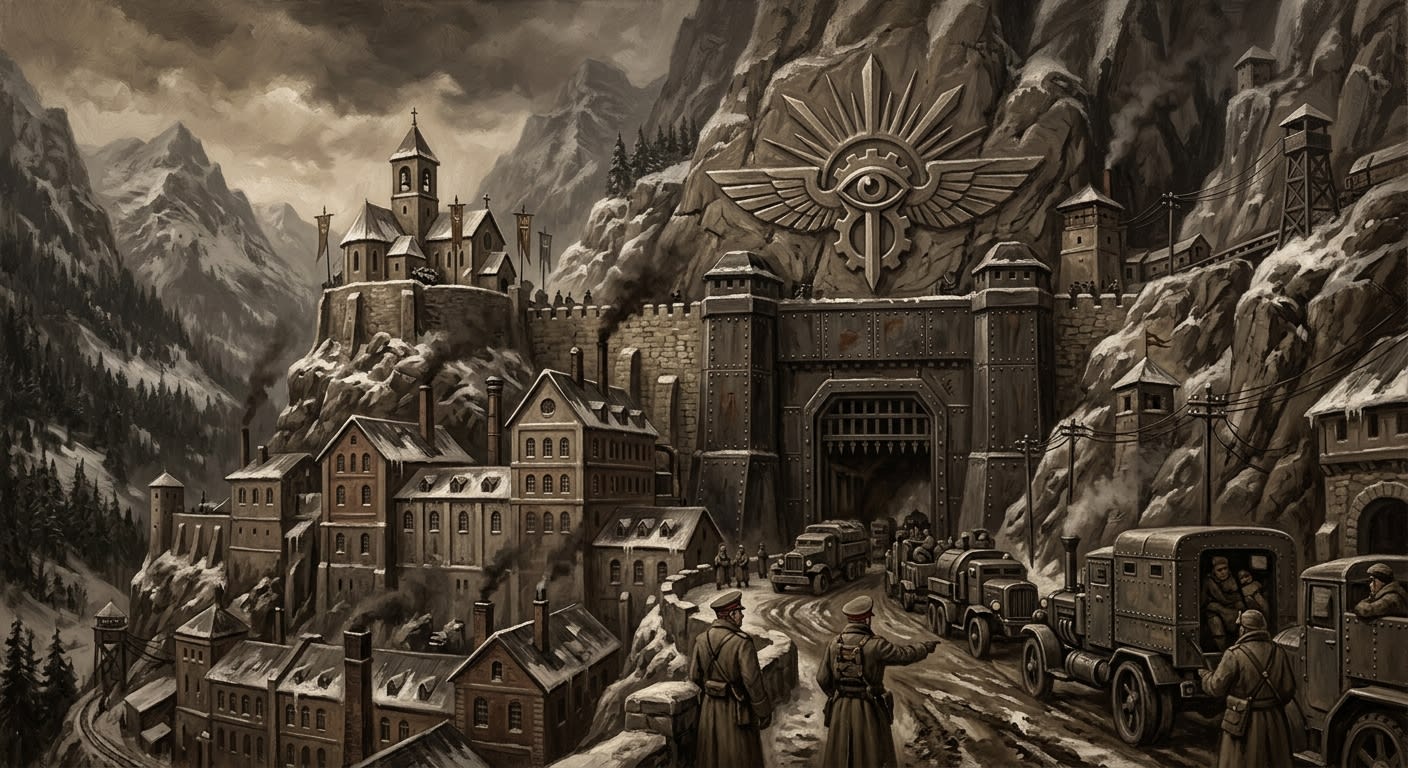
The Carpathian Gates are the mountain hinge by which the middle war closes upon the east: a grinding system of passes, ridgelines, checkpoints, reliquary roads, snow gullies, wire-throats, ossuary shrines, signal huts, mule scars, and fortified errors between Bastion-Przemyśl and the wider Carpathian spine. Older catechisms used the name loosely enough to include half a war and most of its propaganda. The current Bureau usage is tighter, which is to say less poetic, more lethal, and easier to invoice.
They are not a single gate. No one who has crossed them believes in such mercy. They are a series of stone decisions made by terrain and ratified afterward by men with stamps: northern saddles below Przemyśl, the old reliquary switchbacks, the Harrowglass approach, the high mule cuts, the snow galleries, the pass-forts whose names change whenever too many widows learn them, and the road-locks through which the Sagittal Line feeds its middle teeth.
Before the Sundering, salt, cattle, iron, timber, wool, smugglers, bridal parties, tax runners, and monks with too much confidence passed through these heights. After A.S. 45, the same roads carried refugees, relic crates, cannon wheels, fevered children, frozen chaplains, and officers discovering that a mountain does not salute because a captain has shouted at it. By A.S. 65, when the Line hardened from retreat into refusal, the Gates had become military anatomy. A pass became a lock. A lock became a shrine. A shrine became a checkpoint. A checkpoint became a village with a gallows, because administration hates unfinished forms.
#On the Making of the Gates
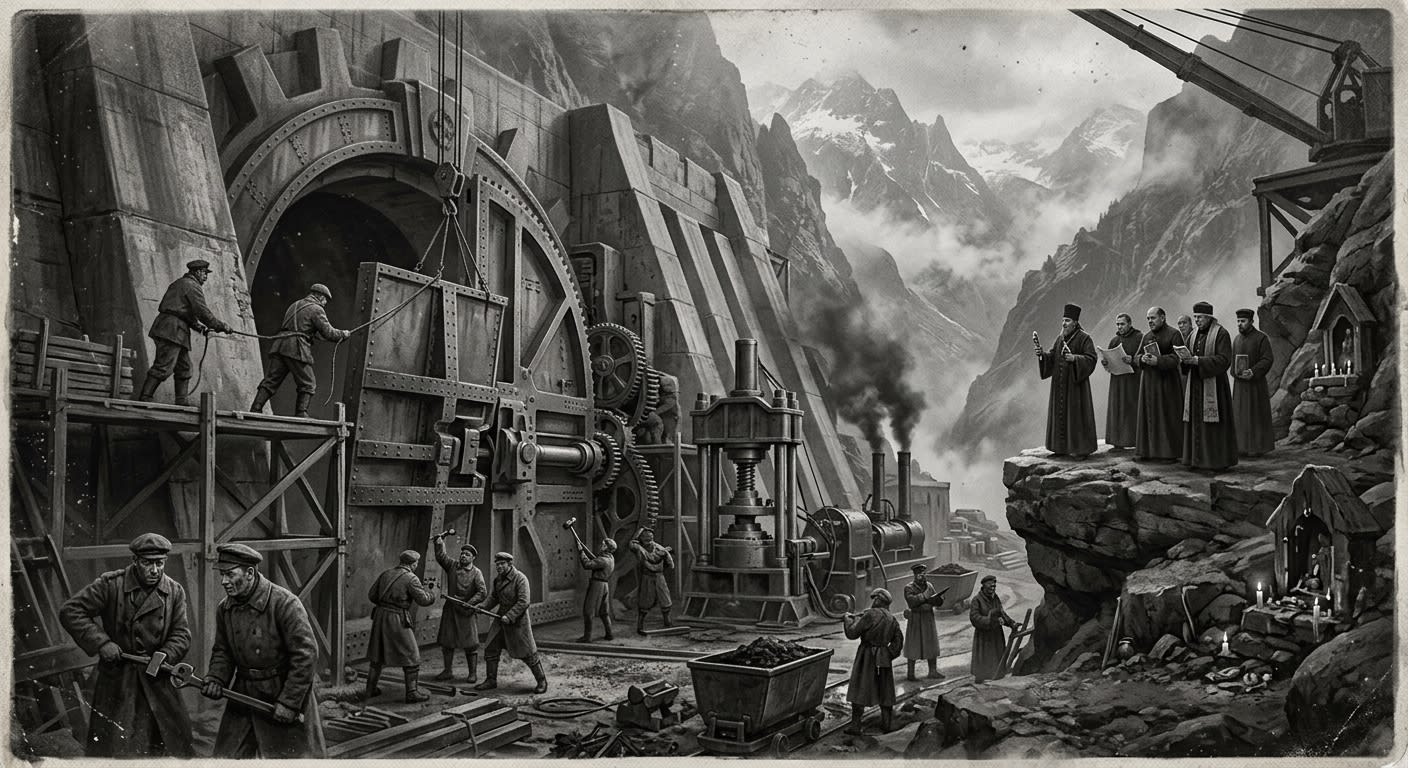
The first fortified closures were improvised by hungry men who did not know they were founding doctrine. Retreat had run west for twenty years after the Sundering. Somewhere among those ridges, retreat became physically stupid. Wagons could not descend fast enough. Bells could not be hauled farther without breaking their frames. Refugees were dying in the road, and a dead refugee blocks traffic as surely as a hero.
So they stopped.
The early Gates were timber beams across old trade roads, shrine stones dragged into gullies, cannon pointed from goat ledges, grave slabs mortared into breastworks, and oath-lines scratched into snow with bayonets after the Sundering made every eastern road a receipt for terror. The Bureau later described this as planned defensive continuity. One admires the Bureau's capacity to arrive after frostbite and claim the architecture.
Early provincial primers describe the Carpathian Gates as “raised in a single campaign by unified Synodal design.”
Corrected. The Gates accreted through stoppage, panic, labour, local bargain, dead mule, and after-action vanity. Unified design arrived when enough desperate improvisations required a department.
A.S. 67 brought surveyors to Przemyśl and gave the northern approaches a centre of gravity. A.S. 72 brought the convoy loss that still poisons the high saddles: eleven wagons, three hundred mules, grain enough for a garrison week, every seal unbroken, every living man missing, the mules later found standing in a circle as if awaiting instruction from a god of poor logistics. By A.S. 74, signal works had begun. By A.S. 75, Przemyśl's wire had teeth enough to change how the Gates breathed.
The Arch of Saint Harrowglass consolidated during the A.S. 68 line works and became the Gates' most famous mouth, though fame in this theatre is usually a polite term for repeated fatality. The authorised saint arrived in story before he arrived in bone, or in bone before story; Doctrine has approved both sequences in different pamphlets, which proves only that pamphlets should not be left unsupervised near saints.
By the Concordat years the Gates had ceased being emergency works and become an organism of passage. War counted men. Pilgrimage counted relics. Purity counted taint. Records counted names. Tithes counted what every other office forgot to hide. The mountain counted bodies and kept the most interesting ones.
#On Harrowglass Arch and the Hollow Ring
Every column entering the Gates must pass beneath the Arch of Saint Harrowglass unless it uses a hidden route, a weather route, a smugglers' route, a goat route, a road denied by Records, or an emergency military exception filed after the fact. Officially, all columns pass beneath the Arch. Officially, all rain falls where barrels wait.
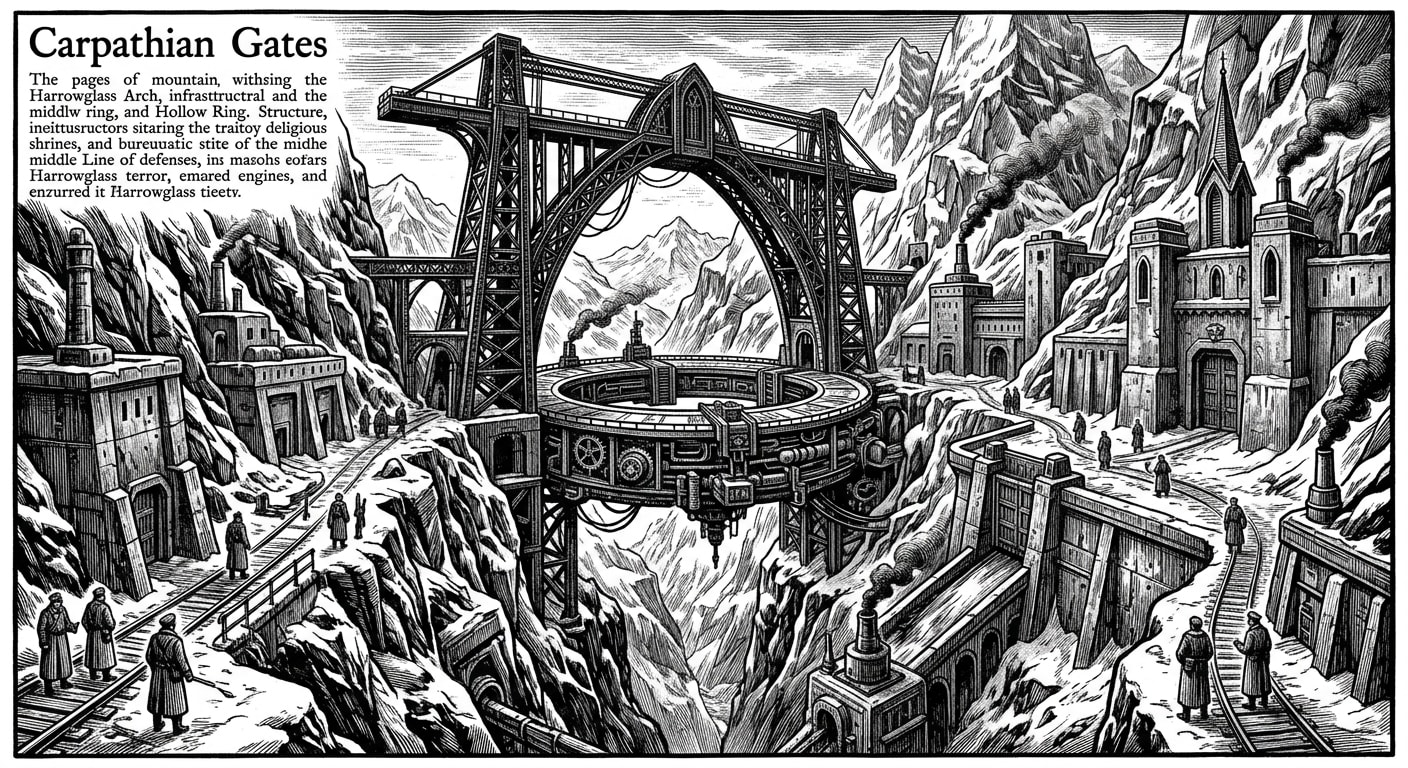
The Arch is ossuary checkpoint, shrine, juridical mouth, cowardice engine, relic-freight screen, and local theatre. Its skullwork is arranged by provenance. Its shrine-glass clouds when false cargo passes. Its chains sweat reddish salt near certain reliquary crates. Its hollow ring sounds under suspected cowardice, suspected taint, suspected desertion, and occasionally turnips. It has accused turnips twice. The turnips were burned. The file remains open.
The approved tale of Harrowglass makes him a Martyr of Ulm attached to the Year Without Dawn relic convoys in A.S. 32, a white-eyed penitent who reached the Gates with cut hands and heard cowardice beneath a levy captain's ribs. The captain confessed and froze. Harrowglass died smiling into broken shrine-glass after seeing the Line hold. His bones were fused into the Arch, and since that pious masonry the span rings hollow when cowardice passes beneath.
The useful tale is simpler. Men fear the Arch, and fear makes them confess before they run.
The Massacre beneath the span (Unregistered) fixed the Arch beyond correction. A levy company halted for bell-count and froze upright by dawn, blackened, hands locked as if prayer had become rigor. The public pamphlets teach zeal. The restricted folios teach caution. The soldiers teach recruits to keep moving if the glass shows a warm room full of mothers.
RESTRICTED GATE FOLIO — HARROWGLASS SPAN Last witness outside the central curve reported that the company turned upward together. Shrine-glass displayed domestic interiors inconsistent with known origin villages. Three faces visible in pane matched mothers of men not assigned to the company. Disposition of witness: █████████████. Instruction: maintain motion; do not interpret comfort.
#On Snow-Voices and Stained Weather
The Gates conduct weather badly. Red snow falls in winters when the eastern air arrives with the manners of a butcher. It cakes rifle barrels, blackens bread, and leaves script-like marks on exposed skin that vanish when copied. The Stained Blizzard (Unregistered) over the old Gate sector blinded half a garrison in older accounts, and though the year in some inherited lore wanders beyond current calendar discipline, the phenomenon remains current enough that doctors keep soot-spoons in the infirmaries.
Snow-voices (Unregistered) are worse. Wind moving through the high cuts carries syllables, confessions, orders, and the beloved dead calling from just beyond the rope line. Confessor Voislav, later styled the Warden of Snow-Voices by men with a talent for making disaster sound like appointment, claimed he could hear heresy in the howling. His reports condemned more than two hundred comrades for snow-borne whispering. Later his ears were found nailed into Gate-stone, still twitching when blizzards rose.
Training broadsheets once praised Voislav as “a model of interpretive vigilance.”
Withdrawn. Interpretive vigilance is admirable until it requires carpentry upon the auditor's head. The current lesson is restraint, by which the Bureau means: condemn fewer men per snowfall unless corroborating ice is present.
Mirror-men (Unregistered) appear during whiteout: figures marching in approved cadence until a blink reveals one's own face where a face should not be, eyeless and smiling. Shells fired eastward sometimes vanish and reappear in western masonry months later with their fuses still sulking. Bells hang from pines bearing village names not yet filed. Patrols find footprints that begin at cliff edges and proceed upward along vertical stone. The Gates are a school of events that teach Records humility; Records has not attended.
The Bureau of Bells has classified portions of the Gates as acoustically contaminated during storms. The Bureau of Purity has classified them as morally suggestive during thaw. War has classified them as passable whenever the supply shortage becomes embarrassing. All three classifications are true at least twice a year.
#On the Roads Through the Teeth
The Carpathian Gates are fed by the Carpathian Corridor, that long throat from Budapest west-bank yards and Bratislava approaches through Turda (Unregistered) and toward Przemyśl and Sibiu. At the Gates, the Corridor stops pretending to be a road and becomes a sequence of jaws.
The first jaw is distance. The second is gradient. The third is paper. A convoy may climb six miles in a day and lose two days at a permit desk beneath a shrine whose saint never existed but whose toll is impeccably documented. Mules balk at red snow. Wheels shatter on frozen shale. Bell-credit expires while the clerk asks whether the axle was blessed before or after the crack. A cargo of flour may enter clean and arrive tasting of candle smoke, mule fear, and the small legal damp that attaches to all food handled by Tithes.
The Reliquary Switchbacks deserve their foul little fame. Widened from an old shepherd's path in A.S. 74, shrined after avalanche, tolled by every office with enough nerve to install a nail, they carry relic freight through turns so tight that artillery wheels have to be prayed around corners. Each turn has a name, a femur marker, a local fee, and a ghost assigned by custom if not by Records. The Bureau of War calls them waypoints. Pilgrimage calls them devotional stations. Tithes calls them revenue opportunities, which is the most honest theology of the three.
The Gates consume labour in small, pious bites. Road crews widen ledges by lantern. Convicts chip ice from culverts while priests recite names over men not yet dead. Trackmen listen for fractures under rails. Bell-runners climb signal stairs with thighs like rope and faces like court exhibits. Women from pass villages sell hot broth, boot leather, smuggled icons, and reliable lies about which turn is safe in fog.
#On Enemy Pressure in the Heights
Atheron presses the Gates from the eastern highlands through altitude, pride, reflected command, and the architecture of looking down. His influence does not always arrive as an army. Sometimes it arrives as posture. A lieutenant begins using royal grammar. A clerk corrects his superior in public and enjoys it. A village headman adds a little tower to his house, then another, then declares toll immunity because his roof has exceeded the chapel cross. Pride climbs easily in mountains. Downhill work is for humility.
The Ebon Heights beyond Przemyśl teach the Gates a permanent upward anxiety. Crownguard Titans are seen on far ridges during clear dawns, motionless as statues until artillery shifts toward them, at which point they are suddenly elsewhere and the gunners are arguing about rank. Mirror-Lords prefer frozen puddles, polished buckles, officer sabres, shrine-glass, and any eye vain enough to meet itself twice.
Velmora's pressure is softer and more effective in the southern approaches: warm coin in cold passes, bribed mule lines, false salvage rights, storehouse keys that return to the hand after being thrown into ravines. Syrion's fog drifts into saddles from the south on bad seasons, making convoys late and then persuading them lateness is rest. Maldrake's ash travels as memory and grit. Kargath's famine arrives in spoiled sacks, rot-ox rumours, and bread that moulds into little mouths before dawn.
The Gates answer all this with old measures: wire, bells, confession, checkpoint heat, saint bones, and men too cold to be imaginative. This is a strength. Imagination in the Carpathian Gates is usually how the enemy enters.
#On the Present Holding
As of A.S. 201, the Carpathian Gates remain held. That word carries the full theological beauty of a cracked cup under a leaking roof. Held means columns pass. Held means the Arch still rings. Held means red snow warnings are posted before men ignore them. Held means the switchbacks have not collapsed this week, or have collapsed in a manner compatible with revised traffic. Held means the enemy has not walked through in triumph, though many smaller things have walked through in disguise.
The eastern revetment of Harrowglass Arch is cracked. The Third Light reports answering fog more often than weather permits. Two pass-forts have requested replacement bells and received pamphlets on sonic thrift. A missing patrol returned after eleven days with its boots unworn and its officers refusing nouns. The Wire Orchard hums lower during storm pressure. Refugee columns from the mountain villages carry stories of hollow churches where bells ring inward. Purity has opened inquiries. War has requested shovels. Records has corrected the spelling of one vanished hamlet and called this progress.
At night, the Gates sound less like a fortress than a throat full of iron. Chains scrape. Bells answer late. Snow taps at shutters like a clerk requesting entry after hours. Under the Arch, skulls click softly in the cold, and the shrine-glass clouds with shapes nobody is licensed to love.