
#On the Survey and the Misalignment
This is a survey, made in A.S. 201 under my hand, of what the Cadence Reforms A.S. 95 file preserves concerning the Kelen Chain-Yard Misalignment. It does not reopen the inquiry. The file lists three recorded desynchronisations among the failures that forced the Reforms, and Kelen is the third. Its year is not established. A.S. 95 dates the Reforms and indexes the file. The clerks who assembled that file wrote the reform year on the cover and left later readers to guess the rest, and guessing readers are how the Ledger catches fevers. This survey gives the incident no year.
The title also needs a warning. "Chain-Yard" is the filing clerk's word. The file describes no yard, no chainworks, no quay, no settlement and no coordinates. A pilgrim who searches the Danube corridor for Kelen will find only his own credulity, at the usual price. What the file does describe is a shrine-barge, a battery, a choir and a seam. That makes Kelen an event, and it is filed here as one.
#On the Separate Measures
Before the Reforms, an early shrine-barge carried guns, hymn-screens, powder sanctums and a choir, and no single authority was empowered to make them work as one machine. The gun captain fired when his sight-line, his smoke gap or his temper told him to. The choir sang at procession tempo, which suits a feast-day embarkation and was never written for artillery. The Bureau of Engineering asked everyone to wait for recoil settlement. War officers shouted over all three. Each party kept its own measure, and the deck had to absorb the difference.
The mechanics are simple enough for a gunner. A discharging gun drives its weight back into its carriage. The carriage drives that weight into its trunnions and braces, and the braces pass it into the deck. A barge has no bedrock under it, only timber, iron and water. When a battery fires on one shared measure, the recoil arrives as a load the rigs were built to receive and the deck has time to settle before the next blow. When guns fire on separate impulses, each one strikes a deck that is still moving from the last, and the timbers have to absorb the whole confusion.
The mature drill of the Shrine-Deck Crew runs in this order: prepare the wards, tune the cadence, load by hymn measure, fire on the sanctioned toll, log the shot, clear the residue. I give it here only so the failure can be understood. It is later, settled practice. Nobody should imagine it pinned to a bulkhead aboard the Kelen barge, waiting to be ignored.
#On the Split Seam
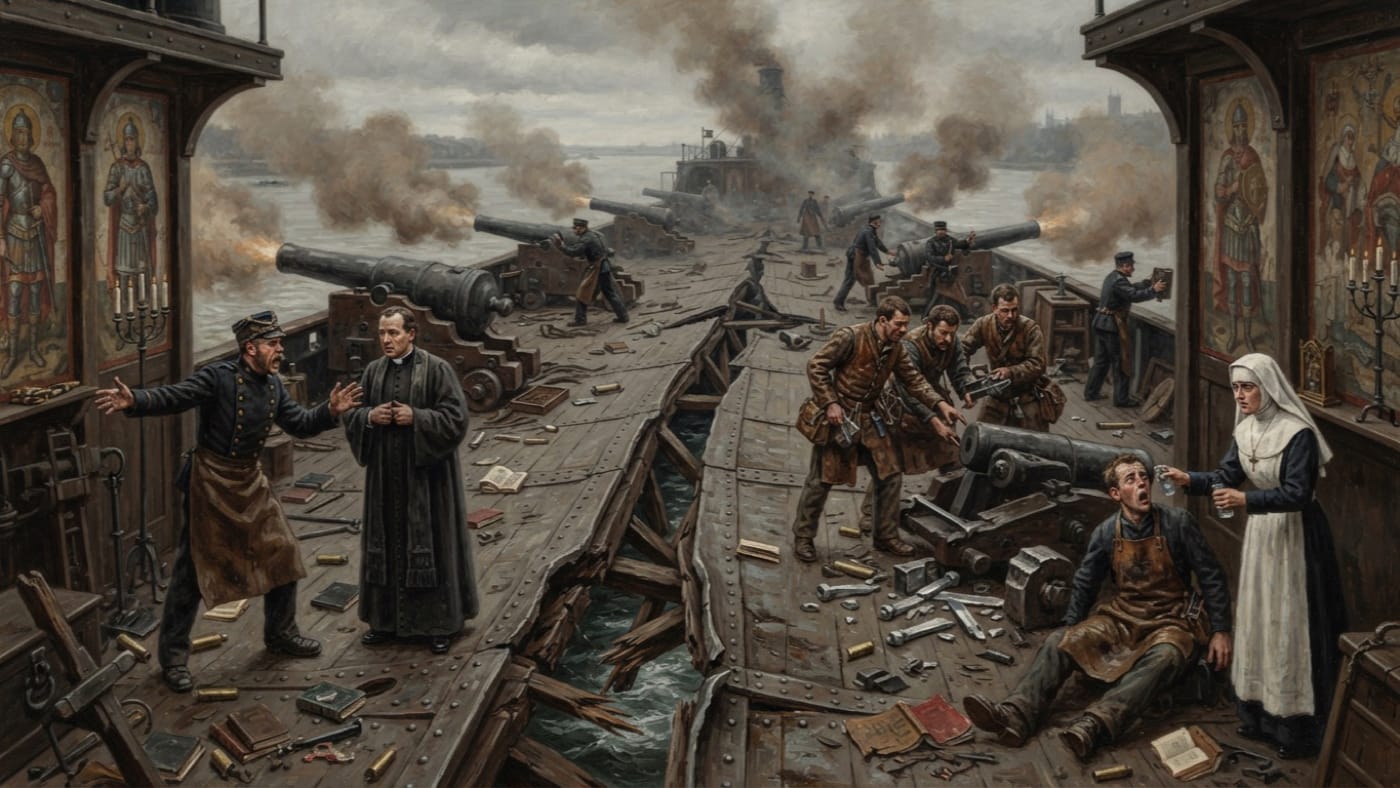
Six guns fired against the choir beat, and the shrine-barge's central deck seam split. That is the whole incident as the file keeps it.
Pious readers want more, and cheap chroniclers will happily supply it. The file does not say whether the six fired together or one after another, how many volleys there were, or what they were firing at. Six is the number of guns that fired out of measure. It does not tell us how many guns the barge carried. A split seam is the damage the file records, and it is the only damage this survey will repeat. The file records no sinking, no explosion and no burning gallery, so this survey records none either. The other two desynchronisations in the reform file have their own damage and their own sufferers, and they keep them. Neither belongs to Kelen.
The Reforms file is explicit on one more point: no demon touched that deck. Men did. A demonic cause would at least have let the battery claim it had been afflicted. The file records only gunners firing out of measure.
#On the Corrected Attribution
The first answer came from War, and it blamed the water.
Earlier War summaries attributed the Kelen Chain-Yard Misalignment to "hostile river turbulence."
Corrected after Engineering produced recoil tables, broken trunnion bolts, and the testimony of a surviving Powder Acolyte who kept repeating, "They fired against the bell."
Each piece of Engineering's evidence did its own work. The recoil tables set out what a discharge does to a barge's bracing, and the damage matched them. The broken trunnion bolts showed where the load had gone, through the mountings and into the timber, and no current runs through a trunnion. The Powder Acolyte gave the cause in five words, and he did not vary them. He was a surviving witness. The file does not call him the only one, and neither do I. His name, rank beyond his office, injuries and later life are absent, and this survey adds none of them.
The Bureau of Mercy sedated him. The file records that and gives no reason. Mercy keeps records along with its bandages, and here it kept the fact of the sedation and nothing else. In my account of the Reforms I said the sedation was done for administrative convenience. That is my commentary and I stand by it. It does not quote any Mercy order, and I have found no Mercy order to quote. A man repeating an inconvenient sentence on a damaged deck needed rest. The deck needed him to stop talking. Both needs were met with one dose.
War withdrew the turbulence account once the tables, the bolts and the acolyte's sentence all agreed. The parent file records the correction. It does not record any apology, and it would be strange if it did.
#On the Bell's Authority
The Reforms invented neither bells nor choirs. Both were already aboard before A.S. 95, ringing and singing with no authority at all. The Reforms changed who held power. They gave the choir's metronome bell legal control of battery discharge, so that the measure keeping the hymn also became the measure keeping the guns.
War asked Engineering for an answer to the failures, and Engineering supplied recoil intervals, brace standards and a memorandum describing human obedience as the defective component. War disliked how accurate this was. The Bureau of Orison supplied a remedy War could accept: make the hymn the law of fire. A gunner may ignore a mechanic. He may ignore a singer. It is much harder to ignore a singer whose measure has become jurisdiction.
The hierarchy that followed divides two powers that the Kelen battery had treated as one: whether to fire, and when. The Ordnance Deacon holds seal authority over whether a volley may happen at all. The Cadence Caller governs timing during the hymn sequence. The Battery Steward commands the crews, and only within that measure. A volley needs both the seal and the toll. Each shell is loaded by measure, so recoil arrives on a beat the rigs can expect and the deck can settle between blows. Six guns firing against the choir beat is exactly what this arrangement makes unlawful.
After A.S. 95, an off-measure discharge counted as liturgical disobedience. Before then, an early or late shot was poor drill, panic or confusion, depending on who wrote the report. The Kelen gunners fired under the earlier condition, whenever that was. They are unnamed, their year is unknown, and this survey does not convict them under a statute that came later. The Synod has a well-documented taste for retroactive law. My own taste stops at men I cannot name.
#On the File's Present Use
The Kelen entry is still in the reform file because it is easy to teach. It has no mutineers, no heroine and no demon. It has six guns, one seam and a river that was wrongly blamed. A crew instructor can explain it before the tea goes cold. Auditors still begin their deck interviews by asking what a man heard at a given toll. That question comes from the settled practice of A.S. 95, and Kelen's acolyte had answered it before anyone thought to ask.
The later inheritance belongs to other folios. The Pilgrim's Ladder Commission of A.S. 110 and the mature Processional Arsenal took cadence law as given and built on it. The Reforms file lists Kelen among the failures that made that law necessary, and this survey leaves it there with its seam, its bolts and its unnamed witness, and without a date. Engineering has not asked for the bolts back. Mercy has not explained the sedation, and nobody has asked it to.