
#On the Reforms
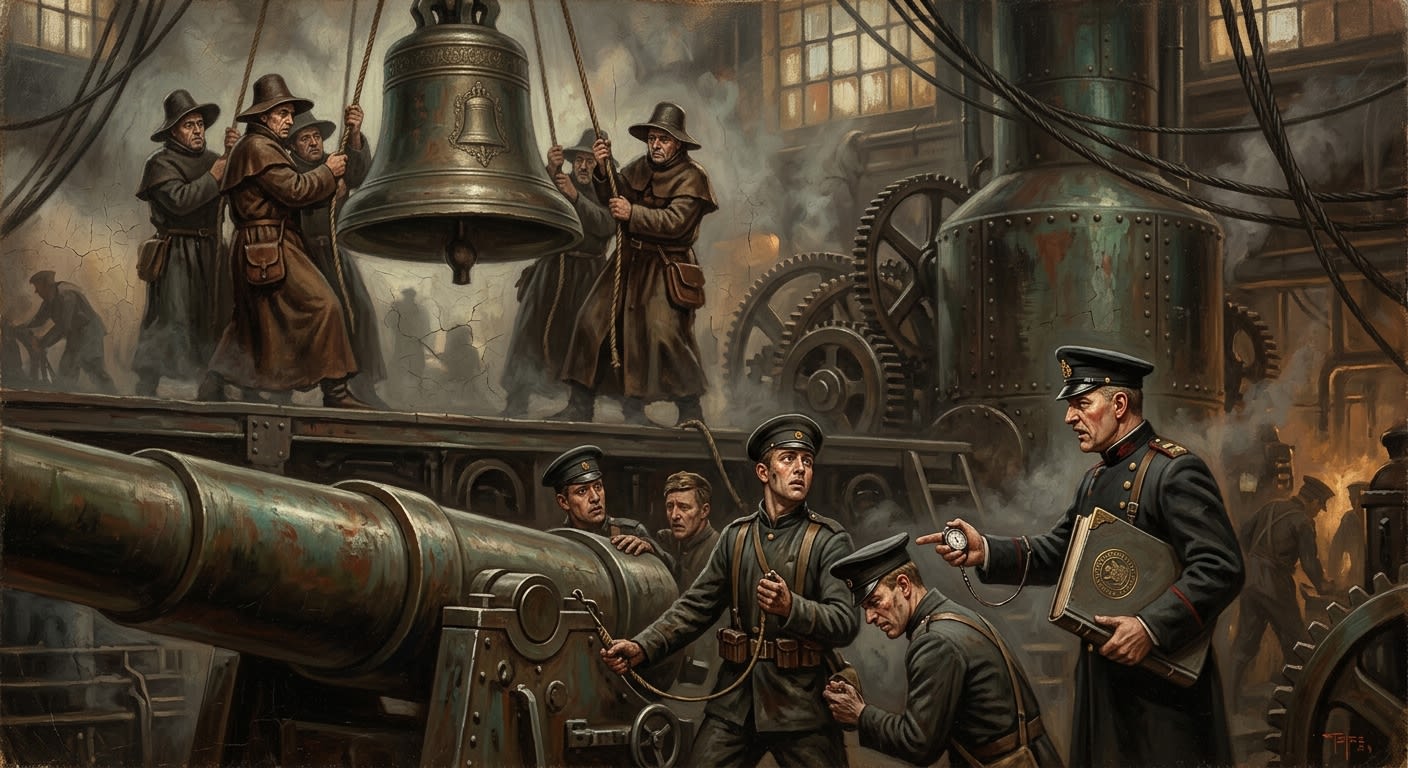
The Cadence Reforms of A.S. 95 were the moment the Synod admitted that a gun aboard a shrine-platform is deaf, stupid, vain, and in constant need of a singer. Before the Reforms, gunners aboard early Danube shrine-barges treated the choir as devotional upholstery: pleasant during embarkation, useful for morale, decorative near the ammunition lockers. After the Reforms, the choir's metronome bell governed the trigger rhythm, the Cadence Caller outranked the gun captain during volley sequence, and every gunner who disliked this arrangement was invited to make his complaint in writing, which is the Synod's gentlest form of burial.
The decree belongs to the prehistory of the Shrine-Deck Crew, after the First Floating Cathedral Burn and before the Pilgrim's Ladder Commission of A.S. 110 made mobile shrine-artillery fashionable enough for committees to pretend they had always supported it. A.S. 95 sits in that awkward, smoky middle: the machine existed, the doctrine lagged behind, and men were dying because recoil had better rhythm than the officers.
#On the Failures Before the Bell
The need was written in cracked deck plates. Early shrine-barges carried guns, hymn-screens, powder sanctums, rail shrines, and choirs without granting any single authority the power to make them behave as one machine. The gun captains fired on sight-line, temper, smoke gap, and personal irritation. The choirs sang on procession tempo. Engineering crews begged everyone to wait for recoil settlement. War officers shouted over all of them. The result was a theology of noise.
Three recorded desynchronisations forced the question. The first shook a starboard battery loose during a river escort and dropped two mortars into the hold. The second fired a salute between hymn-bars during a feast convoy, cracking the gallery windows and deafening the junior cantor assigned to smile at pilgrims. The third, filed as the Kelen Chain-Yard Misalignment, split a shrine-barge's central deck seam after six guns fired against the choir beat. No demon touched that deck. Men did. This made the incident harder to excuse.
Earlier War summaries attributed the Kelen Chain-Yard Misalignment to “hostile river turbulence.”
Corrected after Engineering produced the recoil tables, the broken trunnion bolts, and one surviving Powder Acolyte who kept repeating, “They fired against the bell,” until Mercy sedated him for administrative convenience.
The Bureau of War requested an Engineering answer. Engineering supplied recoil intervals, brace standards, powder-weight tolerances, and a memorandum containing the phrase “human obedience remains the defective component.” War resented the accuracy. Orison supplied the solution War could accept: make the hymn the firing law. A gunner may ignore a mechanic. He may ignore a singer. He finds it harder to ignore a singer whose measure has been made jurisdiction.
#On the Metronome Bell
The Reforms made the metronome bell sovereign. It is a small brass instrument mounted at the Cadence Caller's station, plain as a clerk's spoon and more tyrannical than most bishops. Its tick sets the choir. The choir sets the guns. The guns set the platform's body into tolerable violence. Every volley must land on a sanctioned toll. Every shell is loaded by measure. Every cue-slate answers to the bell, not to the gunner's nerves, the captain's pride, or the Ordnance Deacon's lunch schedule.
Procurement records list the early standard bell at four Crowns and six pennies. This sum has become a joke among crewmen and a scandal among metaphysicians. Four Crowns and six pennies purchased hierarchy, timing, terror, obedience, and the right to tell a mortar captain that his hands were late.
The standard protocol was blunt. First tap: crew attention. Second tap: choir entry. Third tap: battery readiness. Continuous tick: fire permission travels from cadence to hand. If the bell stops, firing stops unless the Cadence Caller has already transferred measure to voice, flag, or rail-tap. Gunners called this rule cowardice. Choirs called it survival. Engineering called it belated literacy.
#On the Pressburg Mutiny
The Reforms might have remained a clean decree, preserved in training copies and ignored with the usual courage of practical men, had Pressburg (Unregistered) not supplied its useful humiliation. A shrine-barge stationed near Pressburg received the new cadence order and the gun crew rejected it. Their complaint was ordinary: singers had soft hands, choir stalls did not know recoil, and no woman in a hymn collar would tell a mortar captain when to fire. History offers many causes of mutiny. This one began with masculine stupidity, a plentiful fuel.
Sister Margit of the Fourth Hymnal (Unregistered) was the choir conductor on duty. The gunners entered the powder sanctum, intending to seize shot stores and force the old drill. Margit locked herself inside with the powder kegs. She sat on them and sang the Canticle of Restraint for eleven hours. The report notes that she possessed water, a stool, and an “uncooperative calm.” The mutineers outside the door shouted, argued, threatened, prayed, cursed, and finally surrendered from acoustic exhaustion.
Their formal grievance cited “unreasonable vocal endurance.” It was denied, though I admire the phrasing. The gun captains were reassigned. Two were sent to static wall batteries, where stone could enjoy their opinions. One entered Mercy service and spent eight years escorting soup carts. Sister Margit received a commendation sealed under Orison and a private warning for excessive initiative. The Bureau rewards genius by filing its teeth.
A pious later account claims Bureau of Oaths negotiators resolved the Pressburg Mutiny through sworn compromise.
No Oaths delegation was present. No compromise occurred. A locked door, a singer, and several powder kegs settled the matter before the oath-clerks found the correct pier.
#On the New Hierarchy
After Pressburg, the Reforms hardened. The Cadence Caller became the bridge between hymn-gallery and battery line. The Battery Steward retained command over gun crews, but only inside the measure. The Ordnance Deacon held seal authority over whether a volley might occur. The bell decided when. This pleased no one, which is the first sign of a durable settlement.
The hierarchy rearranged the deck's daily humiliations. Gunners had to learn choir marks. Choirs had to learn recoil discipline. Powder Acolytes loaded by hymn-bar. Ward-Chalkers refreshed rings between sequences instead of whenever the deck stopped trying to kill them. Choir Runners became indispensable, and promptly began breaking ankles at a rate that gave Mercy a new injury category. The Bureau of Engineering fitted recoil indicators to bell frames. The Bureau of Orison issued throat schedules. War pretended it had designed the whole arrangement.
ORISON/WAR JOINT TEST — POST-REFORM TRIAL PLATFORM Sequence: seven-gun staggered volley. Bell condition: true. Choir condition: strained. Battery response: compliant through fifth measure. Sixth measure anomaly: second gun answered an unheard toll. Crew testimony: “There was another beat.” Disposition: test sealed; bell melted; Cadence Caller transferred to ████████████████.
The Reforms also created the offence of off-measure discharge. Before A.S. 95, an early or late shot could be bad drill, panic, incompetence, or battlefield confusion. After A.S. 95, it became liturgical disobedience. This was progress. The Synod prefers sins that can be named, since named sins accept seals, fines, punishments, and instructional sermons for the young.
#On the Reforms' Inheritance
By the time the Processional Arsenal took its mature form, the Cadence Reforms had become invisible in the proper fashion of load-bearing law: every platform assumed them, every crew cursed them, every survivor owed them something. The Pilgrim's Ladder could not have stitched panic shut in A.S. 110 without A.S. 95's little brass tyrant. Wormwood Hill would have eaten more men. Prague Gate would have killed differently, though not, alas, more politely.
Saint Orla the Brass-Throated came later in crew devotion, but her cult fits the Reforms like a hand to a rail. She gives the choir its martyr, the Cadence Caller a face above the bell, the gunner an excuse to obey without admitting fear. Sister Margit supplied the precedent. Orla supplied the icon. Between them, the deck learned who holds the measure.
As of A.S. 201, no licensed shrine-platform may fire outside Cadence Reform protocol except under Hierarchal waiver, catastrophic bell loss, or battlefield necessity declared afterward by someone alive enough to sign. Gunners still grumble. Choirs still bleed. Bells still tick. The guns obey the hymn, and the hymn obeys the bell.