
#On the Machine That Learned to Pray Upward
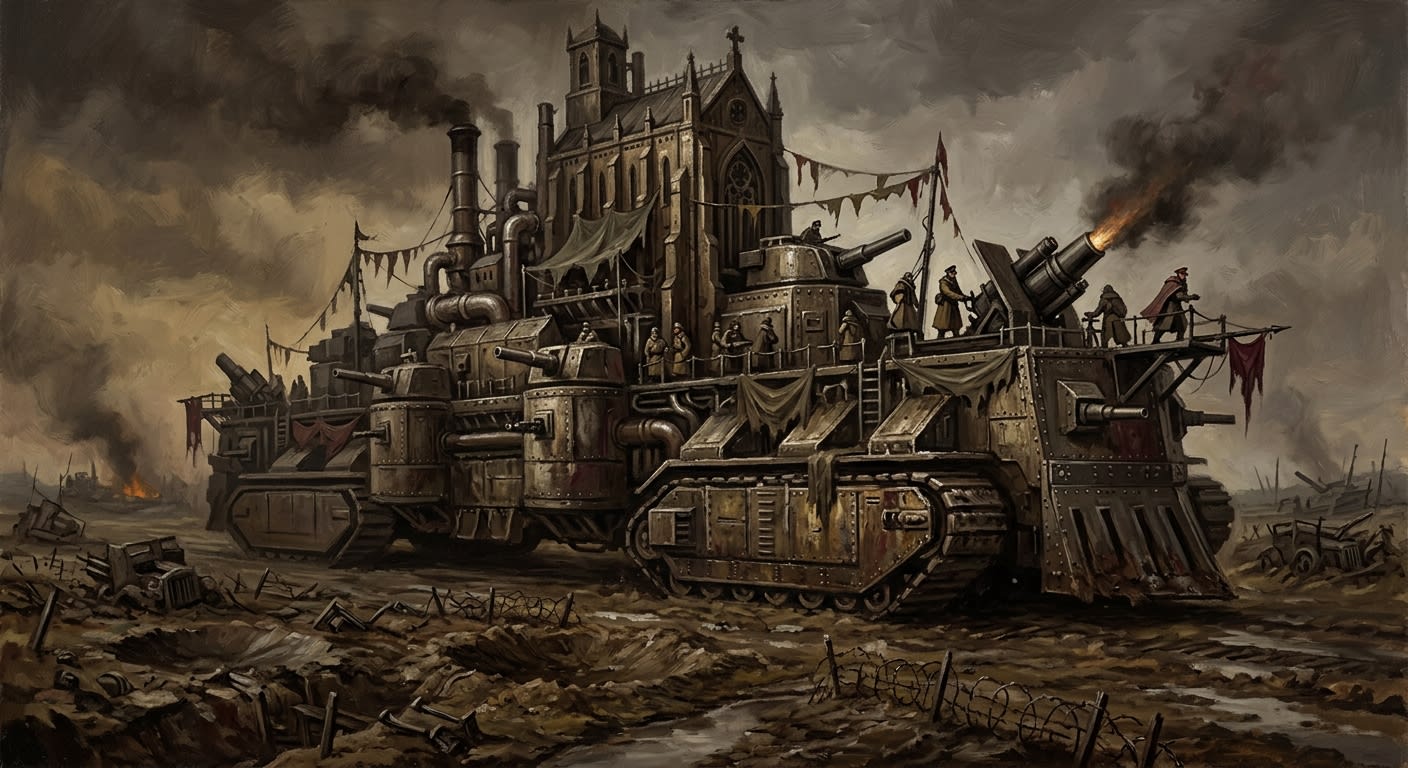
The Pilgrim's Ladder is the prototype diesel land-ship from which the Synod derived the modern Processional Arsenal: a tracked shrine, an artillery stair, a choir-engine, and a political sermon with mortars for punctuation. It was commissioned into doctrinal usefulness in A.S. 110, after the early shrine-platform experiments had already taught the Bureau of War that static guns defend walls while mobile guns defend excuses.
The Ladder rises from prow to stern in stepped gun terraces. Each tier carries a battery-chapel. Each battery-chapel carries mortars, hymn-screens, brass rails, candle niches, relic pins, soot gutters, vox-pipes, and enough small shrines to make a provincial abbey feel underfurnished. Assault companies climb its spine under fire as if ascending a processional stair. The name is literal enough for soldiers, pretty enough for sermon writers, and false enough for Doctrine. No man climbs the Ladder toward Heaven. He climbs toward recoil.
The Bureau classifies the Ladder as a sanctioned Choir-Engine. This means that War owns its targets, Engineering owns its motion, Orison owns its timing, Tithes owns its hunger, Doctrine owns its meaning, and nobody owns the noise after the first salvo. A vulgar army builds a vehicle and bolts guns to it. The Synod builds a moving chapel, orders a choir to discipline the guns, gives the vehicle a pilgrim tail, and then acts surprised when the thing develops opinions.
#On the Commission of A.S. 110
The Pilgrim's Ladder Commission followed two earlier embarrassments that the Bureau, with its usual tenderness toward truth when truth is tied to a chair, now calls preparatory lessons. The First Floating Cathedral Burn in the early A.S. 70s gave shrine-platform crews their shot-ledgers, because forty-one dead men and hymnals scattered over three kilometres of Danube bank persuaded War that powder labelled “supplementary prayer supplies” was a poor storage doctrine. The Cadence Reforms of A.S. 95 gave choir conductors operational authority over gunners after recoil desynchronisations shook shrine-barges apart mid-volley and Sister Margit (Unregistered) sang the Pressburg mutineers (Unregistered) into surrender by the blunt technique of outlasting their resentment.
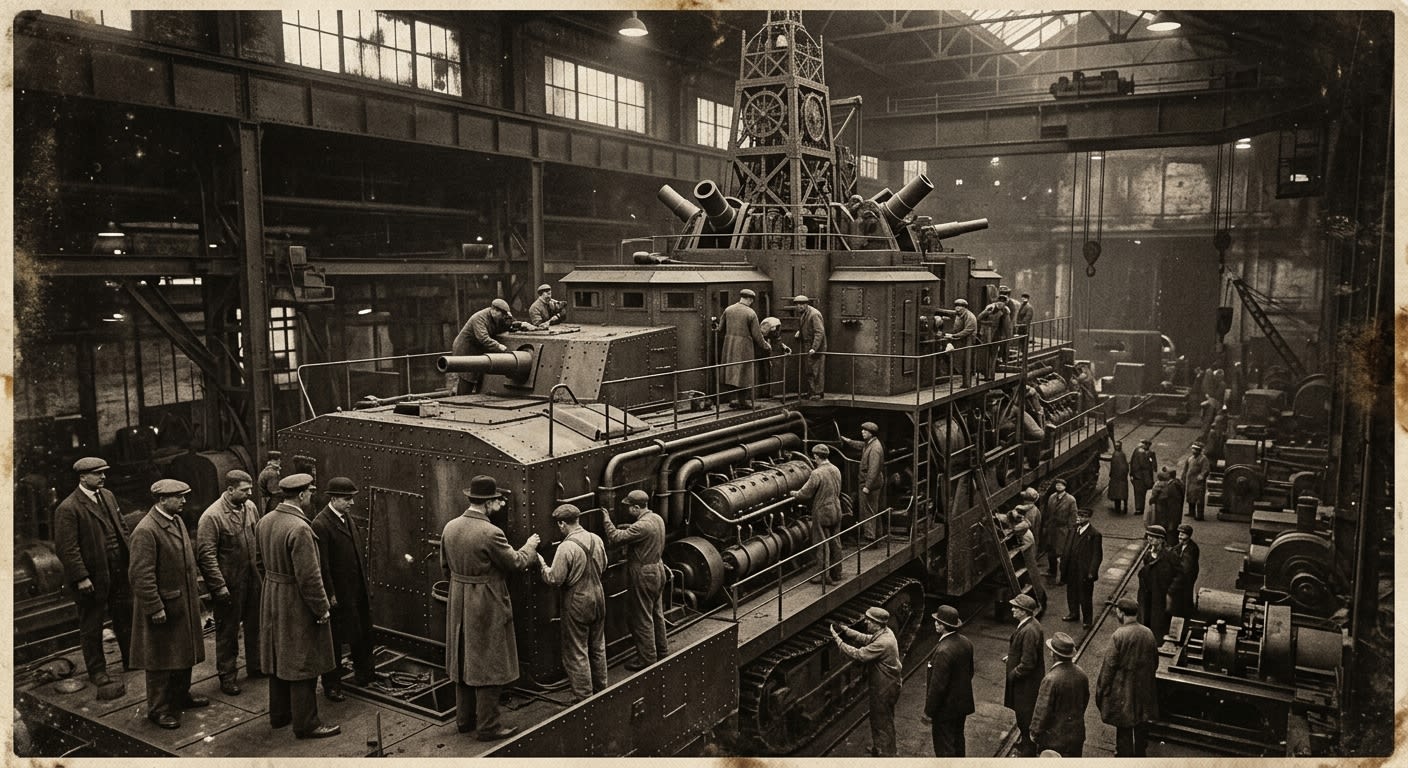
By A.S. 110, War wanted a machine that could move with pilgrims, intimidate towns, break trench surges, and display the Synod's protection in a form visible to illiterates, rebels, garrison wives, and foreign observers. Orison wanted a platform where hymn and recoil could be fused without asking every gun captain to develop taste. Engineering wanted a tracked frame large enough to carry artillery and small enough to cross repaired roads without requiring a new war against bridges. Doctrine wanted a symbol. Doctrine always wants a symbol. It eats them like sugared almonds.
Early Commission abstracts described the Ladder as a “pilgrim escort and defensive reassurance vehicle.”
Corrected after the third trial volley flattened the reviewing stand's wine tent. Approved internal term: coercive mobile shrine-platform. Public term remains reassurance.
The trial that made the Ladder famous was not an assault against the Enemy. It was a crowd-control exercise outside a supply shrine whose grain queues had gone sour. The machine advanced in first cadence. Choirs entered. Mortars fired beyond the crowd line. Panic, which had been spreading through the pilgrims like spilled lamp oil, stopped as if pinned to the road by brass. The report says the barrage “stitched shut” the crowd. I dislike the phrase because it is too elegant for what happened. Still, the crowd stopped moving. The Commission received approval before the dead were counted.
#On the Body and Its Appetites
The Ladder is built around a reinforced central spine carrying stepped firing decks, side chapels, lower pilgrim holds, powder sanctums, hymn galleries, engine pits, ward-chalk stores, and a rear reliquary cabin whose inventory changes whenever audits approach. Its treads are broad enough to chew poor roads into worse roads. Its prow bears a brass ascent rail polished by the hands of pilgrims who believed touching the machine would bring safety, which is adorable in the way hatchlings are adorable before the hawk arrives.
The main batteries are arranged by rung. Lower rungs carry crowd mortars and smoke-shell racks. Middle rungs carry trench mortars and cadence guns. Upper rungs carry sanctified shell tubes, signal bells, and the narrow hymn-vox mouths by which the Cadence Caller screams into the machine's nervous system. Relic pins secure the chalk rings around each gun position. Candle niches blacken within a week. Brass rails vibrate constantly. Men learn to sleep by counting recoil through their teeth.
The Ladder's hunger became legendary during a three-day action when it exhausted candle wax, chalk paste, throat oil, spare metronome clappers, clean water, two racks of fuse-cord, and clerical patience. The first manual called it self-sufficient. The second manual called it supply-intensive. Tithes corrected both to operationally hungry, because hunger can be costed, taxed, deferred, denied, and blamed on quartermasters.
#On the Bell, the Chalk, and the Men Who Serve Them
The Shrine-Deck Crew are the Ladder's true musculature. Deck-Rats clear brass and soot until their hands become a second uniform. Powder Acolytes cradle shells like infants with fuses. Ward-Chalkers renew rings after rain, blood, panic-sweat, and any boot too stupid to respect a firing arc. Choir Runners sprint cue-slates between hymn-gallery and battery stations across decking that moves like an accusation. Above them stand Battery Stewards, Cadence Callers, Recoil-Smiths, and the Ordnance Deacon, whose seal can turn a hymn into blast.
Two objects rule them all: the metronome bell and the shot-ledger.
The bell is small, brass, cheap, and sovereign. It cost four Crowns and six pennies in one procurement file, which proves either that miracles are economical or that Tithes missed an opportunity. Choirs sing to its tick. Guns fire to the choir. Recoil settles into measure or the deck goes hollow. Hollow is the crew word for the moment when the machine still fires but seems to be answered from beneath, behind, or inside the brass.
The shot-ledger receives every discharge: shell type, target class, hymn measure, authorising seal, choir condition, wind, Powder Acolyte name, and doctrinal purpose. Since the Ledger Reforms of A.S. 165, individual loaders are named after a Bastion-Irongate grapeshot incident made collective innocence too crowded for even War to stomach.
#On Wormwood Hill
The Ladder's most beloved battlefield account belongs to Wormwood Hill, where Velkaran perfume-fogs slid through a valley thick with panic and the machine began to fail in the unromantic manner of all machines: engines coughing, treads slipping, fuel pressure dropping, men swearing into sacred apparatus. The choirs did not fail. They held cadence over the diesel cough. Mortars fired by bell measure. The psalm-line cut through the fog long enough for the troops below to remember their names, their rifles, and which direction fear was supposed to face.
The hill was held by dusk. The Ladder burned out two engine housings, cracked six hymn-screens, lost a Cadence Caller to throat rupture, and returned west under tow like a reliquary cart dragged by very angry oxen. The crew received public praise, reduced pensions, and a feast-day allowance later cancelled by audit. Victory is expensive. Gratitude is discretionary.
Popular broadsheets show the Ladder ascending Wormwood Hill under clear banners and steady sunlight.
Correction: field copies record fog, gore, axle smoke, two jammed treads, and a choir singing through blood in the mouth. The banners were added by Heraldry after the fact, because courage without fabric unsettles schoolchildren.
#On Prague Gate
Prague Gate supplied the canonical disaster. A Silence Dome swallowed a shrine-platform identified in several files as a Pilgrim's Ladder pattern vessel and in crew speech as the Ladder itself, because men in terror have little patience for model distinctions. Hymn-vox coordination died. Cue-slates contradicted one another. The metronome bell continued, then did not, then was reported to have continued without sound. Mortars fired out of phase. Shells dropped into the lower holds, where pilgrims clutched relic-candles and waited for reassurance to finish killing them.
Purity called sabotage. Engineering called hymn-jam interference. War called it enemy action. Orison called it acoustic severance. Doctrine printed two explanations, suppressed three, and sealed the rest under Bureau of Silence File 88-K/Shrine. This was merciful. By merciful, I mean useful. The distinction is often sentimental.
BUREAU OF SILENCE — FILE 88-K/SHRINE, EXTRACTED LINEAGE COPY Third voice detected during sustained off-cadence discharge. Crew reports: humming between tolls preceded lower-hold detonations. Pilgrim witness fragments: “the machine answered itself”; “the bell was below us”; “our candles leaned toward the powder.” Disposition: operational language restricted; survivor testimony folded into Engineering fault appendix; hymn-vox parts quarantined.
Prague Gate did not end the Ladder. Effective scandals rarely die; they acquire new checklists. After Prague, hymn-vox lines were doubled, cue-slates colour-banded, pilgrim holds separated from powder sanctums by two additional fire doors and one additional legal fiction, and Cadence Callers were trained to use flag-code when sound failed. The public report praised improved safety. The private report said, in plainer hand, that the next silence would still find something to eat.
#On Its Present Status
As of A.S. 201, the Pilgrim's Ladder remains prototype, relic, warning, exemplar, procurement argument, and moving blasphemy with a choir schedule. Fourteen confirmed shrine-platforms trace their operating doctrine to its Commission; three sit in refit; two are administratively misplaced, a phrase that becomes more alarming when applied to machines with mortars.
The Ladder itself is seen rarely. Some files place it in Cathedral Arsenal (Unregistered) storage near Strasbourg. Some place it on southern corridor rotation. One War Directorate memorandum claims it was reduced for parts after Prague Gate, then cites its presence at a later morale correction outside Vienna, which is either contradiction, misfiling, or a miracle with requisition numbers. The Bureau has approved all three readings.
The Ladder taught the Synod that a church may move, that a gun may sing, that panic may be pinned by cadence, that pilgrims may be reassured from above by shells passing over their heads, and that every miracle requires chalk paste in quantities embarrassing to admit. Its successors still fire on the psalm-beat. Their crews still chew wax. Their ledgers still receive violence before memory can spoil it.