
#On the Post
Kestrel-9 is where the Synod pays men to look at a thing, and pays other men to tell them when to stop.
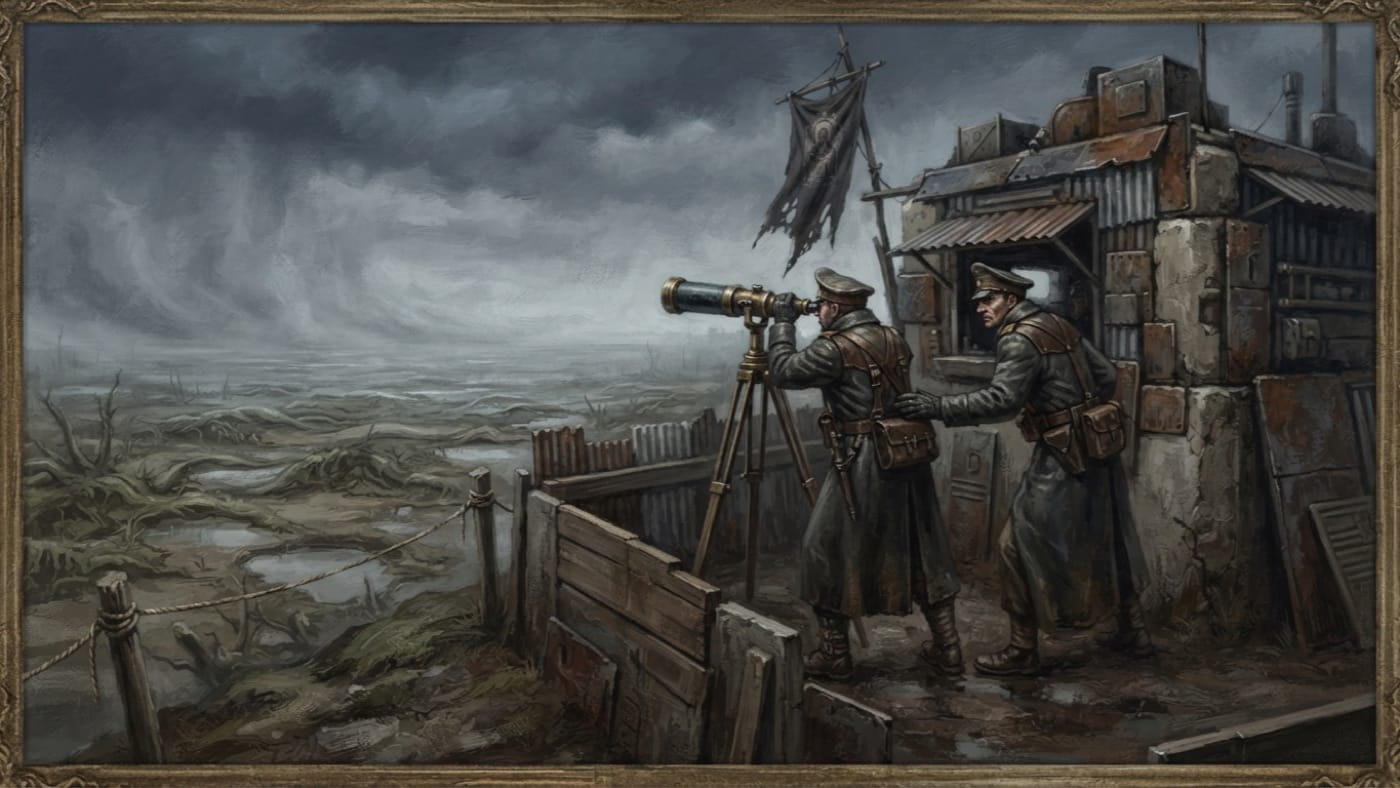
It is one of fourteen numbered observation posts, Kestrel-1 through Kestrel-14, strung along the western perimeter of the Blightmarsh. Each bears a bird's name and a cipher, so the Bureau of War can list them on the same requisition sheet as remount depots and boot nails. Kestrel-9 answers to the eastern watch of Bastion-Constantinople. Its garrison comes from that fortress. Its observers have included men seconded from the Thracian Survey, and Sergeant Vell is the only one my file can name.
The Ledger keeps the post's work and has mislaid its birth. I decline to invent a birthday for readers who like their outposts to have one. Kestrel-9 exists to see the Marsh move before the Marsh arrives, and to write the movement down in a hand steady enough for the Bureau of Records to read.
Beyond the markers lies the country of Kargath: grey mud, grey water, grey sky, and an edge that will not stay where the surveyors left it. The Marsh widens. It eats at its margins the way a clerk eats at a pension, in small entries, each of them defensible.
#On the Keeping of Watch
The post's instruments are humble, and every one of them is a confession.
The garrison lays ash-lines across the roads, and the lines are read at dawn. A cart leaves ruts. A deserter leaves boots. A dog leaves a dog's opinion of the matter. When the ash has been crossed and holds no print at all, the crossing goes on a form. The form goes into a locked box kept for phenomena that ought to have no form whatever. I have handled the box's blank stock, and the paper is excellent. War spends nothing on mattresses and a great deal on stationery. The careful reader may draw his own conclusions about where War believes the danger lies.
Rope markers stand along the boundary to measure creep. Nobody at Kestrel-9 believes a rope holds the Marsh back, though I have heard chaplains from safer provinces speak of the ropes as cordons of grace. A rope's office is clerical. When the grey reaches it, a man writes down which rope and what hour, and the Bureau of War redraws a line on a map in some rear office that nobody on the perimeter will ever see.
The smell ledger is the strangest volume the post keeps. Its columns record bread-wind, the scent of baking that is happening nowhere. In most of the Church's territory the smell of bread is a mercy. Here it is an entry. The Abundance Fields have taught us that the Devourer's country deceives by plenty as readily as by want, and that a starving man walks toward a full table faster than he flees an empty one. The watch writes down the bread, the hour, the direction of the wind, and which man on the parapet remarked on it with too much feeling.
That last column is the real instrument. The exposure clocks measure the men, recording how long each sentry has kept his eyes on the grey. At some point (I do not know when, and I will not guess) the post learned that the Marsh can be studied only at a price, and that the price is collected from the student. The garrison blesses its rations and eats only what it is issued. Neither discipline is a wall. The Bureau of Relics will tell you otherwise. The Bureau of Relics does not stand the dawn watch.
#On the Witness
Sergeant Vell kept watch at Kestrel-9 for months. I took his testimony in A.S. 199 while I was preparing the Blightmarsh entry. Everything in this section rests on his word, which I have found sounder than most bishops' oaths.
He described grey mud moving when there was no wind. He described the smell of bread on days when no bakery stood within thirty miles. He described ash-lines across the roads that had been crossed in the night, without a footprint. He described sentries who chewed ration-cloth in their sleep. He described a watchman who stayed at his field glasses past all reason and afterwards asked, with perfect courtesy, whether the post's dead were being stored for later issue.
When I asked what the Marsh looked like from Kestrel-9, he said: "It looks back, sir."
I wrote six pages of notes during that interview and burned them in my own grate. The rest of the interview is restricted. I do not intend to rebuild from memory what I took such pains to reduce to ash. Readers who feel cheated may petition the Bureau of Doctrine, which will cheat them more formally.
Vell requested reassignment to Bastion-Brest on the Bug River, where the garrison faces the Nameless Tide. The request was granted, and he called it a relief. Of his service after that, my file holds nothing I can certify.
#On Eleven Minutes
For one thing in this entry I need no witness but myself, and that is a weaker authority than it sounds.
In A.S. 199 I made a restricted inspection of Kestrel-9 under the escort of Corporal Drennan of the Bastion-Constantinople garrison. His orders were to keep a visiting Hieromnemon alive along the perimeter. As I have since reconstructed it, he read those orders more widely. He watched the Marsh, he watched the sentries, and he watched me, and he judged all three by the same standard.
The air smelled of bile and old tallow. The mud moved. I watched it for eleven minutes. I have stood before relics that wept, before heretics recanting on the scaffold, and once before a Hierarch in his bath, and none of them held my attention as that grey surface did. It asked for nothing, and that was its eloquence.
At the eleventh minute Drennan touched my elbow and said, "Sir, respectfully, that's enough looking."
He touched; he did not drag. A hand at the sleeve and a single sentence brought my attention back to my body with the least possible force and the least possible insult. I have seen surgeons do worse with better training.
The medical note afterwards recorded my appetite as normal and my sleep as compromised. Both remain accurate. I mention the appetite because the Bureau of Medicine insists, and the sleep because I do.
Eastern Command's preliminary note classified the escort's conduct as "minor escort impropriety."
Corrected under Doctrine. The intervention is ratified as proper escort conduct. Public commendation is withheld for precedent risk, lest every corporal on the Line conclude that a senior officer's sleeve is his to touch whenever the senior officer deserves it.
Of Sergeant Vell's regard for the corporal I have only informal word. It was never written down, and I leave it that way.
#On the File
What the Ledger holds on Kestrel-9 runs to A.S. 199: the post, its instruments, one witness, one inspection, one hand at one elbow.
The line-wide count for A.S. 201 holds that three of the fourteen Kestrel posts stand unmanned. It does not say which. War blames scheduling. I blame nothing, and I will not place Kestrel-9 in the empty column or the occupied one on the strength of a count that declined to name names. Drennan's file after A.S. 199 is thin. Vell's is unresolved. Whether either man has stood on that parapet again is a question for whichever clerk receives the next return. I wish him a dry hand.