
#On the Line Drawn Around Hunger
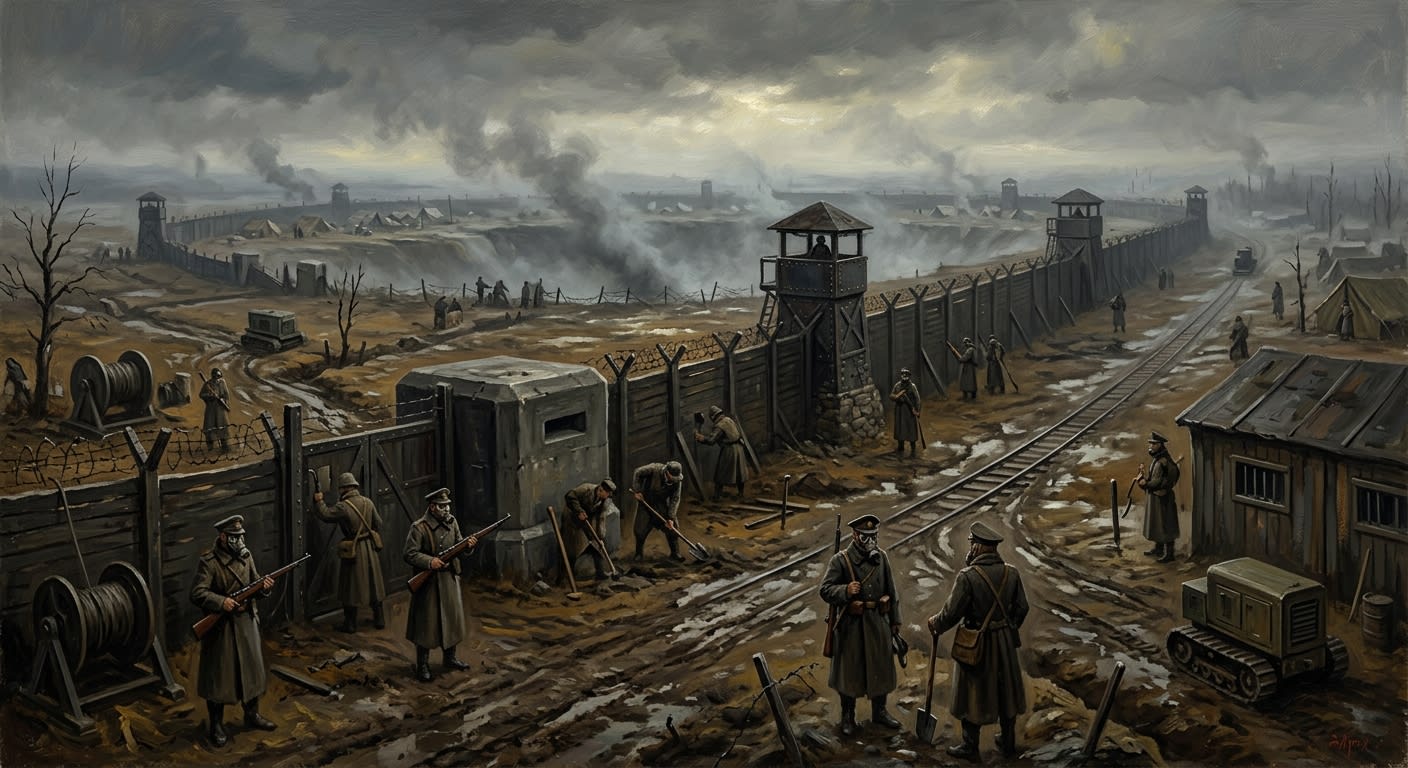
Standing Order 77-K is the Bureau of War’s answer to the Famine Pits, which is to say it answers hunger with distance, discipline, ration ledgers, and the magnificent confidence of officers who believe a perimeter can make the dead polite.
It was issued by Bastion-Constantinople Eastern Command after the Bureau of Medicine confirmed Residual Consumptive Emanation in A.S. 134 and after enough patrolmen had returned from old burial grounds clutching their bellies, vomiting good food, and asking whether anyone else could hear chewing under the mud. The Order mandates a four-mile exclusion perimeter around every confirmed Pit site. Patrols operating within eight miles must carry double rations and rotate on ninety-minute cycles. No patrol may approach within one mile without written authorisation from the garrison commander. No garrison commander has signed such authorisation since A.S. 190.
The Order’s genius lies in its poverty. It cures nothing. It quiets nothing. It reconciles no theology, feeds no dead, and rescues no soul from the radiating appetite of a grave that died hungry and stayed ambitious. It simply says: stand here, not there. The living, being cowards in the useful sense, obey.
#On Its Origins
The Order did not descend from wisdom. It crawled out of embarrassment.
Lieutenant Voss reported the first clean exposure pattern in A.S. 120: distress at three hundred yards, cramping at two hundred, vomiting at one hundred, collapse at fifty. The Bureau shelved him. Fourteen years passed. Other men cramped, vomited, weakened, and died under headings more acceptable to clerks: bad meat, bad morale, bad prayer, bad luck. In A.S. 134, Medicine recovered Voss’s report, matched it against burial sites, and announced that the dead were emitting hunger with measurable force.
War read the confirmation report with the proper expression. The proper expression was not pity. It was liability.
Preliminary routing circulars described Standing Order 77-K as “precautionary.”
Corrected. The Order was reactive. The hazard had been reported fourteen years earlier, confirmed by field cluster, and measured by controlled exposure. Precaution belongs to those who act before the bodies pile high enough to obstruct the file-room door.
The first version of the Order established a two-mile withdrawal recommendation and permitted patrol commanders to use judgment. Patrol commanders used judgment. Men died. The second version replaced judgment with a boundary. The third added double rations. The fourth added ninety-minute rotation. The fifth, after Pit Fourteen’s confirmation in A.S. 197, classified unusual appetite and refusal of appetite as equal symptoms, which was the sort of addition only the eastern theatre could make necessary.
#On the Four-Mile Perimeter
Four miles is not sacred. Four miles is what survived committee.
Medicine recommended a minimum two-mile cordon after the A.S. 135 Pit Seven exclusion. Field officers requested six. The Bureau of Tithes objected to six because six miles removed too many roads, fields, tax-yielding villages, and people still theoretically useful to the Ledger. Doctrine proposed three, because three has liturgical charm and no operational merit. War settled on four and called the settlement prudent.
The boundary is marked with ironwood stakes, brass plates, warning bells, and black cord soaked in bitter oil to discourage scavengers, deserters, pious idiots, and dogs. The dogs are the most compliant class. At some sites the stakes are renewed quarterly; at Pit Twelve they are renewed whenever the ground has finished moving them. At Pit Eleven, where the children are buried, the warning plates are replaced by Rites chaplains who return thinner than they departed and will not say why.
Boundary Maintenance Note, Pit Eleven, A.S. 198: “Stake row C found rearranged in nursery pattern. Bell plates hung lower, at child height. Three escort rifles discharged without order. Chaplain ███████ submitted report consisting only of ‘They are still crying’ repeated forty-three times.”
The Order forbids permanent structures within the perimeter. It also forbids lingering at the boundary, sleeping within the caution zone, consuming local foodstuffs, answering voices, collecting soil, recovering bones without sealed writ, and making devotional offerings. The last prohibition offended Mercy. Mercy wished to leave bread. War replied, with unusual theological brilliance, that feeding the dead had not yet improved them.
#On Double Rations and Ninety Minutes
The double ration provision is the most mocked clause in the Order and the least foolish. Men who approach the Pits become hungry. Some become hungry because their bodies are being lied to. Some become hungry because fear burns faster than drill-sergeants admit. Some become hungry because the dead are reaching. The distinction is useful to physicians, not to sergeants trying to keep twelve men from eating their leather straps.
Every patrol within eight miles carries double ration issue: hard biscuit, salt tablets, tallow cake, bitter pellets of Medicine’s own manufacture, and sealed water inspected by Purity for contamination and by Tithes for theft. The ration cures nothing. It is an instrument. A man who eats and remains hungry has produced a symptom. A man who refuses food has produced another. The Order converts appetite into evidence. This is hideous. This is why it works.
Ninety minutes is the rotation limit because the A.S. 134 Medicine tables show measurable deterioration after sustained exposure beyond that window in the caution band. The figure is arithmetic with widows attached. At the ninetieth minute the patrol withdraws, whether the marker has been set, whether the survey chain has snagged, whether the officer insists the task requires ten more breaths. Ten more breaths is how graves acquire clerks.
#On Medical Protocol 9-C
Medical Protocol 9-C is the Order’s little iron tooth.
Any soldier exhibiting unusual appetite, unusual thirst, unusual interest in soil patterns, bread-smell reports, refusal to eat, excessive calm, dreams of kitchens, dreams of children asking for bowls, or any attempt to feed shadows, boots, ration cards, weapons, comrades, or unseen persons is withdrawn immediately and quarantined. The quarantine lasts until Medicine signs release or War signs disposal. Mercy may attend. Mercy may not overrule.
Earlier garrison summaries treated “declining food after exposure” as a favourable sign.
Withdrawn. Refusal and craving are twin clerks at the same window. Both take names. Both stamp the hand.
Protocol 9-C also requires an appetite sheet, witness statements, ration count, dream transcript, weight record, and mouth inspection. The mouth inspection has saved more men than sermons. It has also found mud under tongues, splinters between molars, and once, at Pit Three, seven human milk teeth in a canvas suit that had been sealed at issue.
#On Enforcement
Standing Order 77-K is enforced by fear, which means it is enforced well.
The Hunger Wardens obey it because the rope line, ration count, and ninety-minute bell are the only mercies their profession receives. Patrol officers obey it because disobedience produces paperwork with corpses attached. Chaplains obey it after their first boundary vigil. Smugglers disobey it exactly once. Peasants disobey it when hunger at home becomes louder than hunger in the Pits, and those cases are the ones the Order cannot solve without becoming honest about the West’s own stomach.
War files violations under negligence, spiritual contamination, or self-endangerment. Doctrine prefers voluntary contamination because voluntary sin is easier to punish than despair. Medicine usually writes “exposure-compelled conduct” and refuses to decorate the gallows.
No Bureau likes the phrasing of any other Bureau. The condemned man remains condemned.