
#On the City in the Records
This is a survey, conducted in A.S. 201 (1911 CE), of what the archives of the Church still hold under the name of Kiev. It is not a gazetteer. A gazetteer requires streets, magistrates, a census, a market day, and someone alive to correct the spelling. The records supply none of these with any reliability, and I decline to furnish them from imagination, which is where lesser compilers get their municipal detail and why their cities all smell faintly of the same bakery.
What survives is brief. Kiev, entered as Kyiv in certain ledgers, lies in the east, beyond the Sagittal Line that divides the western heartlands from the fallen territories. The register of places marks it Lost. Two catastrophes are filed against its name. One carries a year. The other carries none. The chronicles do not say which came first, whether they describe two events or one event remembered by two kinds of witness, or whether the same households suffered both. This survey will not say it for them.
#On the Fall Recorded in A.S. 91
The chronicle in the Lore Book enters the Fall of Kiev under A.S. 91, which is 1801 CE. The entry is three clauses long. Eastern monasteries were overwhelmed. Refugees described what overwhelmed them as "meat tides." The Rationalist administration declared it a "flooding event."
The longer narrative in the same compilation gives the refugees a little more breath. They spoke of monasteries overrun by surging masses of flesh, undifferentiated and hungry. As to origin, the narrative records a quarrel instead of an answer: some held it to be sorcery loosed by Rationalist cruelty, others a manifestation of the Enemy, and the compiler admits that no one agrees. The compiler's phrasing calls it a first arrival; the Sundering has its own date, A.S. 45, and a refugee's sense of novelty does not move it.
The book repeats the chronicle line elsewhere in its pages. I have counted it once. A compilation that says a thing twice has one witness and a good memory.
What, then, is established? A year, a region of monasteries, a body of refugee testimony, and a Rationalist classification. The refugees saw flesh. Refugees are not engineers, and terror describes by resemblance. The Rationalists said water. The Rationalists were not honest men, though even a dishonest clerk occasionally writes down something true by accident. Neither statement is a mechanism. The file stays open on the matter of what moved through those cloisters, and it will stay open after I have finished with it.
#On the Silence Account
The published Codex preserves a different Kiev, and preserves it without a date. The margin of the Syrion entry states that the city starved because orders could not be heard. The Silence Domes tract supplies the domestic particulars under its own name for the catastrophe, the Silence Siege of Kiev, and I take them as it gives them.
Bells refused to carry. Sermons choked. Orders failed. That much is the ordinary arithmetic of a Dome, and on a battlefield it ends with men firing off cadence into their own lines. In Kiev the account describes something slower. The citizens lost the civic sequence by which eating, prayer, queueing, labour, confession, and sleep were arranged into a day. They were never told to stop eating. Nothing told them to eat, and the order of things that brought a person to the table came apart.
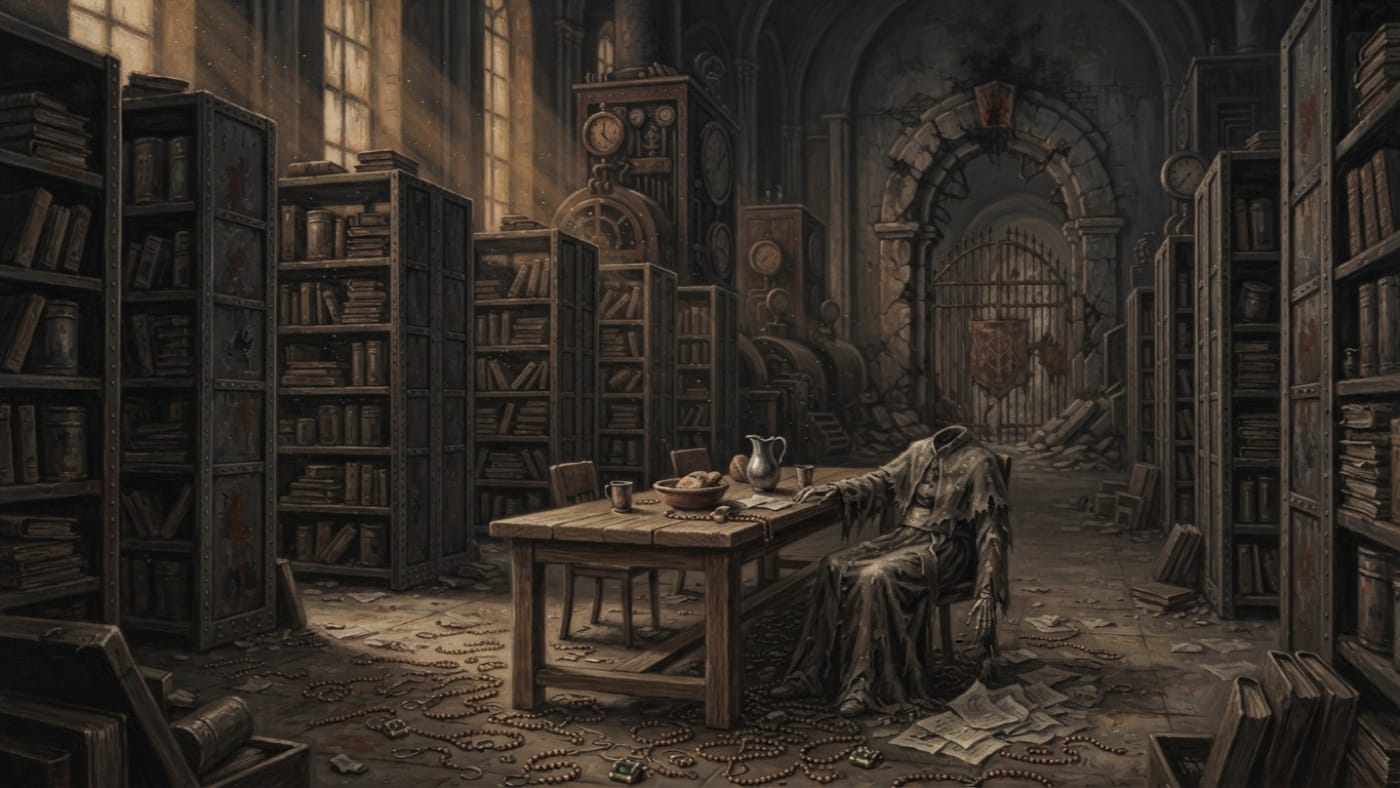
Then the evidence. Investigators reported moulded bread beside skeletal corpses. They reported grain left untouched in bowls. They reported water drawn and never drunk.
Consider the water. Someone drew it. Someone carried it the distance from source to vessel, which is labour, and set it down within reach, which is intent. The act that should have followed was not performed. The record does not say why the cup stayed on the table. It says only that it did, and that the person who filled it was found nearby in a condition that made the question academic.
I was not among the investigators. The record does not give their names, their number, their Bureau, or the season of their arrival, and I will not supply a single one of them. Their findings are reported findings. They stand in this survey exactly as tall as the report that carries them.
The account says the city starved. It does not give a count, and I will not fabricate one to make the horror fit a column.
#On the Bureaus' Findings
Three institutions have looked at the silence account, and each found its own reflection in it.
The Bureau of War classified the disaster as a communications failure. This is a classification: it names what broke. It is accurate as far as it goes, and it goes as far as the parade ground.
The Bureau of Doctrine made two moves. It associated Kiev with Syrion's early work, which is a proposal of responsibility, and it ruled the catastrophe a "failure of civic catechism," which is a verdict on the dead. The attribution rests on resemblance. Sloth's recorded methods run to exhaustion, stillness, and the slow erosion of will, and a city that stopped lifting its own bread looks very like his handwriting. Resemblance is not a confession. As for the catechism, it is the kind of finding a tribunal reaches when the defendants cannot attend the hearing.
The Bureau of Records, in a private margin, offered the most frightening reading: the Dome fed on ritual itself. This is a proposed mechanism. It is also, in the strict sense, a sentence written by a clerk in a margin, and I of all men know what margins are for.
War and Doctrine have never reconciled their findings. None of the three establishes what physically or supernaturally kept food from mouths, and I will not let a good phrase from Records do the work of an inquest.
#On the Accounts Kept Apart
There are two catastrophes in this file, and the temptation to stitch them together is strong enough that I record my refusal formally.
The Fall concerns monasteries, refugees, flesh, and a year. The silence account concerns households, investigators, bread, and no year. One was witnessed by those who ran from it. The other was reconstructed from what remained after no one ran at all. They may be two events. They may be one event preserved in two incompatible traditions. One may have prepared the ground for the other, or neither may have touched the other. No document in the archive proves identity, sequence, or cause, and a survey that chose among them would be inventing the city's history to tidy its folder.
Nor is the silence of Kiev the Eastern Silence of A.S. 38. That omen has its own year and its own file, and it may keep them.
An inherited compilation assigned the Silence Siege of Kiev a precise year, a duration, and a lifting.
Withdrawn for this survey. The year given falls later than the present one, a feat beyond even the Bureau of Records. The siege is undated. The A.S. 91 Fall is not to be borrowed as a substitute, and the duration and lifting go out with the year that carried them.
#On the Present Docket
As of A.S. 201, Kiev remains Lost. The designation records that the city fell outside the Church's reach. It says nothing about who or what lives there now, whether any pall persists, whether anyone has rebuilt, or what an envoy would find on arrival. No current survey has been entered, and I will not file guesses under a city's name.
The wider doctrine is a separate matter. Every bastion sector now drills Dome procedure under the Bureau of Orison: hand-code, rope-signal, mirror-code, the liturgy of gesture by which a formation keeps its orders after its ears have failed. Orison files Domes among Wound-Site phenomena, and it treats the loss of audible command as a danger to cities as well as to trenches. The Kiev records do not say whether the city knew such procedures, lacked them, or tried them and failed. I record the drill because it exists. I do not record that Kiev invented it.
The docket closes where its evidence closes. One dated Fall, attested by refugees and euphemised by Rationalists. One undated silence, attested by a table of uneaten bread. Three Bureau findings, none of them proved. The Warden of the Sacred Ledger certifies the gaps as gaps. Someone else may fill them with whatever they like, on their own seal.