
#On the Plea for Mercy
The Kyrie Eleison is the Church's mercy prayer, the plea a congregation raises once it has stopped pretending to deserve anything. It is short. It is old enough that nobody in my office will put a year to it without a second signature, and nobody has volunteered the signature. Every child of the faithful has it in the mouth before the alphabet. That familiarity is the whole of its danger, and the whole of this article.
The text belongs to the hymnals licensed by the Bureau of Orison and Song, and a codex article that reproduces licensed liturgy invites an audit I have no wish to host. I decline to set it down. The Ledger holds no composer for it, no founding council, no saint who first sang it at a deathbed while the candles behaved symbolically. Readers who require an origin may invent one privately, at their own spiritual risk.
The Ledger holds one documented occasion on which the prayer came back across a field in the wrong throat. That occasion is Prague, A.S. 167. The prayer itself was not on trial there, whatever the barracks believe. Its familiarity was.
#On Prayer Under the Banner
The Church does not let its music wander. Orison and Song licenses every hymnal and prosecutes unauthorised melody as heresy. The Bureau of Bells treats an unsanctioned peal as treason and has melted guild bells into shackles for less. Sound, in the Church, is a regulated commodity, like powder, like ink, like mercy.
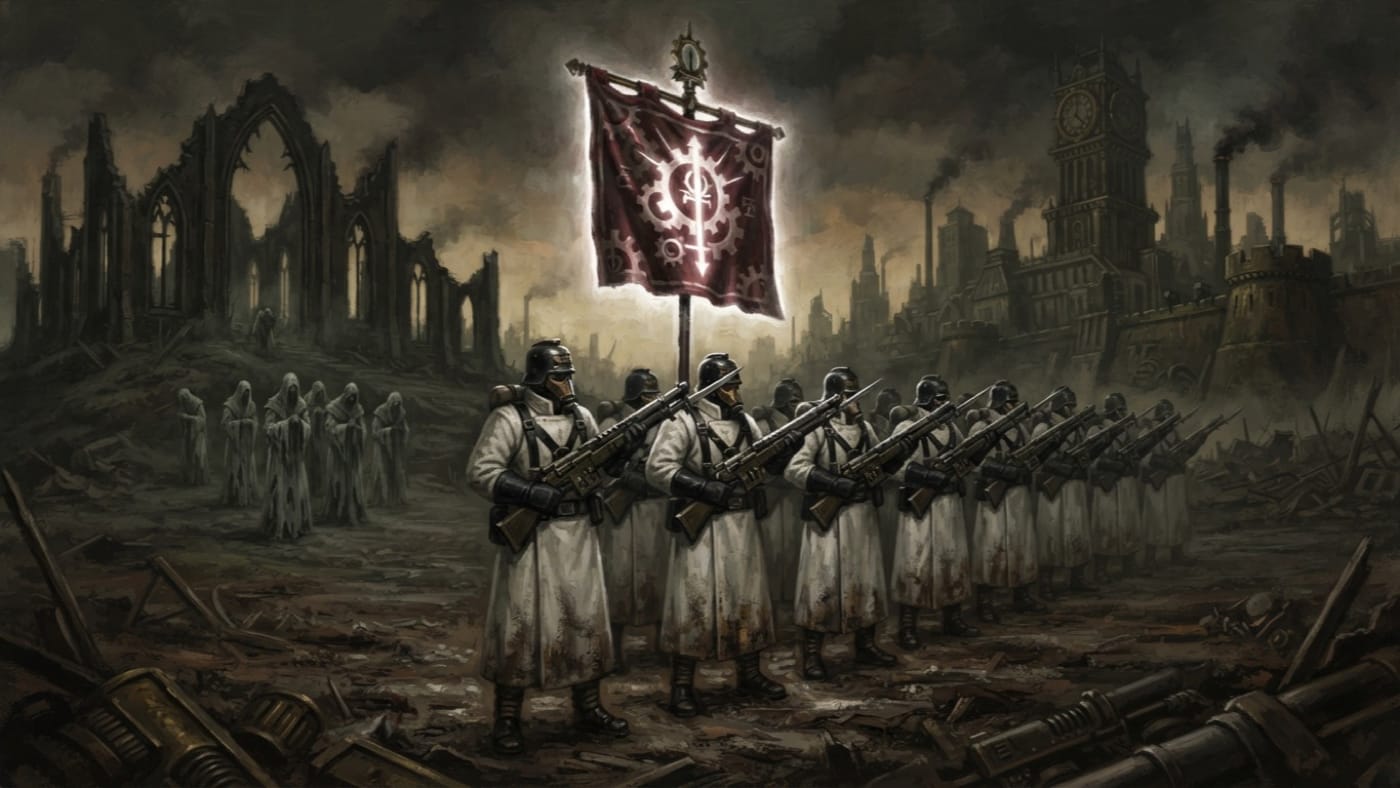
Nowhere is the regulation tighter than in the line. The Radiant Fusiliers load together by prayer, a fragment of psalm on each cartridge and a syllable for each ramrod stroke. Their eyes stay on the consecrated banner, which is doubled and trebled in the mirrored plates of their helmets until holy cloth fills the edges of sight. They wear white tunics striped with powder-burn and gloves dyed black to cradle the weapon. In ordinary practice the banner flares and the first volley goes. It dims, and the second follows. It blazes white, and the third belongs to the Creed entire. Ash Chaplains and the Processional Bands keep the rest in time, with drums for boots, pipes for volley-fire and horns for the bell-cannon. One chaplain wrote before his death at Vienna that a missed note is a misfire. The Bureau of War adopted the sentence as regulation, which is the highest compliment War knows how to pay.
I record all this so the reader understands what was attacked. A Fusilier line is a mechanism built from sacred sound and obedient hands, and every part of it presumes that the prayers in the air belong to the Church.
The evidence does not make the Kyrie the Fusiliers' firing hymn. No cadence table I have handled names it as a command, a cue or a ward. The soldiers knew it the way they knew their mothers' names. At Prague, that was enough.
#On the Inversion at Prague
The full engagement is recorded under Night of Silent Steel. I will not copy my own work at length. Records charges me for ink as though I were a stranger.
In A.S. 167, on the eastern approach to Prague, a regiment of Radiant Fusiliers stood in ranks beneath banner-light, facing a ruined seminary. Older identification calls it the Fourth. The Bureau of Records insists upon the Seventh. No ruling has settled the number, and I have stopped asking, because the asking had begun to appear in my own file.
Seven Pale Chanters occupied the ruin. As the banner rose, they began to sing a slow, droning inversion of the Kyrie Eleison, the mercy prayer drawn out of shape and sent back over the ground. The banner flared white, and no volley followed.
The Fusiliers stood with eyes open and rifles loaded. They did not break, and they did not flee. The enemy advanced into a line that remained in order by every outward measure, and forty-three men died without discharging a round. Forty-three is the number of the dead. It is not the strength of the regiment, whichever regiment it was, and I correct any clerk who writes it that way myself, in red, with the nib pressed hard. The chaplain's roll of those names lies in the Forbidden Stacks.
The Lore Book gives the result in four words: they forgot to fire. My fuller account describes the command as received and the drill as retained, with the passage between the order and the act failing somewhere inside each man. One survivor's deposition puts it plainly. He remembered the command, the rifle and his own finger, but could not remember what firing was for. That is one man's testimony. It is no law of acoustics, and I will not hear a chaplain quote it as one.
What lifts the matter from incident report into tract is the material the enemy chose. The Chanters did not trouble to compose a new hymn. They took a prayer that every man in the line had learned before he could lace a boot, one that reaches the ear already trusted, and they sent it back in an enemy voice at the very moment the banner asked for obedience.
#On the Approved Description
Doctrine has never cared for the sentence "they sang an inversion of the Kyrie." Its approved wording is that the enemy emitted "a counter-hymn bearing superficial resemblance to the mercy prayer." The formula keeps the prayer's name out of the casualty column, and that is its purpose. The men heard the Kyrie. Doctrine heard a resemblance. Both statements sit in the same archive under different seals, and neither has been withdrawn.
Bells named the operational effect cadence severance, a term I admire because it describes what happened and explains none of it. Public annals call the incident command miscommunication. Soldiers call it the day the Creed went silent.
On the question of how, each Bureau has produced an answer suited to its budget. The Bureau of Doctrine attributes the Chanters' power to sorcery, calling it sin given throat, born of priests who betrayed their vows. Engines & Furnaces holds that the chants align with certain subterranean acoustics. A redacted Records note suggests the Chanters may be our own songs returning, distorted, across Wound-Sites. That note was redacted for a reason I am not paid to guess at, and I do not guess for free.
None of the three has proved itself. The administrative description is complete, and the cause is still open.
Pale Chanters across the field began their unhymn — a slow, droning inversion of the Kyrie Eleison.
Orison, Fifth Revision: replace all references to "unhymn" with "counter-hymn." Term "unhymn" banned as insufficiently reverent of structure.
#On Correction and Continued Use
The remedies rest on the parent account, and I have seen no independent folio for them. A review followed in A.S. 168. In A.S. 169 the Fusilier cadence tables were revised. War added a hostile-song interruption drill, Bells added a banner-tone anchor, and Doctrine issued a memorandum forbidding the phrase "the Creed went silent." The memorandum has since carried that phrase into every barracks from Brest to Shipka. Recruits now practise firing while choirs behind screens hum wrong intervals at them. The choirs are paid for the hazard. The recruits are told the experience is educational.
These are training measures. Nobody in Strasbourg has certified a cure, and bronze guarantees nothing. At Vienna the Chanters sang through the peals and bent them off-key. That was a different engagement and a different song. I mention it only so that no reader leaves believing a bell is a promise.
The ordinary prayer is still in use. No document within my reach abolishes it, rewrites it or forbids it to the regiments. Fusilier recruits still learn it as children. Later, on the drill-ground, they learn that the same words may one day arrive from across a field, and that the banner alone governs the hand. The record has tested once whether a man can hold both lessons under fire. That record is kept at Prague, and it ends in forty-three names.