
#On the Room Beneath Strasbourg
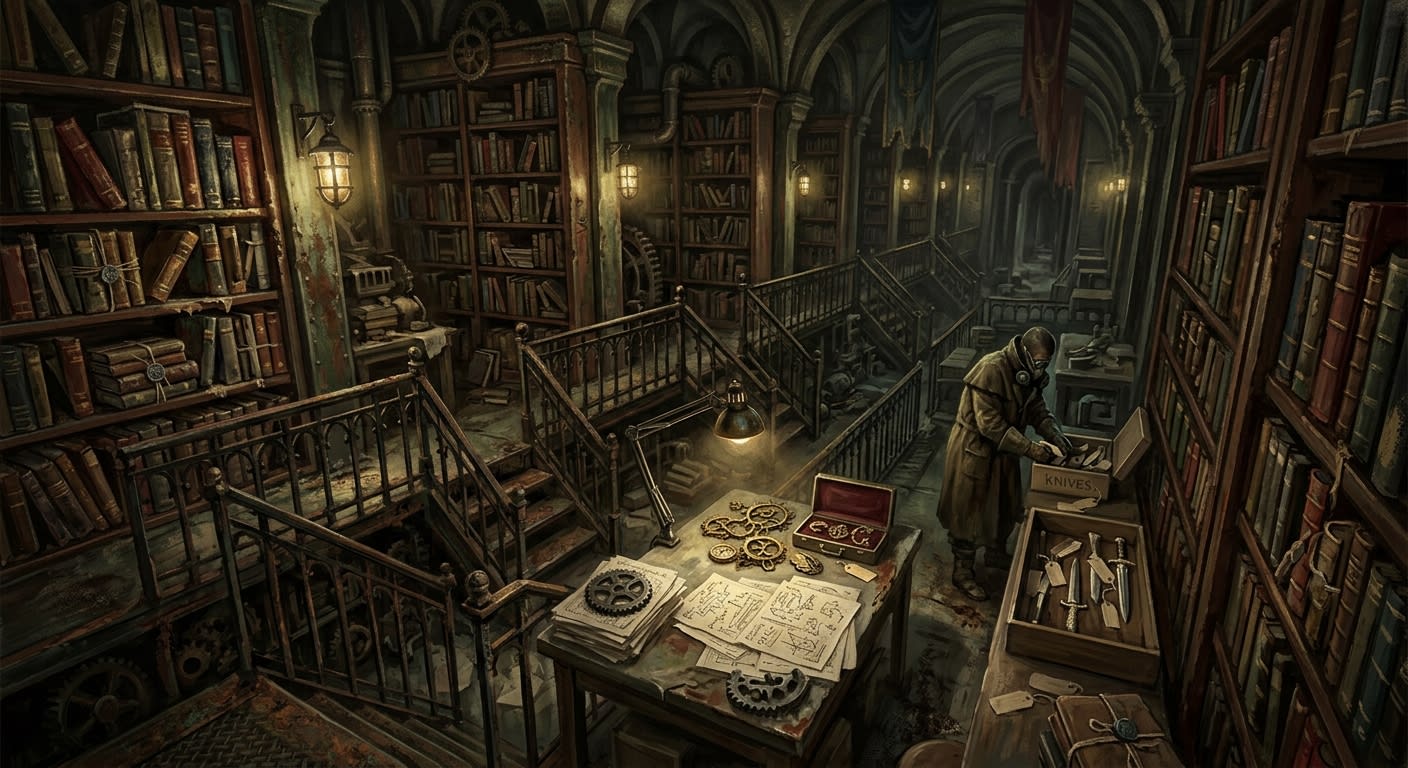
The Forbidden Stacks lie under Strasbourg, below the public archives, below the disciplinary reading rooms, below the dry wells where junior clerks are sent to reconsider adjectives. They are not the deepest vaults. Fools assume the most frightening papers must be kept at the bottom. The Bureau is subtler than fools and less sentimental than architects. The Stacks sit where a forbidden text can be reached quickly by the men licensed to hate it.
The Stacks hold the documents the Synod must preserve without honouring: Rationalist instruments, contraband sigils, confiscated lecture notes, heretical catechisms, trial transcripts annulled but useful, academy memoranda wrong in historically nourishing ways, and sealed fragments of books that have tried to continue their arguments after being cut in half. They are called forbidden because ordinary citizens may not read them, copy them, cite them, kiss them, sell them, dramatise them, or use them to impress undergraduates in cellars. They are called stacks because even terror requires furniture.
#On the First Acquisitions
The earliest Stacks were not planned. They accumulated. In the first years after the Concordat of Strasbourg, the new Bureaus inherited trunks of Rationalist paper from magistracies, academies, prefectural offices, burnt courthouses, abandoned observatories, and the coat pockets of men who had begged for chaplains too late. Burning all of it would have been satisfying. Satisfaction is not policy.
The first catalogue lists three copies of the Concordats of Ulm, nine imperfect editions of De Vera Luce, thirty-seven Broken Cross writ-seals, a stained copy of the Secular Gatherings Act, six military drill manuals of the Republican Guards, and one notebook from Vienna whose final page reads, “Motion to authorize the Third Eastern Observation Expedition is hereby—” before the ink leaves the line and becomes something the Bureau of Alchemical Standards refuses to name in writing.
Early catechism lessons taught that all Rationalist writings were burned after the Sundering.
Corrected. Many were burned. The useful ones were shelved. The Bureau does not throw away knives merely because murderers have touched them.
The Bureau of Records wanted indexing. The Bureau of Purity wanted ash. The Bureau of Doctrine wanted evidence. The Bureau of Silence wanted the door, and took it, because custody is merely theology expressed as hinges. Records received its indexing. Purity received several ceremonial burnings and an annual inspection right. Doctrine received interpretive co-seal. Silence received physical custody. This is what compromise looks like when all parties carry keys.
#On Arrangement and Access
A visitor with proper authority enters through the south catalogue stair of the Basilica-adjacent Records House, signs his name three times, states aloud the subject of his inquiry, and receives gloves that have been washed in vinegar, salt, and suspicion. One clerk unlocks the outer grill. One priest watches the clerk. One Custodian watches the priest. Nobody watches the reader alone, because solitude with a Rationalist text is how pamphlets reproduce.
The Stacks are arranged by harm. Foundational instruments occupy the western shelves: the Concordats, the Amsterdam pamphlets of the Year of Letters, the first printings of De Vera Luce, the mailing lists of the Ulm Congress, and the polite little letters in which professors congratulated one another for opening the throat of Europe. Military instruments occupy the north: guard manuals, artillery tables, Broken Cross banners, Prefectural dispatches, maps of Aachen, copies of the Treaty of Regensburg, and tongue-removal orders under the Edict of Ironmouth. The eastern cabinets hold omen literature, which is to say Rationalist explanations for things that later killed Rationalists.
Contraband symbols are stored under cloth. The Broken Cross standard is not displayed; it is accused in darkness. Buttons, seals, lintel chips, tattooed skin samples, and wax impressions are handled with tongs. The Bureau of Purity insists on this. Doctrine permits the ritual because tongs improve the mood of any archive.
#On What Is Not Kept There
The Forbidden Stacks are frequently confused with Obsidian custody. The confusion is vulgar. Forbidden material is text under guard. Obsidian material is guard under text. A forbidden book may be indexed, quoted under licence, and hated for instructional purposes. A file under Seal Obsidian changes the room around it and may change the reader for having entered. The black iron key of the Shadow Court does not sit beside student pamphlets. The Sisters dossier is not shelved between artillery tables and bad astronomy. The Bureau has standards.
A provincial lecture once described the Forbidden Stacks as “the Synod's most secret archive.”
False. The Stacks are famous. Their fame is part of their discipline. The most secret archive is the one whose absence leaves space on the shelf and a chill in the inventory clerk.
There are materials even the Stacks decline. Books that bleed fresh ink after excommunication are transferred. Maps that add roads while being watched are transferred. Confessions that confess the reader are transferred. The Stacks preserve heresy as object, argument, evidence, poison under label. They do not house active predation unless some senior official has confused bravery with budget conservation.
Incident FS-112, A.S. 187: Junior Reader Calve opened an unregistered pamphlet recovered from a Przemyśl cadet cell. The title rearranged itself into his baptismal name. Calve completed three pages of notes before the Custodian noticed his handwriting had become older than his hand. The notes are sealed. Calve is employed in a non-reading capacity.
#On the Uses of Forbidden Paper
The Synod studies forbidden texts for the same reason an apothecary studies venom: antidote, prosecution, improvement of the jar. The Bureau of Doctrine mines Rationalist prose for the grammar of sedition. The Bureau of War studies Republican drill and has copied several sections after burning the title pages, which is theft made liturgical. The Bureau of Purity traces symbol-contagion through pamphlet seals, theatre props, classroom doodles, and the private notebooks of boys whose parents mistake expensive education for moral formation.
A clerk may spend a lifetime in the Stacks and emerge with three conclusions. First, heresy loves clean margins. Second, evil keeps excellent minutes. Third, men who abolish saints still invent relics; they merely call them first editions.
The annual inspection falls to senior Doctrine officers, of whom I am the finest specimen currently uncanonised. We test wax temperature, page order, ink behaviour, marginal growth, odour, whispering, reader nausea, and ideological smugness. The Bureau of Alchemical Standards refuses “smugness” as a measurable property. It is wrong. I have instruments. They are called taste and authority.
#On the Present Condition
As of A.S. 201, the Stacks contain more than ninety thousand catalogued items and an undisclosed number of items whose catalogue entries are intentionally wrong. Three copies of the Concordats remain under triple seal. The Broken Cross standard sweats in August. The A.S. 32 eclipse memorandum is still warm. The Treaty margins still contain doodles awaiting review. The Vienna dispatch's smear has not dried. The mailing lists of eleven hundred and forty-seven Rationalist correspondents remain legible enough to condemn descendants, should Doctrine ever require a brisk afternoon.
Citizens need not fear the Forbidden Stacks. Citizens should fear the books that never reached them, the pamphlet passed beneath a tavern table, the brass button kept because grandfather looked handsome in blue-grey, the student copy of a banned preface transcribed “for context.” The Stacks are chained. Context is not.