
#On the District in the Record
The Lace District is a district of Strasbourg, capital of the Synod since the Concordat of A.S. 90 and home to every Bureau that matters and several that only believe they do. The district appears in the files when a procession had to pass through it and someone afterwards had to account for the passing. Those entries are all the documentary record it has. The Bureau of Doctrine holds no charter for it. We have no founding year, no founder, no ward number, no surveyed boundary, no census of trades and no list of streets that a careful clerk would put his seal beneath.
What survives is arithmetic, and the arithmetic is disputed. One entry is a Festivals procession report from the first season of the Lantern Accord. The other is a miracle. Strasbourg's other quarters have their own surveys, and the Lace District is absorbed into none of them. It is also distinct from the Marrow Quarter, which has its own famine wounds and its own saint's miracle and wants no neighbour's.
#On the Route and Its Keepers
The manuals of the Pageant Captain profession treat a route as an instrument. Floats travel the main line. Side streets and alleys open onto it, and every alley mouth works two ways: a counted citizen can leave through it and an uncounted one can come in. A Captain designs a procession by deciding which of those mouths will be watched, which will be closed and which will be left open on purpose so that the wrong people find them.
What follows is general procedure. Whether the Lace District's curbs carried chalk marks that day, or whether its tally stations stood at particular corners, the report does not say, and I will not furnish streets the file never surveyed.
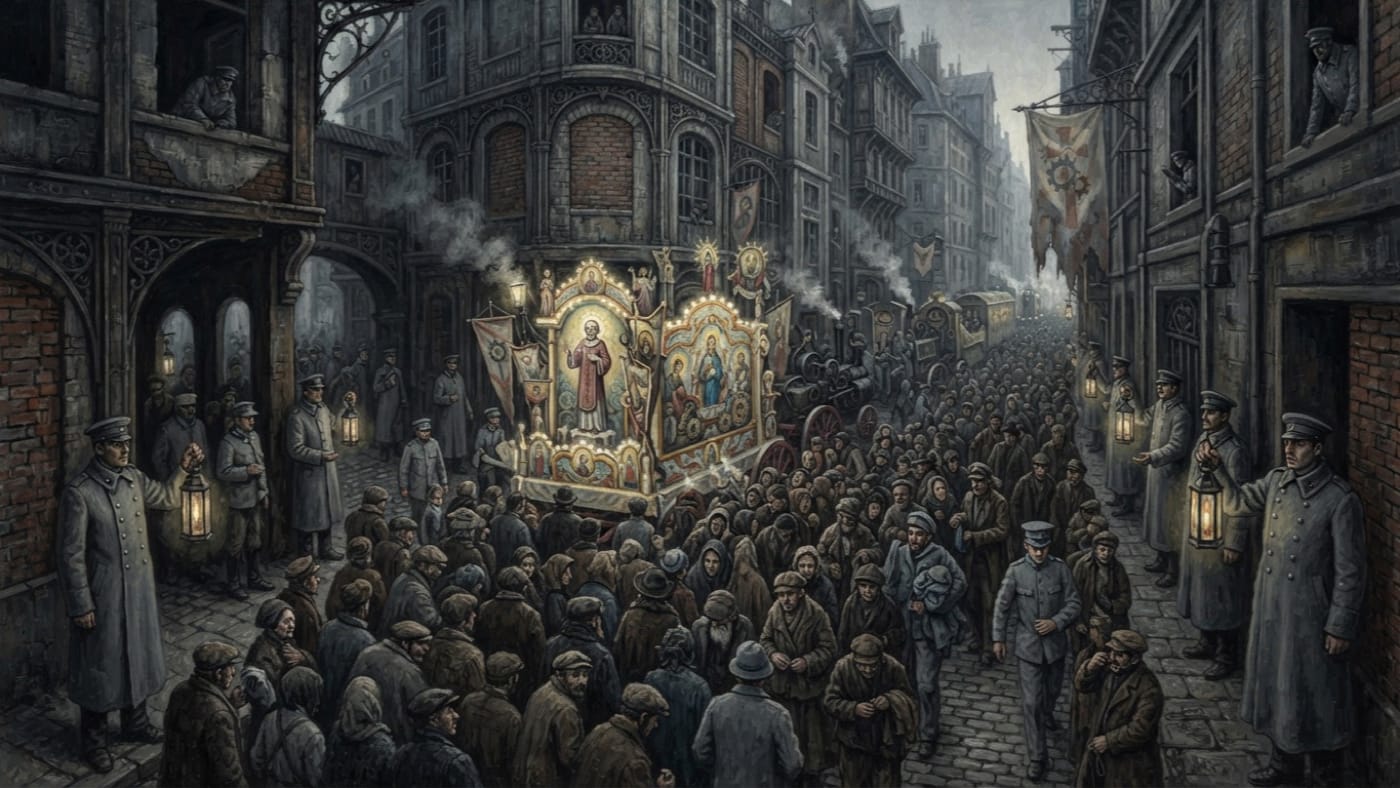
Under the Accord, the posts were divided like this. Lantern escorts in ash-grey, carrying glass-hooded lamps, held the alley mouths. For the length of a sanctioned procession the Accord gave them three things: the right to move along the route, the power to inspect wrist-ribbons, and the authority to detain anomalies until someone more senior could decide what each anomaly was. Ribbon Runners worked the edge of the crowd with punch and smile. The Captain held the drum. When the drum sounded, the Lanterns obeyed it, and men who had spent decades under the Curfew Ordinance of Quiet Hours, signalling by cough and lamp-angle, now took their orders from percussion meant for children.
The float pause was the hinge of the whole procedure. A float stopped beneath its banner and the crowd stopped with it, pleased to have something to look at. In that pause wrists were read: ribbon colour, punch pattern, station mark, tearing. A clean ribbon cost the citizen nothing more than the punch already had. A torn one cost whatever the Lantern at the nearest corner decided.
#On Merrow's Tally
The Feast of Saint Merrow's Tally fell in the first Accord season, A.S. 139. The archive does not give the feast's day or month, and it is silent on Merrow's life. The saint matters to this entry only as the occasion for a procession, which suits most Festival saints well enough.
According to the Accord file, the Lace District that day saw the new arrangement operate in full. Lanterns held the alley mouths. Ribbon Runners worked the edges. Captains held the floats long enough for wrist checks. Somewhere along the route a ration chant began, and the drummers drowned it out before it could gather. The words of the chant were not recorded, and neither were the names of whoever began it or what became of them. In Strasbourg after Gray Week, a crowd that chants about rations is talking about the last time rations failed. Festivals answered with more drum, which is what it answers everything with.
This was the system's first full demonstration in the file. I do not claim it was the first Accord procession anywhere. The district earned the honour by being where the paperwork came out clean.
At the lost-child tent behind the crowd, the procession reported these returns: nineteen children, six deserters, three dead men under false names, and one widow whose ribbon carried the punch pattern of a feast that had not yet happened.
That is the tent's return and should not be read as the attendance. Taken one at a time: the children were what the tent was named for. The deserters show what it was for. As for the three dead men, the file does not say whether they were corpses, men who were dead on paper, or living men held under the names of the dead, and this Codex does not choose among them. The widow's ribbon belonged to a feast still in the future. Nothing in the record explains how, names that feast, or says what happened to her. Explanations come cheap at reconciliation and dear at tribunal, and the Codex buys none.
LACE DISTRICT PROCESSION REPORT — A.S. 139, FIRST ACCORD SEASON Anomalies detained: ███ Ribbons torn during inspection: ██ Children transferred to correct household: █ Children transferred to useful household: ███ Lantern injuries: █ Deaths attributable to crowd movement: none recorded after reconciliation.
Some clerk decided the difference between a correct household and a useful one deserved two separate lines. Both figures are blacked out. That leaves the distinction, which is evidence enough of how the clerk thought. Where the useful children went is not something a classified extract will tell us, and I decline to tell it on the extract's behalf.
#On Serenity After Reconciliation
The report classified the procession as serene. That word describes the report's verdict on itself. It says nothing of how the day felt to the street.
The mortality line deserves slower reading than the Bureau intended. "Deaths attributable to crowd movement" leaves out every death from any other cause, including blade, illness, the lamp, the tent, or whatever happened to the three men who were already dead. "None recorded" refers to the ledger and makes no claim about the cobbles. "After reconciliation" means the count was taken once the totals had been made to agree, and making totals agree is the Pageant Captain's whole art. Each qualifier keeps something out of the record, and the clerk used all three.
Each office then praised the part it owned. The Bureau of Records praised the accuracy. Tithes praised the recoveries. Festivals praised the visible calm. The Brotherhood wrote nothing down and had its oil allowance increased by autumn. The file does not say this one procession bought the oil. It does not say otherwise.
An earlier Festivals cross-file abstract of this entry stated that the Lace District procession of A.S. 139 "passed without harm to any citizen."
Corrected: the report records no deaths attributable to crowd movement after reconciliation, and it withholds the figures for detentions, torn ribbons and Lantern injuries. The abstract turned three limitations into a blessing. The Bureau of Doctrine does not bless figures it has not been shown.
#On Caldrin's Multiplication
The district's second entry is a hagiographic claim with no date attached.
Caldrin of Essen, a Festivals clerk recognised as Saint Caldrin the Jubilant Scribe around the Receipt Reform of A.S. 138, is credited with three miracles. The third is called the Multiplication of Receipts. After a route collapse in the Lace District, he is said to have reconciled nine thousand attendees from five thousand ribbons.
The account leaves almost everything out. It gives no year and does not say whether what collapsed was timber, stone or crowd. It gives no casualty figure and no route, and it does not say how four thousand people came to be counted with nothing on their wrists. This incident must not be merged with Merrow's Tally, set on the same afternoon, or turned into a second disaster at the same tent. The two entries share a district. Beyond that the archive connects them through nothing except the saint whose devices both of them used: the Ribbon Runner, the receipt-scroll and the gratitude pause.
The pious read the miracle as abundance. Working Captains read it as a reconciliation they would never sign, and they say so quietly, under his badge. Either way, the extra four thousand are a problem. If they existed, they passed through a Festival route without being ribboned. If they did not, they were added to a ledger after a collapse. Tithes would want to know about either case. Doctrine classifies the event as procedural and goes no further.
#On Its Place in the Files
The Lace District comes down to the archive through crowd authority that was conditional and totals that would not hold still. The district is the place where the Accord was shown working in full, and also the place where Caldrin's hagiographers set their multiplication. Both entries describe the same machinery. One records it reporting itself serene. The other records it adding four thousand people.
The file does not say whether processions still pass through the district under the same drum-code, whether the tent still stands behind the crowd, or whether the alley mouths are still held by lamps. The Codex makes no present-day claim about streets it has never surveyed. It keeps the two entries, their withheld figures and their unexplained dead, and it leaves the name as found.