
#On the Disposable Leaf
"Never carry proof past dawn." — Field leaf, Section D.
The Lantern Brotherhood owns one book, and it is a single page. The page arrives folded, on wax paper stiff enough to survive a wet stairwell and plain enough to burn without ceremony. Its owner is expected to learn it and then put it to the lantern. Commonly memorised, then burned: that is the only account of its handling I have been able to obtain. I respect the word "commonly." It admits that some copies survive. It declines to say whose.
I have searched for an author and found none. The leaf has no printer's mark, no issue date, no edition number and no seal. It has the shape of a regulation and none of a regulation's standing. The Curfew Ordinance of Quiet Hours of A.S. 94 permits "auxiliary vigil personnel, locally licensed, subject to revocation without notice or appeal," and says nothing whatever about shutters, chalk or jars. Everything a Brother knows about conducting a night comes from a document the Synod never wrote, never ratified and cannot be shown to have read.
That is the leaf's whole merit. A procedure kept only in the memory of a tolerated man can be disowned as quickly as a Warden-Captain can sign.
#On the Lantern Signals
The leaf promises signals for both the street and the silence, and it keeps the promise with a single lamp worked three ways: by the hood, by the swing, and by a broken shard of the lantern's glass.
Hood half-closed, held steady: Inspect. The patrol approaches slowly and shows empty hands. This is a tactic dressed as courtesy. A citizen who sees empty hands does not run, and a citizen who stays put can be questioned past the Ninth Peal at leisure.
Hood fully closed, a single click: Freeze. Nobody moves. Blades come out. One click of brass turns an alley into a tableau.
Three short swings, held low: an underwarren entrance has been found. The patrol marks it and posts a Spark. The Spark is the probationer who carries messages and learns the marks, and now he learns to stand alone beside a hole in the ground until somebody remembers to relieve him.
Mirror-flash from a lantern shard, one–two–one: Circle converge. This is used in hush-zones and dome aftershocks, where the Bellway has failed and a shouted order would reach either no one or the wrong one.
I have saved the fifth signal for last because I would have it framed. Two fast opens and one slow: Warden present. Switch to clean procedure.
Consider what that phrase concedes. A clean procedure exists, and it is to be adopted when a Warden appears. The leaf never describes the procedure in use for the rest of the night. It assumes the reader already knows it from the Oil-Confession, where the lies told in service of vigilance are catalogued and left unabsolved. I have read confessions drawn out with tongs that admitted less than those four words.
#On the Marks
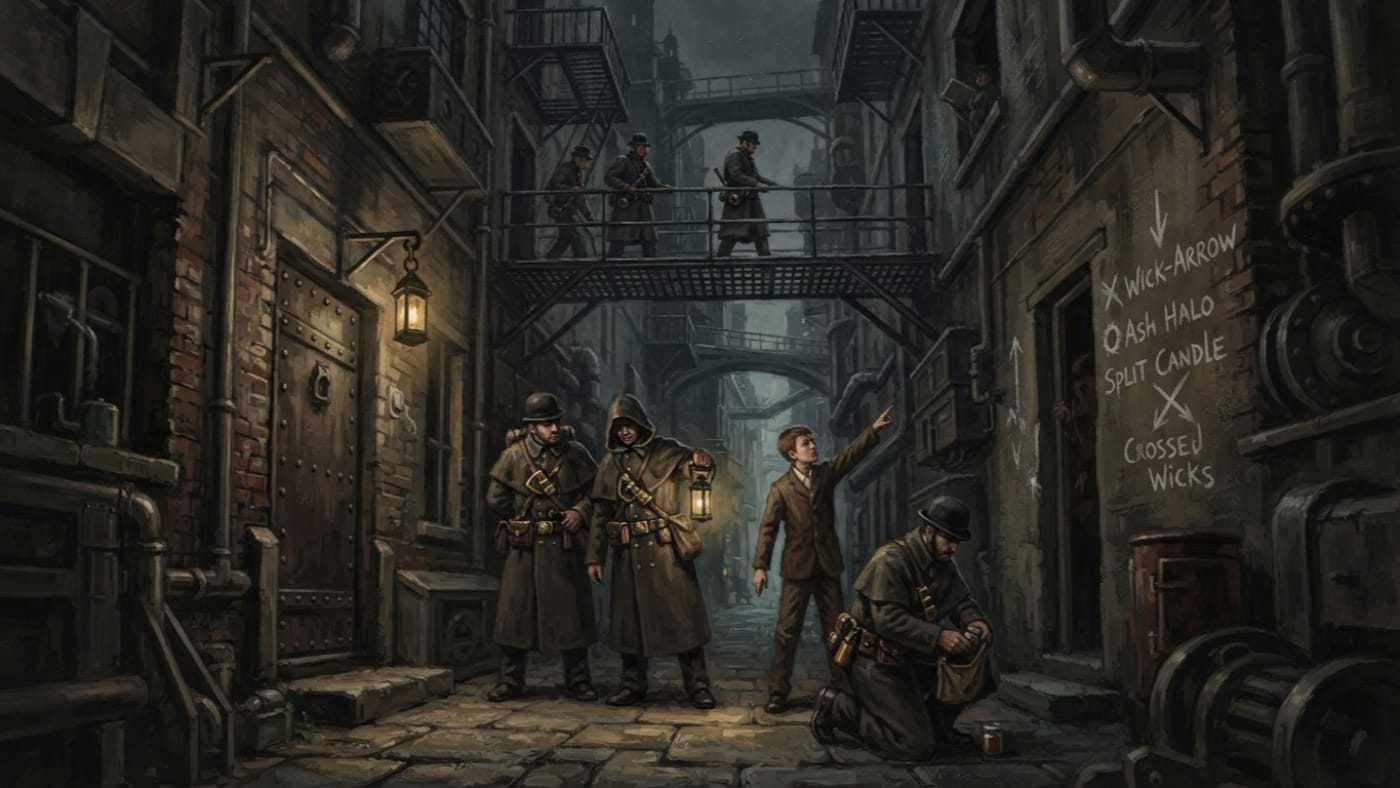
The Brotherhood writes its streets in chalk and ash, and nearly all of it expires.
The Wick-Arrow is a directional arrow with a small hook at its base. It means the path was verified within the last watch. It is knowledge with its expiry already stamped on it. After one watch the arrow is a rumour in chalk, and the next Brother to follow it does so at his own risk and on his own account.
The Ash Halo is a circular smear meaning that demon-hours have been reported. It forbids solo entry. It does not forbid entry. In the Brotherhood's arithmetic, a hazard becomes acceptable once someone else is there to witness it.
The Split Candle is a vertical stroke with two nubs, and it reads two exits, one lies. The leaf does not say which exit lies, how it lies, or who first caught it lying. I have stood before such a mark, and both doorways looked equally sincere to me.
The Wax Dot on a threshold means trap checked, or trap set, depending on the Circle. It is the same drop of wax with opposite meanings. A Brother who crosses a district line without asking which Circle holds it has reached the point where theology turns into carpentry.
The Crossed Wicks mean proof required here. The leaf glosses its own mark: make an arrest, find contraband, or fabricate a reason. Note the first verb. Arrest belongs to the Bureau of Purity, and the Brotherhood's writ extends only to detention. The leaf prints the forbidden word on its own face, so that is one more reason to burn it before breakfast.
#On the Triangle of Witness
"No alley is 'watched' unless it is seen by three lights." — Field leaf, Section C.
The Triangle has three positions. The Anchor is a stationary lantern at a chokepoint, kept visible so the street knows it is being watched. The Blade is a moving pair who search. The Echo is a shadow patrol one lane over, unseen. Count the bodies before you count the lights. The Blade alone is two men, and the leaf gives no strength for the Echo. Three positions need at least four Brothers, and the Triangle is a geometry of functions rather than a headcount.
The order of reporting is the elegant part. When an incident occurs, the Echo writes the first report. The Anchor confirms it. The Blade provides the body. The leaf does not say whether that body is required to be alive.
So the report is drafted first by the man one lane away, whose view of the event was a wall. The stationary man, whose view was a corner, confirms what has been drafted. The pair who actually laid hands on someone contribute only the person. The account comes in three hands from three positions, the positions were fixed before anything happened, and the shape of the testimony was settled before the first shutter clicked. The leaf states its purpose without blushing: truth is less important than consistent testimony.
The Trench-Court Clerk receives three signatures whose geometry is always plausible. He files them without looking up. I have never found a reason to blame him.
#On Proof Before Dawn
The Proof Jar is a wax-sealed vial for powders, fibres and what the leaf calls "fume-scrapings." It is small, cheap and portable. It is the Brotherhood's reliquary, and the relics are whatever the night happened to drop.
The leaf anticipates failure. A patrol that ends its shift without proof brings names, meaning suspects, or maps of new corridors. At the end of a watch, a jar of scrapings, a name and a sketch of an unrecorded passage are all accepted as the same payment. The Wick-Sergeant, who keeps the patrol arithmetic and assigns proof, takes whichever is offered. Someone has to answer for the night.
Then comes the deadline. Never carry proof past dawn. It "spoils." This is the only line on the leaf that glosses its own euphemism, and the gloss is the most honest sentence the Brotherhood possesses: someone higher will use it against you. No chemistry or curse is meant. A vial that serves as evidence at the Ninth Peal becomes, by First Peal, evidence against the man still holding it, once the Bureaus wake and begin asking where it came from.
The leaf does not say what happens to the jar before dawn. It does not say whether the jar is handed upward, logged, emptied or lost. Burning the leaf, burning a scrap of notes and getting rid of a vial are three separate acts, and the page prescribes only the first, and that only commonly.
ERRATUM, Bureau of Records, Third Revision Brotherhood patrol activity is listed in this and prior commentary under Category C/44, "Moral Rectification through Shadowed Vigil." Category C/44 has been merged with C/12, "Auditory Catechism Enforcement." Prior manuals may list both separately. The Brotherhood's field reports, which do not consult the Bureau of Records, continue to cite C/44. So do I.
#On Local Application
The leaf is one page, and the five Circle types read it five ways.
Nine Wicks applies the Crossed Wicks to market wards and ration queues, where proof quotas are met from a locked drawer of pre-signed confessions on nights when heresy will not cooperate. Ashen Steps carries the Triangle into the ossuary rings, where a dark household window counts as a confession and marrow-wax leaves the tallies by a side door. Rope-Road Lanterns sets its Echo on a catwalk, and an Echo above the street sees every crossing between wards and sells what it sees. Mute Radiance treats the one–two–one flash as its native language. The leaf supplies only the grammar. The rumoured Tongue Cabinet would supply the punctuation, and the Bureau of Shadows has never confirmed it exists. Stained Proof turns the Proof Jar into an altar vessel, staging its seizures as pageants and keeping one beautiful thing from each, which then travels upward on its own. Every Circle uses the same signals and marks, and the theft is different every time.
The leaf has no mark for a Lantern Preacher. The Circles that shield them have never needed one. A patrol that turns the corner early leaves its own Echo nothing to write.
The Church has produced finer documents. It has rarely produced a more obedient one. The field leaf asks for one page of wax paper, one night of memory and one minute at the lamp, and in return it gives the Synod a night patrol that leaves no manual behind for anyone to blame. I would grant it an imprimatur if anyone could find a copy to stamp.