
#On Three Lights Making One Story
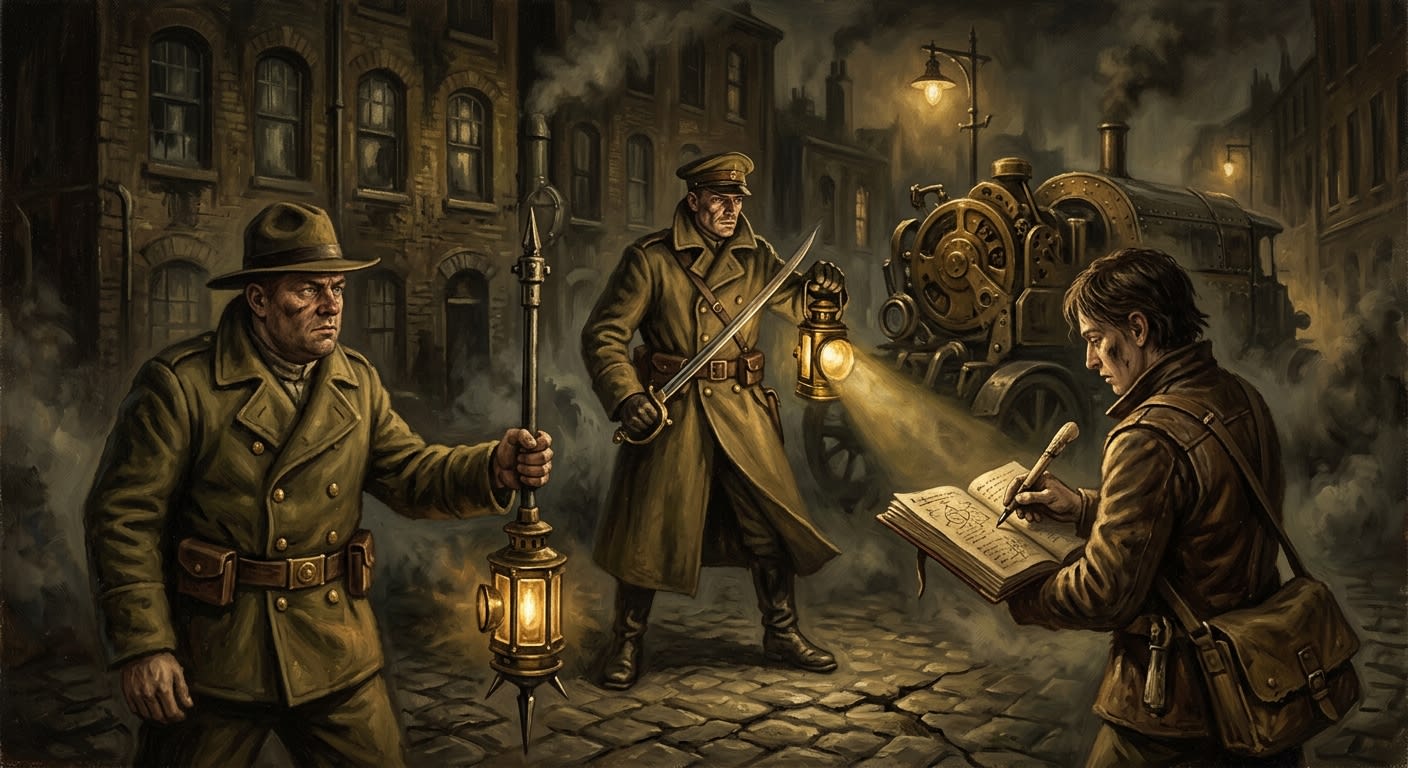
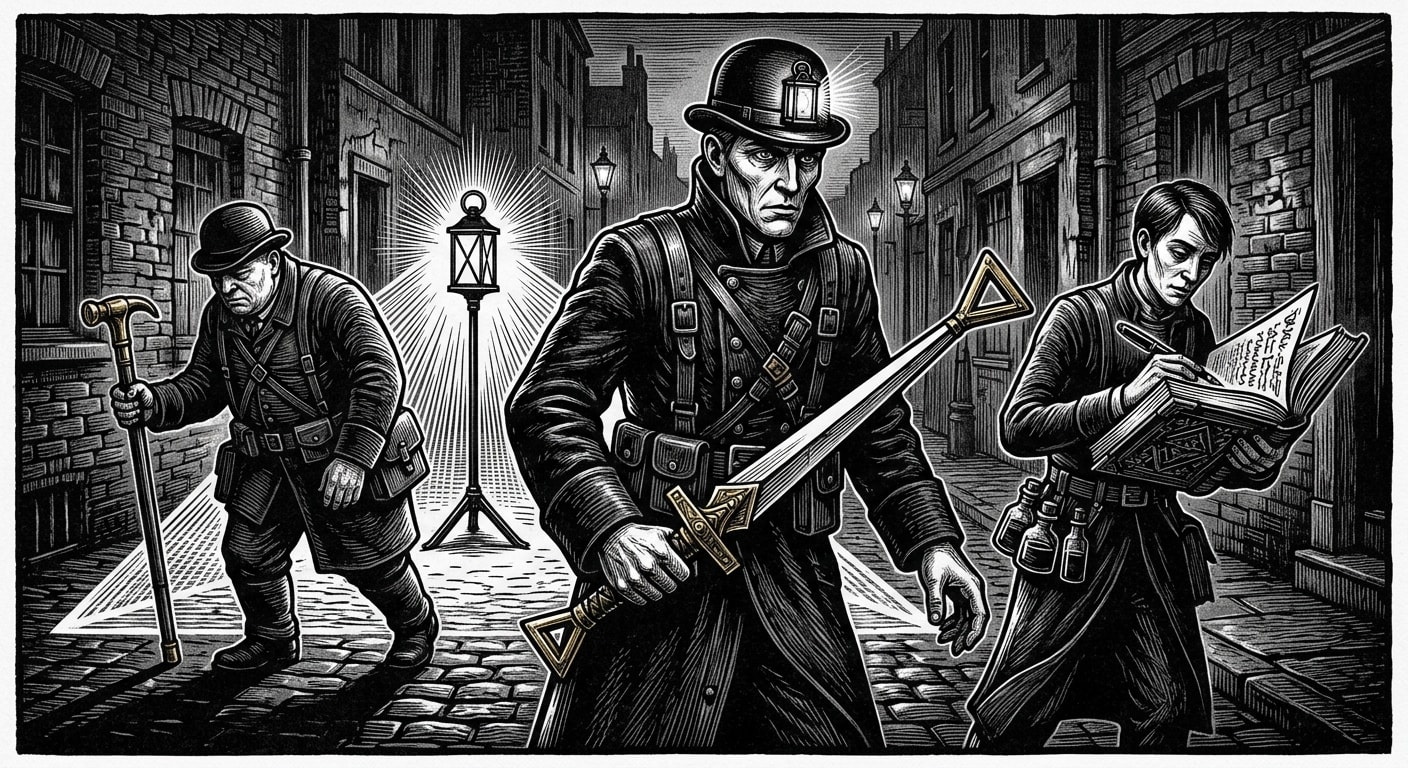
The Triangle of Witness is the patrol doctrine by which the Lantern Brotherhood makes night legible enough for courts, frightened enough for markets, and false enough for government. It is a simple arrangement, which is the first mark of danger. One lantern stands. One pair moves. One watcher writes. Anchor, Blade, Echo: three positions, three signatures, one report arriving at the clerk's desk with the smug geometry of a thing that has already forgiven itself.
The Brotherhood calls it witness. The Bureau calls it auxiliary corroboration. The alley calls it being surrounded.
The Triangle descends from Anselm Rihn even where no Brotherhood manual admits the genealogy. Rihn taught the Rhineland that curfew is a road folded into time; the Brotherhood merely added knives and bad lungs. A road requires fixed points. A curfew requires visible permission. A seizure requires a story stout enough to survive a tired clerk, an angry widow, and one half-sober Warden-Captain who wants the matter closed before Matins. The Triangle supplies all three.
It began as street sense. Wardens held gates and broad squares; Brothers held alleys, markets, stairwells, ossuary lanes, rope-roads, and those bad little gaps between lawful jurisdictions where sin breeds with excellent civic instinct. A single lantern could be rushed. A pair could be bribed. A crowd could deny seeing a thing after seeing it clearly. Three lights, placed so that each made the others plausible, turned alley work into file work. File work survives dawn.
#On the Anchor
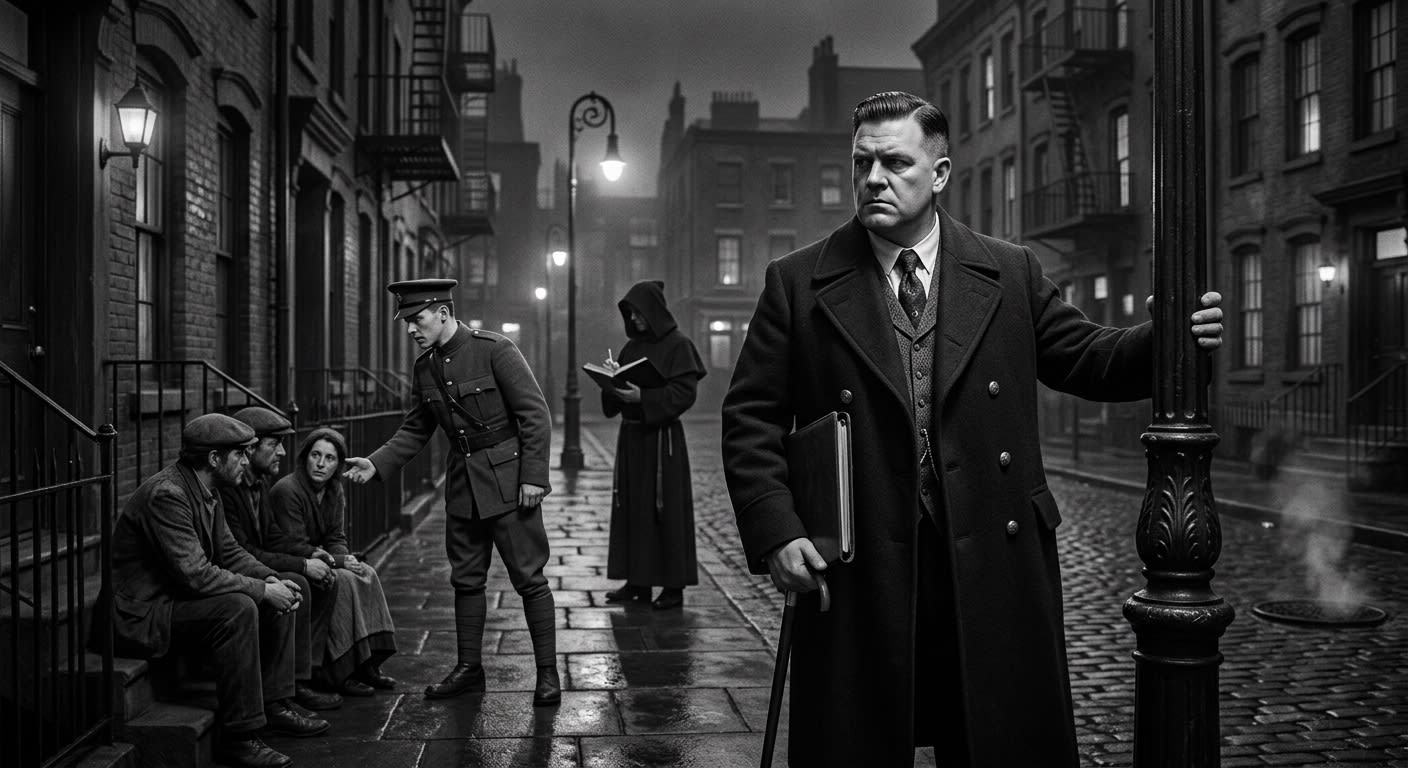
The Anchor is the visible lantern at the choke-point. He stands where everyone can see him and where movement must choose to pass, turn, wait, or confess itself by hesitation. In the Circle of Nine Wicks, the Anchor stands at the bread-hall mouth with the lantern hood half-open, shepherd's crook across the wrist, citation slate held like a poor man's Gospel. In rope-road districts he waits at the stairhead. In ossuary rings he stands where candle lanes narrow between bone carts. In bell-dead zones he is sometimes marked only by a lamp-glass whose glow refuses to move.
Visibility is his office. Immobility is his threat.
The Anchor need not seize. He need not search. He must be seen, remembered, and named. His lantern tells the queue that Order has arrived in the cheapest possible form. His slate tells the clerk that a fixed point existed. His feet tell the Blade where the mouth of the trap lies. A citizen who later claims confusion must answer the simplest question in enforcement theology: if there was no warning, why did you change direction when the lantern rose?
Among Nine Wicks, a skilled Anchor can discipline a queue without touching it. He narrows his lamp hood, and shoulders settle. He taps the slate, and hands leave pockets. He shifts the hook from left wrist to right, and three men with bad flour decide they remembered another errand. Such power is theatrical, which does not make it false. Theatre is how the state saves on cavalry.
#On the Blade
The Blade is the moving portion: usually two Brothers working the line, the alley, the stair, or the stall-side pressure. The singular name is deliberate. Two bodies, one edge. They ask questions softly so the answer must be loud enough for the Anchor to hear and the Echo to claim. They check hands, sleeves, breath, lamp soot, pass folds, ration crumbs, boot mud, and the small betrayals by which the poor discover that hunger leaves evidence.
In market work the Blade performs politeness with impolite range. He asks a stallholder to uncover the sack. He asks a woman why her pass smells of candle grease rather than office wax. He asks a boy why his left pocket is heavy. The crowd learns that questioning can move through it like a knife through cloth: visible at the surface only when it has already passed.
Older Brotherhood catechisms state that the Blade exists “to discover offence.”
Corrected. The Blade exists to produce actionable pressure. Offence may be discovered, induced, purchased, misremembered, or carried from last week's drawer if the night has behaved with insulting legality.
The Blade has the highest corruption temperature because motion invites bargain. A stationary man receives petitions. A moving man receives offers. Bread, oil, safe corridor notes, hidden coin, sex, names, grief, threats against relatives, promises of silence: all present themselves to the Blade before the report dries. The Brotherhood's internal manuals preach discipline. The old soot-men preach division of proceeds. The latter sermon enjoys better attendance.
The Blade's virtue, where virtue survives in that rank, is restraint. Draw one body from a queue without making the queue a mob. Seize one package without scattering every package. Frighten one liar hard enough that three others become honest by proximity. A bad Blade creates incident. A good Blade creates compliance. An excellent Blade creates witnesses who believe they chose to cooperate.
#On the Echo
The Echo is the third light and the first report. He watches from a stall awning, loft vent, shutter crack, roof gutter, shrine alcove, rope-road shadow, ossuary slit, or one lane over with the patience of a spider granted municipal authority. He intervenes only when failure would become expensive. His principal tool is ink. His secondary tool is memory. His third tool is the cowardice of everyone who knows he may have written their name already.
The Echo writes before the accused understands the shape of the accusation. This is not haste. It is sequence discipline. The first report owns the event's spine; later objections become ribs attached at disadvantageous angles. By the time a detained person reaches a Warden room, the Echo's account has already described posture, object, phrase, lamp position, crowd response, and the useful absence of witnesses who might have complicated the matter.
ECHO TRAINING LEAF — DISTRICT COPY, PARTLY BURNED If the Blade finds nothing, write the name. If the Anchor saw no crossing, write hesitation. If the crowd denies sound, write silence-pressure. If the accused has no object, write probable transfer to ███████████████. If mercy intervenes, mark Consolator contact and route to █████████████████.
The Echo gives the Triangle its afterlife. The Anchor terrifies the present; the Blade handles the body; the Echo governs tomorrow. He makes future seizure lists. He notices who leaned away, who stared too long, who refused to cheer at Queue Penance, who whispered after the lantern passed. In A.S. 199, Standing Order 14-V confirmed what every market already knew: the Echo's shadow report may justify later search when combined with Anchor placement and Blade contact. Three small permissions become one large hand.
Among the Mercy Preacher files, Echo notes are especially treacherous. A Consolator's approved phrase may be clean; the Echo records tone. A fog sermon may contain no false word; the Echo records who relaxed while hearing it. Purity loves such notes because they smell of inference. Doctrine dislikes them because inference, like soup, becomes cloudy when too many men stir it.
#On Bread-Halls, Ossuary Rings, and Bell-Dead Alleys
The Triangle changes costume by Circle. Nine Wicks uses it to hold queues, sell light-permit fictions, and keep contraband discoverable at profitable intervals. The Anchor stands at the bread-hall mouth; the Blade moves through the sacks; the Echo writes from the shrine alcove above Saint Varr's permit drawer. Bread obeys geometry better than men do, chiefly because bread lacks relatives.
The Circle of Ashen Steps adapts the Triangle to ossuary rings. There the Anchor stands beside the candle tally, counting household flames. The Blade checks funeral carts, wax seals, and body tags. The Echo watches the mourners, marking which family looks relieved by a closed coffin. The doctrine is simple: grief produces blind spots, and blind spots are where bodies acquire better destinations.
Rope-Road Lanterns place the Anchor below, the Blade above, and the Echo where pulley shadows cross the wall. Height turns testimony into blackmail. A man seen crossing between wards after the Ninth Peal may be cited, taxed, protected, ruined, or preserved for later usefulness. Gravity handles the sermon.
Mute Radiance performs the Triangle in silence. Anchor lamp. Blade hand-code. Echo mirror-flash. In bell-dead zones, where sound behaves like a clerk avoiding responsibility, the Triangle becomes almost beautiful. No shouted warning, no public speech, no quarrel for neighbours to embellish. The report still arrives. Silence, properly staffed, is never empty.
Stained Proof deploys the Triangle around relic-workshop lanes and cathedral outskirts. Their Anchor buys time with visible sanctimony. Their Blade enters as buyer, penitent, or inspector with a thumb already near the seizure tag. Their Echo watches which apprentice sweats before the reliquary lid opens. One beautiful thing often vanishes afterward. The Triangle proves the seizure was orderly. It does not prove the disposal was honest. Do not ask Relics to define honest while silver is in the room.
#On Courts, Clerks, and the Manufacture of Agreement
A Triangle report is designed for exhaustion. This is its bureaucratic brilliance. Trench-court clerks, Warden assistants, Purity intake readers, and Records copyists do not want philosophy at dawn. They want positions, times, names, object description, pass status, witness marks, and a story whose corners align. The Triangle gives them corners.
The report form descends by habit from Rihn's route logic: fixed point, moving force, confirming record. Anchor statement fixes place. Blade statement fixes contact. Echo statement fixes narration. Where these align, the file feels true before anyone has inspected it. Where they fail to align, the Brotherhood calls it fog, crowd pressure, lamp failure, hostile movement, or mercy interference, depending which excuse has room left in the margin.
A Bureau of Records training sheet describes Triangle testimony as “three independent observations.”
Corrected for accuracy. The observations are coordinated, mutually reinforcing, and trained toward agreement before the shift begins. Independence is a luxury; admissibility is the working sacrament.
This does not make every Triangle report false. Falsity would be simpler and less useful. Many are accurate. Many prevent knife fights, food riots, relic theft, sermon contagion, and those night disorders that grow teeth when unobserved. The danger lies in the doctrine's appetite. A tool that can record truth can also pre-arrange it. The difference is often a Wick-Sergeant with an oil debt.
The Bureau of Purity trusts Triangle reports when hunting variance and distrusts them when defending prerogative. Records trusts the form because the form has boxes. Tithes trusts any doctrine that keeps market windows intact. Shadows trusts nothing, which is why Shadows survives its own competence.
#On the Oil-Confession and the Lie Filed Before Patrol
Before some shifts, especially among older Circles, Brothers perform the Oil-Confession. Each washes his hands in lamp oil, names one fear, and names one lie told in service of vigilance. The lie is catalogued, not absolved. This distinction has caused nervous laughter among novices and a healthy silence among veterans. The catalogue remains in the Wick-Sergeant's custody, and any request to inspect it is answered as spiritual overreach by men who otherwise sell darkness by the hour.
The Oil-Confession reveals the Triangle's private theology. The Brotherhood knows its doctrine bends. It knows the Anchor exaggerates, the Blade pressures, the Echo sharpens, and the report may walk farther than the fact. The rite does not cleanse this. It makes the participants complicit in knowing it. Shared guilt binds more tightly than shared oath because guilt has better memory.
A Brother who cannot tolerate the rite becomes a Purist, a drunk, a corpse, or a Mercy sympathizer. A Brother who tolerates it too well becomes a checkpoint wearing boots.
#On the Present Use and Proper Distrust
As of A.S. 201, the Triangle of Witness remains active across Lantern Brotherhood practice in Zones 1 through 5, with local deformations wherever geography, hunger, bells, fog, or bribery have improved upon the manual. Its legal ancestry runs through the Curfew Ordinance, its tactical habit through Rihn's route mind, its market face through Nine Wicks, and its moral infection through every night when a city prefers reportable calm to visible justice.
It should not be abolished. I despise sentimental reform almost as much as I despise amateur cruelty, and abolition would give alleys back to worse men with poorer forms. It should be distrusted professionally, audited without warning, cross-read against Warden logs, and never accepted where the Echo's ink arrived too clean. The Triangle is a lantern arrangement, not a relic. It does not become holy because three frightened citizens nodded beneath it.
The night remains what it always was: a long office with bad lighting. The Brotherhood walks it with ash-oil lamps, soot lungs, local licences, unpaid debts, and the old conviction that a citizen seen from three angles belongs to the file. Sometimes the file saves him from the mob. Sometimes the file eats him before dawn.