
#On High Walks and Hanging Light
The Circle of Rope-Road Lanterns governs the city from above, where virtue is thinner and falling remains the most persuasive argument ever devised.
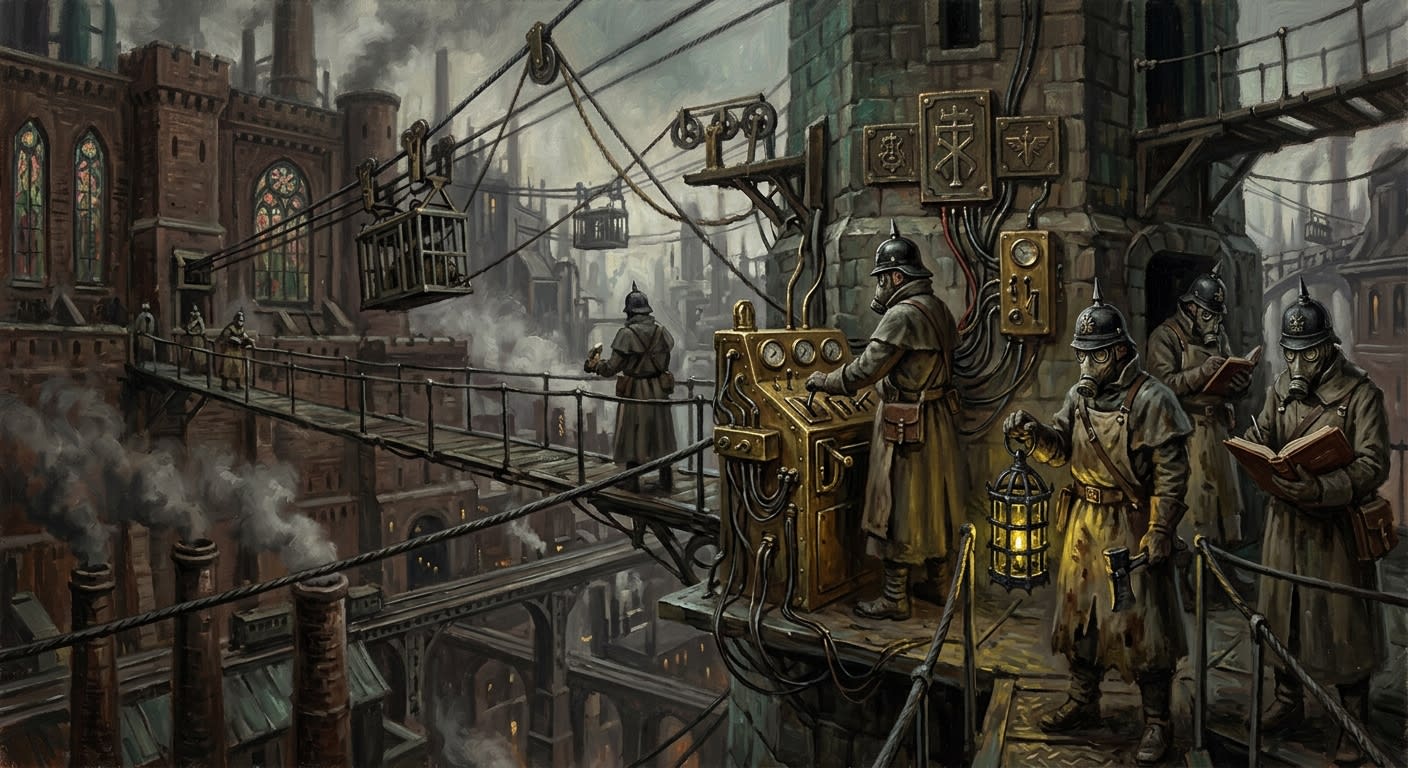
Their territory is the elevated rope-roads (Unregistered), pulley bridges, stacked walkways, cargo slings, inspection gantries, bridge-cords, and customs lanes that hang above bastion streets like a set of clerical corrections written in hemp and iron. Beneath them move citizens, carts, Wardens, corpse-wagons, ration queues, and the whole offended metabolism of the city. Above them move coffins, bread, salt pork, reliquary crates, illicit bundles, official bundles more illicit than the first kind, and men who have paid not to be seen paying.
Within the Lantern Brotherhood, the Rope-Road Lanterns claim a public mandate to control vertical movement and make accidents useful. They descend from the same A.S. 94 toleration clauses as the Circle of Nine Wicks and Circle of Ashen Steps, but their work belongs to the upper city: where a missed knot becomes providence, where a cut line becomes testimony, where gravity itself appears willing to serve as junior clerk.
#On the Rope Roads
The Rope Roads are the strangest arteries of the Spine. Suspended above mud, trench, canal, courtyard, and bastion gorge, they carry the war in swaying parcels: coffins beside ration crates, reliquaries beside salt barrels, wounded men lashed like cargo, conscripts strapped under tarpaulin and told not to scream because screaming upsets the pulley rhythm. The Bureau of Orison and Song has codified Rope Road Hymnals (Unregistered) to keep crews pulling in time. The pulleys sometimes sing back. The Bureau of Engineering denies this with the exhausted dignity of men who have heard it.
A rope-road is never simply transport. It is vantage. A man standing at a pulley bridge sees who crosses between wards after curfew, whose bundle is heavier leaving than entering, which widow visits which clerk, which priest avoids which checkpoint, which Warden carries a sealed box without a seal visible. The Rope-Road Lanterns sell this knowledge with admirable directness. They bait with passage. They sell the future moment when the passage becomes evidence.
#On Pulley Station Hark
Pulley Station Hark (Unregistered) is officially a bridge-inspection post. It has a maintenance ledger, a rack of authorised tools, a pulley-key cabinet, and three signs reminding workers that tampering with sanctified cordage carries penalties spiritual, civil, and immediate. Unofficially, it is the Circle's chapel, counting-house, threat-room, and theatre loft.
The upper platform is locked. Behind that lock are shutter-lanterns, grapnels, sling-cord evidence bags, rope knives with devotional notches in the handles, and the blackmail wall: a chalked surface recording who crossed, when, with whom, what they carried, and which detail would damage them most if repeated in a voice of civic concern. The wall is wiped at dawn. The information is not. By breakfast, selected crossings have become anonymous tips to Wardens, convenient rumours in ration queues, or private summons written with the politeness of a hand already resting on a knife.
PULLEY STATION HARK — UPPER PLATFORM INCIDENT, A.S. ███ Inspection team discovered chalk list containing ███████████████ names, including two Warden-Captains, one Shrine-Assessor, and a child registered dead in the previous quarter. Team leader ordered temporary sealing. By Matins the wall had been wiped. The team leader later fell from a stair with handrails on both sides.
#On the Drop Test and Light Angles
The initiation rite is the Drop Test. The candidate cuts a weighted pouch from a rope at a precise moment so that it lands in a marked circle below. Miss the circle and the candidate repeats the exercise until hunger, terror, or aptitude corrects the hand. The lesson is doctrinally elegant: the smallest choice made above becomes fate below. The Bureau of Doctrine could preach that for an hour and do worse.
Patrols operate in pairs plus a trailing Spark (Unregistered). The Spark never looks down. This is the whole office. While the pair searches forward, checks knots, silhouettes suspects, and extorts the night into legibility, the Spark watches behind for blades, rivals, informants, loose saints, and citizens with the deranged courage of the injured. Lantern shutters create light angles that throw a suspect against wall, cargo net, or bridge plank in profile. A hidden bottle becomes a silhouette. A folded paper becomes a rectangle. A guilty posture becomes whatever the Circle needs it to become.
Favoured punishments preserve the Circle's grammar. The Rope Lesson makes an offender cross a bridge on knees under public view, terror training for the offender and entertainment for the city, which has always enjoyed education more when someone else is receiving it. Netting suspends the offender in a cargo net over a courtyard, low enough to hear laughter, high enough to imagine death carefully. No injury is required. Fear leaves cleaner paperwork than blood.
#On the Accident Window
At midnight the Circle conducts what its schedule calls the accident window. Selective drops. Selective rescues. A sling-crate of contraband falls where Wardens can find it. A courier stumbles into a net long enough for his satchel to be searched and resealed. An agitator crosses the wrong span in the wrong wind and learns that rope has opinions.
Prior Brotherhood memoranda describe all rope-road falls during curfew as “transport mishaps under adverse height conditions.”
Corrected. Several height conditions appear to have been men with knives.
What the Rope-Road Lanterns trade for toleration is interception often enough: smuggled sling-crates seized at dramatic intervals, fugitives caught between wards, illicit relics discovered in parcels that were permitted to travel just far enough to incriminate their recipients. Their failures are explained by wind. Their successes are explained by vigilance. Their murders are explained by wind again.
The Bureau of Shadows appreciates the Circle because high places collect secrets without requiring architecture. The Bureau of Purity dislikes them because blackmail competes with confession. The Bureau of Tithes likes the revenue, dislikes the leakage, and has written memoranda in which both positions occupy the same paragraph without embarrassment.
#On the Fall List
The Fall List is the Circle's toleration-killer: a hidden roster of people “helped fall” off rope-roads on command. Murder-for-patronage is the impolite phrase. The Circle prefers “vertical removal under civic necessity.” The dead, being dead, rarely object to nomenclature.
Names enter the list through favours owed upward: a guild witness, a troublesome widow, a clerk who counted too carefully, a Mercy Preacher whose sermon made three alleys quieter than doctrine allows. The method varies. A bridge-cord frays after inspection. A boot-iron slips despite fresh pitch. A shutter-lantern blinds at the precise second a man reaches for a guide rope. The report cites wind, panic, poor maintenance, unlawful haste, divine warning, or any combination suitable to the reader's rank.
If one widow obtains the Fall List, the Wardens will erase the Circle to protect public order from the vulgar discovery that public order has suppliers. The Rope-Road Lanterns know this. They keep copies. Sensible criminals always do.
#On Useful Heights
The Circle remains tolerated because the high walks must be watched. Rope-roads feed bastions. Pulley bridges move bodies faster than streets. Stacked catwalks let cities function after curfew, during flood, under shelling, amid the ordinary congestion produced by a civilisation that has mistaken queues for sacrament. Someone must stand above and count.
So the Rope-Road Lanterns count. Crossings become tips. Tips become pressure. Pressure becomes quiet. Quiet becomes Order, and Order, as every Bureau knows, is the holiest name ever given to fear wearing a clean collar.