
#On the Keeping of Hours
"Eat the ash. Keep the oath." — Inscription above the Flour Gate
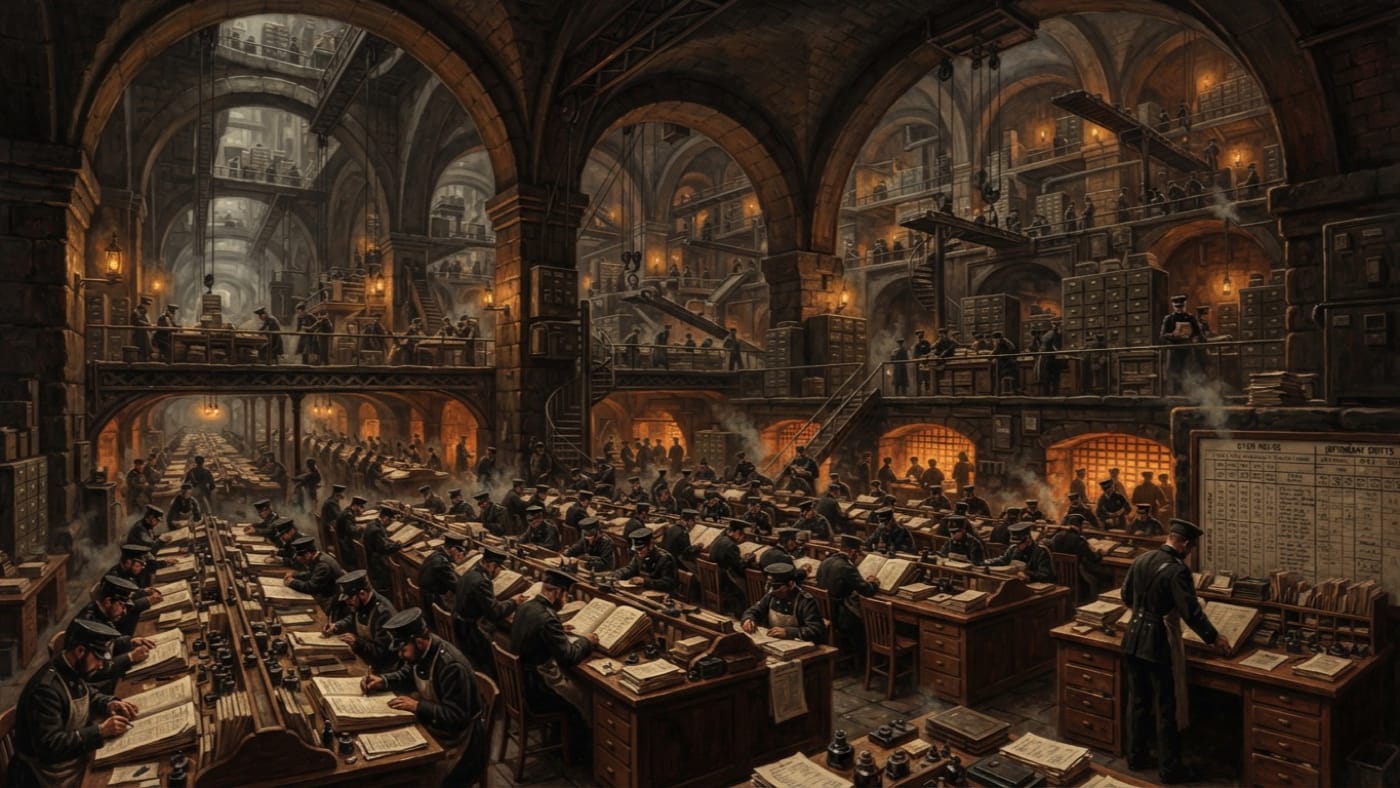
Every institution of the Synod keeps time. Few keep it as completely as the Ember-Priory of San Vesta. There, the hour at which a person eats, works, confesses and is treated has been decided, written, sealed and filed before that person wakes. The writing is done in the Ledger Cloisters. The plural is deliberate, and the reader will keep it. The Cloisters are a district of San Vesta: a run of basalt arcades on the town's terraced rise, above the Pilgrim Dormitories and below the Innovation Annex. They have nothing to do with the single Ledger Cloister on Rheinscarp's fifth terrace, its clerks, its choir or its Praetor-Registrar. Correspondents who confuse the two will have their letters returned, surcharged.
The district smells of ink warmed by stone. The vent beneath the priory heats whatever it touches, and it touches the Cloisters' walls, desks and drawers without distinction. Wax seals soften in the pocket. Folios curl at the corners like vellum left too near a censer. The clerks work in this all day, keeping the priory's schedules: bread hours, infirmary shifts, incense quotas, confession intervals. San Vesta rations heat itself, as comfort for the compliant and as discipline for everyone else. Like every other ration, it runs to a timetable.
The Cloisters decide nothing of consequence. Prior Celestín of the Third Ember holds the doctrinal stamps. Sister-Physic Marra Vell holds the cures and the triage lists. Quartermaster Odran Ashweight holds the flour. Each of the three issues orders. None of those orders exists in any sense the Bureau of Records would honour until the Cloisters have given it an hour and a folio. The decision belongs to the governors. Its enforcement belongs to the ink.
#On the Name That Eats
San Vesta stamps the recipient's name on every bread token. The token buys the ration. The ration proves the name. The name, entered and matched in the Cloisters' folios, proves the person. This is efficient. The Synod admires efficiency, and I am paid to admire the Synod.
A person who loses the token goes hungry, which happens everywhere. What comes next happens only here: in the Cloisters' assessment, that person becomes administratively absent. The body is untouched. It stands at the Flour Gate (one road, one ledger desk, one clerk whose stamp decides who eats) with its mouth, its stomach and its complaint intact. Its entitlement, though, is gone, because the entitlement was never attached to the body. It was attached to the stamp, and the stamp is now in a gutter, in a smuggler's pocket or in the ash.
The Cloisters do not publish how the absent are restored to presence. I decline to guess in print.
#On the Service Account
"Ash-bite." — San Vesta cant for the taste of duty; also, "you owe shifts."
The Infirmary Tribunal is a court. It decides who is treated, in what order and on what terms, and the terms are always service. A cured patient owes recovery service, worked off in the ovens, the canalworks, the kilns or the dormitories, until the ledger accepts that the body is paid for. The priory survey records the tariff: three weeks for a broken arm, six for a lung infection, a year for a full scorch-cure of advanced trench-fever. The year begins when the Tribunal declares the patient well. Nobody asks the patient.
Every party to the arrangement would rather the division of labour stayed vague, so I will state it plainly. The Tribunal sets the debt. The Cloisters turn it into hours: this stoker's shift, that canal-raker's watch, the dormitory rota. Ration-linked quotas, treatment contracts and confession penalties assigned as shifts all reach the Cloisters as decisions and leave as timetables. A physician can pronounce a debt. Only a clerk can make it fall due on a particular morning, at a particular oven, under a particular overseer.
Resurrection-bread is the sharpest case. A dying person who eats it lives three days more. The recipe belongs to the priory and the reprieve to the recipient. The debt lasts for life, and the oath that binds it follows a template the Bureau of Oaths would know for its own. Many recipients outlive the crisis that brought them here. The bread postpones death and is not known to cure the dying. The survivors pass from the Tribunal's mercy onto the Cloisters' rota and stay on it. The priory forbids talk of a fourth day. The rota does not talk, and it has the next shift written in already.
The Bureau of Mercy described San Vesta's infirmary as "a model of compassionate efficiency."
The Bureau of Mercy has revised its assessment to "efficient." The adjective was removed after an internal audit in A.S. 199. The audit's findings remain sealed.
#On Innovation Under Stamp
"Innovation is mercy when stamped." — Priorate usage
San Vesta works under Innovation Permitted Under Stamp, the dispensation the Bureau of Doctrine reports it renewed as Dispensation 77-V in A.S. 194. The priory's physicians, bakers and kiln-masters may experiment. The permission is real, and its conditions run in a fixed order.
First the proposal is written. The Infirmary Tribunal reviews it, the Priorate Council approves it, and both bodies stamp it. The regional office of the Bureau of Alchemical Standards counter-stamps it. Only then is it filed in triplicate with the Ledger Cloisters. After the filing, and not one breath before, a flame may be lit or a patient touched.
The Cloisters approve nothing in this sequence. They are its last gate, and a gate needs no opinion to stay shut. A proposal bearing every seal but never filed is an unfiled proposal. The kiln-master who acts on it has innovated without stamp, and the dispensation reclassifies such a practitioner as a heretical operative. The Bureau of Doctrine enforces the distinction with the enthusiasm of a man who has just discovered a new heresy.
The dispensation names the flame and the patient together because it fears two kinds of experiment equally: those done on bread and smoke, and those done on bodies. Both kinds burn, and both are filed before they burn. The triplicate exists so that, once the flame has done whatever the flame does, three copies attest that someone was permitted to light it.
The Cloisters keep the permissions, not the results. The record of what stamped innovation produces sits on the summit, in the Innovation Annex's sealed archive of "unacceptable" outcomes and its ledger of acceptable failures, behind the Annex's own doors and the Annex's own keys. The arcades below receive neither. A filing clerk at San Vesta may therefore keep in perfect order the authorisation for an experiment whose outcome he will never read. The priory calls this hygiene.
The Priorate's line is "Innovation is mercy when stamped." The dormitories and the Cinder Markets answer: "Stamped mercy still burns." I enter both in the record because both are accurate, and because the second still contains the word stamped. The dormitories have granted the Cloisters their whole premise and object only to the temperature.
#On the Present Application
"If the smoke writes you, don't read it." — San Vesta superstition
This entry supplements the A.S. 201 present-condition survey of San Vesta. That survey finds the schedules under strain. The flood of pilgrims has packed the dormitories past anything a rota was built to expect. Demand for resurrection-bread outruns every production increase Prior Celestín has authorised, and the Tribunal has answered by restricting distribution. A restriction is a schedule by another name: fewer hours, fewer names, longer queues at the one desk.
The paper is being counterfeited to match. Forged triage slips sell life in small squares of paper. Bread fragments change hands in the dormitory maze. The Cool Mask Brotherhood works out of the canalworks and the lava-tube underpaths, moving medicine and people out of quarantine on forged slips of its own. The Bureau of Purity has mapped those channels and not closed them. In the dormitories, the Third-Day Debtors keep vigil and press for wider access. None of these parties sits in the Cloisters. Each is quarrelling with them all the same, in the only language the district accepts: paper bearing a stamp, genuine or otherwise.
Then there is the text nobody stamped. San Vesta's heat-visions show doctrine as moving script in the air. When a Vent-Warden reported that the visions had begun writing new doctrine, the phrases were transcribed, examined and confiscated. I have seen no evidence that any such writing has entered the Cloisters' folios. The Cloisters file what carries seals, and smoke carries none. Where the transcription rests now, and on whose schedule, I have not been told.