
#On the Posthumous Honour
A.S. 201 — a current survey of the register's attested use; its opening year is unknown.
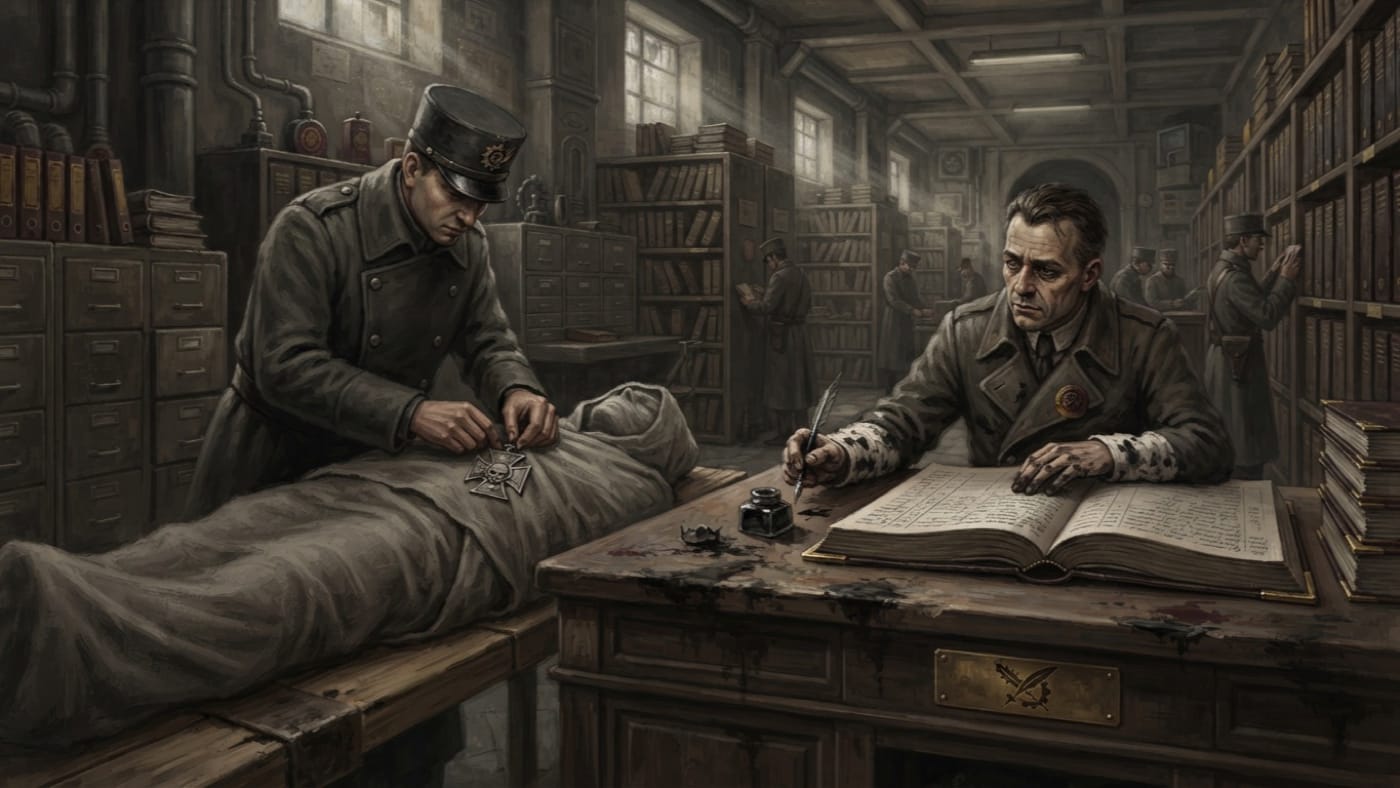
The Bureau of War strikes one medal for surviving a charge and another for dying in one. The second is presented to the corpse. An attendant pins it through the shroud, because the tunic beneath has usually been cut away, burned, or reissued to someone still breathing. A clerk then enters the decoration in the Ledger of Honourable Dust. That is the whole rite. I have watched it performed in under a minute, with a queue.
The Ledger records honour given to the military dead. It does not register the death itself. That belongs to another book and is filed by other hands. The Ledger records that the Synod looked at a particular corpse, decorated it, and wrote down that it had done so. The soldier is buried with the metal. The page stays above ground.
I find the arrangement beautiful. A medal on a living man is a wager. He may yet desert, blaspheme, or live long enough to complain about his pension. A medal through a shroud has settled all its accounts. The recipient cannot embarrass the award.
#On War's Record
The Bureau was founded in A.S. 105 under the Charter of Crimson Ink, whose public articles provide for the record of battle, of martyrdom and of authorised loss. The Charter does not name the Ledger of Honourable Dust. Nobody has shown me the order that opened it, the hand that made its first entry, or the shelf where its earliest volume rests, and I do not invent shelves. I can say this much: War had decided to keep the record of its own fighting, so it was never going to leave the record of its own dead to parish sextons.
Go down beneath the Arch of Campaigns in Strasbourg and you will find the medal office and the funeral correction office. They share a wall, a stationer and a filing system. A soldier may enter one as a casualty and leave the other as a martyr, with a decoration through his shroud and a revised cause of death that flatters the terrain. The shared stationer is the detail I treasure. Both offices draw ink from the same order book, and nobody downstairs thinks this remarkable.
The division of labour is simple. War produces the campaign account, recommends the medal and proposes the funeral language. The Bureau of Records keeps and revises the entries. The Bureau of Doctrine rules on what the words mean. Every office touches the dead soldier except the one that carried him to the stretcher. The stretcher-bearers keep no files.
#On Decorations and Classification
War decorates with appetite. The citations on record honour "strategic mud participation," "sustained devotional endurance under artillery," and "voluntary exposure to relic-ash inhalation." I give them exactly as written. The Bureau's prose needs no improvement from me, and I will not give its medals names it has never published.
A decoration, a casualty classification and a designation of martyrdom are three different instruments. Families who confuse them pay for the confusion.
The decoration says the Synod approves of how the man died. The classification says what kind of loss he has become, and the state's obligations follow from it: notice, inventory, burial and pension. Martyrdom is another matter again. It belongs to the Seal of Martyrdom, which receives War's recommendations and decides what the parish may lawfully say. A medal through the shroud does not make a saint, and it certainly does not make a relic. Mothers who bring a son's decoration to the reliquary offices are turned away politely, and with forms.
The Ledger is also separate from the Book of Departures, the Church's distributed register of lawful death. That book is assembled from cathedral reconciliations, parish returns, hospice slips and bastion casualty annexes. The Book of Departures records that a man died. The Ledger of Honourable Dust records that his death was decorated. A soldier may appear in both books or in only one. They have different bindings, and any petition you hope to see approved should keep them in different sentences.
#On the Danubian Revision
The method is easiest to observe in a case where the arithmetic survived.
In A.S. 172, on the Danubian forward corridor between Budapest and Bastion-Irongate, the Vexillators of Strasbourg forced three crossings in a single charge. War declared it a miracle of locomotion. The Bureau insists the men did not swim. They were carried. The Night of the Three Bridges produced a supply column on the eastern bank, a great many medals, and a casualty roll that would not hold still.
Earlier dispatches recorded 4,200 casualties: dead, drowned, missing, frozen, or otherwise removed from formation.
Revised by the Bureau of Records after War petitioned for doctrinal review. 1,800 are retained as casualties. 2,400 are reclassified as translations to glory mid-crossing. The total remains 4,200. Families may apply for commemorative ribbon in lieu of pension under Form 172-Bridge-G.
Read the erratum twice. It did not raise, find or return a single man. The river kept what it kept. Only the column headings moved.
Under ordinary processing, a casualty obliges the state to pay compensation, calculate a pension, notify the family, inventory the man's effects and allocate a grave. A translation to glory is an official classification expressed in devotional language. For these families, its documented consequence was a ribbon offered in place of a pension. I do not certify what becomes of a translated soldier. Doctrine has filed the phrase. Reading phrases is the limit of my competence.
I will not tell you that the 2,400 are written in the Ledger of Honourable Dust. The sources I hold do not say so, and I do not manufacture pages. I offer the Danube because it shows the same offices working the same material. A death becomes a decoration. A heading in a column decides what a mother may draw from the paymaster. The shared wall beneath the Arch was built for exactly this traffic.
#On the Family's Copy
The family receives the body, if there is a body. They receive the medal pinned to it, which they may remove before burial or leave in the cloth for the earth. They receive notice of the classification. They will not be able to read it without help, and their parish clerk will not be able to explain it without asking a superior.
This is where the Ledger shows its quality. The decoration is designed to outlast its recipient. The metal is struck to outlast a coffin. The entry is copied and recopied by clerks with ink on their cuffs and wax under their nails, and Records audits it until it cannot drift. The honour is permanent. Everything else attached to the man can be revised, including the column that decides whether his widow eats.
A family seeking a correction soon learns which document governs. The medal governs nothing. It is evidence that the Synod was pleased, and the Synod's pleasure is not a payable category. The classification governs the purse. When the classification moves, the decoration stays exactly where it was, pinned and recorded. A household that had been owed a pension finds itself holding a ribbon and an honour that nobody disputes.
The Danubian families keep their ribbons in drawers. I am told that some keep the application form beside the ribbon, folded in three, as though it might be refiled.
I have stood at the counters where these questions are asked. The petitioners bring everything they have: the letter of notice, the parish stub, and the medal itself, wrapped in a handkerchief to keep it bright. They believe the metal is proof. It is. It proves he was honoured.
#On Continued Use
War does not let an approved account sit idle. The words it proposes for its dead return as sermons, commemorations and school recitations, and from there they reach the musters. After the Danube, levy officers invoked the crossing on the mustering fields. The authorised formula was to be repeated at musters, at commemorations and at levy inductions. The Continental Levy, decreed in A.S. 110, takes one son in ten from every household. It takes them more easily when those households have heard what becomes of sons who die well.
I record this with admiration. A lesser institution would spend its dead once. War spends them in the mud and then again at the muster, where the decorated name recruits the next boy. The Sagittal Line needs bodies without pause. A decoration costs a few grams of metal and a minute of a clerk's time, and it keeps earning for a generation.
So the attendant comes with the pin, and the clerk opens the book, and the shroud is pierced once, cleanly, at the breast. The man inside has no further obligations. The Bureau has several.