
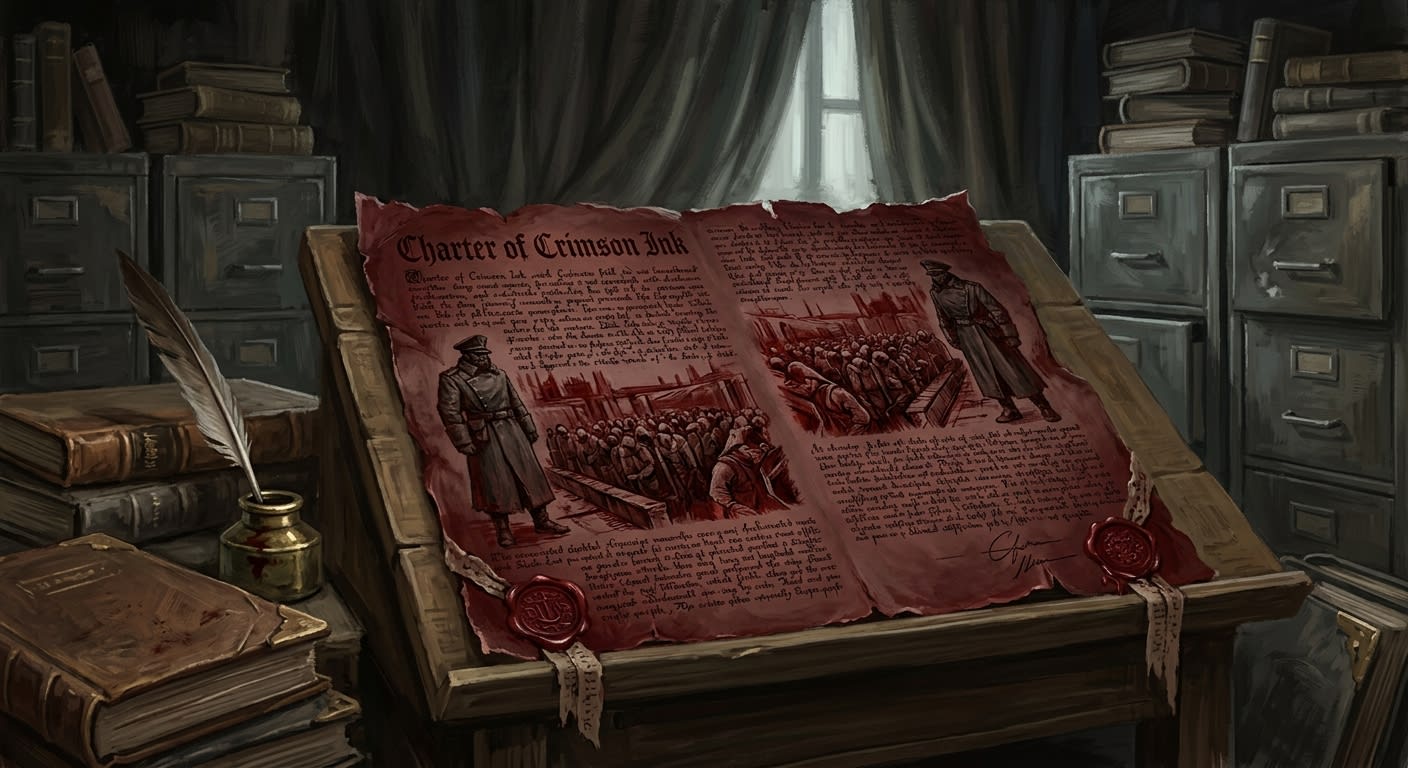
#On the Writ That Taught Europe to Bleed in Order
The Charter of Crimson Ink was sealed in A.S. 105, in Vienna's ash and Strasbourg's appetite, to solve a scandal that had embarrassed the Faith for ninety-five years: armies kept existing before they had been properly owned. Lords raised men. Bishops blessed them. Cities armed militias, guilds hired pikes, pilgrims swung farm tools, and every desperate captain called his panic a holy mobilisation. The result was courage without schedule, martyrdom without procurement, and victory whenever Providence was willing to compensate for incompetence.
Providence, being divine, is not obliged to serve as quartermaster.
The Charter answered with a permanent instrument: the Bureau of War, charged with raising, equipping, drilling, rationing, certifying, deploying, recalling, praising, burying, and spiritually laundering all military force beneath the Synod's banner. Men had fought for the Faith before A.S. 105. After A.S. 105, they fought through a form.
The ink was crimson by prescription. Not red, not carmine, not vermillion, not the theatrical gore of cheap martyr prints. Crimson: iron gall, ox blood, reliquary ash, and one mineral additive the Bureau of Records refuses to name because secrecy is cheaper than admitting a quarry can squeeze the army by the throat. The ink fixed the Charter's authority in a colour that resembled blood while behaving better than blood. Blood clots. Ink files.
#On Vienna's Ash and the Need for Ownership
The Charter did not emerge from serenity. No useful institution does. It came after the old faithful war-making apparatus had displayed, in campaign after campaign, the gallant uselessness of inherited command. Feudal lords arrived late and argued precedence. City militias demanded exemptions by ward, trade, feast day, and grandfather. Bishops blessed banners whose bearers had no boots. Mercenary companies sold bravery by the week, then renegotiated under shelling, which is the traditional mercenary sacrament.
Vienna's surviving clergy, and the officers who had learned arithmetic in the smell of burned grain, grasped the point: the Synod could not defend Europe by begging private men for public swords. It needed custody over violence itself. Custody is stronger than enthusiasm. Custody has shelves.
Provincial military histories credit the Council of Cologne with founding the Bureau of War.
Corrected. The Council ratified and repeated what the Charter had already sealed. A council may bless a sword. It did not forge this one. Vienna's ash did.
The Charter's first clauses stripped ambiguity from command. No levy could be raised outside Synodal writ. No campaign could proceed without War's seal and Doctrine's countersignature. No officer could claim purely noble authority in the field. No provincial arsenal could withhold arms from a duly certified requisition. No priest could declare a private crusade merely because his parish had become noisy with courage and poor judgement.
This was called centralisation by its enemies, discipline by its friends, and relief by anyone who had ever tried to feed five thousand pious amateurs in rain.
#On the Crimson Articles
The original Charter contained thirty-three articles. Records preserves thirty-one in public copy, thirty-two in restricted copy, and the thirty-third in a folio whose accession tag has been replaced by a polite blank space. The Bureau calls this preservation. I call it a locked mouth with excellent handwriting.
The public articles divided military authority into five obedient limbs. The first limb was levy: flesh tithed by household, counted by age, inspected by parish, delivered through provincial routes, and entered as offering rather than seizure. The second was armament: every musket, bell-cannon throat, hymn-drive housing, bayonet, ration tin, boot nail, mule collar, and trench shovel subject to War inventory. The third was command: officers certified by competence, oath, and theological examination, because a man who can read a map but not a catechism may win ground and lose meaning. The fourth was doctrine: every campaign to be interpreted before, during, and after action so that casualty, retreat, delay, frostbite, dysentery, and occasional success could be placed in their proper relation to Providence. The fifth was record: nothing had happened until Records could prove it had happened in a usable sequence.
The phrase “authorised loss” enters Synodal military vocabulary here. The Rationalists killed men and called it expenditure. The old princes killed men and called it honour. War, improved by Doctrine, killed men and called it authorised loss, which at least had the decency to admit a clerk had been involved.
The Charter also established the principle later sung in the Litany of First Earth: the soldier belongs first to the Creator, second to the Synod, third to the regiment, fourth to the family that surrendered him, and fifth to himself if any self remains after mud baptism, pay deduction, lice, and the attentions of Tribune-Chaplains. Families disliked this order. Families are sentimental units with poor strategic visibility.
#On the Ink Itself
The Charter's ink became famous because men are children before colour. Crimson signatures looked like wounds that had learned grammar. The first public copy, displayed for three days beneath guard, reportedly drew pilgrims who knelt before the signature columns and asked whether the page was a relic. The Bureau of Relics declined to answer until it could determine ownership.
The ink formula mattered. Standard black ink could fade, be altered, be scraped, or be alleged to have faded by provincial officials with suspiciously clean knives. Crimson Charter ink bit into vellum. It stained the reverse. It made amendment costly. A later clerk attempting unauthorised correction would leave a paler scar, and scars are what Records reads best.
Copies were not merely copied. They were propagated through authorised stain. Each regional military chancery received a charter-skin touched with wet crimson from the Vienna master copy. The gesture was theological theatre and administrative genius: every daughter copy claimed contact, every contact claimed continuity, every continuity claimed obedience. One page became a family. Unlike most families, it improved under supervision.
The phrase “Crimson Ink” later spread to other War recensions, campaign codes, warrant seals, levy certificates, execution permissions, and memorial rolls. This proliferation annoyed Records, delighted War, enriched ink contractors, and gave Doctrine a colour capable of making violence appear sacramental before the reader reached the verb.
A.S. 141 school primers state that the Charter was signed in the blood of seven martyrs.
Corrected. The authorised crimson contains ox blood and reliquary ash. No verified martyr blood appears in the master copy. The Bureau permits the schoolroom image in oral instruction, provided no child asks about supply volume.
#On the Bureau It Created
The Bureau of War grew quickly, as appetites do when fed by law. It received a seat beneath the Arch of Campaigns in Strasbourg, a crimson sash for its officer caste, a budget that made Tithes hiss through its teeth, and the impossible mandate of turning Europe's panics into an army that could stand along the Sagittal Line without dissolving into local heroics.
It did not create military intelligence, artillery, levy practice, chaplaincy, siegecraft, or the grim habit of telling young men that mud loves them. These existed already. The Charter gathered them, stamped them, ranked them, paid them badly, and made them answerable. The difference between a rabble and an army is not courage. It is whether the bread arrives with the right seal before the courage gets hungry.
The Bureau of Inter-Infernal Analysis illustrates the Charter's appetite for absorption. Founded in A.S. 94 by pre-charter military command, the office spent eleven years in three rooms studying the rivalries of the Sin-Generals before War swallowed it into directorate custody. This is the Bureau's genius: it discovers something useful already exists, declares that usefulness incomplete without War supervision, and annexes the chairs. Assessor-Tertiary Yrsa Haugen still corrects visitors who confuse the dates. She is right. She is often right in ways that injure hospitality.
The Charter also hardened the relation between War and industry. Three years after the Bureau's founding, a procurement officer arrived at Essen with seventeen writs and a mandate to produce steel of doctrinal purity, calibrated by hymn, in quantities sufficient to arm the Line. The guild-masters laughed. By Lent they had been absorbed. Laughter, like ore, is most useful after processing.
#On Resistance, Evasion, and Provincial Sulking
Every province obeyed the Charter eventually. The interval between eventual obedience and immediate compliance produced most of the early War docket. Noble houses attempted to reclassify household guards as devotional escorts. Town councils hid muskets inside festival wagons. Bishops claimed old crusade privileges. Three abbots in the Rhineland asserted that artillery housed on monastery land had become contemplative property. War sent inspectors. Doctrine sent explanations. Tithes sent invoices. The abbots discovered contemplation has recoil.
The Charter anticipated evasion with a clause of magnificent bluntness: any armed force not held under Synodal writ was presumed mutinous unless proven ceremonial, and proof of ceremony required disarmament. This ended the charming custom by which provincial cavalry called itself a procession when inspectors approached.
The cities resisted differently. They did not invoke honour. They invoked cost. Cologne demanded reimbursement for powder. Marseille disputed transport tariffs. Aachen, already preserved under penitential continuity after its A.S. 25 shame, paid promptly and complained through intermediaries, which proves disgrace can educate. Essen negotiated through output: if War wanted steel, War would accept furnace schedules, labour exemptions, and certain quiet accommodations in the Shard Markets. War accepted, then called acceptance temporary. Temporary arrangements that last ninety years are a Synodal art form.
RESTRICTED COPY — CHARTER ADDENDUM, ARTICLE XXXIII In circumstances of terminal provincial refusal, the Bureau of War may classify a loyal city as enemy-held for purposes of requisition, seizure, cleansing, or instructional bombardment, provided Doctrine supplies language before dawn. Usage record: █████████████████████████████ Review status: never initiated.
#On Its Present Authority
As of A.S. 201, the Charter remains active, cited, disputed, kissed in ceremonies, cursed in barracks, invoked in levy courts, and misquoted by officers who want more shells. Its crimson has darkened toward brown in the Vienna master copy. This pleases Records, which says darkening indicates permanence. It displeases War, which prefers colours that look fresh in parade light. Doctrine, with admirable opportunism, has declared the darkening a sign that violence matures under obedience.
The Charter's true power lies in its refusal to let war remain an event. War becomes office, schedule, doctrine, supply category, sermon, assessment, medal, widows' queue, school lesson, procurement priority, and budget fight. A battle ends. The Charter does not. It sits beneath every order like an old wound beneath a clean sleeve.
A soldier at the Line may never see the Charter. He sees the mud, the ration tin, the Tribune-Chaplain's teeth in winter, the bell schedule, the rifle whose serial number knows him better than his mother now does. The Charter sees him. It saw him before recruitment, priced him at levy, armed him by article, moved him by warrant, excused his fear as instructional weather, and will classify his death with a neatness his body cannot match.