
#On the Ledger That Receives the Last Breath
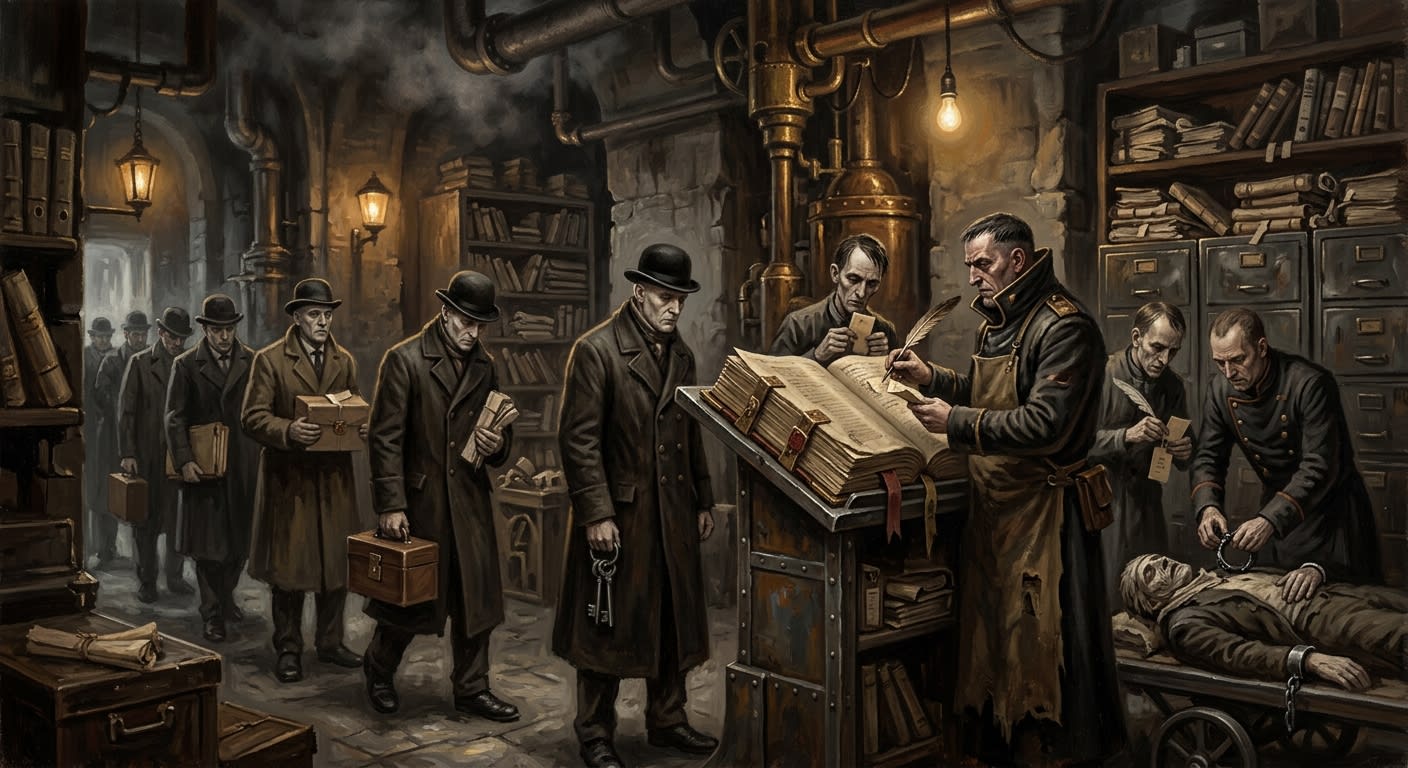
The Book of Departures is the Synod's most tender instrument and its most perfect threat. Every death must enter it. Infant, soldier, bishop, rat-catcher, debtor, saint by anticipation, heretic by convenience: each receives a line, and by that line the soul becomes publicly dead, legally gone, fiscally corrected, and available for prayer without litigation.
The catechism shows a single vast volume beneath a cathedral vault, black-bound, iron-cornered, large enough to crush a Rationalist lecture hall if Providence supplied the pulley. This picture is useful for children and provincial clergy. The actual apparatus is larger, meaner, and more beautiful. The Book is a distributed cathedral ledger system: master reconciliations at Strasbourg, diocesan death volumes under local vaults, bastion casualty annexes, hospice routing slips, parish returns, ashbinder tallies, sealed addenda, and the small miserable scraps of paper that families clutch until the ink softens under their thumbs.
To die unrecorded is an unthinkable dishonour. That phrase is old enough to pass for folk wisdom and useful enough to have been adopted by the Bureau of Records with unseemly appetite. “Better the child die in infancy than slip from the Book unwritten.” The proverb did not begin in Strasbourg. Strasbourg merely taught it to speak in every parish.
#On the Origin of the Book
The Book predates the Bureaus as a habit and follows them as a machine. Early dioceses kept death rolls because priests, for all their defects, understand that grief becomes dangerous when names are left loose. After the Sundering, when bodies outran bells and pits outran priests, local rolls broke under mass casualty. The first southern trench winters taught a doctrine no council could have invented politely: if the dead are not named quickly, the living begin to bargain with silence.
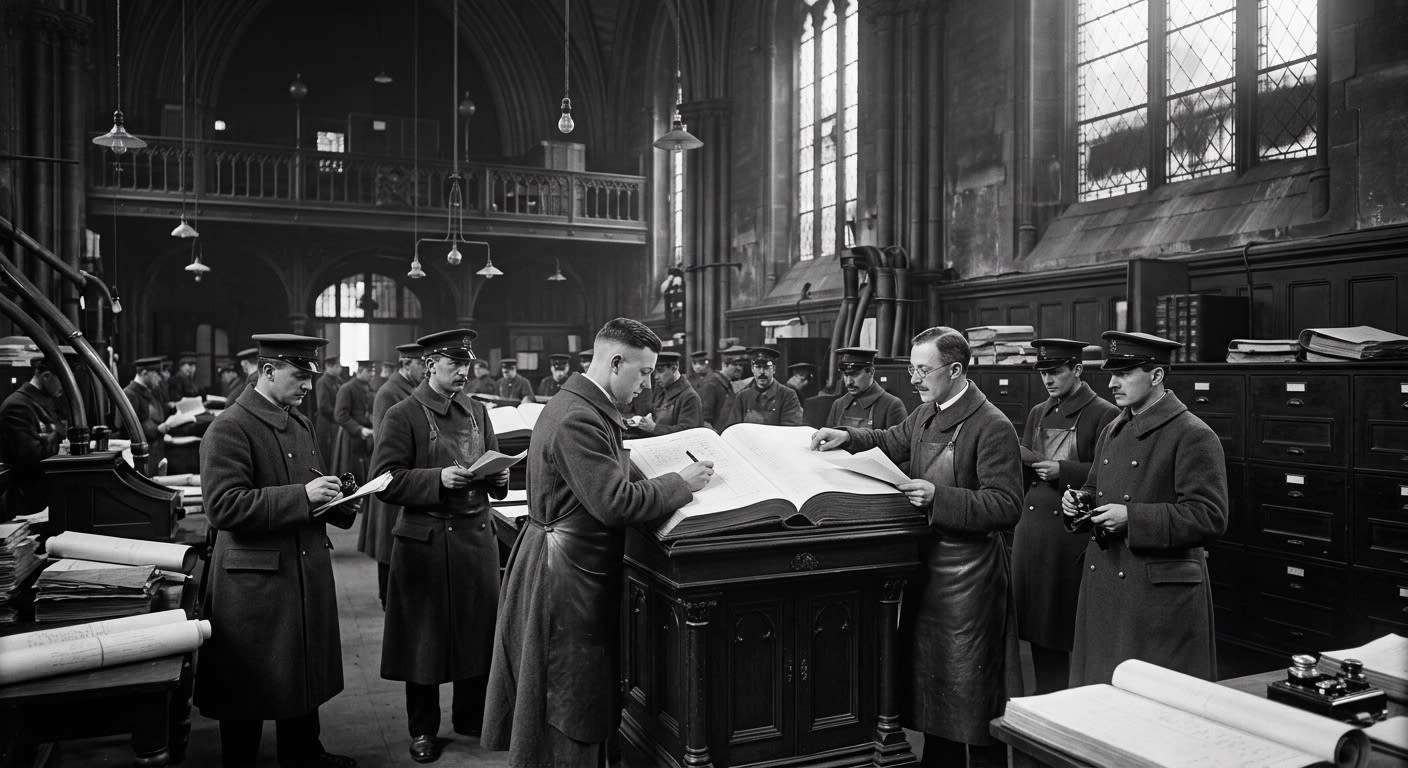
By A.S. 78, during the Lull of Names and the Great Plague, deaths outpaced transcription. Fourteen heresy cells survived because terminal accusations vanished with the dying. Families fought over property attached to men whose bodies had been burned in batches. Mercy wards closed mouths before Records opened pages. The dead, if the filed testimony is to be believed, objected from under lime.
The formal Book system hardened across the next generation. Standing Order 22-C made terminal confession harvest a discipline. The Ledger Laws of A.S. 112 made mercy recordable by body, measure, bell-hour, hand, ration class, confession packet, death tag, and witness sign. The Hospices of Departure gave the Book its cleanest tributary: death with bed, witness, cup, slip, and routing mark. The office grew because terror required a form and the Synod, being merciful, supplied several.
Certain devotional primers state that the Book of Departures was opened whole and perfect at the Concordat of Strasbourg.
Corrected. The Concordat ratified the central reconciliations. The Book's present authority grew from plague rolls, bastion casualty annexes, parish death leaves, Mercy slips, and the A.S. 112 Ledger Laws. Holiness arrived after the filing system proved difficult to replace.
The old priests named the dead for salvation. The Bureau names them for salvation, inheritance, ration adjustment, pension liability, burial geometry, ash allocation, ossuary grid reference, and post-mortem stability. Improvement is often a matter of adding columns.
#On Entry and Witness
A proper Departure entry begins before the last warmth leaves the body. The witness hears the name. The witness hears the final words, if the dying has been inconsiderate enough to supply any. The witness notes whether confession was complete, interrupted, refused, incoherent, politically inconvenient, or useful. The body receives its route: burial, ash, ossuary, transport, salvage, contaminated hold, or sealed classification. The black line is drawn. The living exhale because the dead has crossed from domestic crisis into clerical fact.
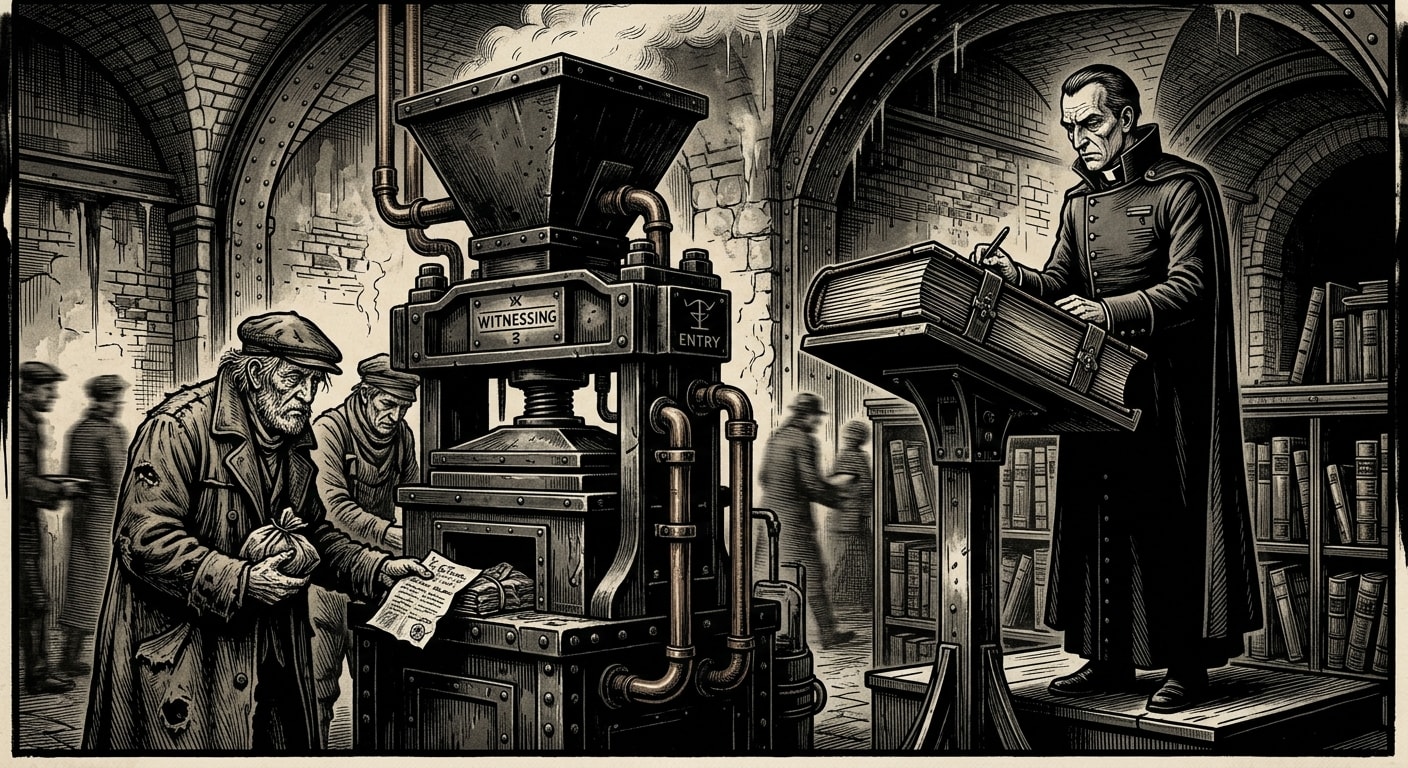
At a Hospice, the mechanism is exquisite. The Records Witness rests the Book slip on a small ledger-board while the Mercy Sister holds the cup. The family stands at the chalk line. The choir lowers pitch. The chest stops. The witness marks time. By morning, the family receives a Departure Slip certifying name, registry number, witness, draught measure, body disposition, and Book routing. Without that slip, inheritance stalls, ration status remains uncorrected, marriage petitions tangle, and prayer becomes socially awkward, which in the Synod is worse than grief because grief lacks a counter window.
On the Line, entry is cruder. Tags arrive torn. Names arrive phonetically murdered by officers from better provinces. A shell may convert a platoon into a dispute between War arithmetic and human remains. The bastion casualty annexes permit provisional entry when identity is materially incomplete but socially necessary. At Bastion-Constantinople, doctrine holds that every soldier who dies within earshot of the carillon is entered automatically without clerical hand. Records objects in private: “Our ink never runs dry in Constantinople. That is not the same as autography.”
The automatic-entry doctrine persists because soldiers need it. A man can charge across the Thracian mud if he believes the bell has already guaranteed his line in the Book. He can die in fragments and trust that the fragments will be gathered into grammar. This is paperwork answering war's demand, astonished by its own compassion.
#On Omission
Omission is the Book's black sacrament. To be omitted is to remain socially alive where one should be closed, fiscally active where one can no longer pay, spiritually uncalled where prayer should have begun. The omitted dead are domestic ghosts before they are atmospheric ones. Their widows cannot inherit. Their children cannot transfer ration class. Their debts keep feeding. Their beds cannot be reassigned without appeal. Their names hang in the house like damp laundry no one is permitted to remove.
The Bureau rarely threatens omission. It does not need to. Families understand the knife. A son will pay arrears before his father's death line is released. A widow will surrender a hidden coin jar to retrieve a misfiled Departure Slip. A parish will produce witnesses for a plague cart whose driver disappeared three winters ago because unentered bodies make the chapel cold.
There are honest omissions: fire, flood, battle, plague, clerical exhaustion, bad ink, worse handwriting, a mule kicking over the wrong satchel. There are useful omissions: condemned men held outside public pity, couriers erased by Black Decree protocols, political prisoners whose absence must not acquire the dignity of death, families reduced quietly without making martyrs. The Book's virtue is completeness. The state, being practical, has discovered that controlled incompleteness has administrative flavour.
Courier appendix, A.S. 58: the men who carried certain black-wax writs after dusk appear neither in the Index Damnatus nor in the Book of Departures. Their payroll lines terminate. Their birth parishes show correction marks. Their mothers' petitions were received, bundled, and routed to █████████████. Classification: completion without departure.
The faithful fear omission as damnation. The Bureau describes omission as procedural defect. The dead appear to treat it as an insult with consequences.
#On the Dead Who Require Their Line
The article on the Dead records the uncomfortable fact with suitable caution and inadequate applause for my restraint: the filed dead rest more reliably than the unfiled. Bone-stamps settle them. Bell-schedules calm them. Ashbinders' pyres reduce disturbance. The Book's entries, when properly witnessed and spoken during the Festival of Departed Flames, reduce post-mortem activity in ways the Bureau of Rites attributes to divine benevolence and the Bureau of Doctrine attributes to whatever phrasing causes least trouble that week.
I attribute it to names.
The unrecorded dead repeat themselves. They murmur in walls. They press cold into rooms. They return in ledgers as smears, in dreams as half-faces, in confessionals as voices too old for the throat speaking them. Their messages are rarely grand. They want how they died known. They want where the body lies known. They want a debt cancelled, a child found, a false name corrected, a wife told that the last word was not what the captain wrote. They want, with tiresome mortal dignity, to be a line in the Book.
At the Third Ossuary beneath Constantinople, where the first dead were sealed before the bone-stamp reached maturity, dogs lie facing doors no man has opened twice without changing. At the Ash-Glyph Marshworks, corpse barges queue while burial grids glow. At the Famine Pits, names come back attached to mouths no longer present. In each site, manifestation increases when names are lost, hurried, falsified, or filed under bulk lot. A mass grave is not a scandal because many died. A mass grave is a scandal because too many were asked to share one sentence.
A Records memorandum of A.S. 196 stated that bulk casualty entry “satisfies all spiritual requirements where individual identification is materially impossible.”
Amended for internal guidance. Bulk casualty entry satisfies immediate administrative closure. Spiritual sufficiency remains unproven, contested by Rites monitoring, and denied in public until a more economical doctrine can be prepared.
#On the Cathedral Vaults
The diocesan Books are kept beneath cathedrals because stone, cold, and fear preserve paper better than sentiment. Each vault has its own habits. Strasbourg's master reconciliation vault smells of wax, dust, and old authority. Lyon's death volumes are bound in black calf and carry fasting notations in margins where Seraphine clerks could not resist moral commentary. Constantinople's cathedral annex dries ink faster than anywhere else on the Line, a phenomenon Records swears is humidity, heat, and volume, while soldiers insist the carillon drinks the wetness from names before Hell can lick it.
The vault clerk is priest, accountant, mortuary guard, inheritance hinge, and minor psychopomp. He receives the slips. He verifies the witness. He cross-matches the body route. He enters the line. He closes the red living record and opens the black dead record. If the dead was canonized, he applies gold. If the dead was administratively dissolved, he applies gridlines so fine the eye aches. If the dead was inconvenient, he waits for a sealed addendum and learns patience, which is the clerkly form of cowardice.
Every year, during the Festival of Departed Flames, selected names are read from the Books. The reading is partial, despite public affection for impossible numbers. Records supplies representative sequences, high-mortality lists, unresolved omission corrections, and family-paid inclusions. The voices fray by the third hour. Readers stumble over names they know. Margins show damp. The dead calm anyway. Even abbreviated acknowledgement has force when spoken by an institution otherwise designed to ignore everything until stamped.
#On Fraud, Purchase, and Correction
Where a line in the Book closes accounts, fraud gathers like flies around a hospice lamp. False Departures have ended marriages, debts, civic prosecutions, inconvenient apprenticeships, and military obligations. Living men have been entered dead so that property could pass, charges could vanish, or a son could escape the levy by becoming, on paper, a lamented memory. Some later return, which is inconsiderate. Records dislikes resurrection chiefly for the correction workload.
Purchased Departures are subtler. A rich family may obtain quick entry, clean routing, priestly presence, a flattering final-words classification, and prompt allowance activation. A poor family may wait three days for a clerk to decide whether “Tomas of Lower Quay” is the same man as “Thomas, quay-adjacent, probable,” while the body becomes persuasive in summer heat. The Bureau denies unequal death. The Bureau is lying with excellent stationery.
Corrections are possible. This should comfort no one. A correction petition requires witnesses, parish mark, body route confirmation, fee remission or payment, and a clerk willing to believe the petitioner is grieving rather than attempting fraud. Successful correction adds a marginal line, not a clean replacement. The Book remembers error. It simply gives error a smaller script.
The worst cases are premature entries. A man entered in the Book while still breathing becomes a legal absurdity with lungs. His ration line closes. His wife may remarry if sufficiently prompt. His debts shift to estate review. If he protests, the Bureau asks for proof of life in a voice suggesting life should have brought better paperwork. Some win restoration. Some accept the practical advantages of being dead in one district and alive in another. The Bureau of Purity calls this fraud. I call it the state receiving what it has taught.
#On Present Strain
As of A.S. 201, the Book is under pressure. The dead increase. The wars continue. The bastions generate casualty annexes faster than cathedral vaults were built to reconcile them. The Hospices operate at full capacity in several regions. Industrial deaths arrive in lots. Plague returns in administrative disguises. The dead monitored by Rites show increased restlessness since A.S. 198. Records requests more clerks. Tithes requests proof that the additional clerks will not qualify for pension too quickly. Doctrine requests phrasing.
The greatest danger is not that the Book will fail. Institutions as old and hungry as the Book do not fail cleanly. They accrete exceptions, provisional categories, emergency addenda, wax colour variants, parish substitutions, and temporary measures that become hereditary. The danger is that the faithful will continue believing every death has been entered while the margins fill with unresolved dead pressing cold fingers against the page.
I have inspected enough vaults to know the truth the Bureau will eventually announce as if it invented the concern. The Book must grow. More clerks, more bells, more witness training, stricter bastion routing, fewer bulk entries, harsher penalties for purchased omission, and a public doctrine capable of admitting that the dead require acknowledgment without sounding as though the Synod has been taking dictation from graves. This is possible. It will be expensive. Denial comes first.
The Book receives. The Book closes. The Book remembers what the living cannot afford to keep open. A line of black ink is a mercy, a tax instrument, a burial rite, a property key, a prayer license, a muzzle for ghosts, and the final little courtesy civilisation pays to meat that once paid dues.
At the vault door, the clerk sharpens his nib. Above him the cathedral chants. Beneath him, if he has erred, something waits for the correction.