
#On the Lower Galleries
The file gives the night a name and no explanation for it. The Ledger follows the file.
Bastion-Irongate stands in the Iron Gates gorge of the Danube near Orșova. The river narrows there between two cliffs, and the Church has bolted cannon to both of them. Soldiers call the place the Gasket Choir. The lower cliff galleries are its damp intestine. The cut stone sweats, steam climbs off the river into the vaults, and soot falls from the seams whenever a gun recoils. The lamps throw three shadows where an honest lamp would throw one.
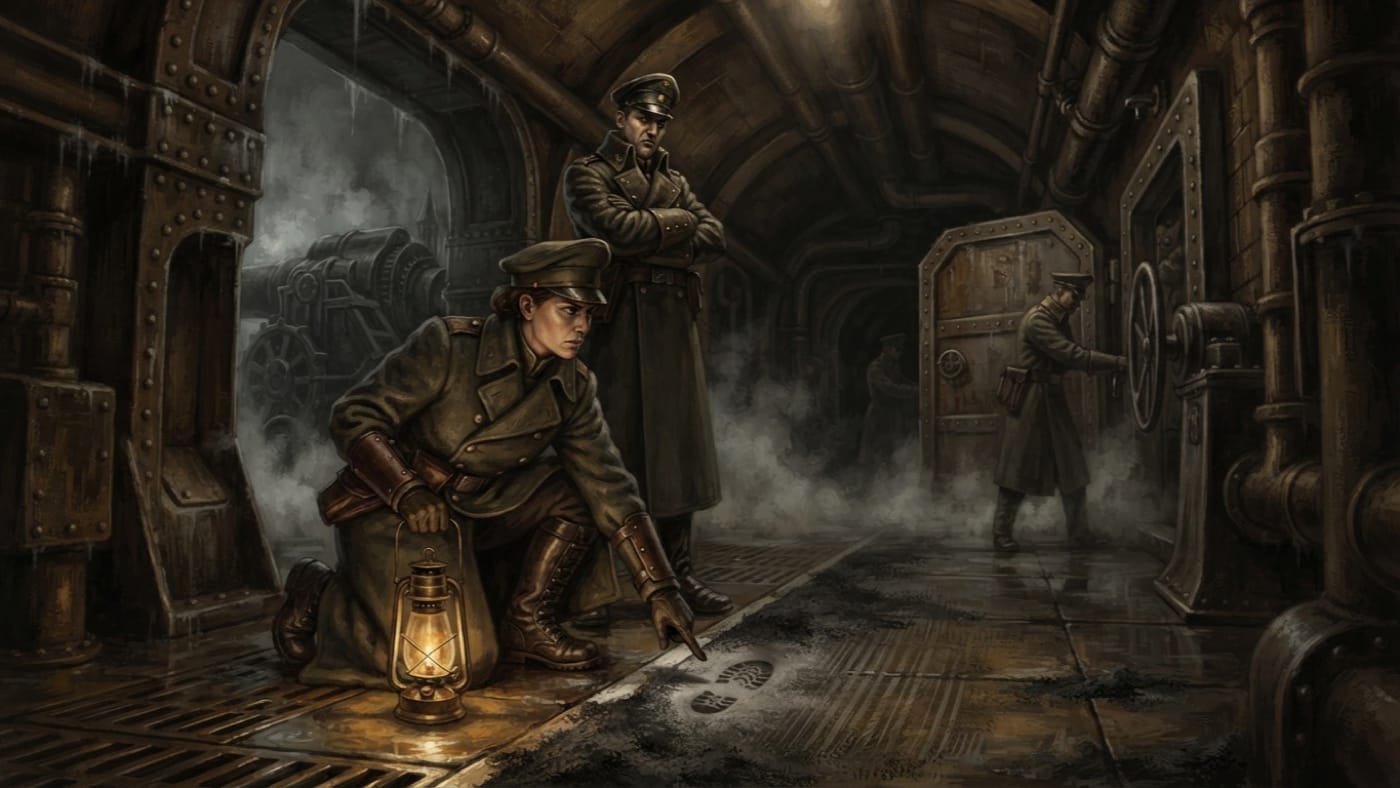
Sergeant Elke Voss of the Line Watch Detachment kept the night watch there, on the stretch between Battery Saint Cuthbert and the Third Lung access stair. The precautions in her galleries were older than her posting. They had been paid for in A.S. 171, when a sentry saw a shadow come out from under a gun-carriage and cut the throat of the man beside him. The Bureau of War did not believe the report until further throats changed its mind.
Bureau of War position, A.S. 171: the report of a shadow detaching from beneath a gun-carriage is not credited.
Corrected after three more sentries died in the same way. It has always been the position of the Bureau of War that sentries in the lower galleries are to be believed.
By Voss's time those lessons had become standing practice. Standing Order 88-H required ash to be dusted along the threshold lines. Bell-pulse checks ran at irregular intervals. Reliquary niches stood wherever Tithes had approved the expense, which was in fewer places than were needed.
The first confirmed penetration during Voss's watch came in A.S. 196 / 1906 CE, on a wet night that the file calls Lent-Eve. That is all the file says about the name. The Ledger records it and builds nothing on it.
#On the Ash at Gate Vent Four
Ash is the cheapest instrument in the Church's arsenal and the most honest one. It costs nearly nothing, and nobody can bribe it, flatter it or promote it. It keeps whatever touches it until the next broom comes.
At Gate Vent Four the ash had kept a heel-print. The print was narrower than any regulation boot issued to the galleries. Anywhere else a narrow heel among hobnailed men would be an irregularity. In the lower galleries of Irongate it was an accusation, because the Veil-Stalkers had already taught that garrison what a shadow can do with a knife.
For readers lucky enough to know only the word, a Veil-Stalker is a man. He is a starved cultist covered in glyphs of concealment, and he feeds those glyphs with what remains of his own life, spending it one step at a time. He is mortal and he is dwindling, and he can still hold a blade. Such creatures do not storm a gallery. They pass through it, pick one man out of many, and leave the rest to watch each other.
The bell-pulse was run. It made nothing visible.
That left the question the file puts to any sentry who has a lamp and a career: how much is a negative result worth against a mark in the ash? The bell showed nothing. The ash showed a foot. The threshold had been swept fresh, and the broom-lines still stood in clean furrows. The heel had crossed those furrows without disturbing the soot beside them.
Voss believed the ash.
#On the Order to Seal
She ordered the gallery sealed.
Her lieutenant objected. The file does not give his name, and the Ledger will not lend him one. His objection was that the print might be old. That is a reasonable sentence. Officers are trained in reasonable sentences the way choirboys are trained in Latin: early, by rote, and with little regard for meaning.
Voss answered with the evidence. She asked him whether old footprints usually crossed fresh broom-lines without disturbing the soot beside them. A lieutenant has no good answer to that. A print made before the sweeping would have been swept away. A print made after the sweeping by any honest boot would have kicked soot across the furrows. What was left was a narrow heel, set down lightly after the broom had passed and before the sergeant arrived.
The file records that the lieutenant disliked grammar from a sergeant. It records nothing else between them. There was no reprimand, no apology and no recantation. The gallery was sealed on her order and over his objection. The Ledger leaves the two of them standing in the steam exactly where the record leaves them.
An hour later a clerk was found dead in the pressure office.
The file does not name him. It records where he was found and when. It does not record how he died or when he died. So it cannot tell us whether the seal came before the killing or after it, or whether the order shut something in or simply came too late. The hour measures when he was found. Readers who want it to measure the murder may apply to the Bureau of Speculation, which does not exist and is overstaffed.
#On the Clerk's Keys
His key-ring could open a service hatch of the Choir Magistracy.
That sentence is the whole of the evidence, and the reader must not step beyond it. The keys fitted. The file does not say they were taken, used or returned. It does not say the hatch was opened. It does not trace any route from the ash at Gate Vent Four to the pressure office or the Magistracy's door. A key that fits a lock is a fact about brass.
The brass matters because of what the Magistracy is. Since the Great Hush of A.S. 94, the Choir Magistracy has licensed voices and governed the pressure hymnals sung through Irongate's works. Guns, vents, valves and counter-song engines all run to measure there. A fortress built this way is less a wall than a schedule, and its service hatches are the back stairs of that schedule.
The file reads the Stalker's aim as timing, and adds, in the weary hand of a soldier, that this is what Stalkers do. That reading belongs to the file. The wider record on Veil-Stalkers supports it in general terms: they pick out particular personnel, and their purpose is to spoil coordinated work. Running up a tally of dead is not the object. A clerk in a pressure office with keys to the Magistracy's service doors is exactly the kind of man whose absence makes an hour run wrong.
The file does not say which valve, which chant or which battery's hour was meant, and the Ledger supplies none. Nor does the file record the Stalker taken, killed or escaped. The account ends with a dead clerk, a ring of keys and a sealed gallery, and the Ledger ends there with it.
#On the Subsequent Testimony
What came after the incident was paperwork. In A.S. 197 / 1907 CE Voss filed the deposition for which the Ledger chiefly remembers her. It testified that vigilance at Irongate's pitch was an injury without blood, and that the Bureaus would rather call it a virtue, because virtues need no pensions. The deposition does not blame the whole of that injury on Lent-Eve, and neither will I. That night was one confirmed penetration among the many watches it describes, and the first under her command.
Still, the later testimony can already be seen in the earlier night. A sergeant trusted ash over a bell and a broom-line over her officer, and she was right. Because she was right, every later watch would be stood by people who knew, from the file and from the body, that a gallery the bell showed empty could still hold a heel.
War's eventual reply to the deposition was procedural: paired sentries, irregular bell-pulses, varied countersigns, and shorter rotations where they could be managed. Those measures belong to the reply, and the Ledger does not back-date them to A.S. 196. On Lent-Eve the galleries had ash, bells, niches and a sergeant. The Bureau of Mercy has never admitted to holding the deposition at all, which is how one knows it read every page.
The lieutenant at Gate Vent Four is hereby informed, retroactively, of the Bureau of War's long-standing position on believing sentries.