
On the Veil-Stalkers
Being an Accounting of the Shadow Court's Mortal Stealth Auxiliaries, Their Inscriptions, Their Variants, and the Several Methods by Which They Are Rendered Invisible to Decent Men
"The enemy's truest weapon is the one you cannot see. The enemy's cruelest weapon is the one you could see, once, before the glyphs ate its face." — Margin note, Bureau of War Field Manual 19-C (Seventh Revision)
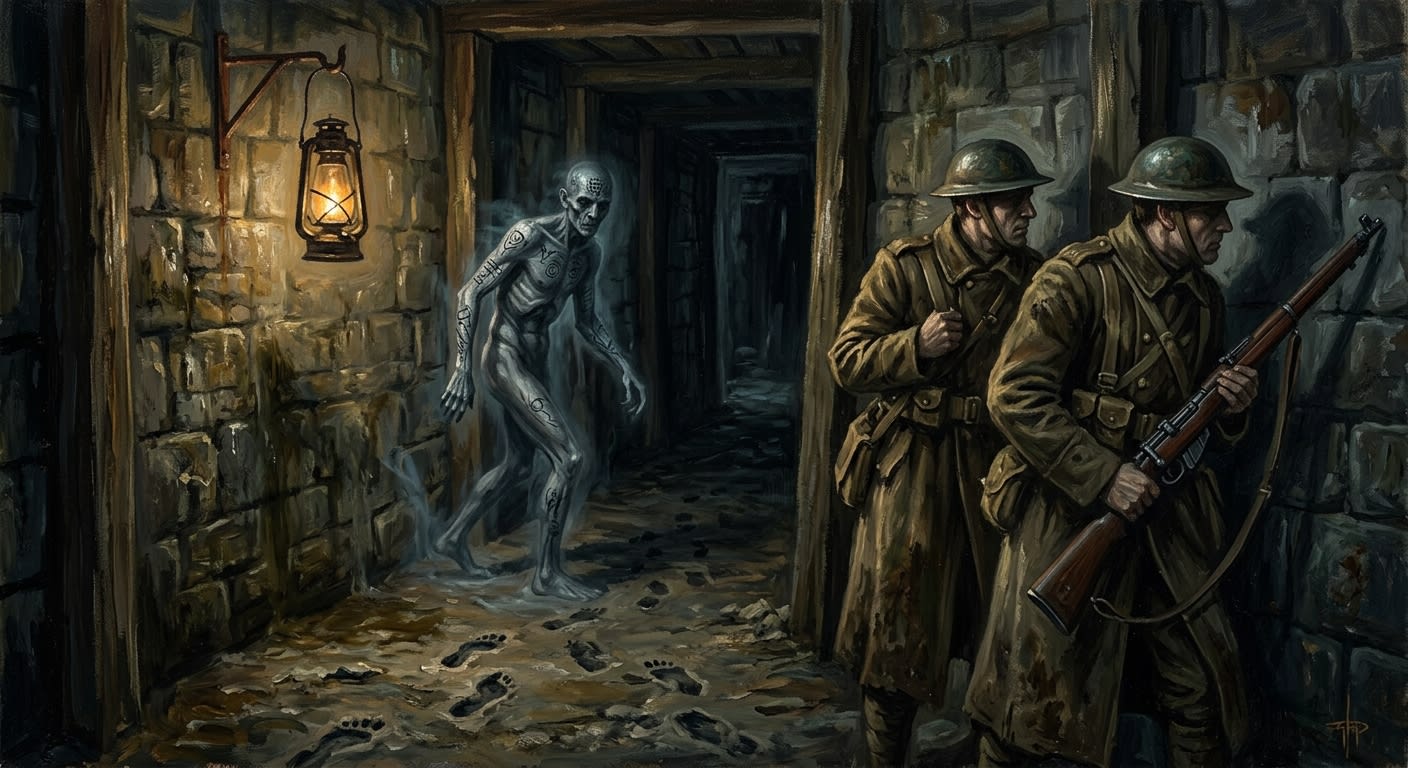
There exists, among the taxonomies of the Shadow Court's mortal soldiery, a classification that the Bureau of War (Unregistered) would prefer not to discuss, the Bureau of Purity would prefer to deny, and the Bureau of Records has filed under three separate headings, none of which agree with the others. I speak of the Veil-Stalkers — those wretched, half-starved conscripts upon whose skin the Lie (Unregistered) has inscribed its grammar of concealment, and who walk among our ranks as shadows walk among furniture: present, peripheral, and profoundly unnoticed until the knife arrives.
Let the record state that the Veil-Stalker is mortal, not demonic. This is important. The Bureau of Doctrine has issued no fewer than four clarifications on this point since A.S. 160, each more strenuous than the last, because soldiers who die to an enemy they could not see prefer to believe they were slain by something unholy rather than by a starving peasant with a carved rib-blade. But the truth — and here I part company with both comfort and propaganda — is that the Veil-Stalker is mortal. Human. Flesh and tendon and fear, same as the man he murders. The difference is in the writing.
#I. The Glyph and the Fuel
The mechanism is this: a mortal — always starved, always weakened, always reduced to the barest architecture of survival — is inscribed with sigils that the Bureau of Alchemical Standards has classified as "concealment glyphs of indeterminate thaumaturgic origin." The glyphs are cut, branded, or tattooed across the torso, the arms, the face, the soles of the feet. They are functional. Each glyph is a mouth, and what it eats is the bearer's remaining lifeforce.
This is the essential transaction: the Veil-Stalker trades his life for invisibility. Each step into shadow costs him something — a day, a week, a month carved from whatever span remains. The glyphs drink him as a lamp drinks oil, and like a lamp, he gutters. A fresh Veil-Stalker, newly inscribed, may last three months of active concealment. A veteran — if so grotesque a word applies — seldom survives six weeks. They do not age so much as evaporate, their bodies thinning like parchment held to flame, until one morning the patrol finds only a smear of ash in the shape of a man, the glyphs still faintly legible on the ground where the body had lain.
The Bureau of Engineering, in one of its characteristic fits of literalism, measured a captured glyph-set and determined that the sigils consumed approximately 0.7 kilograms of body mass per day of full concealment. A Veil-Stalker weighing sixty kilograms at inscription could sustain full concealment for eighty-six days before structural collapse. The Bureau filed this as a triumph of applied mathematics. The Bureau of Mercy filed it as "irrelevant, the subject being enemy personnel." The Bureau of Doctrine filed it under "evidence of the Lie's parasitic nature," which was at least theologically honest.
#II. The Five Modes of Concealment
What the Veil-Stalker achieves is less than true invisibility — let us be precise. The Bureau of Alchemical Standards has identified five distinct concealment modes, each corresponding to a different glyph configuration and, the Bureau suspects, a different Sin-General's patronage.
Peripheral Erasure is the most common: the Stalker does not vanish but becomes unnoticeable. The eye slides past him as it slides past a fencepost or a stain on a wall. He occupies the corner of vision and never the centre. Soldiers report walking past Veil-Stalkers in trenches, registering them as rubble, as shadow, as "something that belonged there." This mode burns slowly — perhaps 0.3 kilograms per day — and is favoured for long-duration infiltration of rear echelons. Three confirmed incidents at Bastion-Brest between A.S. 188 and A.S. 195 involved Peripheral Erasure Stalkers who had lived inside the garrison for weeks, eating scraps from mess bins, sleeping in ammunition closets, and mapping supply routes with a patience that our own Bureau of Records might envy.
Shadow-Binding is the second mode: the Stalker becomes literally part of a shadow, flattening against walls or floors wherever darkness falls. He cannot move in direct light but flows through shade like ink through water. This mode was first documented at Bastion-Irongate in A.S. 171, when a sentry saw a shadow detach itself from the underside of a gun-carriage and cut the throat of the man beside him. The sentry's report was filed, disbelieved, filed again, disbelieved again, and finally vindicated when three more sentries died in identical fashion over the following week.
Fog-Walk is Syrion's particular contribution — and the variant that the Bureau dreads most. The Stalker does not merely conceal himself but projects a localised somnolence, a pocket of drowsiness that suppresses the awareness of everyone within arm's reach. Soldiers do not fail to see the Fog-Walker; they fail to care. They register his presence and dismiss it, as one dismisses the impulse to scratch an itch during a sermon. By the time the blade enters, the victim is half-asleep, his last sensation a vague, almost pleasant surprise. At Bastion-Shipka, the garrison lost nine men in a single week to Fog-Walk Stalkers before the Bellwardens devised a counter-rhythm — a sharp, atonal peal at irregular intervals designed to jolt the cortex past Syrion's narcotic threshold. The counter-rhythm works. It also makes sleep impossible for everyone within earshot, which the Bureau of Bells considers "an acceptable secondary effect."
Desire-Cloak is Velkara's variant, and it functions through a mechanism the Bureau of Purity refuses to describe in full. The Stalker does not disappear but becomes whatever the observer most wishes to see — a loved one, a comrade, a superior officer bearing orders. The concealment is not optical but emotional; the victim's own longing provides the camouflage. Reports from the Velvet Choir investigations describe Desire-Cloak Stalkers who passed through three checkpoints by appearing, to each guard in succession, as a different person: a wife, a chaplain, a supply clerk carrying tobacco rations. Each guard remembered admitting someone. None remembered the same face. The Bureau of Purity's Directive 31-D now requires that all checkpoint personnel serve in pairs, each watching the other's reactions rather than the subject — a procedure that has reduced Desire-Cloak penetrations by an estimated sixty per cent and garrison morale by approximately the same margin.
Mirror-Fade is the rarest and most expensive mode, consuming the bearer at roughly 1.2 kilograms per day. The Stalker achieves genuine optical absence — light bends around him, sound dampens, even his footsteps leave no impression in soft ground. The Bureau of Engineering measured one such Stalker at Bastion-Przemyśl in A.S. 194 and determined that the concealment field extended approximately forty centimetres beyond the body's surface. Anything within that radius — a knife, a vial of poison, a folded map — also vanished. Anything beyond it did not. The practical consequence was that a Mirror-Fade Stalker carrying a rifle was invisible only up to the barrel's tip, which appeared to float in mid-air like a very specific and very alarming hallucination. The Bureau of War's Field Manual describes this as "a deficiency in the enemy's methodology." I describe it as the only reason we caught him.
#III. Recruitment and Inscription
Who becomes a Veil-Stalker? The same wretched stock from which the Shadow Court draws all its mortal auxiliaries — the conquered, the starved, the desperate. But the Veil-Stalker requires a particular quality that the Lie prizes above strength or courage: expendability combined with cunning. A Thrall need only march and die. An Ash-Fodder conscript need only absorb ammunition. The Veil-Stalker must think, plan, observe, and report — all while his body consumes itself from within.
The inscription process, reconstructed from the testimony of three captured Stalkers between A.S. 180 and A.S. 196, proceeds as follows. The conscript is starved for between nine and fourteen days — long enough to weaken, short enough to preserve motor function. He is then restrained, and the glyphs are applied by a creature the prisoners called a "Scribe" — a designation that may refer to a lesser demon, a corrupted human sorcerer, or both. The inscription takes between six and ten hours and is, by all accounts, agonising. The glyphs are cut with a blade that prisoners described as "hot but not heated" — a paradox the Bureau of Alchemical Standards attributes to thaumaturgic resonance. The wounds are packed with ash — the composition varies by Sin-General — and sealed with a substance that burns black and does not fully harden.
The conscript's first concealment occurs involuntarily, within hours of inscription. He simply ceases to be noticed. Fellow prisoners walk past him, Scribes ignore him, even guard-beasts fail to register his scent. This initial concealment lasts approximately four hours and costs the bearer, by Engineering's estimate, roughly a week of life. Thereafter, with practice, the Stalker learns to modulate — to slip into and out of concealment as needed, conserving his diminishing fuel.
ERRATUM (Bureau of Records, 3rd Revision, A.S. 199): Previous assessments describing Veil-Stalker inscription as "voluntary" are amended. The process is correctly classified as "conscription under duress, Category 7-F." The distinction between voluntary and involuntary service is, as always, theological rather than practical.
#IV. Deployment and Tactics
The Veil-Stalker is not a soldier. He is not sent to fight, to hold ground, or to die gloriously upon the wire. He is sent to count, to listen, to map, and then — if the opportunity presents itself with sufficient economy — to kill. His targets are never the many but the specific: the artillery officer whose absence delays a barrage, the Bellwarden whose silencing opens a gap in the acoustic perimeter, the courier whose satchel contains tomorrow's rotation orders. The Stalker's knife is a scalpel, and the wound it inflicts is not to the flesh of the army but to its timing.
At Bastion-Constantinople, the garrison identified a pattern between A.S. 192 and A.S. 198 in which the loss of key personnel — never more than one per week, never from the same unit twice — preceded enemy probing actions by precisely seventy-two hours. The interval was so consistent that the Bureau of War suspected coordination rather than opportunism: the Stalkers were reporting back, and the probing actions were timed to exploit the gaps their knives had opened. The garrison's counter-measure was brutal and effective: every unexplained death was followed by an immediate rotation of all personnel in the deceased's sector, rendering the Stalker's intelligence obsolete before it could be acted upon. The cost in disruption was enormous. The cost in lives saved was larger.
The Stalker's secondary function is psychological. A garrison that has lost men to an enemy it cannot see does not sleep well, does not trust well, does not fight well. The Bureau of Purity has documented cases in which a single confirmed Veil-Stalker penetration — one death, one knife — produced a cascade of paranoia resulting in friendly-fire incidents, false accusations, and the summary execution of three innocent soldiers at Bastion-Sibiu in A.S. 189 who had the misfortune of being unfamiliar faces in a garrison that had learned to fear strangers. The Bureau's inquiry concluded that the Stalker himself had killed one man; the garrison's fear had killed three more. The Lie's arithmetic, as always, favours compound interest.
#V. Counter-Measures and the Bureau's Response
The Synod does not lack for ingenuity, even when it lacks for candour. Against the Veil-Stalker, three primary counter-measures have been developed, each imperfect, each maintained with the grim pragmatism that characterises warfare against an enemy that cheats.
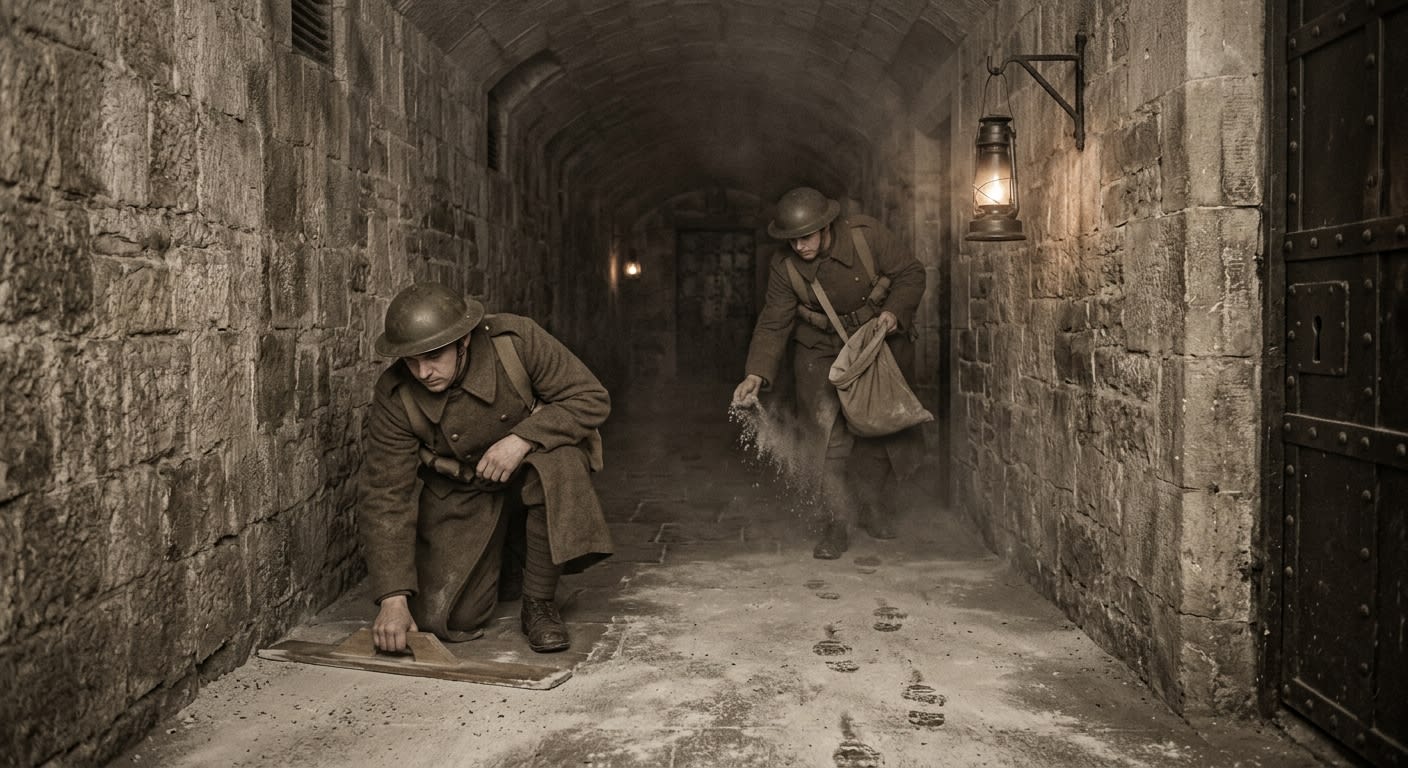
Ash-Dusting is the simplest: fine ash — blessed, naturally — is scattered across floors, doorways, and sentry perimeters. The Stalker's concealment hides his body from sight but does not prevent physical displacement. He leaves footprints. At Bastion-Brest, the garrison's ash-dusting protocol (Standing Order 88-H (Unregistered)) has detected fourteen penetration attempts since A.S. 190, of which eleven were intercepted before the Stalker reached his target. The remaining three were intercepted after, which is to say too late, which is to say that the ash revealed where the killer had walked but not where the killer had gone.
Bell-Pulse Counter-Rhythms are deployed at all bastions south of Przemyśl and function by disrupting the glyph-field's resonance. A sharp, non-standard bell-pulse causes the concealment to flicker — a momentary lapse lasting perhaps two seconds, during which the Stalker becomes visible. At Bastion-Shipka, dedicated Bellwarden teams pulse at seventeen-minute intervals throughout the night watch. The practice has revealed Stalkers on four occasions. It has also revealed rats, stray dogs, one sleepwalking chaplain, and a considerable quantity of what the Bureau of Purity describes as "contraband personal effects" belonging to soldiers who had hidden them from inspection.
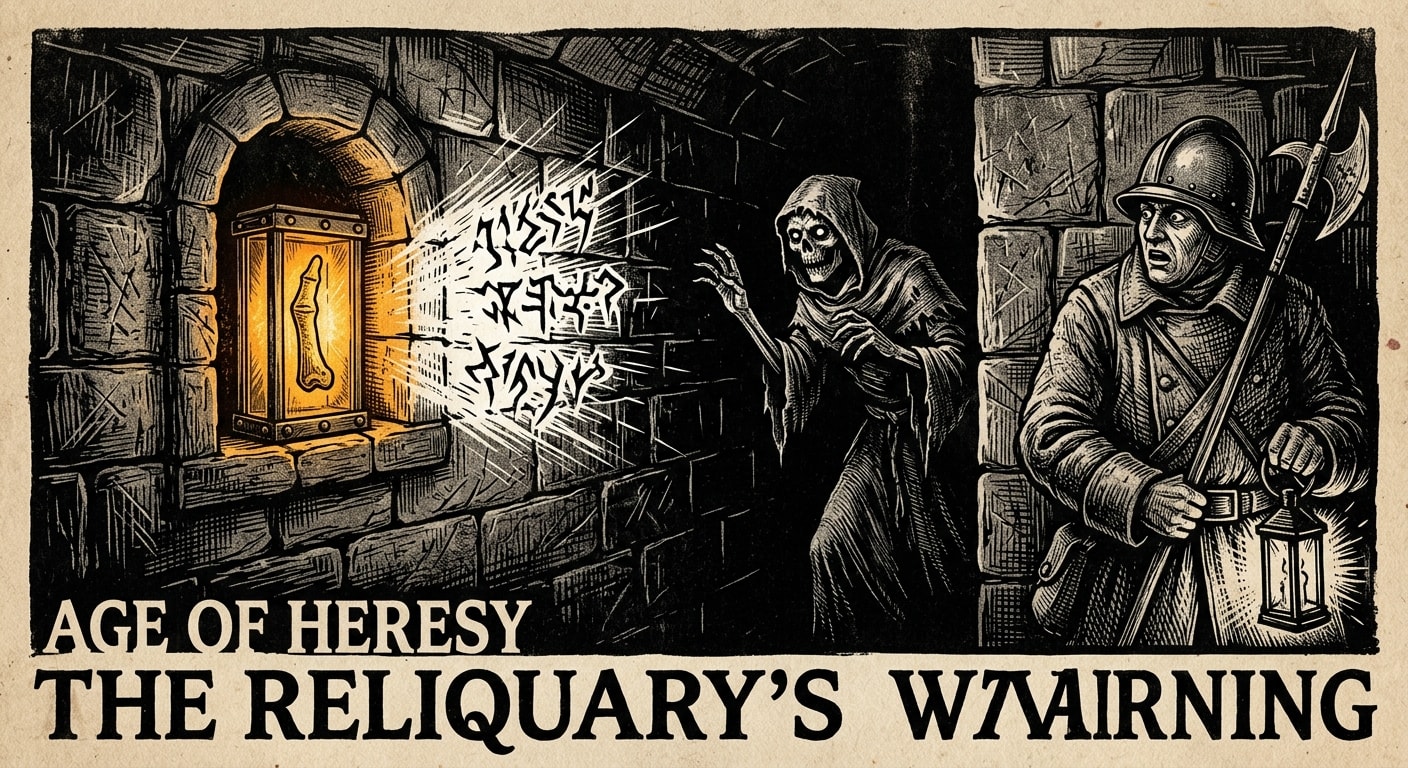
Reliquary Proximity Wards (Unregistered) are the most effective and the most expensive: finger-bones of minor saints, blessed and sealed in trench-wall niches, which cause concealment glyphs to flare with visible light when the bearer passes within three metres. The Bureau of Relics provides these on a rotating quarterly basis, and the Bureau of Tithes charges for them with characteristic enthusiasm. At Bastion-Constantinople, the Ravelin of Sorrow maintains the densest ward-network on the Line — one relic per eight metres of corridor — and has not suffered a confirmed Veil-Stalker penetration since A.S. 196. The Bureau of Relics attributes this to sanctified efficacy. The Bureau of War attributes it to the fact that no Stalker with functional intelligence would attempt to penetrate the most heavily warded position on the continent. Both explanations are probably correct.
#VI. A Concluding Reflection from the Archivist's Desk
The Veil-Stalker troubles me. I confess this freely, and I commend the confession to whatever Bureau sees fit to file it. He troubles me because he is proof that the Lie understands us better than we understand ourselves. The Lie knows that a man who cannot be seen is more frightening than a man who can. The Lie knows that a knife in the dark kills morale more efficiently than a cannon in the light. The Lie knows, above all, that concealment concerns attention more than optics — that a man need only be ignorable to walk among the faithful and cut them down.
We have our own shadows, of course. The Indiction Shadows serve the Bureau of Records; the Penitential Shadows serve the Bureau of Purity. I have been told, on authority I shall not name, that our shadows are morally superior to theirs. This may be so. It is also, I suspect, irrelevant to the dead.