
#On Its Station at Irongate
The saint lends a name. The Bureau of War supplies everything else, grudgingly, by requisition.
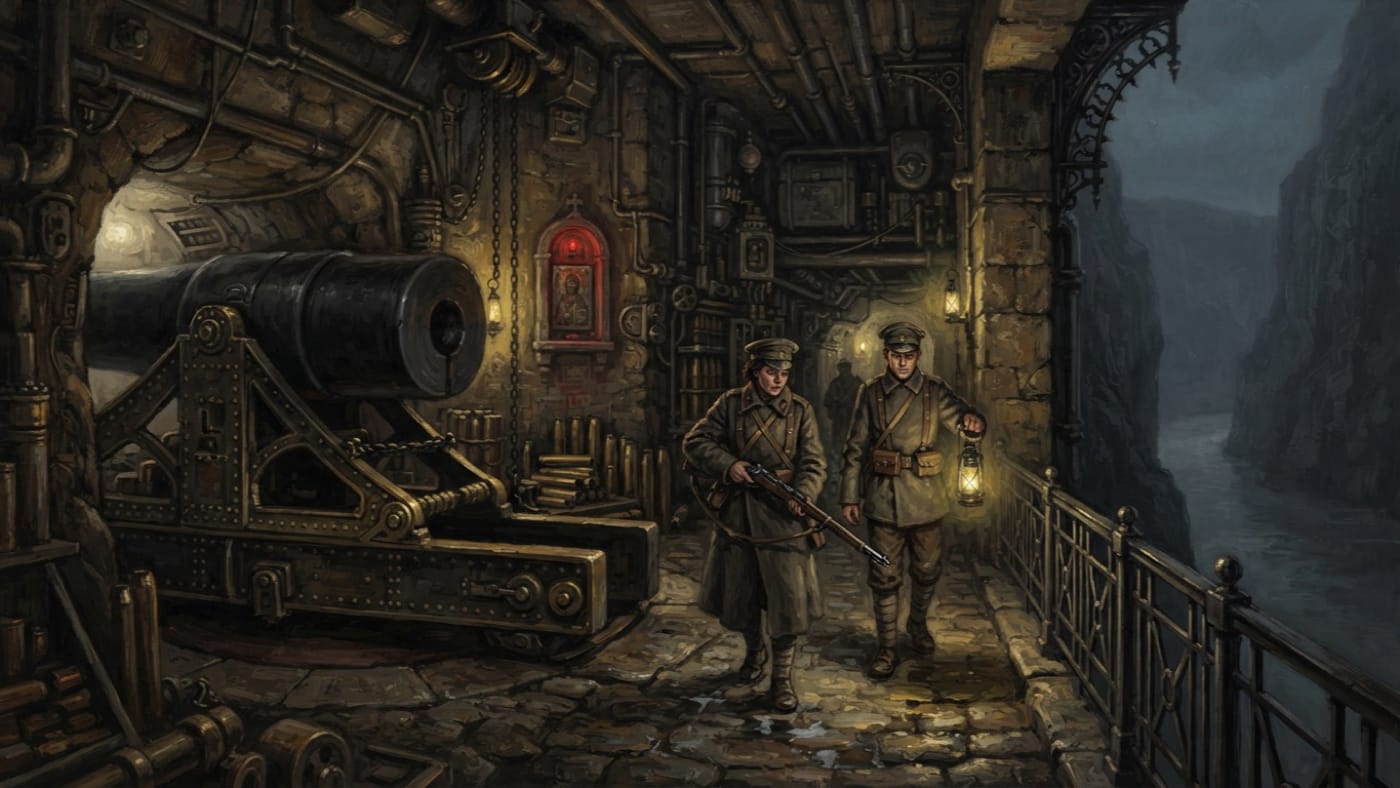
Battery Saint Cuthbert is a named gun position of Bastion-Irongate, the Danube fortress its garrison calls the Gasket Choir. Irongate holds the Iron Gates gorge, where the river runs between cliffs so close that two ships abreast is an act of faith, and it mounts cannon on both of those cliffs. Saint Cuthbert belongs to the lower-cliff galleries: sweating stone, vents, valve-work, and the long passages that join one mouth of iron to the next.
The Ledger places the battery through a single relationship. The night watch of Sergeant Elke Voss ran between Battery Saint Cuthbert and the access stair of the Third Lung. The Third Lung is a sealed chamber, and although its wall admits nobody, its stair still serves as a landmark on the walk. The battery enters the record because it stood at one end of her patrol. Its own file is lean. It gives no year of construction and no rite of dedication. It names no gun, states no calibre, counts no crews, and seats no commander. The saint who supplies the name has no entry attached to the battery at all, and this Codex will not manufacture a hagiography to decorate an embrasure.
Voss did not command the guns. She was a sergeant of the Line Watch Detachment, and her charge was the approach: the corridor, the stair, the underside of things. Gunners served Saint Cuthbert. Sentries kept anyone from walking up behind them.
#On the Guns and the Galleries
A cannon fired in a cliff-gallery is not finished when the shot leaves. Recoil runs back into the rock. Soot shakes loose from the vaulted seams and sifts down for some while afterward, so every ledge and pipe seems to keep moving after the gun has stopped. River steam climbs out of the gorge and hangs in the passages in folds. Oil lamps gutter sideways in the draught from the vents. Each flame throws a fresh set of shadows, and they shift whenever it does.
Then comes the machinery. Irongate breathes by pressure, and its lower galleries carry the evidence: brass valves, gauges, chains, ladders, ammunition hoists, saint-niches, the steady hum of counter-song engines and the licensed chant carried through the pipes. Litany-Engineers and gasket mechanics pass through on maintenance rounds with lamps, keys and tool-rolls. Every one of these things has a lawful reason to move, drip, knock or cast shade. A sentry who challenges them all will be hoarse by the second bell.
For an enemy who hides, this is a cathedral of alibis. Movement is ordinary. Noise is ordinary. A shape beneath a gun-carriage is ordinary right up to the moment it stands.
#On the Night Watch
The sentries' labour is separate from gunnery, and in the lower galleries it is heavier. The drill Voss inherited required a sentry to inspect gun and gun-shade, stair and the angle under the stair, comrade and the space beside the comrade. Standing Order 88-H required ash to be dusted along threshold lines, so that a foot crossing an empty doorway would leave its confession in grey. The Bureau of Bells supplied bell-pulse checks, run at irregular intervals so that no watcher in the walls could learn the schedule. Reliquary niches were installed where the Bureau of Tithes approved the cost, which is to say in fewer places than were requested.
Later routines added more. Ash-lines were renewed every two hours. Countersigns varied. Sentries walked in pairs.
The quarry was mortal. Veil-Stalkers are starved cultists inscribed with glyphs of concealment, and every step they take unseen is paid for from their own fading life. They are neither ghosts nor borrowed faces. They carry knives, they need doors, and they must cross floors. The sector lies under pressure from Morwen, Sin-General of Envy, along the Danube approaches. The file does not say whose hand sent any particular Stalker, and the Ledger does not guess.
None of these precautions guarantees a sighting. Ash takes a print only from a foot that touches it. A bell-pulse can pass through a gallery and reveal nothing whatever. Each measure costs someone an hour of labour and a portion of their wits. Each also tells the sentry, accurately, that the danger has not gone.
#On the Recorded Penetrations
The dated precedent belongs to A.S. 171 (1881 CE). In the lower galleries a sentry saw a shadow detach itself from beneath a gun-carriage and kill the man beside him. He reported it. The Bureau of War disbelieved him. Three more killings of the same kind followed, and after that nobody could keep disbelieving him.
Bureau of War disposition of the A.S. 171 gallery report: account not credited; no shadow present.
Corrected after the three further killings. The report now stands as substantially accurate. The file does not name the battery to which that gun-carriage belonged, and Saint Cuthbert shall not be lent to it for the sake of a tidier plate.
The second record is Voss's own. During her watch in A.S. 196 (1906 CE), the fresh ash at Gate Vent Four showed a heel-print that had no business being there. The bell-pulse revealed nothing. Voss sealed the gallery regardless. A clerk was afterwards found dead in the pressure office, and his keys opened a service hatch of the Choir Magistracy. Stalkers aim at access.
Neither account records an assault on Saint Cuthbert's guns, magazine or officers. Both belong to the galleries its sentries walked.
#On the Cost Entered by Voss
Deposition 197-V/Voss, filed in A.S. 197 (1907 CE), is the nearest thing Battery Saint Cuthbert has to a casualty return, though few of its dead are named and none of its wounded bled. Records holds a copy. War holds a copy. The Bureau of Mercy denies holding one, which is how the reader may be certain it has read every page.
Voss described what the watch does to the watchers. Sleep goes first. Suspicion follows, hardens into habit, and ends as the only way the eye knows how to look. Challenges fall on the wrong people: comrades who cough too late, who stand too still, who laugh after dusk. She recorded that vigilance at Irongate's pitch "reduced ordinary affection to tactical liability." She also wrote: "The enemy eats his own body to disappear. We eat our sleep to find him."
The institutional account runs as follows, and it has not improved with keeping. Mercy proposed a watch-fatigue category for concealment operations, then deferred it pending War's concurrence, which never arrived. War adopted the practical measures described above and let the category lie. Records restricted the testimony to the Line. The Bureau of Doctrine refused it for public instruction, lest recruits imagine the symptoms before they had earned them.
A category would make every lower-gallery sentry a patient. Patients require rest, and rest requires soldiers the Church has not got. The Creator may count sleepless nights. The Bureau prefers to count bodies, which at least lie still for the clerk.
Voss's own history, her scar and her squad belong to her dossier. This plate keeps only what her testimony says about the stone between the battery and the stair.
#On the Continuing Instruction
By A.S. 201 (1911 CE), Voss appears in Irongate rosters under instructional night protocols. She teaches younger sentries the walk she kept: ash, countersign, pairing, the underside of the carriage. The roster says nothing of Saint Cuthbert's present gun strength, crews or readiness, and this plate will not fill that gap with confidence it has not earned.
The watch continues. The bureau best placed to answer the deposition has still not acknowledged it. The battery keeps its name.