

#On Her Station at the Gasket Choir
The Bureau says vigilance is virtue. Sergeant Voss filed a correction in the only ink soldiers possess after midnight: exhaustion.
Sergeant Elke Voss served at Bastion-Irongate, the Danube gorge fortress the soldiers call the Gasket Choir because its guns, vents, pressure valves, and counter-song engines make more music than most cathedrals and considerably less mercy. She was a sentry-sergeant in the lower cliff galleries, attached to the night watch between Battery Saint Cuthbert and the Third Lung access stair, where stone sweats, lamps gutter sideways, and the river below sounds like a giant turning pages it has no right to read.
Her importance to the Ledger rests on one deposition, filed A.S. 197, concerning Veil-Stalker operations and the cost of sustained vigilance upon sane flesh. The deposition is seven pages in the Records copy, nine in the War copy, and eleven in the Mercy copy, although the Bureau of Mercy denies possessing it. This tells us Mercy read the whole thing.
Voss was not a noble, saint, doctrinal author, weapon-founder, or decorated corpse. She did not win a breach. She did not save a Governor-Praelate from assassination. She did not die prettily under bells. She stood watch. There are few duties the Bureau praises more cheaply and understands less.
At Irongate, watch is labour against the eye's own treason. The gorge breeds angles. Steam from the Danube climbs into the galleries and hangs in folds; oil-lamps multiply shadows; artillery recoil shakes soot from vaulted seams so that every surface seems to move after the gun has ceased. A sentry there watches stone, pipe, chain, ladder, door, saint-niche, ammunition hoist, pressure gauge, and fellow sentry. The enemy needs only one missed object. The sentry must suspect all of them.
#On the Incident of the Shadow Under the Gun-Carriage
The old Irongate story begins in A.S. 171, before Voss's deposition but inside the same corridors that taught her to stop trusting corners. A sentry saw a shadow detach from the underside of a gun-carriage and cut the throat of the man beside him. Records filed the report. War disbelieved it. Records filed it again. War disbelieved it again. Three more sentries died in identical fashion, after which disbelief became administratively expensive.
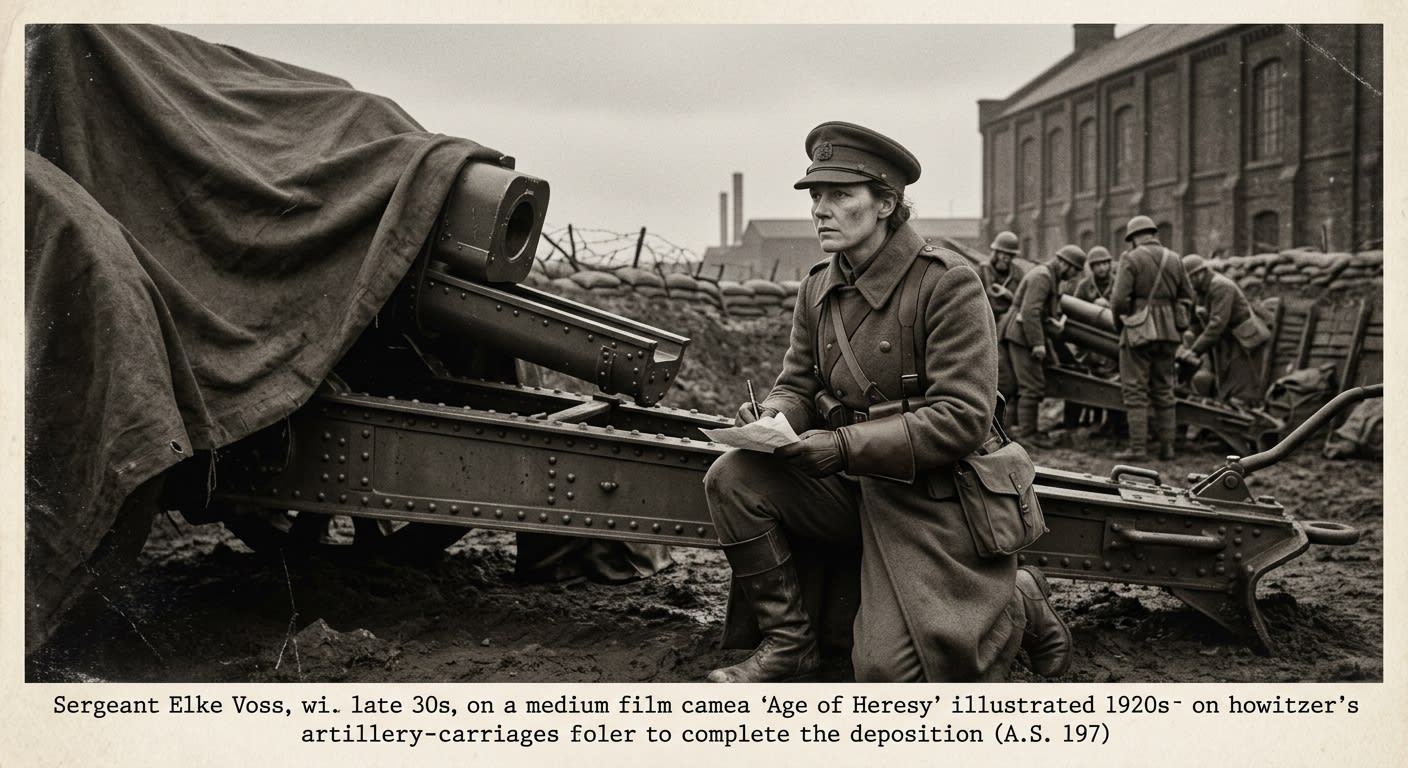
By Voss's service, that story had become drill. Every recruit entering the lower galleries learned to inspect gun and gun-shade, stair and under-stair angle, comrade and the comrade-shaped absence beside him if the lamp were behaving honestly. Standing Order 88-H (Unregistered) required ash-dusting along threshold lines. Bell-pulse checks ran at irregular intervals. Reliquary niches were installed where Tithes approved the cost, which is to say fewer than needed and more than Tithes later admitted.
Earlier barracks versions claimed the A.S. 171 sentry invented the shadow to hide a murder committed during a ration quarrel.
Corrected after the fourth identical throat-cutting. The Bureau of War now classifies the original report as substantially accurate, although the sentry's pension remains reduced for “initial descriptive excess.” One may be vindicated and punished in the same file. This is called balance by people with chairs.
Voss inherited the consequence. The enemy she watched for was mortal, glyph-fed, and dissolving by the hour, but mortality did not make him comforting. A starving man whose skin has been written into absence can still hold a knife. He can still wait behind a hinge for six hours. He can still learn the breathing rhythm of the guard who checks the hinge every nine minutes and cut on the tenth. The Shadow Court spends such men with accountant calm.
The first confirmed penetration during Voss's watch occurred on a wet Lent-Eve night in A.S. 196. The ash at Gate Vent Four showed a heel-print too narrow for regulation boots. The bell-pulse made nothing visible. Voss ordered the gallery sealed anyway. Her lieutenant objected that the print might be old. Voss asked him whether old footprints usually crossed fresh broom-lines without disturbing the soot beside them. The lieutenant, being an officer, disliked grammar from a sergeant. He disliked the dead clerk found in the pressure office an hour later even more. The clerk's key-ring opened a Choir Magistracy service hatch; the Stalker had aimed at timing, as Stalkers do.
#On the Deposition
The line everybody quotes is real: “It is not the blade I fear. It is the not-knowing. Every shadow that moves wrong, every sound that stops too suddenly — I watch the dark and the dark watches me back. The Bureau says vigilance is virtue. I say vigilance at this pitch is a kind of madness, and the Bureau can file my opinion wherever it files all the other things it does not wish to read.”
Records copied it accurately. War underlined kind of madness. Mercy, in its nonexistent copy, placed a red mark beside the word pitch. The mark matters. Mercy hears things War calls morale and Records calls testimony. Mercy knew Voss was describing an injury without blood.
Her deposition continues in a hand that begins square and worsens toward the bottom of each page. She describes the first hour of watch as discipline: counting lamp-flutters, checking ash-lines, answering countersigns, listening for chain-hum from the Third Lung. The second hour becomes suspicion: a comrade's cough arrives too late, a nail head catches light twice, steam bends around an empty space. The third hour becomes accusation. The eye, deprived of certainty, begins prosecuting the world.
DEPOSITION 197-V/VOSS — EXCERPT SEALED BY MERCY REVIEW At the fourth hour I knew Private Harn (Unregistered) was dead because he stood too still. I challenged him. He answered correctly. I challenged him again. He answered with my mother's voice. Then I understood I had not slept in █████ hours and that Private Harn was alive and terrified of me. I ordered him searched anyway. Nothing was found except his fear, which I had put there.
This is the Veil-Stalker's secondary wound. The knife kills one man. The possibility of the knife drafts everyone else into a tribunal without adjournment. A garrison that fears an unseen infiltrator becomes its own interrogator. Men watch friends for signs of borrowed faces. Lamps are cursed, then blessed, then cursed again for failing to improve. New arrivals are treated as hostile until their names have been shouted by three witnesses and one bell. Strangers become evidence. Familiarity becomes insufficient.
Voss did not soften this. Bless the woman; she was a sergeant, not a pamphleteer. She wrote that vigilance sustained at Irongate levels “reduced ordinary affection to tactical liability.” She wrote that laughter after dusk caused three separate weapon-ready incidents in one week. She wrote that a good sentry became, by Bureau instruction, a person unable to trust perception, memory, affection, silence, movement, or rest. She wrote: “The enemy eats his own body to disappear. We eat our sleep to find him. I request the Bureau decide which starvation it prefers.”
#On Mercy's Non-Acknowledgement
Mercy has not acknowledged Voss's deposition because acknowledgment would create a category, and categories breed claims the way damp barracks breed lice. If sustained vigilance is an injury, then every lower-gallery sentry at Irongate becomes a patient. If every sentry becomes a patient, rotations must change, watch lengths shrink, rest schedules harden, compensation expand, and the sainted arithmetic of manpower will begin screaming in its crib.
The Bureau prefers virtue. Virtue is cheaper. Call vigilance holy and a sleepless soldier becomes admirable instead of damaged. Call his tremor zeal. Call his suspicion discipline. Call his inability to sit in a dark room without facing the corner devotion. Stamp him fit for duty and send him back beneath the gun-carriage.
War's answer was procedural: shorter watch rotations where possible, irregular bell-pulse schedules, paired sentries, ash-line renewal every two hours, compulsory countersign variation. These measures saved lives. They also multiplied the rituals of fear. Each new precaution told the sentry, correctly, that the world was more dangerous than yesterday's instruction admitted. The same logic governs Brest corridors and Shipka fog-posts, but Irongate adds machinery that can kill a man while everyone is looking elsewhere.
Records' answer was archival: Voss's deposition entered under Veil-Stalkers, Psychological Incidental Effects, Line-Restricted. A copy was sent to Doctrine. Doctrine returned it with no public teaching use authorised, on grounds that soldiers hearing the testimony before service might “pre-imagine symptoms.” The phrase is so smooth one could slide a corpse across it.
#On Voss Herself
The file gives fragments. Voss was thirty-one at deposition. Broad-handed. Left cheek scar from a recoil splinter, A.S. 193. Commended twice for ash-line discipline. Reprimanded once for striking a bell apprentice who rang a pulse six minutes early as a joke; the reprimand was later marked “instructional” after the apprentice transferred to candle inventory and refused corridors.
Her squad liked her, which is not the same as finding her pleasant. Pleasantness kills sentries. Voss inspected boots for wrong ash, sleeves for hidden cuts, eyelids for sleep-fog, speech for delays. She confiscated three private charms, two illegal stimulants, one unlicensed relic tooth, and a love letter whose perfume caused the checkpoint pair to argue for nineteen minutes about whether roses counted as Velkaran risk. She returned the letter after airing it under a bell.
She prayed badly, according to Chaplain Orr. This means she prayed honestly. Orr wrote that Voss stood during office with eyes open and head turned toward the west corner of the chapel, where the candle-rack made complicated shade. When corrected, she answered: “The Creator knows I am listening. The corner does not.” Orr filed concern. Purity filed interest. Voss filed nothing, which shows admirable restraint.
A later barracks tale claims Sergeant Voss slept with a lantern burning inside her locker for three years.
Corrected. The lantern burned outside the locker, hung from the hinge, angled to cover the gap between door and floor. The distinction matters to any reader who has ever checked a room for things that prefer thresholds.
#On Her Present Disposition
The public file ends with retention pending review. A soldier who writes too clearly becomes a problem. The Bureau cannot call her hysterical; the incidents support her. It cannot call her disloyal; she kept watch. It cannot call her wrong; the dead would object, and the dead, properly filed, remain persuasive.
So the review extended. A.S. 198. A.S. 199. A.S. 200. By A.S. 201, Voss appears in Irongate supply rosters as assigned to “instructional night protocols,” which is bureaucratic lacework for teaching younger sentries how not to die and how to endure the cost of not dying. Her deposition circulates unofficially in copied extracts, folded into prayer books, tobacco tins, and the backs of rifle-cleaning cards. War disapproves. War reads the copies.
At least once, a recruit asked Voss how to tell the difference between an ordinary shadow and a Veil-Stalker. The answer survives in a private letter from that recruit to his sister in Metz: “Sergeant said there is no difference until there is. Then she told me to eat before watch, sleep when ordered, trust ash more than courage, and never challenge the dark twice in the same words.”
There. A doctrine fit for men with eyelids.