
#On the Bench That Listens Before It Judges
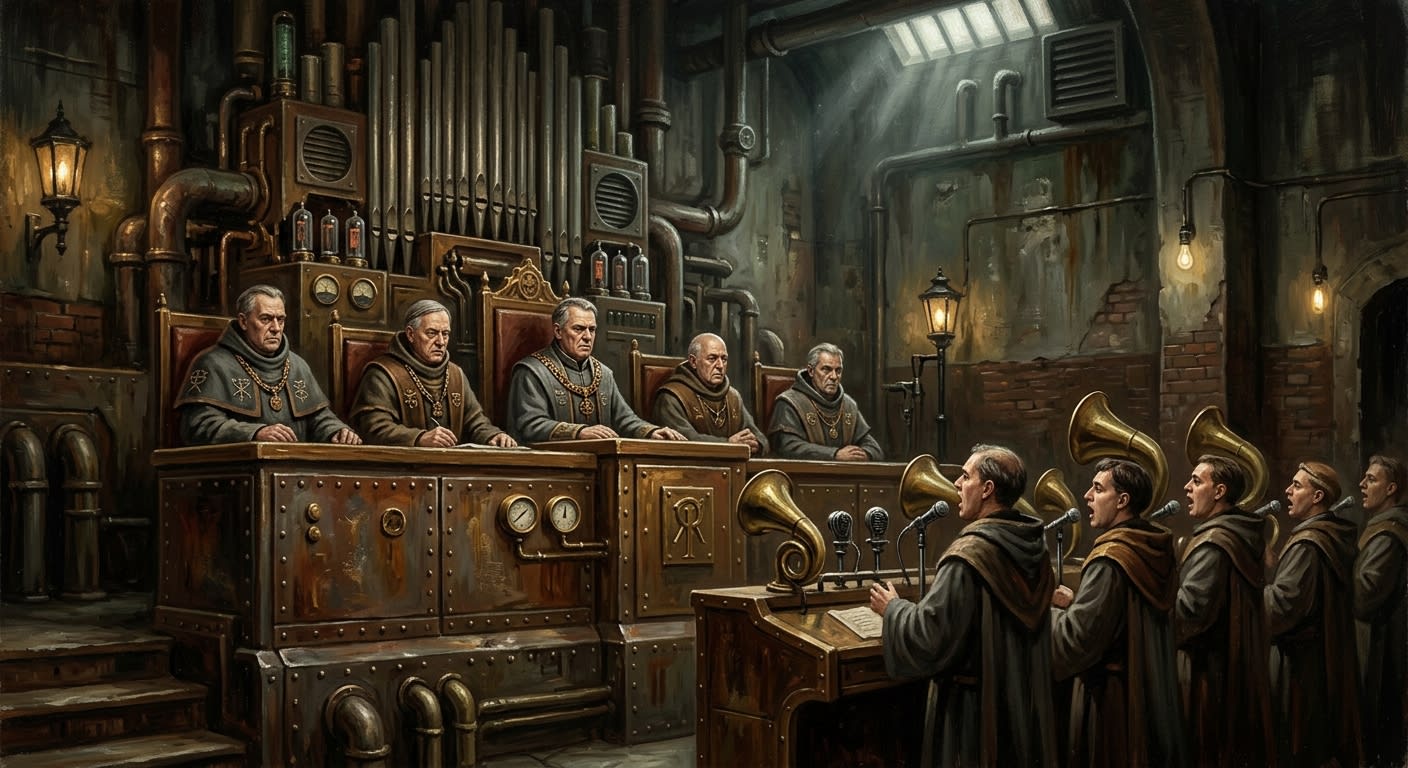
The Choir Magistracy of Bastion-Irongate is the tribunal that decides which voices may keep a mountain hollow.
This sounds poetical. It is not. Poetry has rarely signed a heat denial order, though poets have deserved several. The Magistracy governs the licensed vocal labour by which the Gasket Choir maintains Irongate's pressure seals, tunnel lungs, gasket housings, bolt seats, brass baffles, and the thousand little mechanical consciences that persuade the Iron Gates gorge to remain fortress rather than geology. It sits at the seam where liturgy, engineering, punishment, class, breath, and survival have been bolted together under damp stone. Its seal appears on hymn pages, voice-tier notices, pressure orders, Hush Court summonses, heat allocation slips, cracked-throat waivers, and death certificates that decline to use the word exhaustion.
The Magistracy calls itself an office of necessary acoustic governance. The chant workers call it the Warm Bench. The Underchords call it the Ear. The Counterkey Circle calls it the Cage Choir. I call it one of the most perfect institutions on the Line, by which I mean that every cruelty it commits can point to a pressure gauge and ask whether the objector would prefer burial.
The Magistracy's genius is its modest claim. It does not say: obey because Doctrine commands. It says: sing because stone is listening. It does not say: submit because Strasbourg desires order. It says: hold the note because the Third Lung dropped three thousand men when silence was permitted to become weather. It does not need an altar when it has A.S. 94.
The result is a court whose verdicts are heard in the throat before they are read on paper. A man may dislike a tax office. He may fear Purity. He may curse Records. At Irongate he learns to fear a woman tilting her head during the fourth measure and saying, softly, that his upper register has become expensive.
#On the Great Hush and the Birth of Jurisdiction
Institutions adore founding documents. Superior institutions arrange founding corpses.
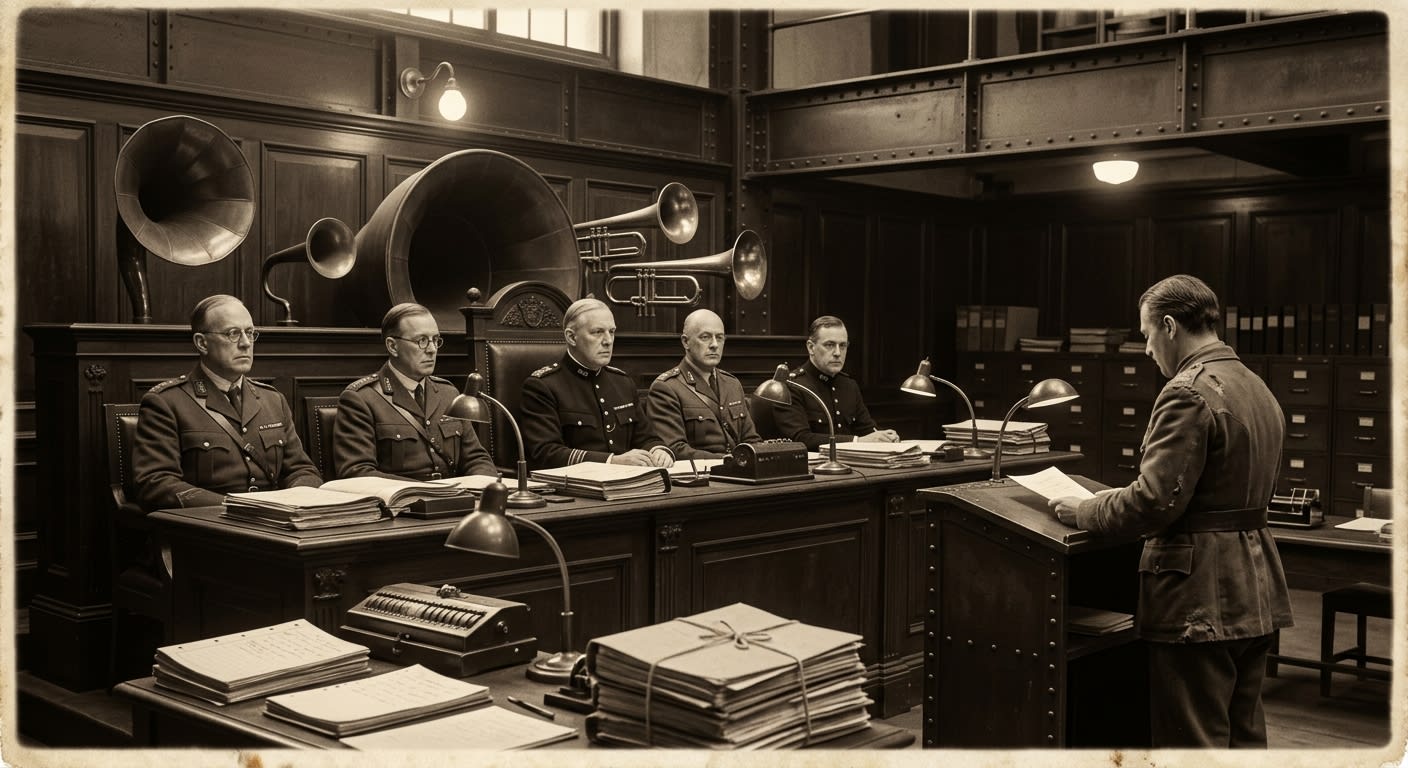
The Choir Magistracy was born from the Great Hush of A.S. 94, when a pressure inversion settled over the Danube gorge and the tunnel-mouths of Irongate fell silent for nine hours. The early fortress, crude, timber-lined, overconfident, and full of engineers who believed iron ribbing could compensate for ignorance, had already been held by vibration without admitting it. Wind through sixty-three tunnel mouths, cart traffic, machinery, shouted orders, forge rhythm, river throat, barracks noise: all of it kept the seals alive by accident. When the accident ceased, the mountain remembered itself.
The Third Lung compacted by dawn. Pressure doors failed in sequence. Gaskets slackened in their seats. Bolts worked loose by increments too small for a clerk and large enough for death. Three thousand were buried beneath stone, iron, timber, bread carts, bunks, prayer stools, and the professional embarrassment of the Bureau of Engineering. Rescue crews heard knocking for sixteen days. The public report, being merciful and cowardly in equal measure, preferred weather, fatigue, and poor timber selection. Doctrine preferred a cleaner truth: silence killed them.
Early Engineering memoranda described the post-Hush chant regime as “temporary vocal reinforcement pending structural remediation.”
Corrected. Temporary arrangements that acquire benches, seals, budgets, executions, and hereditary jargon are no longer temporary. The chant regime became structure. The Magistracy became the regime's mouth.
The first magistrates were not judges. They were pressure readers, bell analysts, exhausted chaplains, senior chant foremen, and engineers with enough shame to obey a hymn. Their earliest task was to keep men singing while the dead still knocked behind masonry. This is how authority hardens: by standing near disaster with a workable order and a face arranged into certainty.
Within three years the provisional pressure desk had acquired robes, a tier ledger, punishment authority, hymn recall rights, and the Hush Court. By A.S. 97 the Voice-License Tier System was ratified under Transit and Breath authority. By A.S. 105 every resident of the mountain was classed by vocal utility. By A.S. 134 the Magistracy had learned to distinguish a cracked throat from a moral failing only when paperwork required mercy, which paperwork seldom does.
The Great Hush is recited before every novice magistrate. Not as lament. Lament softens. It is recited as title deed. Three thousand dead gave the Warm Bench the right to ask every living throat for rent.
#On Voice-Licensing and Heat
Voice-licensing is the Choir Magistracy's central sacrament, though the office objects to the term because sacrament invites theology, and the Magistracy prefers to pretend its cruelty is purely mechanical. Every resident of Irongate receives a vocal tier. First tier permits residence and menial labour. Second and third allow minor breath-line chorus duty. Fourth grants chamber work in the principal lungs. Fifth permits supervisory stanza correction, gauge-adjacent service, and the delicious civic privilege of telling another worker he is flat while the mountain waits to see who dies.
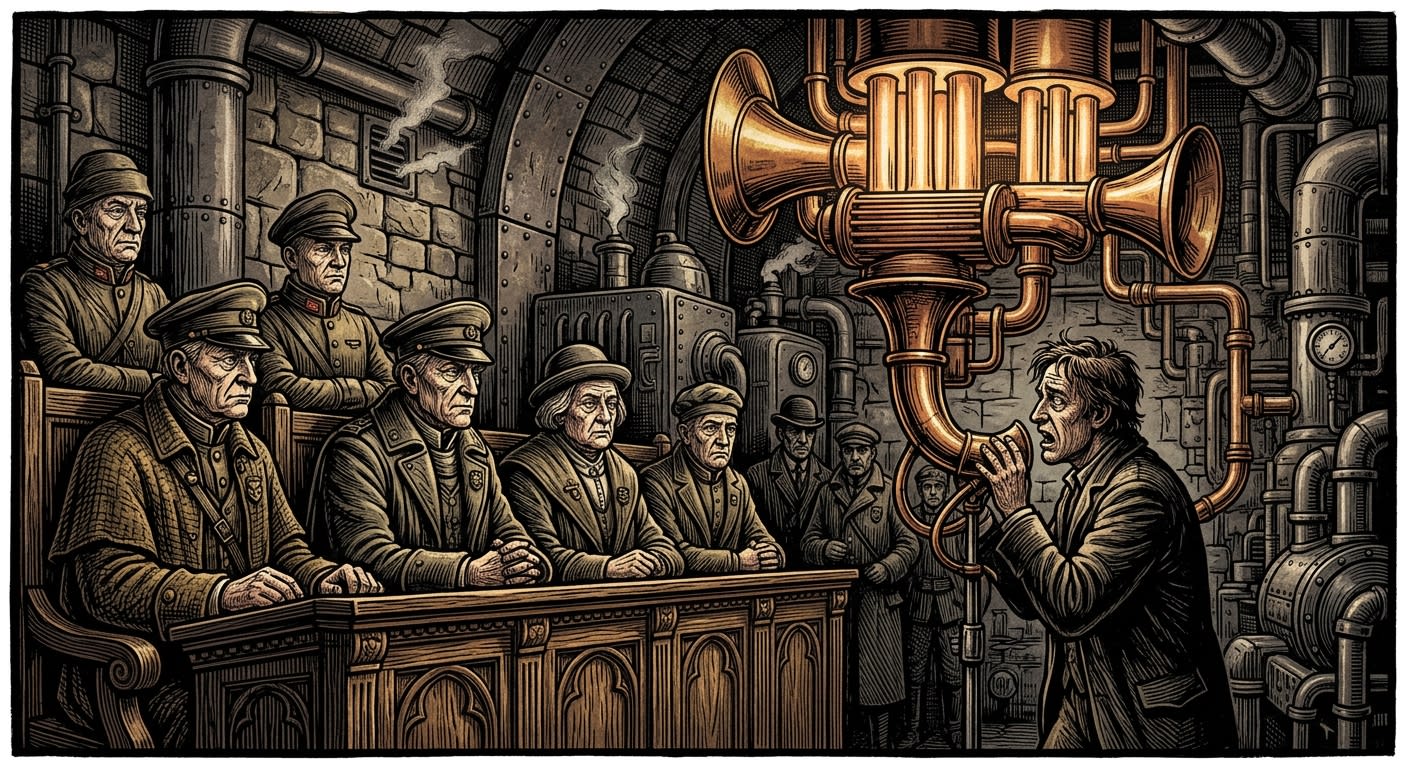
Above fifth tier stand Master Cantors, Presiding Ears, Bench Wardens, and the excellent monsters who can hear a gasket loosen through thirty yards of stone, two brass baffles, a convoy rail, and a dormitory argument. Below first tier begins the cold country. To be unlicensed is to remain physically inside the mountain while losing the legal warmth by which the mountain permits life. Heat allocation falls. Ration priority thins. Bunk hours shrink. Medical access becomes instructional. A man can live for weeks under such correction. This allows the Magistracy to deny that it has sentenced him to death.
The audition ritual is conducted in a chamber whose acoustics have been deliberately purified of kindness. A worker stands on a marked stone. A Choir Warden holds the candle. A gauge clerk watches pressure. A magistrate names the stanza, tempo, chamber condition, and duration. The worker sings. If he sustains the required harmonic, the seal remains on his file. If he fails, the court considers possible causes: ice-lung, fatigue, grief, sabotage, contamination, malingering, heresy, Morwenic envy, Underchord contact, or age. These distinctions occupy the minutes before the verdict. They rarely alter it.
Cantor Ys Varr presides over the higher auditions with a stillness that workers hate more than shouting. Shouting at least acknowledges flesh. Varr listens as though the throat before her is a pipe fitting that has developed opinions. Her notes are famous: upper measure thinning; warm rations conditional. Breath leak after second cadence; recheck kin contacts. Contralto suitable for Third Lung mourning tone; do not waste in Valve Quarter. One famous ruling on a boy of fifteen reads only: usable until winter. The boy lasted until first frost. Varr's prediction was exact. Accuracy is the devil's favourite credential, and the Bureau's.
Licensing converts survival into apparent merit. The strong-voiced sleep warmer. The cracked sleep near stone. Children learn early that lullabies are practice, coughing is evidence, and a father whose voice lowers during supper may be gone from the household ledger before the next pressure weather.
#On the Hush Court
The Hush Court sits beneath a reinforced ceiling that has been repaired three times and trusted never. Its benches are black basalt, its gauge board is brass, its air is dry by Irongate standards, and its silence is so complete that defendants often begin to sweat before the charge is read. The court tries silence crimes: incidental silence, negligent silence, malicious silence, and that broad grey province called suspicious quiet.
Incidental silence occurs when a worker faints, vomits blood, loses breath under injury, or drops from the line because the body has petitioned for mercy without clearance. Negligent silence includes missed entries, unsanctioned sleep, private weeping in resonance corridors, laughing another singer off tempo, hidden coughing, and failure to report a cracked colleague. Malicious silence includes refusal to sing, counterkey markings, muffled baffles, stolen hymn pages, ear-plugs, strike murmurs, and any sign that the mountain's own hum has become more interesting to the accused than the Magistracy's page.
Proceedings are brief. Long trials require stable air and the Magistracy dislikes wasting stability on guilt. The charge is read. The test note is struck. The accused answers, fails, or answers wrongly. Records writes. Doctrine witnesses. Engineering attends whenever a verdict may affect load-bearing facts, then spends the session pretending facts are impartial.
HUSH COURT FILE 34-K/199 Charge: malicious silence during Third Lung reinforcement. Defence: no audible statement. Medical appendix: vocal cords fused by ice-lung scarring; speech anatomically impossible. Verdict: guilty. Sentence: carried out. Pressure effect: stabilised forty minutes later. Training notation: successful deterrence.
The Hush Court's defenders point to the last line and fold their hands. Pressure stabilised. There speaks the whole theology. If a dead man and a punished district produce a stable gauge, the gauge becomes advocate, witness, judge, and choir. Opposition must then argue against the ceiling, and ceilings are notoriously poor at receiving appeals.
Several provincial lectures describe the Hush Court as “ecclesiastical mediation between labour need and structural safety.”
Amended. Mediation presumes parties of comparable standing. The worker has lungs. The mountain has mass. The Magistracy owns the room. Call the thing by its name: a court where physics wears a robe.
Yet the Hush Court is not mere theatre. I deny it the comfort of being only cruel. Its sentences often work. Men return to shifts. Hidden mufflers are found. Stolen hymn pages reappear under bunks. Pressure holds. It would be easier if the Magistracy were wrong. Useful tyranny is the administrator's ugliest inheritance.
#On Offices, Factions, and the Warm Bench
The Choir Magistracy presents itself as a single bench. It is a little ecology of authorised ears. Cantor Ys Varr holds the principal magistrate's chair and controls final licensing appeals. Beneath her sit Bench Wardens, Gauge Readers, Pressure Clerks, Hush Advocates, Chamber Ears, and Hymnal Custodians, each rank armed with enough authority to make a worker's life worse and too little authority to bear blame alone. This is fine design. Blame, divided properly, becomes atmosphere.
The Choir Wardens patrol the breath lines, watch stance, mark cracked voices, confiscate unsanctioned lozenges, and strike test notes without warning. They are disliked even by the magistrates who require them. A Warden's duty is intimate in the worst fashion: he must know how a man's voice sounded last week, how his cough behaved yesterday, whether his wife has started singing lower to cover him, whether his child has been seen carrying gasket-rings, whether his silence is fatigue or faction.
The Hymnal Custodians guard the numbered pressure pages. Each chamber has stanzas for damp wind, cold wind, convoy surge, valve replacement, mourning tone, alarm inversion, gasket reseating, and emergency overpressure. A missing page can feed the Underchords, arm the Counterkey Circle, or merely allow an exhausted worker to practise before audition. The Magistracy treats all three as threats because mercy and sabotage use similar doors.
The Magistracy's relation with Tunnel Commandant Hadrik Sorn is cordial in the manner of two knives sharing a sheath. Sorn controls gates, troops, demolition charges, pressure doors in military emergency, and the brutal privilege of collapsing a compromised section before Morwen can wear it as a glove. Varr controls voices, heat, licensing, chamber tempo, and the right to call a soldier structurally useless. Each requires the other. Each resents the requirement. The fortress survives in the seam between their mutual contempt.
The Breath Office complicates matters by stamping the permits through which air becomes property. Seal-Brokers such as Lysa Murne turn clearance, quarantine, bunking, convoy passage, and candle-test results into brass and wax. The Magistracy pretends to despise their corruption while relying on their desks for enforcement. A revoked voice-license is merely a judgment until a seal clerk removes heat, ration, and movement rights. The ear hears. The seal bites.
#On the Underchords and the Counterkey Accusation
No account of the Choir Magistracy can remain decent after entering the Underchords, which is fortunate, since decency inside Irongate usually means the file has been washed.
The Underchords are the denied tunnels beneath and behind the sanctioned fortress: sealed maintenance voids, pre-Hush remnants, crawl-spaces behind baffles, abandoned ventilation channels, and the Dead Gallery where maps become embarrassed. The Magistracy officially treats them as non-habitable maintenance infrastructure. This prevents responsibility for the bodies living there, the counterfeit licenses minted there, the stolen hymn pages traded there, and the harmonics whispered there without sound.
The Underchord Cartel profits from every tier denial. A worker stripped of heat can buy a quiet pass. A singer terrified of audit can buy a stolen stanza. A Warden with debts can sell page numbers. A Breath clerk can misplace a seal. A magistrate can denounce the trade at dawn and benefit from its information by dusk. Tap-King Jaro, Mira Slate, and the lower corridor brokers understand the Magistracy more accurately than the Magistracy understands itself: the Warm Bench is both enemy and supplier.
Then comes the Counterkey Circle, a theological infection carried by acoustics rather than a smuggling quarrel. The Circle claims that the Magistracy's prescribed harmonics are wrong: capable of holding the mountain, yes, but inefficient, costly, politically useful, and maintained because dependency preserves the Warm Bench. It teaches alternative frequencies, counterkeys, in silent-sign and gasket grease. It recruits the discarded: aphonic workers, ice-lung veterans, failed fifth-tier candidates, sons of women frozen by heat denial, men who spent years as instruments and then heard the mountain hum without them.
The Magistracy calls this structural heresy. The phrase is excellent because it is true from several angles. A false harmonic can kill thousands. A true harmonic outside official custody can also kill an office. The Circle threatens both the mountain and the social machinery built around saving it. Varr knows this. Sorn knows this. Reed, the aphonic leader who burned out his own voice with heated gasket grease, appears to know it best of all.
Purity executed fourteen after the A.S. 199 Hush Court proceedings. Fourteen brought in. Fourteen left without voices, and then without more than voices. The Magistracy filed it as preventive maintenance. The Circle answered by moving deeper. Bells sent commissions. One returned with a report, one with a hymn, one did not return, and one lingers too long in the Dead Gallery. The mountain, unhelpfully, continues to hold.
#On Morwen's Use of Resentment
Morwen's campaign against Irongate is envy conducted through architecture. She does not merely send beasts against the gates. She sends comparison, grievance, replacement, borrowed faces, and the suspicion that another man's warmth was purchased with your breath. The Choir Magistracy, being necessary and hated, offers her a splendid surface.
A worker loses tier after twenty years of service and hears a younger man take his line. A mother watches her daughter's candle test pass while her own heat slip fails. A Warden marks a friend down for a cracked note and receives a warmer bunk. A magistrate says the mountain requires sacrifice and then returns to an office with steam pipes under the floor. Envy needs no sermon in such air. It only has to point.
Mirror Discipline guards the garrison against replacement, but the Magistracy lives amid subtler mirrors. The voice-license ledger tells every throat what it is worth compared to another. The heat roster ranks families by sonic utility. The audition bench makes private decline public. Morwen cannot have designed a better schoolroom unless, and I dislike the thought, she merely found ours adequate.
MIRROR DISCIPLINE / CHOIR CROSS-NOTE — A.S. 200 Subject: two licensed fourth-tier altos, identical audit scores, identical throat scarring, mutually hostile kin records. Ledger of Self confirms both. Voice test: both correct. Pressure response: improved when both sang together. Disposition: ███████████████████████ Bench annotation: “Do not permit harmony to establish identity.”
The Magistracy's defenders argue that envy exists because Morwen presses the gorge, not because the Warm Bench creates ranking. This is childish. An enemy may press a bruise; someone still made the bruise. The office's sin is not that it classifies voices. Classification is unavoidable. Its sin is that it mistakes classification for holiness and then pretends the warmth of its own benches is incidental.
#On Drax's Inspection
I inspected the Choir Magistracy at second watch, because first watch is ceremonial, third watch is exhausted, and second watch shows an institution after vanity has had breakfast.
The Choir Nave struck me first as a cathedral built by men who distrusted the Creator but trusted brass. Black basalt walls sweated into runnels. Baffle banks hung like rib cages above the chant pits. Gauges trembled in rows, each needle a small accusation. The workers sang the Gate One compression hymn in a lower register than the page prescribed. I noticed. Varr noticed that I noticed. The pressure held. We were both too well bred to say the forbidden sentence: the page was wrong and the workers had corrected it by custom.
Varr's office was warm. This is the first fact and the last indictment. A kettle steamed beside pressure ledgers. Throat lozenges sat in a lacquered tin. Her personal hymnal had marginal notes in three inks, some musical, some judicial, some private enough that I pretended not to read them until she left the room. One note beside the Third Lung mourning tone read: old cadence still steadier. Another beside the official revision read: politically necessary. I admired the honesty. I copied it, naturally.
A worker was brought in during my visit: second-tier, male, forty-three, ice-lung onset, suspected Underchord kin contact. He sang badly because his lungs were failing. He lied badly because his son had vanished below. Varr listened, lowered him to first tier, suspended heat reduction for seven days, and ordered kin surveillance rather than immediate Hush Court referral. Mercy? Calculation? A test to see who contacted him? All three, my beloved reader. Institutions rarely commit one motive when three will serve.
At the Hush Court I heard no case. I heard the room waiting for one. That was worse. Benches polished by fear. Ceiling dust gathered in seams. A test note fork placed on cloth. Records ink already uncapped. Every object in the room had learned the posture of anticipated guilt. I have built such rooms in Doctrine. I know the craft. I resented their competence.
#On the Present Magistracy
As of A.S. 201, the Choir Magistracy holds Irongate in song, fear, heat, resentment, paperwork, and necessity. Cantor Ys Varr remains presiding ear. The voice pool is shrinking under ice-lung and overwork. Emergency doubles increase during pressure weather. Counterfeit licenses circulate despite three purge cycles. The Counterkey Circle persists after executions. The Underchords expand through denial. Morwen presses from without and, more elegantly, from within.
The Magistracy wants more Wardens, stricter page custody, wider heat authority, and legal control over all throat medicines entering the bastion. The Bureau of Bells wants cleaner acoustic data. Engineering wants fewer doctrinal claims attached to gasket reports. Purity wants names. War wants the gorge open. The workers want warmth, lozenges, sleep, and a note they can hold without tasting blood.
The present licensing rolls record twenty-two thousand registered residents under ordinary garrison conditions, of whom slightly fewer than nine thousand possess any choir-useful tier. The figure is false in the usual administrative fashion: too exact where it should confess uncertainty, too narrow where it should admit bodies hidden below. It excludes convoy transients, punitive work details, sealed patients in the Breatheries, children below candle-test age, and every unlicensed throat surviving in corridors that Engineering marks as stone. It also excludes the soft category called provisional breath: widows permitted to remain through winter for cleaning duty, sons awaiting audition, daughters whose pitch has been reserved but remains unpurchased by a chamber, and old men whose voices are gone yet whose memories of gasket failures remain useful to younger mechanics. The Magistracy knows this. Its ignorance is selected, warmed, and fed.
A.S. 201 also brings the small humiliations by which great offices announce fatigue. Page recalls take longer. Two Wardens were caught selling audition warnings through a laundry chute above the Valve Quarter. A fifth-tier supervisor altered his own cough notation and blamed Records ink creep, which would have been a beautiful defence if the clerk he accused had not died three months before. A shipment of sanctioned throat lozenges vanished between Bratislava and the Snowmouth Gate, reappeared in Underchord hands, and was later purchased by the Magistracy through an unnamed intermediary at four times tariff. Officially, the lozenges were recovered from smugglers. In practical terms, the office bought its own medicine back from the cellar.
The Counterkey pressure worsens because its accusation now has witnesses inside respectable ranks. Younger Gauge Readers notice unofficial corrections in old margins. Chamber Ears hear workers adjusting cadences before the page commands it. Gasket-Hymn Mechanics mutter that certain forbidden intervals seat seals faster during damp wind. None of these people are rebels by temperament. They are worse: competent technicians irritated by bad instructions. A rebel can be frightened. A competent technician with a recurring measurement becomes a theological crisis in boots.
Varr has answered with selective mercy, which is the most dangerous sort. She postpones heat reductions for useful informants. She restores a tier to one worker in twenty so the other nineteen may learn gratitude by deprivation. She allows certain customary cadences while prosecuting the same intervals when found written on Underchord walls. This is not hypocrisy. Hypocrisy is clumsy. This is jurisdiction: the note is lawful when the Bench hears itself in it, heretical when the cellar writes it down.
A recent Magistracy circular states that “all licensed voices participate equally in the Choir's holy burden.”
Corrected. Fifth-tier supervisors participate warmly. First-tier workers participate cheaply. The unlicensed participate by example. Equality is a poor word inside a mountain where heat rises by permit.
Still, the Choir sings. This is the Magistracy's defence, and no honest enemy can dismiss it. The Transit Spine remains passable. The pressure doors hold within tolerance. Convoys move between Sibiu, Irongate, Shipka, and Constantinople. Morwen has not owned the gorge. The Danube continues to pass below like a witness too old to be impressed by our arrangements.
At shift change the chant thins, then thickens. A thousand throats hand the mountain to the next thousand. Varr's bench listens. The gauges tremble. Somewhere below, a pipe taps twice, pauses, taps once, and falls silent before a Warden can locate the source. The stone hums under official song. The Magistracy pretends not to hear the difference.
The ceiling holds.