
#On the Litany's Recorded Use
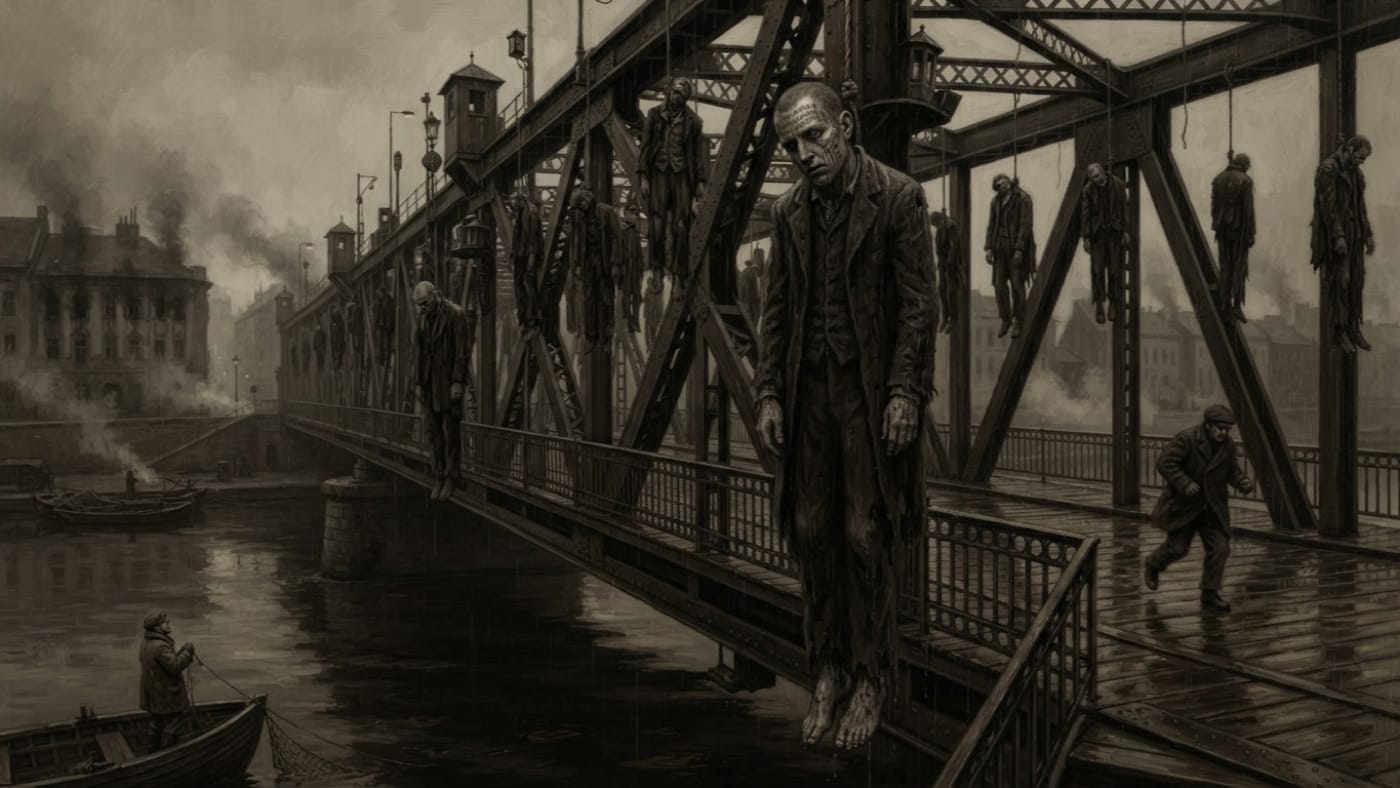
The Litany of Obedience appears in the Vienna case papers exactly once, and it appears on a face. Forty Rationalist dead were displayed on the Hanged Bridge over the Donaukanal. One of them, unnamed in every register I have been permitted to see, carried the Litany's opening across brow, cheek and jaw. The others wore psalms, anathemas and fragments of the Creed. This one wore obedience, or the first lines of it, which is as much of the text as a human head could reasonably hold.
That is all the evidence there is, and the Codex will not pad it. Some later compiler will want a verse count, a melody, and a composer with a beard and a feast day. He will be disappointed, and the disappointment will do him good. I also decline to set the opening down here. Whatever copy the Bureau of Records keeps, it keeps. A reference article that quoted liturgy at length would need its own licence, and I have read enough of this case to dread becoming the second unlicensed voice in it.
What the Bridge does establish is the Litany's most perfect congregant. He could neither mumble nor lose his place, and he could not give the vicar the look that vicars write up as "insolent cadence." He displayed the approved words in public for as long as the weather allowed. He raised no objection, having been killed first.
#On Recitation and Correction
The Church does not keep its doctrine in drawers. It keeps it in mouths, and it checks the mouths. In the Catechism Schools each day begins with the Creed spoken in unison until the walls ring. Children copy scripture until their fingers bleed ink and chant catechisms until their voices crack, and the masters call the ones who survive soldiers of the Word. On the streets, Doctrine Street-Vicars halt ration queues and market traffic for square-stops. They test a passer-by on the creed, correct the faltering line in front of witnesses, and hand over a correction slip that prescribes recitation and penance. The Bureau of Orison licenses what may be sung, and it has prosecuted melodies found wandering abroad without papers.
Nothing in the Hanged Bridge file says which of these mouths recite the Litany of Obedience, and I will not invent a schedule of schoolrooms and barracks for it. The surrounding practice is enough to show why the Litany belonged on a bridge at all. In the Church, a correct text is only half the instrument. The other half is performance: the words spoken aloud, overheard, corrected and entered in a register. A creed that no officer hears is a private opinion with good grammar.
The living reciter is a permanent administrative risk. He stammers. He drops a clause, and his doorframe gets marked "uncertain" in chalk. He recites perfectly while thinking something abominable, and the vicar knows it and has no column to write it in. Every recitation is a small trial that never reaches a verdict.
The dead reciter closes the file.
#On the Writing Across the Face
The forty were remnants of the old faith in Reason. They were active in the lower quarters of Vienna between A.S. 99 and A.S. 102, in the hard years after the Siege returned the shrine-city to the Church. They were killed by ordinary means, and the Bridge displayed their bodies afterward. Sentimental pamphleteers keep confusing the two. A bridge called Hanged sounds like an execution device. In practice it was a shelf.
Each body was tattooed after death. The ink was black-green with an ash binder, needled into skin that had stopped resisting needles. Psalms went across backs and anathemas along ribs. Creed fragments went on forearms, where a living man might have rolled up a sleeve to show them. The Litany's opening went on the face.
The offices still quarrel over whose scheme it was. The Bureau of Purity claims deterrence: a rebel wearing orthodox verse would rebut his own cause to everyone who passed. Records claims custody: marked bodies could be identified if the river took them, and the river did. The Bureau of Doctrine claims authorship of the whole intervention, as it claims most successful things done near a pen. That claim covers the tattooing. Nothing in the file extends it to the composition of the Litany, whose origins the case papers never discuss.
No record says who chose the face. I can say why it was the right choice. A psalm on a back can only be read by someone walking behind the corpse, and an anathema on the ribs needs the right angle. The face meets the crowd head-on. It is where the living look first to judge whether a man is lying. The Bridge put the opening of a prayer of submission there, in a hand that was not his, over a mouth that would never contradict it again. This did not make him penitent, since repentance needs a penitent. It made him a notice-board with an expression.
As Records observed in fewer words, it was also poor anatomy. Rain made the cheeks run. In wet weather the black-green lettering slid down toward the jaw, so that in this one place the Litany of Obedience obeyed gravity before it obeyed the Bureau.
By A.S. 102 the Bridge was empty. The official notice says the bodies were cut down. The fishermen say the canal cut them down for itself. No register says which of the forty went first, or whether the face that wore the Litany ever came back up in the nets as bone.
#On Correct Words Without Permission
Then the canal began handing the lessons back. A fisherman's night net brought up a radius inscribed with four words from the Seventh Antiphon. A child found a knuckle near the quay bearing an inked D. A Mercy barge pulled a jawbone out of its paddle housing, its inner curve lettered so small that Records needed a lens and a clerk with clean hands. Purity examined twenty-three fragments, and Records copied forty-nine lines. Those are totals for the whole recovery. They are not the length of the Litany, and no document I have seen makes the antiphon on the radius a section of it. I set this down because men who have never assembled anything are strongly tempted to assemble these bones into a prayer.
No office explains how lettering on skin became lettering on bone. I will not try either.
The scandal was that the words were correct. Doctrine compared the phrasing against the canonical editions. It searched for infernal inversion, for an acrostic praising the Great Deceiver, and for a Rationalist cipher tucked into the cadence. The search came back empty and furious. The words were right, the hand was one Records did not recognise, and the ink did not fade.
Hanged Bridge case reference: active demonic site.
Withdrawn in the bridge case file after Doctrine's review. The recovered bones bear orthodox scripture in an unrecognised hand. Purity's first memorandum blamed demonic interference. Its revised memorandum adopted "residual doctrinal saturation" and recommends no action.
Residual doctrinal saturation means the site absorbed correct teaching so thoroughly that its matter keeps expressing it without supervision. The term records where the Bureau has filed the problem. It says nothing about how the thing works, which is why it has survived every review.
For a liturgical text, the case is a peculiar insult. The Litany was put on a dead man's face so that approved words could be shown without his leave. The bones that came back show approved words without the Church's leave. Doctrine at least claims to have licensed the tattooing. Nobody claims the hand on the jawbone.
Purity's field addendum adds testimony from three witnesses. They say a rib fragment, recovered wet, recited under its breath. The audio verification failed. The fragment was sealed in linen, and the linen was later found marked on the inside with the same verse in a second hand. That proves the linen was marked. The addendum does not say who marked it or what was speaking, and I will not say it for them.
#On Reading What Has Been Recovered
The current regulation for the Hanged Bridge makes removing inscribed bone a felony unless it is surrendered within one bell. It suspends reading aloud from recovered fragments, pending further theological convenience. These rules govern the bridge recoveries only. They do not touch the Litany of Obedience as a text, and any congregation licensed to say it may go on saying it. What is suspended is giving voice to a bone.
This is the sharpest distinction the case has produced. A Records clerk may read a fragment with his eyes. He may compare it to the canonical edition, copy it out, and certify it correct. He may not read it aloud. Correctness belongs to the wording, and the clerk can examine wording. Permission belongs to the speaker, and in this case nobody can name one.
Fishermen still bring fragments to the Vienna Records office in exchange for copper tokens and silence receipts. The Bureau of Pilgrimage wants the Bridge on its route. Purity objects to devotional handling. Doctrine waits, because waiting is how Doctrine turns an argument into jurisdiction.
My own concern is which office owns the Litany's words when they arrive by water. Doctrine holds the canon, Records the bone, and Purity the site, while Orison holds the right to make a sound. For one rainy season, the face that carried the Litany's opening belonged to all four offices and to none of them. The corpse filed no objection.