
#On the Bridge Above the Donaukanal
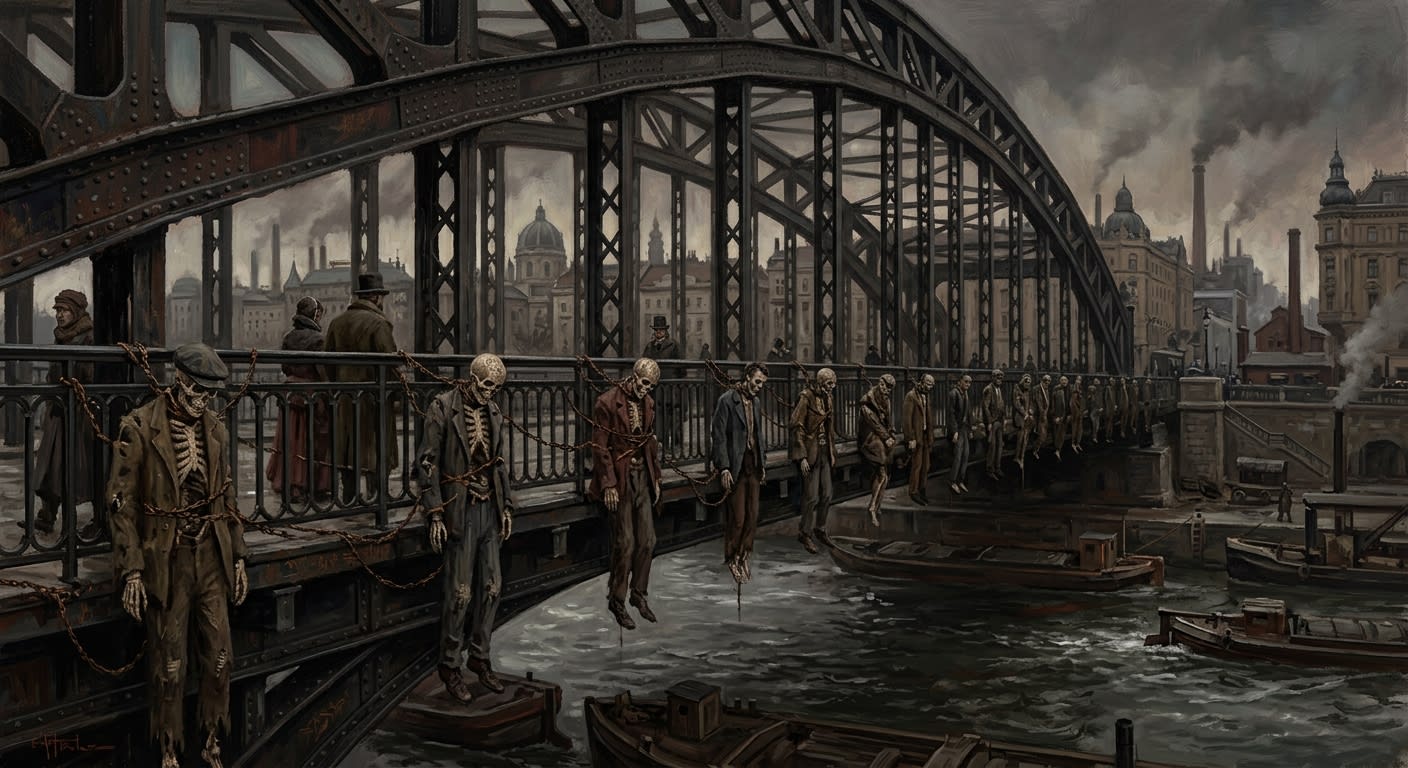
The Hanged Bridge stands over the Donaukanal in Vienna, narrow, iron-ribbed, blackened by incense soot, river vapour, and the administrative habit of leaving useful horrors in place. It is not a grand bridge. Vienna has grander stones, grander ruins, grander lies. The Hanged Bridge is a lesser span by measurement and a superior one by consequence, for forty dead men have made better sermons there than most living vicars manage from approved pulpits.
Forty Rationalist rebels were strung along its length after the reconsecration of the shrine-city and the hard years that followed the Siege. Their bodies had already been killed. This distinction offended several later sentimentalists, who imagined that hanging should precede death if the state is to retain good manners. The Synod is not a finishing school. It is an instrument of correction. Order required display, display required bodies, and the bodies were available.
#On the Forty and Their Writing
The rebels were Rationalist remnants, post-Republican bitter-enders, pamphleteers with pistols, bridge-cutters, cellar printers, and one former artillery clerk who had decided, after the collapse of every premise he had served, to continue serving the premises out of spite. They gathered in the lower Vienna quarters between A.S. 99 and A.S. 102, where the ruined streets still offered hiding places and the rebuilt authority of the Synod had not yet learned every crack by name. Their cause was restoration. Their method was arson. Their theology was denial carried past the point where denial ceased to be cowardice and became comedy.
The executions themselves were ordinary. The aftermath was not.
After death, each corpse was tattooed with scripture. The sources disagree on whose idea this was. Purity claims necessity: dead rebels displayed with orthodox verses would prevent sympathy by converting their bodies into rebuttals. Records claims custody: marked bodies could be identified if the river took them. Doctrine claims authorship, which is what Doctrine does when another office stumbles into eloquence.
A district schoolbook once described the forty as “martyrs of correction.”
Withdrawn. Martyrdom requires witness to truth. The forty witnessed nothing until after they stopped breathing. Their corpses became useful. Utility is not sanctity, though the Bureau of Tithes keeps trying to invoice the difference.
The verses were cut into skin with black-green ink and ash binder. Psalms across backs. Anathemas along ribs. Fragments of the Creed on forearms. One corpse bore the opening of the Litany of Obedience across the face, which was theatrically satisfying and anatomically poor, because rain made the cheeks run. The Bridge took them in a row, forty black pendulums over the canal, each turning slightly in wind from the water.
#On the Canal Taking Its Lessons
The bodies did not remain where they were placed. No public display ever does; weather is the oldest censor. The Donaukanal rose during spring thaw, swelled against its stone, and took the lower corpses first. Ropes rotted. Knots slipped. One body fell at dawn during the third bell and struck the water face-first, scripture downward, which witnesses interpreted according to appetite. By A.S. 102 the Bridge was empty. The official notice says the bodies were cut down. The fishermen say the canal cut them down for itself.
Recovery began almost at once. A fisherman hauling night nets snagged a radius bone inscribed with four words from the Seventh Antiphon. A child found a knuckle near the quay bearing the letter D, deeply inked. A Mercy barge reported a jawbone caught in its paddle housing, every tooth blackened and the inner curve marked with a line so small that Records required a lens and a patient clerk with clean hands. The script was orthodox. The hand was unrecognized. The ink did not fade.
PURITY FIELD ADDENDUM — HANGED BRIDGE RECOVERIES Object HB-17: rib fragment recovered wet, reciting under breath according to three witnesses. Audio verification failed because █████████████████. Fragment sealed in linen. Linen later found marked inside with same verse in a second hand.
The villagers along the canal began to say the drowned bodies preached beneath the waves. The Bureau forbade the phrase “preached beneath the waves” for eight months, then abandoned the prohibition when tavern singers proved faster than notices. A better bureaucracy adapts. A lesser one keeps stamping water.
#On Orthodoxy and Alarm
Bones emerging with scripture make a small administrative nuisance. The Age provides stranger annoyances before breakfast. The true problem is that the scripture is correct. No infernal inversion. No missed cadence. No hidden acrostic praising the Great Deceiver. No Rationalist cipher tucked into verse initials. Purity examined twenty-three fragments, Records copied forty-nine lines, Doctrine compared the phrasing against canonical editions, and every office arrived at the same intolerable conclusion: the dead were preaching Orthodoxy without a license.
The first Purity memorandum attributed the phenomenon to demonic interference, because Purity owns a hammer and regards the world as a nail that has failed catechism. The revised memorandum, issued after Doctrine's review and three unpleasant meetings, adopted the current term: residual doctrinal saturation. It means the site absorbed correct teaching so violently that matter continues to express it without supervision. It is a beautiful phrase. It explains nothing. It pays pensions.
A previous official documentation reference listed the Hanged Bridge as an active demonic site.
Corrected. The recovered bones bear orthodox scripture in a hand the Bureau of Records does not recognise. The Bureau of Purity recommends no action. When Purity recommends no action, sensible men ask what frightened it.
#On the Present Traffic
The Bridge remains open to foot traffic, though carts are forbidden and pilgrims are discouraged from lingering with buckets. A low rail has been installed to prevent relic-harvesting, suicide, sentimental leaning, and the local children's sport of lowering prayer ribbons into the canal to see whether they return annotated. The ribbons do return annotated often enough to maintain the sport and seldom enough to preserve doctrine's official irritation.
The canal below carries ordinary filth, rainwater, candle stubs, fish, lost tokens from the Via Stahlhand, and whatever the dead choose to release. On the first of November the Donaukanal steams. On certain fog mornings the underside of the Bridge appears lettered, though the words vanish when ladders arrive. Fishermen still bring bone fragments to the Vienna Records office in exchange for copper tokens and silence receipts. The silence receipts are ignored. Fishermen, unlike clerks, understand that a river which gives up sermons expects them repeated.
The Bureau of Pilgrimage wants to fold the Bridge into the standard Vienna route. The Bureau of Purity objects to devotional handling. The Bureau of Tithes has already printed three draft fee schedules and pretends this is preparatory diligence rather than hunger with columns. Doctrine waits. Doctrine is very good at waiting until argument ripens into jurisdiction.
The Hanged Bridge persists: a narrow iron span, forty absent bodies, a canal with excellent memory. The rebels meant to restore Reason. Their bones now cite the Creed in waterlogged script beneath a city Reason lost.