
#On the City That Died Three Times
"Vienna is a reliquary. The difference is that most reliquaries contain their saint. Vienna contains only the saint's absence, and charges admission." — Drax, marginal annotation, Bureau of Pilgrimage Quarterly Accounting, A.S. 199
I have walked Vienna twice. The first time, in A.S. 183, I was young enough to be appalled. The second time, in A.S. 194, I was old enough to admire the gift shop. Between these two visits the city did not change, which is the point: Vienna has not changed since A.S. 95, when Clemens Stahlhand struck down Althazar of Pest with a reliquary blow that, according to seventeen independent testimonies, rang the marrow of the earth. The blow ended the Rationalist Republic's last territorial claim in the Central Corridor. It also ended whatever Vienna had been before. What remained was a city preserved in the amber of its own ruin, too sacred to demolish, too broken to rebuild, too profitable to abandon.
#The Rationalist Capital: A.S. 0–45
Before it was a shrine, before it was a ruin, before it was a wound that would not close, Vienna was the capital of everything the Synod exists to repudiate.
The Council of Nine governed from Vienna's Imperial Palace. The Rationalist Republic's thirty-seven Philosophical Prefectures radiated outward from the city like spokes from a wheel whose hub was confident, well-lit, and catastrophically wrong. The Concordats of Ulm were drafted in Viennese lecture halls. The Lumen — that hateful coin bearing the motto RATIO SOLA — was minted in Viennese foundries. The Académie des Sciences published its seven contradictory treatises on the Year Without Dawn from Viennese printing presses, each treatise more confident than the last, each citing the previous as authority, each now useful exclusively for kindling.
The Holy See of Vienna — the old ecclesiastical seat, a thousand years of accumulated devotion — was dissolved at swordpoint under the Treaty of Regensburg in A.S. 30. Three days later, the Rationalist Prefecture of Public Instruction (Unregistered) staged the Black Procession in the Heldenplatz: forty-seven saint-effigies paraded through the boulevards, draped in mourning cloth, and burned upon pyres in the public squares.
The fires produced light. They did not produce heat.
Three citizens died of exposure within six feet of a pitch-fed pyre in November. Frostbite was recorded at distances the Bureau of Doctrine later classified as "theologically significant." The Rationalists cancelled the second day of celebrations and published an atmospheric explanation that satisfied no one and was cited by everyone. The Bureau of Doctrine's retroactive classification — "First-Order Portent, Providential Warning, Category: Elemental Rebuke" — was filed sixty-two years later, from Strasbourg, with the quiet satisfaction of men who had outlived the people they were classifying.
The cathedral vault at Saint Stephen's (Unregistered) still housed the reliquary of Saint Aldebrand — the same femur the Rationalists had declared "pig fragment, common, undressed" in the Amsterdam trial of A.S. 11. The reliquary glowed. It had been glowing since A.S. -32, when the Bureau's earliest records first noted the phenomenon. The Rationalists catalogued it. They measured it. They published papers on its phosphorescence. They could not make it stop. The femur glowed in their capital, in their cathedral, in the vault they had locked and sealed and officially declared empty, and it glowed with the patient luminosity of something that knows it will be needed.
#The Great Retreat: A.S. 48–50
When the Sundering tore the Balkans open in A.S. 45 and the legions of the Great Deceiver poured westward, Vienna stood in the path of the retreat like a boulder in a river of blood.
The city's ancient cathedral spires — heavy with relics accumulated over centuries of devotion that the Rationalists had failed to locate, confiscate, or explain — flared with protective light when the Sin-Generals' advance guard approached. For six months the city held. The crypt of Saint Stephen's blazed with a luminosity that the Bureau of Records' field observers, writing from the retreating columns, described as "visible from fourteen miles, white-gold in colour, steady as a fixed star." Relic-light does not flicker. Relic-light does not dim gradually. Relic-light burns at full intensity until the relic is consumed, and then it stops.
The relics in Saint Stephen's crypt burned for six months and twelve days. On the thirteenth day, the last relic-light guttered. The garrison withdrew in good order, carrying what bones they could salvage, burning what they could not.
An earlier edition of this entry stated that the garrison "fled in disorder" from Vienna during the Great Retreat.
The garrison withdrew in good order under the command of Garrison-Prior Aldric Venn, who ensured that relic-salvage operations were completed before the last bell of Compline. The Bureau of War commends his conduct. The Bureau of Records notes that he did not survive the subsequent march. His conduct is commended regardless.
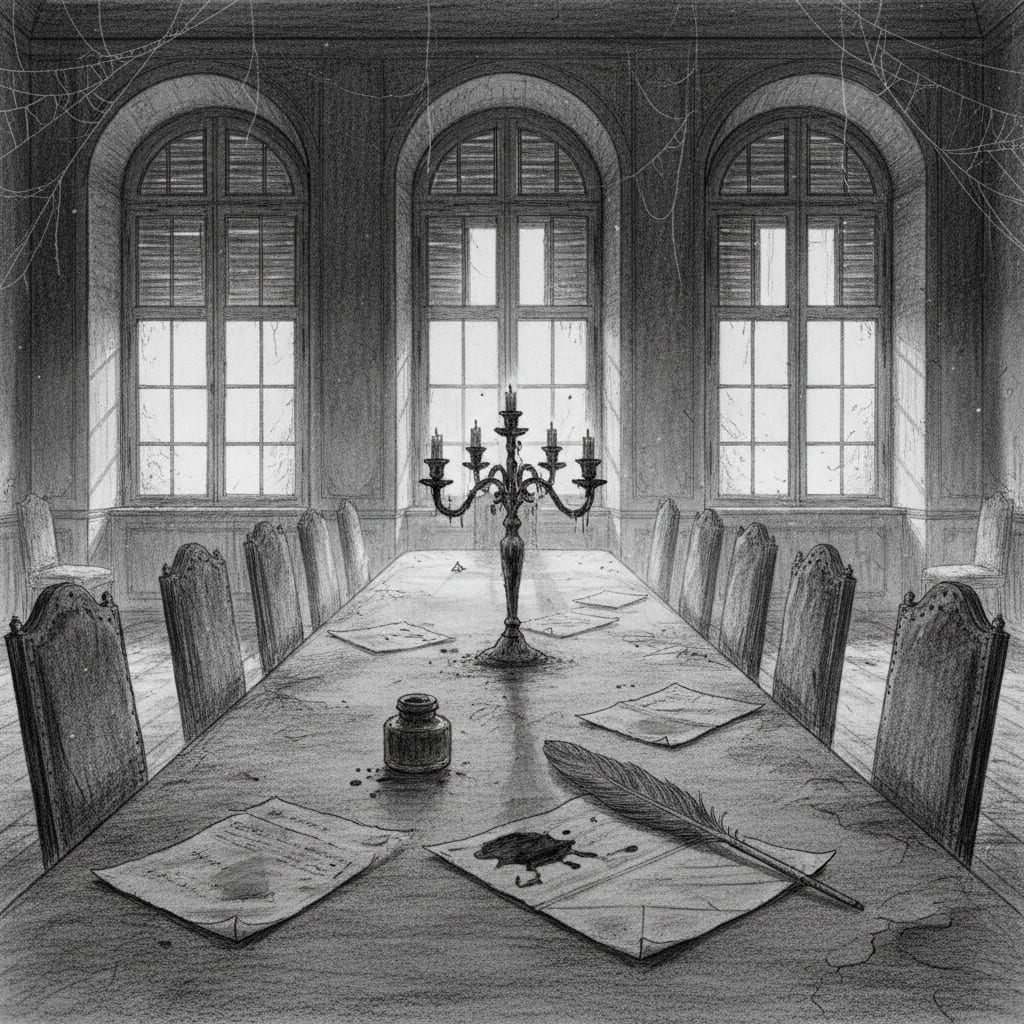
What followed was approximately forty-five years of silence. The Rationalist remnants who had clung to Vienna's administrative apparatus through force of habit — clerks who continued filing reports to prefectures that no longer existed, tax collectors who continued assessing levies on districts that had been consumed by fire — gradually dissolved. Civil order did not collapse so much as evaporate. The Council of Nine's meeting chamber was found, years later, with the minutes of its last session still drying on the desk, the final sentence unfinished, the ink still wet in the pen.
The city between the Great Retreat and the Siege was a ghost wearing the clothes of a capital. Demonic pressure from the east was intermittent — Morwen's plagues swept through in waves, and Velmora's agents picked the ruins clean of anything worth hoarding — but no Sin-General claimed Vienna as territory. The city was too far west for the Charnel Lands proper, too far east for safety, and too broken for anyone's ambition. It sat in a zone the Bureau of War would later designate Zone 3 (Unregistered), though at the time the only designation that applied was the one the refugees used: dead ground.
#The Siege: A.S. 95
Five years after the Concordat of Strasbourg, the Synod turned its attention to the ruin.
The Siege of Vienna — A.S. 95 — was the Synod's first major reconquest in the Central Corridor, and its last. Bishop-Warden Clemens Stahlhand marched east from Budapest with three divisions of Synod regulars, a full Bureau complement, and the reliquary of Saint Aldebrand strapped to a gun-carriage. The reliquary had been recovered from the ruins of a Dalmatian monastery during the Great Retreat — carried, as the official account has it, by a chain of anonymous clergy whose names the Bureau of Records cannot verify and whose existence the Bureau of Doctrine does not question.
Althazar of Pest held Vienna. He was not a Sin-General. He was not, strictly speaking, a Rationalist — the Rationalist Republic had been dead for five years, its Council dissolved, its coinage worthless. Althazar was something the Bureau dislikes more than heretics or demons: a man who had simply decided to be in charge. He commanded a garrison of deserters, mercenary remnants, and what the Bureau of Shadows later classified as "mortals in voluntary communion with infernal sponsorship" — men who had made arrangements with Velmora's agents in exchange for food, ammunition, and the kind of protection that costs more than it saves.
The Siege lasted eleven days. On the twelfth, Clemens Stahlhand walked through the breach in the Kärntner Gate (Unregistered) with the reliquary raised above his head and struck Althazar of Pest a single blow.
The blow killed Althazar. It also killed the two men standing beside him, shattered every pane of glass remaining in the Hofburg Palace, cracked the Heldenplatz flagstones in a radial pattern still visible today, and — according to one account the Bureau has declined to authenticate or deny — briefly stopped the Danube.
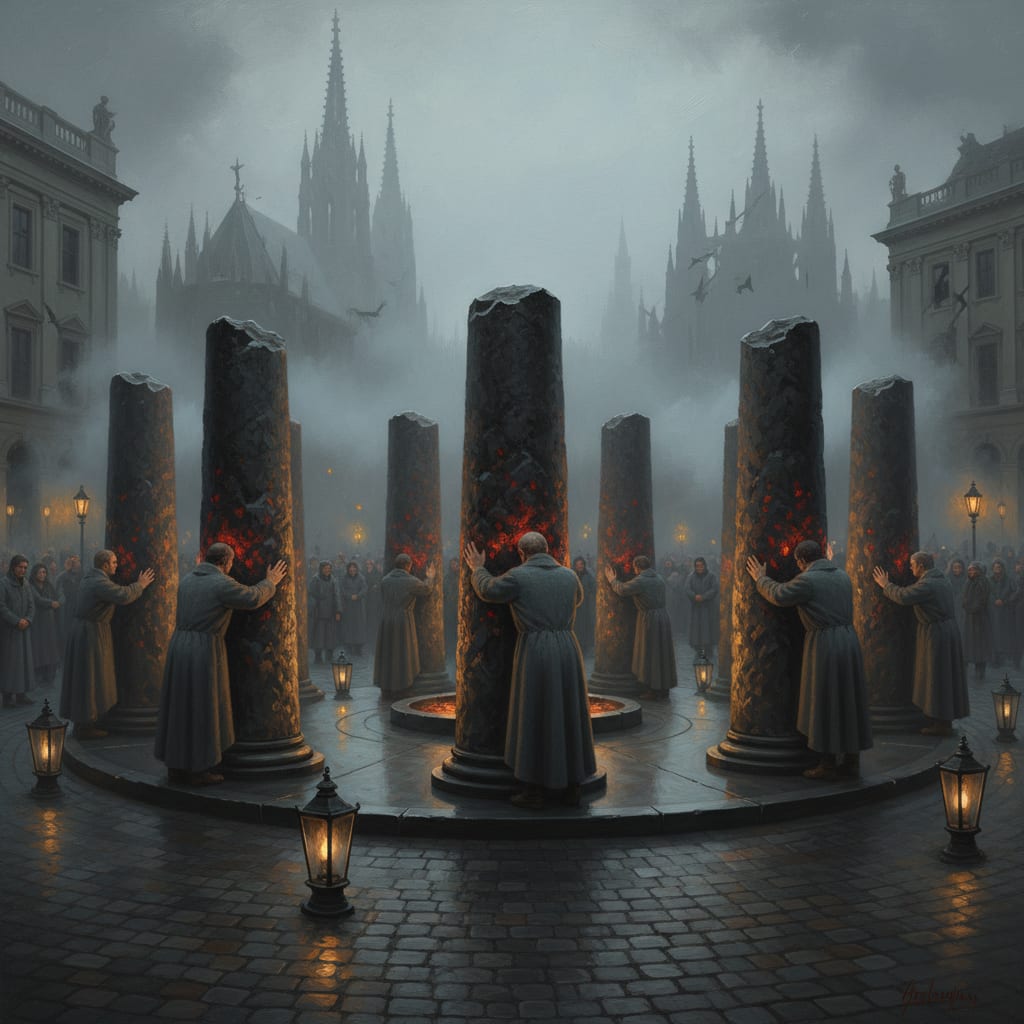
The Heldenplatz was reconsecrated that same year. Seven basalt columns were erected on the sites of the old cold-fire pyres — the same spots where the Rationalists had burned their saint-effigies sixty-five years prior. The columns radiate constant warmth at thirty-seven degrees, the temperature of living blood. The Bureau of Engineering has measured this. The Bureau of Doctrine has explained it. Their explanations are different. Both are stamped.
#The Shrine-City: A.S. 95–201
The Vienna that Clemens reclaimed was not the Vienna the Rationalists had ruled. The Imperial Palace was a shell. Saint Stephen's crypt was a crater. The university quarter had been consumed by one of Morwen's plague-fires sometime in the A.S. 70s; the exact date is unknown because no one was alive to record it. Of the city's pre-Sundering population — estimated at six hundred thousand under the Rationalist census of A.S. 29 — fewer than four thousand remained, and the Bureau of Mercy's intake reports describe their condition in language I will not reproduce.
The Synod did not rebuild. It consecrated.
The ruins of Saint Stephen's were declared a First-Order Martyrdom Site. The Hofburg Palace was sealed — its chambers preserved as they were found, the Council of Nine's last meeting still set on the table, the pen still wet, the ink still undrying. The Kärntner Gate breach was left open, the rubble arranged into a processional path that pilgrims now walk on their knees, from the outer wall to the spot where Clemens struck his blow, a distance of four hundred and eleven metres that the Bureau of Pilgrimage designates as "the Via Stahlhand."
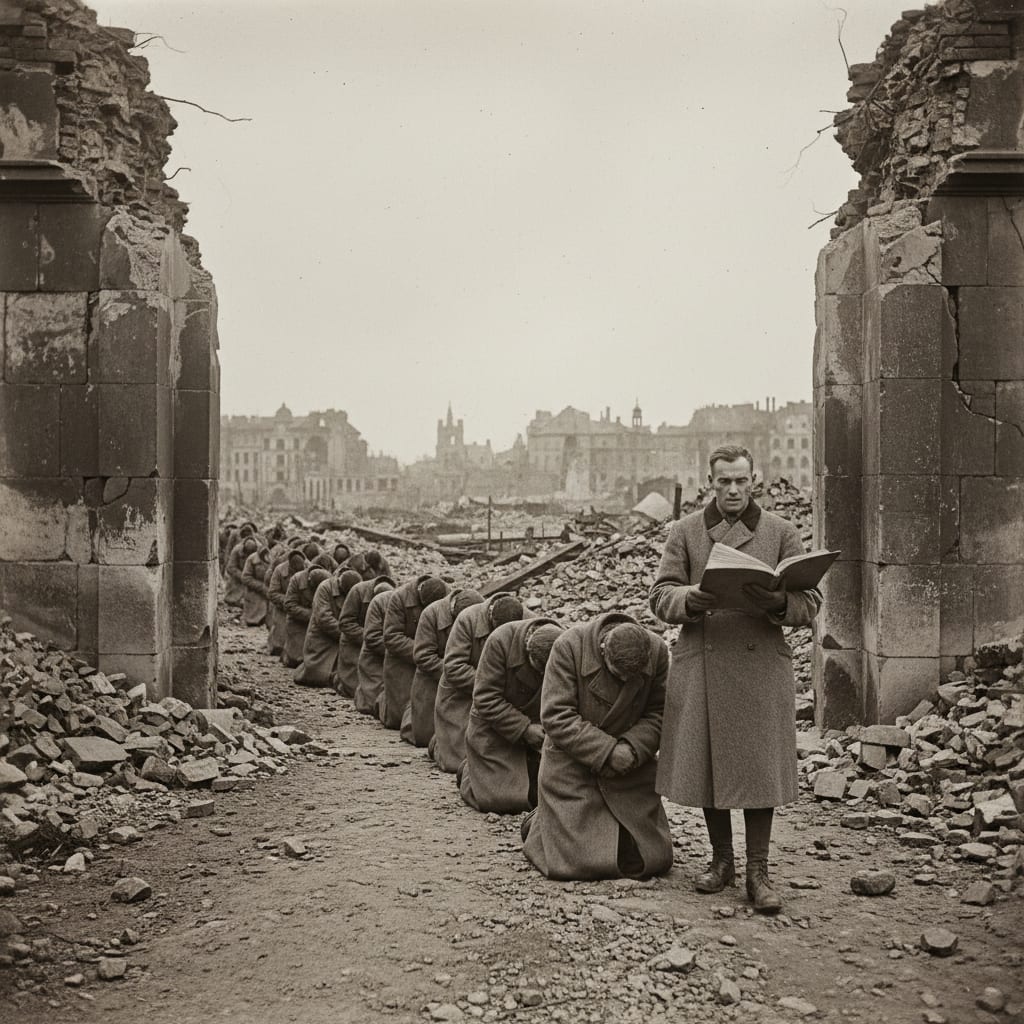
Around the shrine-ruins, a living town has accumulated — ninety thousand souls by the A.S. 200 census, most of them employed in the pilgrim trade. The Bureau of Pilgrimage maintains its Central Corridor headquarters here. Licensed guides conduct tours of the ruin-shrines on a schedule calibrated to maximize devotional impact and minimize looting. The gift shop — and there is a gift shop, because the Bureau of Tithes has never encountered a sacred site it could not monetize — sells replica reliquary fragments, miniature basalt columns that do not radiate warmth, and illustrated pamphlets explaining the Siege in language suited to children and the theologically unsophisticated, which is the same audience.
The city serves a secondary function as the Central Corridor's last major staging hub before the Carpathian passes. Supply convoys bound for Bastion-Przemyśl and Bastion-Sibiu pass through Vienna's rebuilt rail junction, where the Bureau of War maintains a modest garrison and the Bureau of Records operates a checkpoint that processes approximately twelve thousand transit papers per week. The soldiers stationed here call Vienna "the Waiting Room": they do not wait there; the city itself seems to be waiting for something, though no one agrees on what.
The Hanged Bridge still stands over the Donaukanal. The Rationalist rebels strung from its length during the Concordat-era repressions — forty of them, tattooed with scripture after death — were cut down in A.S. 102, but the bridge still carries their weight in other ways. Fishermen on the canal report snagging bones in their nets. The bones bear lines of scripture in a hand the Bureau of Records does not recognise. The Bureau of Purity has classified the phenomenon as "residual doctrinal saturation" and recommended no action.
A previous edition attributed the Hanged Bridge phenomenon to "demonic interference."
The Bureau of Purity's revised assessment notes that the scripture found on recovered bones is orthodox. The bones are preaching. They are preaching correctly. The Bureau considers this reassuring, which tells you everything you need to know about the Bureau.
Vienna smells of incense and old stone and the faint mineral tang of the Danube, which has not run red since A.S. 34 but which the locals swear still steams on the first of November, every year, as if the river remembers what it carried. The Bureau of Orison and Song maintains a permanent censorial presence — the Vienna lullaby purge (Unregistered) of A.S. 94, in which five thousand mothers were branded and their tongues charred for singing unlicensed melodies to their infants, remains the Bureau's most cited enforcement action and its least popular. The mothers are commemorated by a shrine on the Judenplatz that the Bureau has attempted to remove four times and which reappears each time within the week, the candles already lit, the names already carved.
The basalt columns in the Heldenplatz still glow. Pilgrims press their palms against the warm stone and weep, or pray, or stand in silence, depending on what they came to find and whether they found it. The warmth is constant. The warmth does not fade. The cold-fire pyres burned for two days and produced frost. The warm columns have burned for a hundred and six years and produced — what? Comfort? Proof? Revenue?
The Bureau of Tithes would say revenue. The Bureau of Doctrine would say proof. I, Valerius Drax, say that the columns answer a question the Rationalists asked sixty-five years before Clemens ever walked through the Kärntner Gate: whether fire could be made to serve reason without faith. The answer is in the temperature. Thirty-seven degrees. The warmth of a living body. The Rationalists could not produce it. The Synod did not try. The columns produce it regardless, without fuel, without explanation, without apology, and the pilgrims press their palms against the stone and feel what the Rationalists spent fifty years trying to measure and could never find.