
#On the Canal That Refuses to Behave Like Water
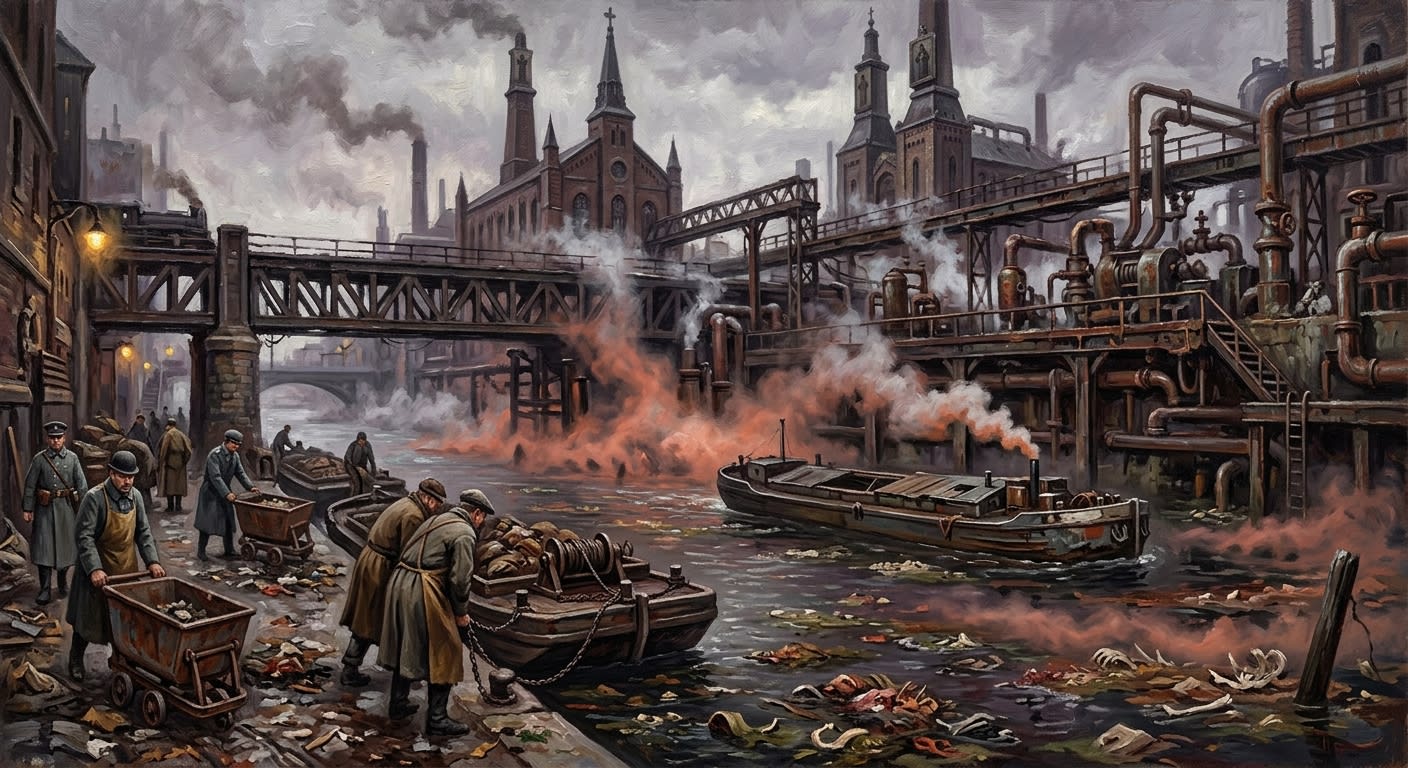
The Donaukanal is Vienna's lesser arm of the Danube, which is to say the arm that reaches into the city's ribs, touches the old wounds directly, and comes away with scripture under its fingernails. It runs through Vienna-Ruins with the patience of a clerk who has watched too many governments die to hurry for the present one.
The official maps describe it as a regulated urban watercourse, supply gutter, drainage channel, bridge corridor, minor barge route, and shrine-boundary feature of Zone 3. The official maps are accurate in the narrow manner of autopsy notes. The Donaukanal is also a reliquary sluice, a confessional drain, a fog-bell carrier, a mothers' witness, a rebel bone archive, and the only municipal official in Vienna with enough dignity to keep its mouth mostly shut.
It receives rain, sewage, candle wax, shrine barley, bridge soot, pilgrim coins, contraband notation, ration tags, grief cups, drowned pamphlet ash, and the occasional fragment of a Rationalist whose posthumous conversion to useful Orthodoxy has embarrassed three Bureaus and delighted me beyond the limits of pastoral restraint.
#On Its Course Through a City That Has Died Repeatedly
Vienna died first as Rationalist capital, then as retreat wound, then as reclaimed shrine. Cities with fewer deaths become ruins. Vienna became policy.
The Donaukanal carried each death differently. During the old Rationalist period it ran beside warehouses, lecture houses, boarding quarters, lock sheds, fish markets, and those confident little civic offices in which godless men wrote minutes as though paper could hold back Hell. After the Sundering, the canal received refugee traffic, burnt furniture, relic crates, military waste, and prayers so hurried that even the Creator must have admired their efficiency. During the hard road to the Siege of Vienna in A.S. 95, it became a boundary of salvage, retreat, and eventual reconsecration: too useful to abandon, too filthy to sanctify cleanly, too implicated to ignore.
An early Pilgrimage placard called the Donaukanal “the silver thread of reclaimed Vienna.”
Withdrawn after complaints from the Water Office, the Bureau of Purity, and anyone possessing eyes. The approved phrase is “regulated devotional watercourse.” Poetry is permitted only when it has washed first.
The canal divides the city with more than water. Above its walls stand repaired shrine façades, ration houses, bridge approaches, cheap lodgings, watch booths, Orison horn posts, Mercy receiving rooms, old Rationalist cellars with sealed lintels, and the low quarters where the exhausted learned that an unlicensed lullaby could make a child sleep better than a printed placard from Mercy.
The stones remember feet. The water remembers weight.
#On the Hanged Bridge and the Orthodoxy of Bones
The Hanged Bridge stands over the Donaukanal like a sentence the city has not finished reading. Forty Rationalist remnants were displayed there after death, their bodies tattooed with scripture in the years after Vienna's reconsecration, when rebellion still hid in cellars and the Synod, young enough to be insecure, answered pamphlets with corpses.
The bodies vanished by A.S. 102. The official notice says they were removed. Fishermen say the canal took them. The canal's version has better evidence.
Bones came up in nets: radius, jaw, knuckle, rib, slivers of sternum, fragments bearing lines from the Creed and Antiphon in a hand no Records clerk could identify. The scripture was correct. That was the scandal. Had the bones sung blasphemy, Purity would have arrived with iron and grateful certainty. Correct scripture from unlicensed dead men is a harder category. It turns government into a listener.
The canal below the bridge is now licensed for fishing only under reporting obligation. Any inscribed bone must be surrendered within one bell. Reading aloud from recovered fragments remains suspended pending theological convenience, which is the official phrase for a dispute nobody has yet found a profitable way to win.
#On the Low Quarters and the Lullaby
A decade after the bridge emptied, the Donaukanal heard a softer crime.
The Vienna Incident of A.S. 112 began in the low quarters near the canal, where pilgrim mothers rented rooms by the week and quiet by the minute. Their children were fevered, frightened by bells, and incapable of sleeping to approved phrases pasted on Mercy placards. Someone sang a folk lullaby about rain and barley. The children slept. The tune moved through laundry steam, stairwells, boarding rooms, cradle cloth, and the domestic mercy by which the poor commit most of their finest treasons.
The canal helped carry it. Sound moves strangely over water at night. A humming in one window becomes an answer across stone. A cadence under an Orison horn can slip along damp walls while the official prayer climbs upward to bore Heaven. The Bureau of Orison and Song called this clustered auditory anomaly. Mothers called it the only thing that worked.
Tone Inquisitors swept the quarter. Purity cordons closed alleys leading down to the canal stairs. Mercy carts waited beside old lock sheds. Five thousand mothers were branded. Their children were reassigned to orphanages. The lullaby was classified as an unsanctioned cadence exhibiting potential for doctrinal contamination, a phrase so bloodless and so lethal that I would admire it if admiration did not require washing afterward.
The canal received the ash from branding irons, the wash-water from ration hall floors, the spit of women whose tongues had been turned into warnings, and the barley grains that began appearing afterward near the Mothers' Shrine in the Judenplatz. Rivers do not testify. They accumulate.
VIENNA WATER OFFICE / ORISON JOINT ADDENDUM — A.S. 112 Canal-side acoustic review after sweep found ███████ low-frequency recurrence beneath Third Horn Bridge. No singer identified. No full melody recorded. Three infants slept during exposure. Recommendation: seal stairwell drains; increase horn volume; deny recurrence.
#On Steam, Scripture, and the First of November
On the first of November the Donaukanal steams.
The learned will object that water steams when warm air meets cold surface or cold air meets warm discharge, depending on the apparatus and the sermon one wishes to defeat. The learned are invited to stand beside the canal at dawn on that date, breathe the mineral vapour, watch letters form beneath the Hanged Bridge for the space of a Miserere, and then return to their lecture rooms with their mechanistic innocence somewhat dampened.
A Bureau of Engineering memorandum attributed the annual steam to “subsurface thermal exchange and seasonal pressure variance.”
Corrected by Doctrine only in tone. The mechanism may be thermal. The date is not. Engineering may keep its pipes; Doctrine keeps the calendar.
The first of November is the Sundering's date, the wound from which the calendar never stops bleeding. Vienna insists the Donaukanal remembers what the Danube carried during the retreat years: ash, furniture, reliquary straw, half-burned catechisms, bodies marked and unmarked, Rationalist tablets smashed into civic gravel, soldiers' letters, chapel keys, and little wooden toys from refugee carts. The Bureau of Records says memory requires a mind. The canal, being water, declines the premise and produces vapour.
Pilgrims gather despite discouragement. Some cross themselves. Some lower ribbons and draw them back blank, wet, altered, or smelling faintly of hymn-fire. Fishermen do brisk business selling nothing officially devotional: warm cups, dry gloves, approved viewing positions, and silence.
#On Custody, Trade, and Small Crimes
The Donaukanal is governed by too many offices, which is proof that it matters. The Water Office manages sluices and dredging. The Bureau of Records manages recovered fragments. The Bureau of Purity manages doctrinal contamination. The Bureau of Orison and Song manages acoustic risk with the wounded pride of a choirmaster whose choir has been outperformed by masonry. Pilgrimage manages routes. Tithes manages the fees that Pilgrimage forgot to admit were fees.
The poor manage everything else.
Canal stairs host illegal washing after curfew, quiet exchanges of stitched melody fragments, barley packets wrapped in brown paper, counterfeit silence receipts, candle-end trades for Judenplatz visitors, and little bridge charms made from ordinary fishbone sold to pilgrims who dearly wish them to be more scandalous. Most are fraud. A few are not. The authorities dislike both categories for different reasons.
Barges still pass when the locks permit. Supply boats carry grain, lime, candles, Orison hardware, Mercy bedding, and repair timber through a city that pretends its wounds are attractions. Pilgrim boats are restricted. Children are counted twice near the old low quarters. Mothers are watched with the delicate discretion of men who have been told not to create a second Incident and have chosen, in response, to create a permanent rehearsal for one.
There is a canal market at the third stair below the ration shed, officially a fish exchange and actually a parliament of small evasions. Fishermen sell carp. Widows sell candle stubs. Ward-boys sell orphanage gossip by the spoonful. A retired Records copyist, left-handed and drunk by noon, will translate water-damaged inscriptions for two copper pins and a promise that his name never reaches Purity. His translations are accurate often enough to keep him alive and inaccurate often enough to keep him interesting.
The Bureau tolerates the market because suppression would require witnesses, and witnesses near the Donaukanal have an ugly habit of remembering aloud. Better to tax the fish, monitor the wax, confiscate the obvious bones, and let the smaller sins circulate in baskets. Every city needs a sump. Vienna, being holy by administrative insistence rather than civic merit, has made its sump liturgical.
#On the Present Condition of the Canal
As of A.S. 201, the Donaukanal remains open, licensed, watched, dredged, prayed over, cursed at, and imperfectly understood. Its water is unholy. Its water is unclean. Its water is unsafe to drink unless one has already made peace with parasites, civic history, and the possibility of receiving doctrine internally.
Its importance lies in refusal. The canal refuses to keep categories separate. It carries Rationalist bones bearing orthodox scripture beneath a Synodal bridge. It carried the sound-shadow of a lullaby that Orison tried to burn from tongues. It steams on the Sundering's morning with a punctuality that makes Engineering sweat in every sense. It laps at the base of Vienna's shrine economy while accepting gutter filth from houses too poor for proper drains. It permits pilgrims to call it memory and clerks to call it drainage, then leaves both damp.
The Donaukanal runs through Vienna with black water, stone patience, and a habit of returning what authority thought it had successfully discarded. Cross its bridges. Do not sing beneath them. Surrender any bone that quotes at you.