
#On the Winter That Entered the Ward
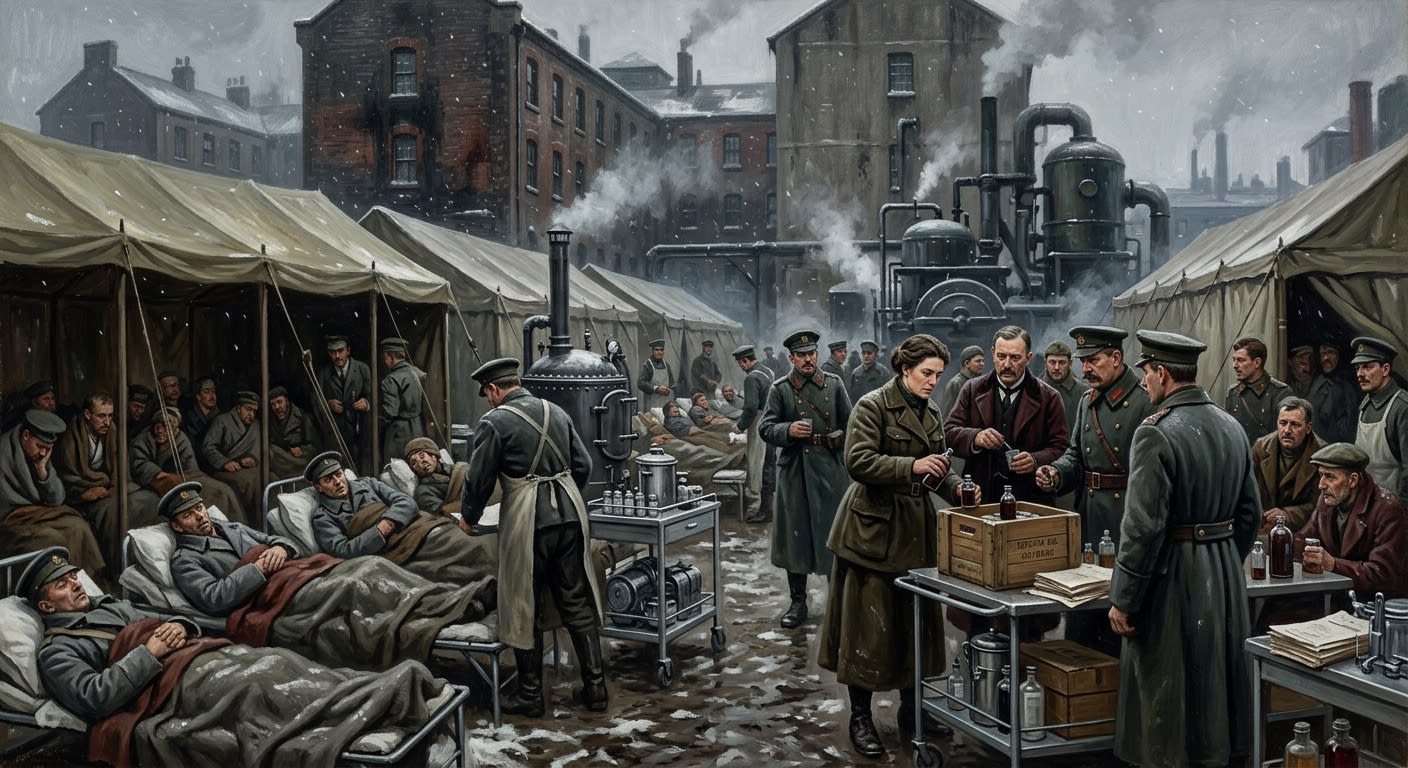
The Fever Winter of A.S. 112 was a typhus season in the Hinterland garrisons, which is the Bureau of Medicine's preferred way of saying that four thousand soldiers died in six weeks while officials sprinkled salt on failure and called the residue care.
It began along the rear barracks east of Halle, where levies moving toward the Sagittal Line slept in wool that had been damp since Michaelmas, under roofs patched with requisition notices and optimism. Lice travelled faster than orders. Fever followed. By the second week, the infirmary straw was warm with bodies. By the fourth, the dead were stored outdoors because the cold kept better records than the clerks.
#On Sanctioned Treatment
The sanctioned treatments were prayer, fasting, blessed salt, and ward discipline. Prayer comforted the frightened. Fasting weakened the sick. Blessed salt remained salt, with the admirable consistency of minerals and the tactical usefulness of a hymn sung into a locked pantry. Ward discipline meant keeping dying men in rows so their death certificates could be written without the clerk turning his chair too often.
The Bureau of Medicine had remedies in its sealed shelves that might have helped. Some were Rationalist. Some were pre-Synodic. Some were merely old house knowledge wearing the wrong family name. The shelves stayed locked because a man can die under approved ignorance more safely than he can recover under forbidden competence. Safe, here, means safe for the official.
A Medicine catechism printed in A.S. 116 describes the Fever Winter's first phase as “a period of limited therapeutic uncertainty.”
Corrected. The uncertainty was unlimited. The therapy was limited. The dead were exact.
Chaplains moved through the wards with bowls and censers, marking tongues, hearing delirium, deciding which muttered names counted as confession and which counted as fever. Sisters boiled cloth until fuel ran low, then boiled less cloth and prayed over the difference. Soldiers learned to fear the sound of the wardmaster's tally-beads. Each bead clicked like a little door shutting.
WARD ELEVEN — HALLE GARRISON, LATE WINTER A.S. 112 Morning count: 63 living, 19 delirious, 8 dead awaiting removal Noon count: 57 living, 24 delirious, 13 dead awaiting removal Evening note: “Civilian woman requests bark access. Chaplain objects. Wardmaster authorises under protest because protest has not lowered fever.” Following names removed under Standing Order 14-D.
#On Gerda Weil's Pot
Gerda Weil entered the record because she entered the ward with a pot. This is offensive to institutions that prefer salvation to arrive by decree, escorted by seals, with four witnesses and a bell. Weil was a midwife from Halle. Her grandmother had kept a Rationalist medical text hidden inside a bread-oven for sixty years, which proves that old women understand archives better than most Censor-Prelates.
Weil prepared willow bark and boiled water. Bark scraped clean. Water brought hard to boil. Decoction cooled before the lips. Repeated before the fever climbed again. No relic. No choir. No solemn ratification. A bitter draught, administered on schedule, by hands that had delivered children and knew blood, noise, family stupidity, and men giving orders from doorways.
Seventy percent of treated cases improved in the Halle logs. The number was written, sealed, copied, disputed, corrected, copied again, and finally buried beneath the phrase irregular civilian intervention. Numbers that save men often suffer this fate. They become irregular because the proper authorities arrived late.
#On the Theft of Cure
Purity arrested Weil before the fever was finished. The ward kept using her method. This is the Fever Winter in one sentence: the source was chained while the stolen remedy circulated under supervision. Her oven was broken open. The hidden text was seized. Her household was stripped of papers. The Bureau of Medicine requested “access to civilian preparation notes” with the delicacy of a vulture asking whether the corpse has finished with its coat.
In A.S. 113, Medicine published Protocol 7-C(Emergency Revision) (Unregistered). It prescribed willow-bark decoction and boiled water in intervals matching Weil's practice. The document credited internal research. Forty-seven garrison medical logs were amended. “Folk remedy, source: civilian, unverified” became “Bureau of Medicine Protocol 7-C, origin: internal research.” The living swallowed the draught. The file swallowed the woman.
Protocol 7-C was described in its public abstract as a product of “accelerated internal study under wartime conditions.”
Clarified for sealed circulation. The study was accelerated by Gerda Weil, internalised by theft, and wartime conditions supplied the corpses that made delay embarrassing.
#On the Ashen Inheritance
The Ashen Circle did not cause the Fever Winter. It inherited the wound. The Circle had already learned, from the Great Purge of Margins, that approved containers keep forbidden knowledge alive. Weil's oven became the domestic proof of the same doctrine. A family text in a bread-oven outlived raids, sermons, inspections, and the brittle male presumption that useful knowledge lives only where men have catalogued it.
After A.S. 114, Circle cells treated Weil as a martyr. This was half gratitude and half recruitment. Martyrs are useful. They travel well through cellars. They make novices endure cellars. They make cowardice look poorly dressed. Weil never enrolled, never held rank, never met an Ash-Master, and never asked to become anyone's emblem. She used bark because men were dying. The Circle, being scholars, added a doctrine after the fact.
Weil died in the Paper Mines of Ulm in A.S. 114, of the same fever she had taught others to reduce. The symmetry pleased no one worth pleasing. Ulm turned condemned bodies into paper. Medicine printed approved truth on paper. Somewhere in that loop, the Synod achieved its favourite sacrament: the useful person erased, the useful method retained, the useful lie stamped clean.
#On the Administrative Afterlife
The Fever Winter changed medicine less than it should have and more than Doctrine admits. Protocol 7-C entered ward practice. Boiled water gained new theological dignity. Willow bark became bitter mercy, then restricted mercy, then ordinary stock under lock. Surgeons learned to ask fewer questions about origins when a patient was still warm enough to object.
It also changed the Ashen Circle's patronage. Officers who had watched blessed salt fail and bitter bark work became susceptible to forbidden competence. A surgeon with twenty living men where five should have survived can denounce heresy at chapel and request contraband notes after dusk. This is hypocrisy. It is also triage with better tailoring.
As of A.S. 201, the Fever Winter is taught in Medicine halls as the birth of emergency fever discipline. In Ashen cellars it is taught as the proof that a pot can defeat a department. Both lessons are correct. The Bureau owns the lecture room. The Circle owns the cellar.