
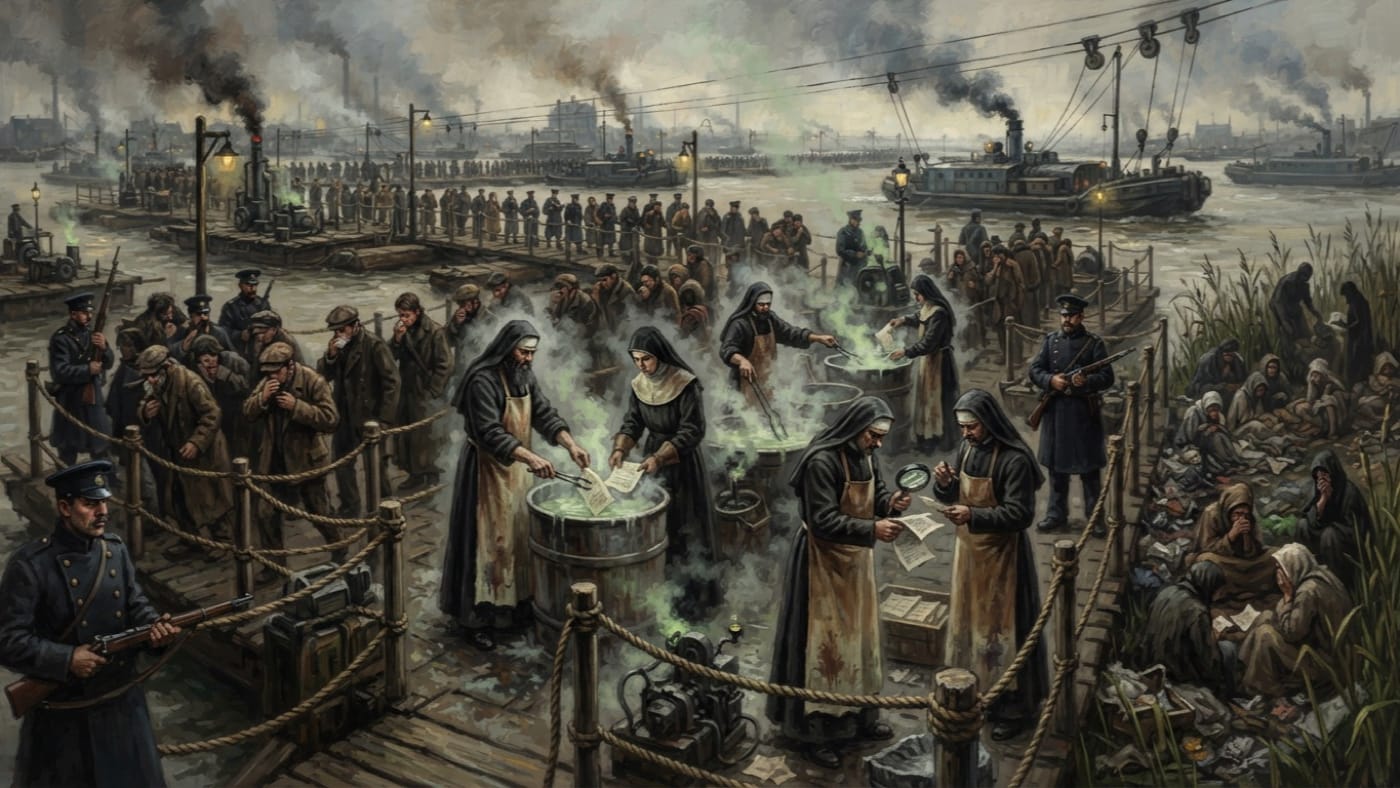
#On the Wardens' Station
"Never haggle with a quarantine washer." — courtesy of the Chain
The Lye Order keeps no gate. It keeps something better: the right to say who is fit to approach one. Every soul processed through the Rope-Ferry Chain is subject to quarantine inspection, and that inspection belongs to the Quarantine Wardens. The crews call them the Lye Order, after the one substance they have never been known to ration.
The registers class them as a monastery in service: a body of religious under rule, put to a task. The task is the prevention of plague. Their house is the Quarantine Piers, fourth of the Chain's eight named nodes, a cluster of floating platforms fenced with rope and given over to washhouses and queues. From those planks they exercise an authority that no charter I have read troubles to describe. They may pass a body. They may hold it. Everything else the Chain sells lies between those two verdicts: a place in the ferry queue, a ration, a night's sleep on dry timber.
I can give the reader no founder, no foundation year, no superior's name and no count of the brothers and sisters under the apron. The Order has supplied none of these to the Bureau of Records. Records will catalogue a drowned toll-keeper's teeth, and it has not asked. The Bureau of Mercy treats and quarantines the plague-struck across the Church's lands. The Piers answer one question with a bucket: does the Lye Order report to Mercy, to the Synod Transit Office in Strasbourg, or only to its own chapter?
#On the Wash and the Stamp
"Holds life in a bucket of lye." — the Chain's description of the quarantine washer
The sequence is fixed, and I set it down as the Order performs it.
First comes the wash. The washers stand at their tubs in leather aprons gone stiff and pale at the hem, and each traveller goes through the caustic lye. In dock idiom this is the lye kiss, though nobody who has received it says the phrase fondly. Eyes stream. Skin reddens. Whatever the traveller carried in the folds of a coat has gone through the tub as well, and the papers come out the far side wet.
Second comes the stamp review. The inspector takes the papers in that condition, with the ink bleeding, the wax softened and the sheet gone the texture of tripe, and pronounces on whether the Quarantine Lye Stamp they bear is good. Third, the traveller's goods are read against the cargo manifest line by line, by a man with a dripping thumb. Fourth, at the inspector's discretion, comes the search. That discretion is total. Suspicion may move it, or the Spirit, or coin, and the Piers keep no register that tells the three apart.
Observe what has been examined. The skin has been scalded and the paper has been read. A fevered man with a clean stamp crosses. A sound woman with a smudged one waits. The Order does not certify bodies; it certifies documents about bodies. In every form I have been able to obtain, it has had the honesty, rare on the river, never to claim otherwise.
ERRATUM — Office of the Hieromnemon, appended at sealing Under On the Wardens' Station, for "They may pass a body. They may hold it," read "They may pass a stamp. They may hold its bearer." No record shows the Order passing a body on its own merits. Bodies accompany their papers.
This makes a clean stamp the dearest thing on the Chain. Coin buys bread. A minute-block buys waiting. A ration chit, if it is not a dead one, buys broth at the dawn market. A cargo seal buys a crate's passage. None of them moves a person past Node Four without the lye stamp. The stamp is therefore worth more than coin, and it is therefore forged. A ring at the Piers does nothing else, and by the queue's account does it rather well.
Revocation takes a single motion of the inspector's hand. The revoked do not go back up the queue. They are detained on the Piers, on wet planking behind rope, until they are cleared. Some are never cleared. The Bureau of Records attributes their deaths to "pre-existing conditions exacerbated by temporary accommodation" and attaches no figure to the phrase, which spares everyone the arithmetic.
#On the Widening Cordon
In the decade before this survey, the Lye Order widened its cordons three times. Each widening coincided with a rumour of plague. I do not say the Order invented these rumours. I say that it stood nearest to the place where rumours of plague are born, which is the washhouse, and that it was the first party on the river to profit from each one. Some of the fevers may have been real. The Piers do not publish diagnoses.
A widening has the same consequences every time. More of the queue falls inside the rope. The wash lines lengthen and throughput slows. A market opens in emergency quarantine stamps for those who cannot afford the delay, at prices that would interest the Bureau of Tithes. I decline to record those prices, because they move with the rumour. The Order collects twice: once from the fee, and once from the fear that makes the fee bearable.
Some distinctions must be kept here, or the reader will mistake the Order for the river's master. A cordon is rope laid across planking. A closure is another instrument entirely. Closures belong to Chain Superintendent Halvick Sorn and to the master closure slate locked beneath the Ink Dock Hall, and no Warden has ever written on that oak. Arrests and confiscations belong to Provost-Captain Merrow Venn, whose squads hold the cordon ropes the Order lays. The rope itself belongs to Lysa "Splicehand" Kett. The Order commands none of the three, and it has no need to.
Venn tolerates each widening because the Order shares what it learns at the tubs: who travels, with what goods, and sweating how much. The Superintendentate tolerates the delays because slower throughput justifies dearer fees. Every office on the river is paid, and the queue pays all of them.
The precedent is older than the present decade and less tidy. In a year the registers do not fix, quarantine was laid around a bank district that had set itself against the Chain. The registers also give no name for the district and none for whoever gave the order. Food did not cross the cordon. Hundreds died in the queue lanes, and the flats behind the old pilings keep their graves unmarked. The instrument is now called a Public Health Hold. I know of no cleaner demonstration of it, and I have found no record that it was ever condemned.
#On Those Refused
The Order's verdict leaves a remainder, and a refused stamp does not make that remainder vanish. It goes somewhere.
Some of it goes behind the Piers. In the reed flats where the river shallows, the Reed Mothers keep huts for the people quarantine will not take. They nurse the sick whom the Wardens decline, shelter children whose parents were pressed or detained, and hide persons the system has elected to forget. Their laundry lines carry signals in the arrangement of the cloth, and their tunnels run through the reed beds to culvert mouths upriver. All of this belongs to the Mothers. I have found no evidence that any Warden directs them, supplies them or informs on them, and I record none.
Some of it goes across by night. After curfew the Black Ferrymen work the reed channels by hand-line, carrying whoever the daytime river has turned away. A refused stamp makes them a customer. No one has shown that the Order deals with these crews. It has only supplied their trade, season after season.
Some of it stays on the planking. A child cannot buy an emergency stamp. A sick traveller cannot pass a wash that leaves the healthy coughing. The Order's ledger records the held and the cleared. It records nothing about where the refused go next, because the Order's interest in a person's health ends at the rope.
#On the Present Application
The Chain as I find it in A.S. 201: quarantine expanding, rations shrinking, the Mouth reporting grain shortages that the upstream nodes deny shipping, and the Queue Road delivering more bodies than the ferries can process. Every deterioration improves the Order's position. A hungrier queue is a sicker queue, a sicker queue is a more frightened one, and fear is the only commodity the Order deals in. On the river it is in surplus.
Superintendent Sorn privately judges the Chain to be one bad winter from cascade failure. That winter has not arrived. When it does, I expect the cordon to be the first thing widened and the last thing lifted. A slate closure starves a node by decree, and someone must sign the decree. A cordon starves by procedure, and procedure signs for itself.
Supplies bound for the Sagittal Line still pass Node Four. They pass wet.
The Synod charged the Order with preventing plague. I can identify no plague the Order has failed to prevent, and no plague it has demonstrably prevented. The Bureau of Doctrine will recognize that as a spotless record.