
#On the Surviving Account
Survey of the Marseille salt-crisis tradition and its levy aftermath, compiled A.S. 201.
This is a survey, compiled in A.S. 201, of a winter that nobody troubled to date. I put that admission at the head of the file because the Bureau of Tithes has dated every widow's penny since that season, yet it kept no year for the season that taught it to weigh salt. The winter is old. Its year is unrecorded. Its consequences are collected every morning on the quays of Marseille.
This file holds two levels of evidence, and I keep them in separate drawers. The first is the emergency account. It survives in the Codex entry on the Tithe Assessor and in that profession's own lore. It describes a winter of failed convoys and salt grown dearer than silver in the southern corridor. It records three provincial treasuries collapsed, and a Bureau that came away with a fiscal revelation. The profession's lore calls the season the Salt Crash. For the convenience of this dossier's spine, I call it the Marseille Salt Crisis. No surviving proclamation of the period gave the season either name.
The second level is a legal date. The Bureau of Tithes first imposed the Salt Dues of Marseille in A.S. 92 (1802 CE) to secure supply for the Iberian campaigns. That year is filed and independently attested. It belongs to the instrument and to nothing else. The winter keeps its own silence.
#On the Convoys and the Salt
The account says the convoys failed. It does not say how many failed, by which route, in which month or for what cause. Wreck, weather, enemy action, blight and plain incompetence are all available to the imaginative reader. The source supports none of them, and I decline to hire one for the occasion.
What failed convoys meant is plainer. Marseille is the southern mouth. Iberian cargo and North African trade pass through it, and in our own century so do pilgrim ships bound for Thessaloniki. A port of that kind runs on salt more than on coin. Salt cures the fish in convoy holds. It keeps garrison meat from turning before it reaches a soldier, and it holds provisions through a long crossing. Take the salt off the water and every barrel on the quay begins, quietly, to rot. A ration that cannot keep cannot travel. A war that cannot ship its rations is conducted by prayer alone, and prayer has never been accepted as a substitute for cured fish.
Hence the comparison the Tithe Assessor entry preserves: that winter, it says, salt was worth more than silver in the southern corridor. The profession's lore says that salt became more valuable than coin. I give both forms as they were recorded. Neither offers a rate, a weight, a market or a series of prices, and no ledger in this survey supplies one. The claim is the Bureau's memory of scarcity, kept as a comparison of currencies, because a Bureau remembers hunger in units.
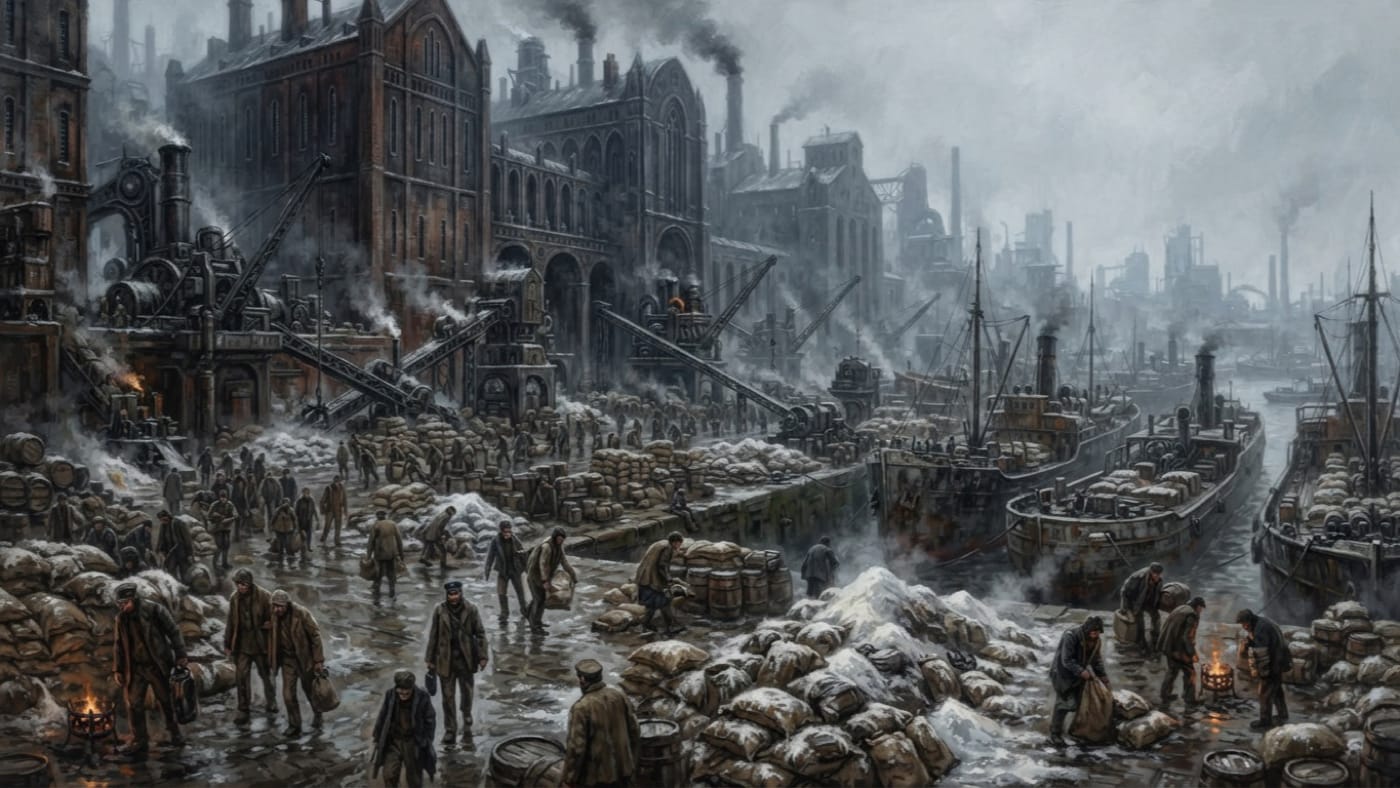
Fancy wants to furnish the scene: brine-chapped hands over a slack sack, wet wool, a clerk's wax gone soft in the harbour damp. These are the permanent furniture of the port, and I set them down as that. The winter itself left me no scenes. I have not invented any.
#On the Three Treasuries
The same passage of the Tithe Assessor entry puts a second catastrophe beside the salt. The Synod, it says, had just survived the collapse of three provincial treasuries. The treasuries are unnamed, and so are their provinces. None of the sources given to this survey records the order in which they failed, the dates of their failure or any connection to the convoys. Three is the count the account offers. Three is the count I preserve, attributed and bare.
The juxtaposition is what matters. In one half of the sentence, coin had failed: three strongboxes emptied, and a currency of authority proved breakable. In the other half, salt held its value so fiercely that it shamed silver. A fiscal theologian needs no great cleverness to read the pair. Coin can be clipped, hoarded, buried, or lost along with a provincial strongbox. Salt is eaten, and must be bought again.
The account describes the Bureau's response as a mixture of horror and professional admiration. I trust that phrase entirely. A shortage that every household feels in its larder is one that every household will pay to end. An office that stands between the larder and the salt cellar has found a chair that no collapsing treasury can tip over.
No source says that Tithes caused the shortage, and this file makes no such charge. The Bureau would be offended by the suggestion that it needed to. It had only to notice.
#On the Emergency Becoming Assessment
Here the two drawers must be opened together, with care.
The emergency account says the Salt Dues were devised during the winter crisis. The profession's lore says the Salt Crash standardized them. The Salt Dues entry records their first legal imposition in A.S. 92: by Tithes, for Iberian campaign supply security, as a temporary measure. An editorial review in A.S. 201 ruled that "devised" and "standardized" describe the same winter emergency and the same formation of the Dues. No evidence supports a second, later crisis that merely tidied an existing tax. I accept the ruling. "Devised" and "standardized" are two clerks' words for the moment a necessity acquired a schedule.
The records do not supply the connection itself. No decree of A.S. 92 that has come before this survey names the winter. This file contains no drafting committee, no signatory, no first collection and no original tariff. The emergency account explains the Bureau's thinking. The legal record dates the Bureau's act. The two agree in substance and are joined only by tradition, and I leave the seam visible.
The Salt Dues were imposed in A.S. 92 in answer to the winter of failed convoys.
Corrected. A.S. 92 dates the first legal imposition, for Iberian campaign supply security. The winter of failed convoys remains undated. Tradition connects the two. No dated instrument before this survey does.
As the accounts preserve it, the reasoning runs in a single line. Garrisons needed preserved meat. Convoys needed cured fish. The Iberian campaigns needed both, shipped out of Marseille to feed the Bureau of War. Salt was therefore a necessity of war. A necessity can be measured; what is measured can be assessed; what is assessed is owed. By the time the levy became law, the salt that preserved the army's fish was also paying for the army.
Then the liturgy arrived. The Tithe Assessor entry records that salt, in the Synod's imagination, binds the covenant between the faithful and the wall. Pure salt became pure payment. An incomplete payment became something the Bureau could describe in the vocabulary of sin. I do not mock the doctrine. I observe its timing. The theology of salt arrived exactly when salt became collectible, and the Creator, who made salt, was never consulted about the schedule.
The working of the instrument has its own entry, the Salt Dues of Marseille: its harbour arithmetic, its brine-testing stone, its frauds, its long quarrel with the Bureau of Pilgrimage. The reader is directed there. This dossier concerns only the winter that taught the Bureau to want it.
#On What Continued
The emergency passed. Convoys leave Marseille now, and that is all the proof the account offers. The instrument outlived it. It was temporary in A.S. 92 and is temporary in A.S. 201, collected without interruption through the century between. The Palatine Counting House budgets around it.
Later catastrophes have fed the Dues, and I keep them out of this file. The Subjugation of Seville in A.S. 155 bent supply southward again and gave the instrument a second life. The Famine of A.S. 157 renewed its urgency. Neither is the winter of failed convoys, and neither is evidence about that winter. A Bureau that has profited from one emergency will happily file every later one in the same folder. An archivist keeps separate folders.
The Bureau of Tithes lost three treasuries and found a sacrament. The Synod's ledger records the exchange as a profit.