
#On the Throat of the Aegean
"No ship without psalm. No soul without stamp." — Inscription above the Chainward Quays, attributed to no one, obeyed by all
There are ports that welcome ships and ports that consume them. Thessaloniki does neither. Thessaloniki processes them — counts them, stamps them, confesses them, taxes the salt off their hulls and the sins off their crews, and permits them to continue only when every document is inked, witnessed, and filed in triplicate against the possibility that the Creator Himself might require a receipt.
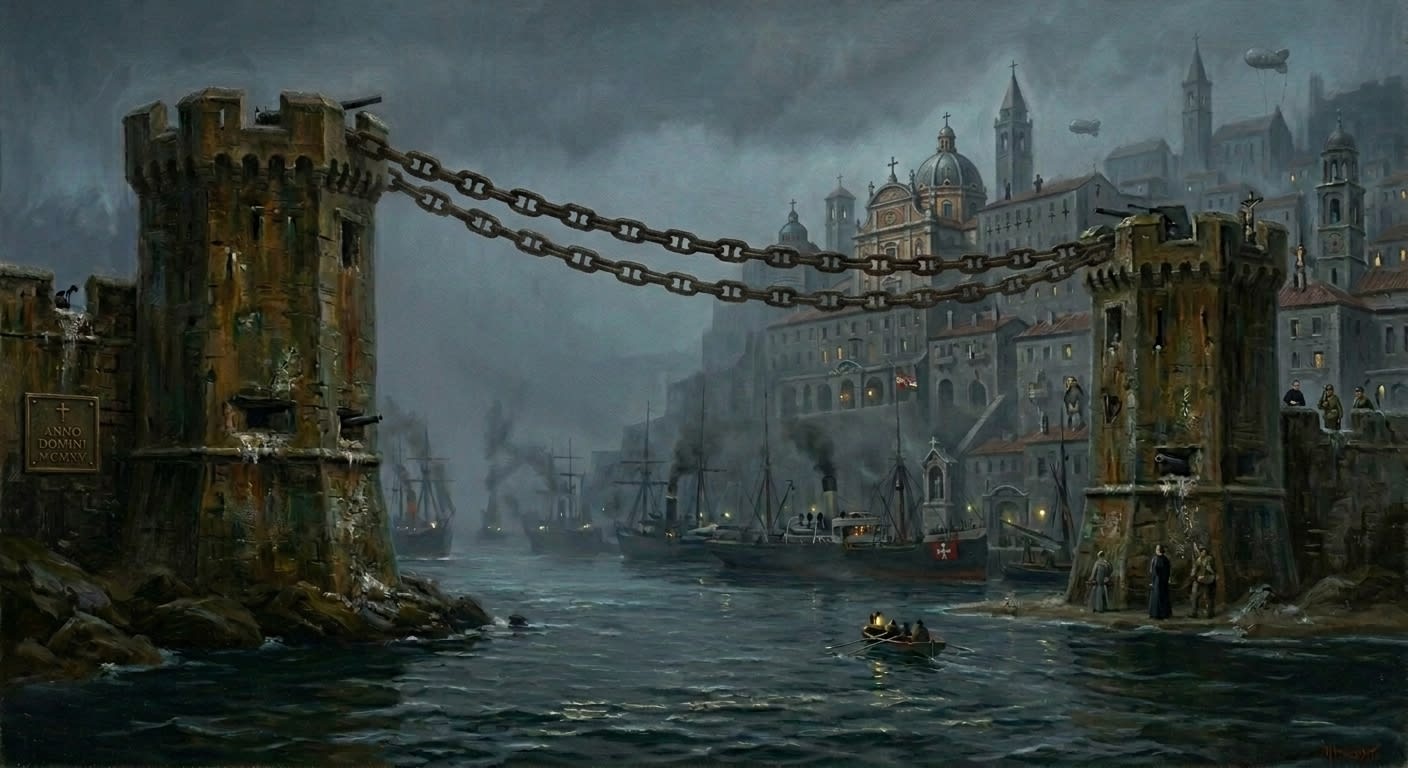
The city squats at the Aegean inlet like a customs house built over a cathedral built over a slaughterhouse, and the sequence of those foundations is theological, architectural, and — on certain nights when the chains begin to hum — acoustically literal. The Twin Towers of the Harbor-Chain gate rise from the water on either side of the narrows, Elder and Younger, their chains stretched between them in a curtain of consecrated iron that glows faintly under fog and sings psalms to ships that pass beneath. Two hundred and eighty thousand souls reside here, give or take the flux of refugees, rotated garrison men, and itinerant crews whose names are filed in the Harbor Ledger beside their cargo manifests and whose confessions travel, per regulation, in the same crate as their dried fish.
The Sagittal Line's southern theatre depends on this port the way a body depends on a windpipe. Every grain convoy feeding the Sister Trenches, every munitions shipment bound for the coastal batteries, every regiment of conscripts shipped from Marseille with their boots still dry and their faith still theoretical — all of it passes under those chains and through the Bureau's paper mill before it reaches the war. If the Chainmaster closes the gate, the trenches starve in a week. If the Harbor Prefect-Archivist suspends her stamps, the convoys rot at anchor and the rats inherit the rations. Thessaloniki is the Synod's gullet, and the Synod has trained it to swallow on command.
#On the Founding and the Ash Wedding
"The sea was here first. The Synod merely filed the paperwork." — Chainwright proverb, origin disputed
Thessaloniki was a port before the Synod existed, before the Age of Heresy had a name, before anyone thought to stamp a psalm onto an iron chain and call it theology. The Greeks had it. The Romans had it. The Rationalists, briefly and badly, had it. When the Sundering cracked the world open in A.S. 45, Thessaloniki found itself on the wrong side of a coast that had begun to produce things from the water — things that sang, things that wore the faces of drowned men, things that walked up the shingle at low tide and stood in the marketplace until someone noticed that the fishmonger had been dead for three weeks but was still selling mackerel.
The coastal wars that followed are poorly documented. The Bureau of Records insists this is because documentation was not yet standardized. The Bureau of Shadows insists there is nothing to document. I insist that both statements are true and that truth, in Thessaloniki, has always been a matter of which stamp you carry.
The chains came first as rope, then as forged iron, then as reliquary iron inlaid with psalm-script by the Bureau of Engineering and blessed by the Bureau of Rites in a ceremony that lasted nine days and cost the lives of four divers who were crushed between links during the tensioning. Their names are inscribed on the Elder Tower's inner wall. Their widows received stamped compensation in the amount of one docking window per annum, in perpetuity, which the Harbor Ledger Office has honoured without interruption for over a century and which — I am told — constitutes the most reliable pension in the entire Synod.
The Twin Towers were rebuilt as bastions during the Choir-Mortar campaigns, when Maldrake's forge-sorceries reached the Aegean coast. A famed evocation during the Siege of Thessaloniki summoned a heat-hammer in the air itself, pounding the city's walls with invisible fists until priests boiled alive in their own sanctuaries. The Synod responded with Choir-Mortars — and here the Choir-Mortars succeeded too well. A single barrage brought down five sorcery towers at once, collapsing them into the city. The rubble entombed thousands of civilians who had been kept alive as sorcery fodder. The air above the ruins shimmered with reflected cries for weeks. The Bureau of Doctrine insists the dead were "willing offerings." Locals call it the Ash Wedding — a union of Heaven's hymn and Hell's cruelty — and they do not call it that twice in the same room, because Purity is always listening and the word "cruelty," applied to the Synod's instruments, is a Category Two offence.
ERRATUM — BUREAU OF DOCTRINE, OFFICE OF HISTORICAL CLARIFICATION The designation "Ash Wedding" is not recognized by the Bureau. The events of the Choir-Mortar engagement at Thessaloniki are classified under "Collateral Sanctification, Necessary." Citizens employing the deprecated nomenclature are reminded that grief is not a license for imprecision.
#On the Towers and the Chains
The Elder Tower anchors the primary chain on the western headland. It is bronze-stained from salt, crusted with gull-droppings that no amount of scrubbing removes (the Chainwrights believe the gulls are part of the consecration and refuse to shoot them), and houses within its spiral stairwell a series of choir cellars where the psalm-hum of the chains is amplified to a pitch that makes your molars ache. I have climbed it. I do not recommend the experience.
The Younger Tower, on the eastern spit, anchors the secondary chain and serves as a memorial space for what the Chainwrights call "refugee tongue" — the languages of those who passed through the harbor and were processed into the Synod's records, their old names ground down into the Bureau's Latinate filing conventions. There is a wall of carved names in the Younger Tower's base, but the names are in scripts the clerks can no longer read, and no one has thought to translate them because translation would require acknowledging that the names existed before the stamps did.
Between the towers, the chains hang in catenary arcs above the water, each link the size of a man's torso, each link inscribed with psalm-text that the Bureau of Bells has approved and the Bureau of Doctrine has loaded with meaning and the Bureau of Records has catalogued in a folio that weighs more than the chain itself. When a ship passes beneath, the links vibrate. The vibration produces a hum. The hum, say the Chainwrights, is a psalm. The psalm, says Doctrine, is a blessing. The blessing, says the Harbor Ledger Office, is a registration event.
And that is the secret of Thessaloniki, if one may call a secret what everyone knows and no one says: the chains are not a barrier. They are a counting instrument. Every passage hum is a registration event. Every ship that sails beneath them is entered into a ledger that has no clerk, no office, and no filing system that the Bureau of Records has been able to identify despite — I am told — seventeen formal investigations and one informal burglary.
#On the Districts and Their Odours
"You can navigate Thessaloniki by smell. When the tar turns to incense, you've gone too far inland. When the incense turns to vomit, you've reached Quarantine." — Attributed to Pilot-King Nenos, who has one eye and no patience
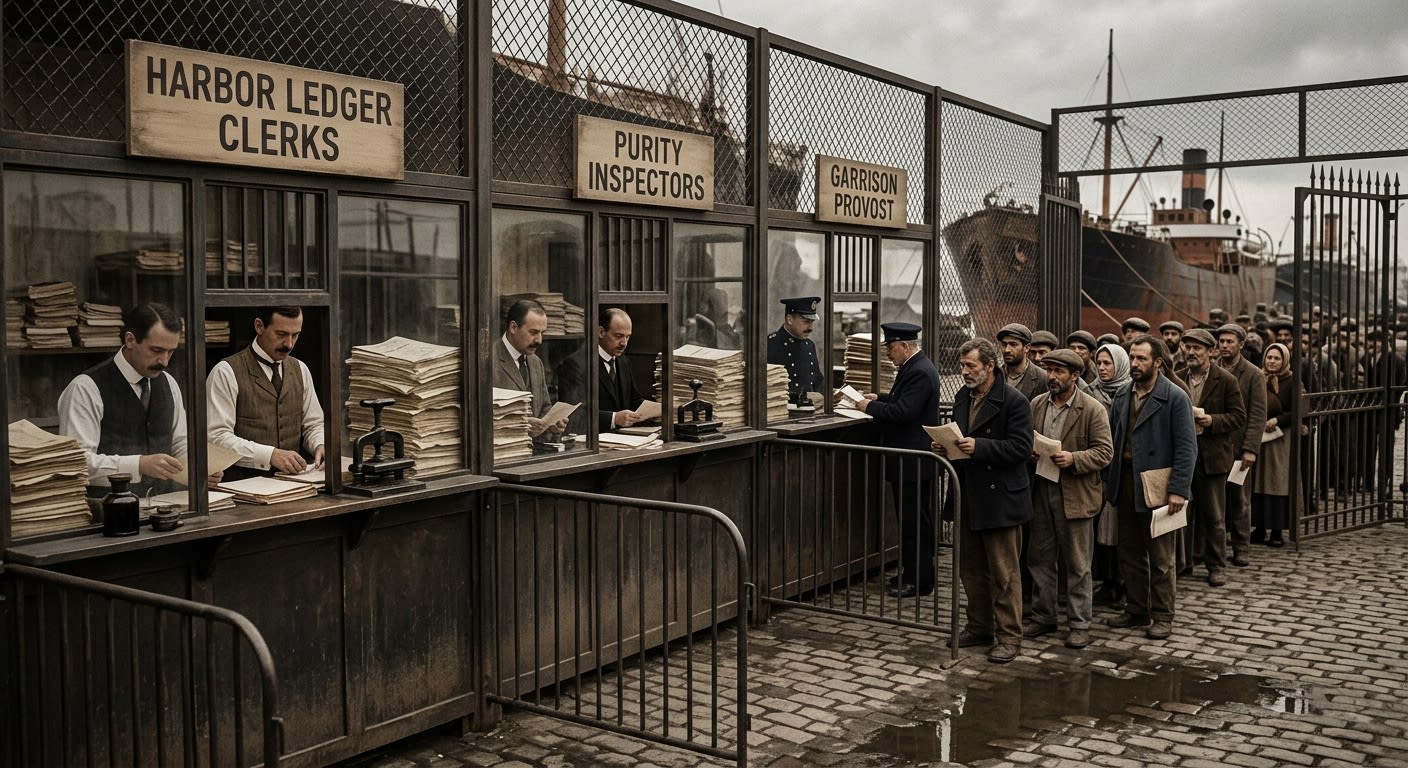
The city arranges itself along the waterfront in a linear spine, terraced inland like a lecture hall built for an audience of two hundred and eighty thousand reluctant students. The Chainward Quays form the front row — docking, inspections, the smell of hot tar and ink-wax and human desperation. Three layers of paper-checkers stand between your ship and a berth: Harbor Ledger clerks for the first pass, Purity inspectors for the second, garrison provost for the third. Each layer requires its own stamp. Each stamp requires its own fee. Each fee requires its own receipt.
Behind the quays rise the Ledger Steps, the terraced clerks' quarter where the real governance of Thessaloniki takes place in rooms that smell of wet paper, lamp oil, and the particular sweat of men who know that a misplaced comma can destroy a family. Harbor Prefect-Archivist Iolana presides here with the cold precision of a surgical instrument that has learned to enjoy the cutting. She controls the manifests. She controls the "lost paperwork resurrection" — the process by which documents that have been conveniently mislaid can be conveniently found, for a consideration that is never discussed and always paid. Her fear, which she exploits with the efficiency of a master craftsman, is simple: being erased from your own records.
Above the Ledger Steps sits Bellhouse Heights, where the tower-bell administration maintains the choir barracks and the bell-schedule that governs every legal hour in the city. The bells of Thessaloniki are famous — or infamous — for the Silence of A.S. 198, when the twin bells did not ring for three nights. When finally struck, their tones emerged reversed: the Elder bell rang the Younger's note, and the Younger rang the Elder's. The Bureau of Doctrine classified this as a "test of fidelity." The locals call it an omen that has not yet run its course. Both explanations serve their respective audiences, and I — in my capacity as Warden — endorse whichever one the reader finds least comforting.
The Pitch Markets stink of resin, fish-guts, and smoke. The Maskwright Lanes stink of hot sand and metal filings. The Quarantine Crescent stinks of carbolic and vinegar and the particular despair of human beings who have been told their freedom depends on a medical stamp that the Quarantine Collegium issues at a pace best described as devotional. Drowned Row, the sailor quarter, stinks of brine ale, wet wool, and the sweat of men who know that the sea sings their names at night and that the singing gets closer.
And at the bottom of every hierarchy, the Refugee Sheds — semi-permanent shanties built against the city wall, smelling of damp wood, tallow, and prayer. The refugees hum at night. This is not entertainment. This is countermeasure. If the communal hum is maintained, the sleep-singing does not take hold, and no one walks to the water.
#On the Drowned Choir and Its Liturgy
"The sea doesn't forget — only Records does." — Thessalonikan proverb
The Drowned Choir of Thessaloniki is the fact around which the city has organized its entire theology of the sea. Soldiers posted to the Sister Trenches hear it beneath the surf — a harmony that pulls dreams into the tide. Pilots hear it through the chain-hum on foggy nights, a second voice braided into the psalm-vibration that says words the psalm does not contain. Refugees in the Sheds hear it as the sound that precedes the sleep-singing, the frequency at which the boundary between waking and drowning becomes, briefly, administrative.
The Bureau of Doctrine has spent eighty years deciding whether the Drowned Choir is divine or demonic. It has not decided. The file remains open. The file will remain open until the Choir itself submits a theological position paper, which — given the Choir's demonstrated capacity for institutional patience — may yet occur.
What is known: the Choir accumulates names. The chain-hum registers passages. The fog that holds shape near the chains is — per the Bureau of Rites — a Category Three Harmonic Anomaly, which is to say an anomaly significant enough to classify but insufficiently understood to suppress. On heavy-hum nights, sensible citizens tie their boots to their bedposts. The less sensible keep a stamped name-slip on their tongues while sleeping, which is both dangerous and — per the Harbor Ledger Office — technically a document violation, as name-slips are not authorized for oral use.
The Crying Choir incident of A.S. 145 remains the worst. Refugees huddled in the Harbor-Chain towers began to sing in their sleep. The song was not in any language the Chainwrights recognized. By dawn, every child among them had lost their tongue — dissolved, the surgeons said, as if the tissue had been replaced with salt water while the body continued to function. The Bureau declared them "sacrificed to silence." The declaration was stamped, filed, and sealed. The children were transferred to the Quarantine Crescent. Their names remain in the Harbor Ledger, listed under "Port Loss (Clerical)." They are, by the Bureau's reckoning, alive. The sea's reckoning may differ.
#On the Demon Glass and Other Heresies
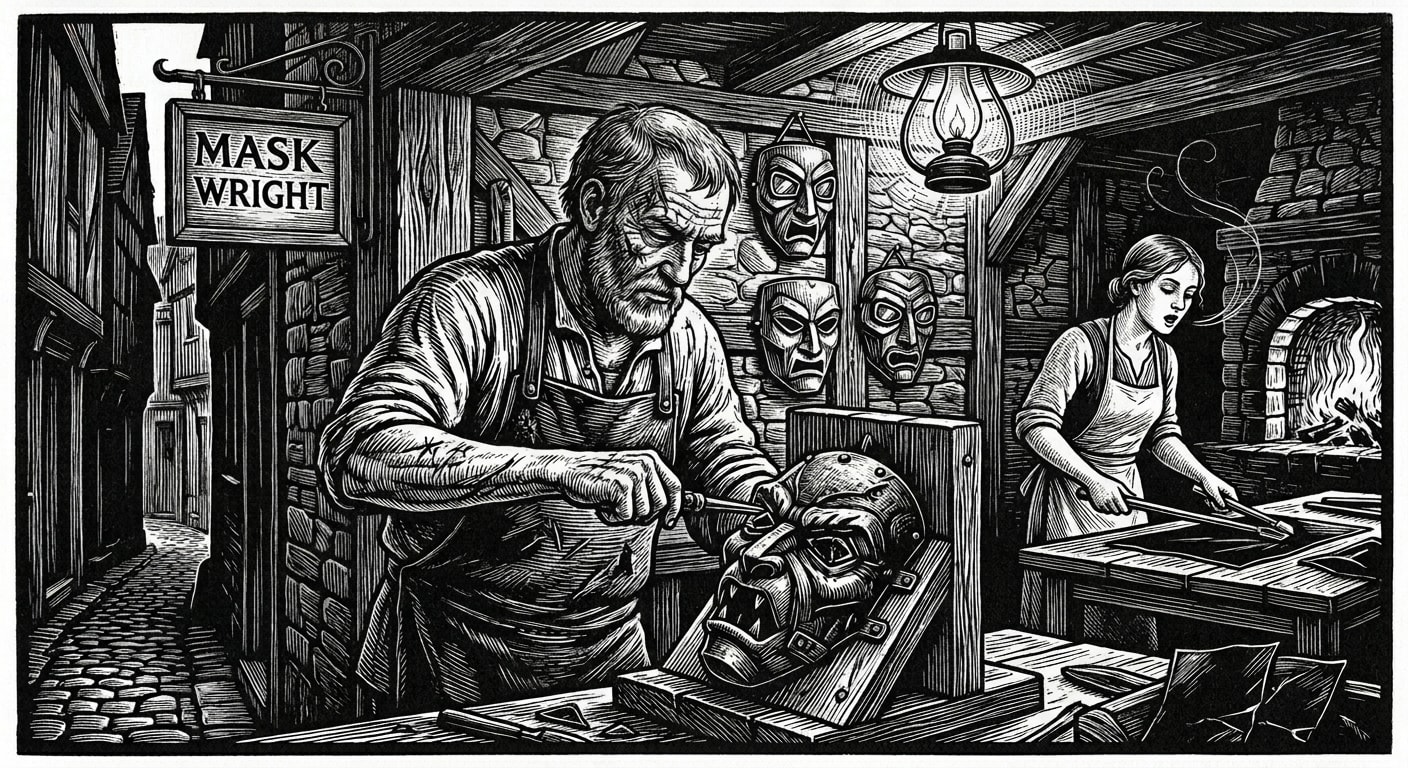
Thessaloniki's Maskwright Lanes produce trench-masks for the coastal regiments — iron-framed, leather-lined, fitted with glass lenses against brine and fog. The legal masks are ugly, functional, and entirely orthodox. The illegal masks are works of art. Glassman Dimo, whose burn scars map the topography of a dozen kiln accidents and one Purity raid he declines to discuss, embeds demon glass shards into the eye-pieces so that soldiers can — he claims — see the enemy's soul. Purity purges the practice in fire every few years. Every few years the practice returns, more widespread than before.
The Bureau of Purity's Salt-Scourge Detachment wants total suppression. The Bureau of War quietly orders more masks. The tension between these positions is resolved, as all bureaucratic tensions are resolved, by pretending it does not exist while maintaining two separate filing systems for the same inventory. Inquisitor Velek announces raids with the dry voice of a man reading a weather report. Captain Mavra stages the arrests with theatrical flair — noon, public square, maximum visibility, minimum actual contraband seized. The masks that matter have already been moved through the under-quay tunnels and loaded onto night convoys bound for the Sister Trenches, where regiment commanders fit them to their men and file the requisition forms under "Optical Supplies, Standard."
The Drowned Row Syndic runs the under-quay tunnels, selling night pilotage, forged manifests, fuel, and quarantine shortcuts. Pilot-King Nenos, one-eyed and one-tempered, guides ships under the chain in fog with his remaining eye closed, navigating by the hum alone. His counterpart in the paper economy is Ledger-Ghost Tamsin, a clerk who does not appear in any official record and who can therefore process documents that officially do not exist for people who have officially never arrived. The Bureau of Shadows is aware of both. The Bureau of Shadows has not acted. I have my theories as to why, and my theories have been filed under Seal Amber, where they will remain.
#On the War and the Water
Thessaloniki's garrison is strong by coastal standards — cannon batteries on both tower platforms, patrol boats in the narrows, chain-tension mechanisms that can close the harbor mouth in the time it takes to sing the Passage Psalm, which is to say approximately ninety seconds if the choir is sober and one hundred and forty if it is not. The coastal defence doctrine relies on the chain-gate as a hard barrier, quarantine as a secondary perimeter, and the bell-schedule as a timing mechanism that synchronizes patrols with tidal patterns the Bureau of Engineering has mapped and the sea has, so far, obliged.
The real war at Thessaloniki is fought with paper. The Sister Trenches consume rations, ammunition, and bodies at a rate that would embarrass an abattoir. Every shell, every tin, every conscript passes through Thessaloniki's permit system before it reaches the Elder or Younger trench. The logistics officers call this process "the funnel." The soldiers call it "ink-drowning." Both are accurate.
ERRATUM — BUREAU OF WAR, SOUTHERN LOGISTICS COMMAND Reports that the garrison of Thessaloniki is "adequate" have been revised to "sufficient." The distinction is material. "Adequate" implies room for improvement. "Sufficient" implies that improvement would constitute a criticism of current allocation, which is — per standing policy — already optimal.
The Saffron Bastion's quarantine protocols are the envy of every coastal installation from Marseille to Thessaloniki. This is what the official memoranda say. What they do not say is that Thessaloniki's quarantine protocols are not designed to prevent plague. They are designed to prevent unregistered arrival. The Quarantine Collegium — Warden-Physic Iri and her staff of practical despair — monetizes the fear of contagion with the same efficiency that the Harbor Ledger Office monetizes the fear of erasure. A medical stamp costs time, and time in Thessaloniki is currency. A quarantine "extension" is imprisonment by another name. A "corrective silence" — the euphemism is local and chilling — means your tongue has been removed, your testimony rendered inadmissible, and your name transferred to a file that the Bureau classifies as "Resolved."
#On the Present Condition
"Better a stamped lie than an honest blank." — Common saying, Thessaloniki
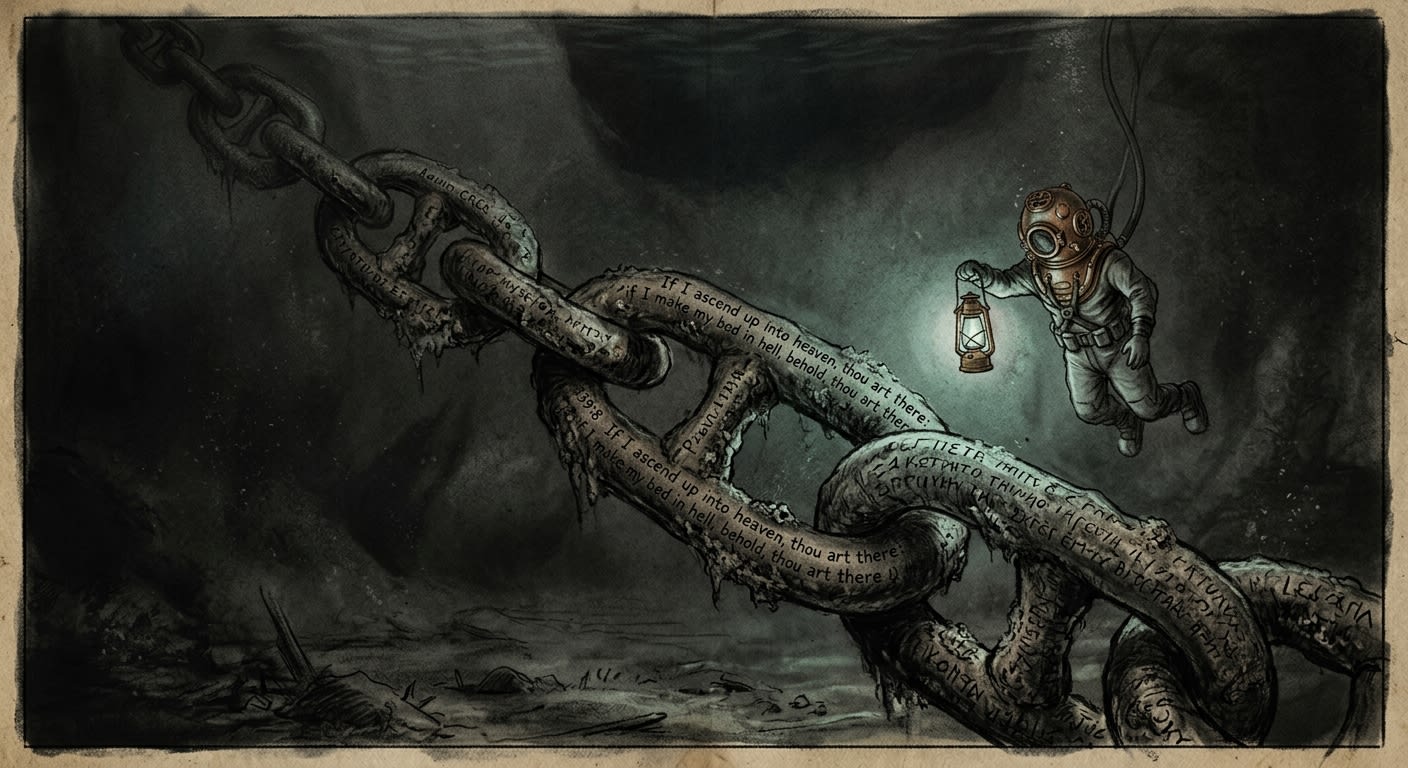
The chains sag. This is the rumour, and it is not entirely rumour. The Custodians of the Chain — Chainmaster Superior Kosta and his Chainwright brotherhood, whose scarred hands and forge-pier territories give them a monopoly on the city's physical infrastructure — have reported hum-pattern shifts that do not correspond to any known tidal model. The chain links vibrate at frequencies the Bureau of Bells cannot catalogue. Diver-Matron Sera, who has not slept in four years and whose reports grow longer and more alarming with each inspection, has noted corrosion patterns on the underwater links that resemble — her word — handwriting.
The audits have increased. Strasbourg has dispatched an external inspection team — the first in eleven years — and the Harbor Ledger Office is preparing its files with the frantic energy of a household expecting an inquisitor for dinner. Iolana's clerks work double shifts. Brencis smiles with renewed intensity. The Drowned Row Syndic has moved its operations deeper into the under-quay tunnels, and Pilot-King Nenos has been seen purchasing provisions for a voyage he will not discuss.
In the Refugee Sheds, the humming has grown louder. The communal drone that keeps the sleep-singing at bay has developed, over the past months, a second voice — a harmony that Aunt Velka, the Sheds' unofficial matriarch, says she has never heard before and that the children produce without being taught. It is not unpleasant. It is not orthodox. It is the sound of a population learning a psalm that no Bureau has written, for a choir that no Bureau controls, in a register that the chain-hum recognizes as its own.
The sea, as always, is patient. The sea is counting. And the chains — glowing faintly in the fog, humming their psalm to ships that pass beneath — the chains are counting too. The only question, which no one in Thessaloniki asks because everyone in Thessaloniki already knows the answer, is what happens when the two counts disagree.