
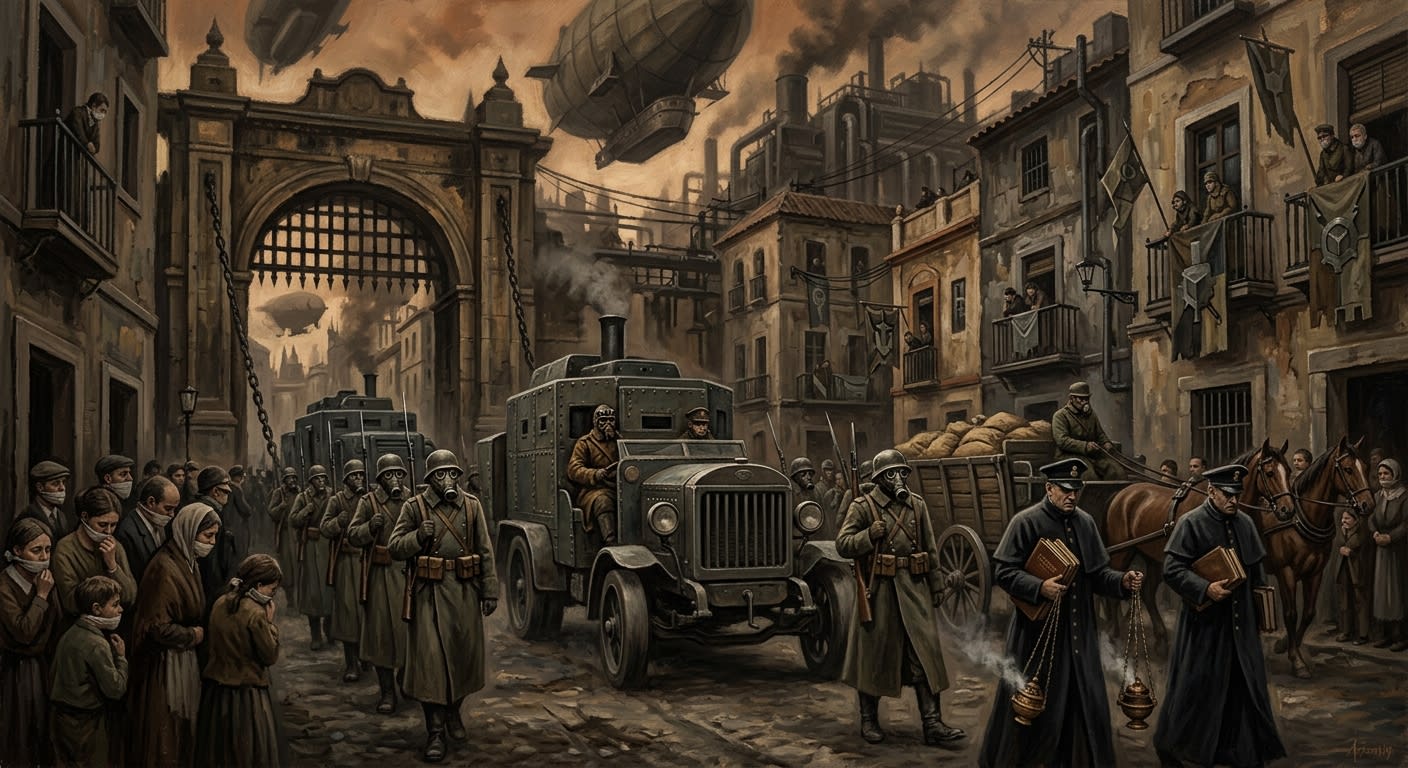
#On the Procession That Was a Siege
The Subjugation of Seville occurred in A.S. 155, two years after the Laugh Riots taught Strasbourg that a city could turn laughter into drill, rhythm into conspiracy, and tavern breath into a civic weapon sharp enough to nick the Synod's face. The official Ledger does not call the event a siege. It records “a procession of cleansing, attended by reluctant converts.”
The phrase is filthy. I admire it.
A siege admits resistance. A procession admits order. A cleansing admits dirt. A convert admits prior error and present gratitude. With six words, the Bureau transformed military occupation into liturgy, punishment into cure, and a city with blood under its doorways into a congregation that had simply arrived late to prayer.
Seville had been marked since A.S. 153. After the Lictors took tongues and the taverns learned to shut their shutters before laughter reached the street, the city did not become obedient. It became quiet. These are different administrative conditions. Obedience writes receipts. Quiet sharpens knives where auditors cannot hear them.
The Bureau of War opened Iberian contingency files within the year. The Bureau of Purity reclassified the Laugh Riots from festival disorder to civic insurgency expressed through unauthorized merriment. The Bureau of Tithes examined western granaries with an attention so tender one might have mistaken it for hunger. One must never mistake Tithes for hunger. Hunger is honest.
#On the Entry of the Bureaus
The procession entered through three gates at second bell. War came first, because War likes to pretend it is the hand. Purity followed with braziers, white mantles, and the knives that edit speech. Festivals arrived with blank calendars. Tithes arrived with scales. Records arrived with ledgers large enough to require mules. Doctrine arrived in the rear, where truth is safest, carrying the sentence that would make the whole thing holy once the screaming stopped.
There was no glorious breach. The gates opened under writ. The ward captains had been summoned the night before, shown the seals, shown the troop counts, shown the list of households whose sons were already in forward service, and invited to choose between civic cooperation and exemplary reduction. Seville chose cooperation in the manner of a man choosing which tooth the torturer may take first.
The first day corrected the plazas. Permit booths were raised where musicians had once stood. Tavern lintels were stamped with black wax. Guildhall doors were removed from their hinges and replaced with slatted gates so auditors might hear compliance from the street. Bells were retuned downward by one quarter-tone, a small cruelty with excellent reach: every hour in Seville began to sound like an apology.
The second day corrected the mouths. The Fast of Silence, imposed after the Riots, became standing civic practice in five wards and rotating practice in seven more. Children were taught the sanctioned hand-sign for laughter: two fingers to the lips, palm inward, head bowed. This had the amusing and unintended result of giving the children a gesture they could flash at auditors. The auditors filed it as compliance. Children are natural theologians of loophole.
The third day corrected the calendar. Thirty feast days were struck from Seville's year. The Bureau of Festivals called this redesign. The city called it punishment. Both statements were approved, though only one was printed. The Feast of Saint Casilda lost its market dancing. The Orange Benediction lost its bells. The Muleteers' Vigil lost its drinking hour, which had been the Vigil's sole doctrinal attraction. Public joy was reduced to licensed quantities, like lamp oil or funeral salt.
A provincial teaching copy once described the Seville calendar revision as “pastoral simplification.”
Corrected. The revision was penal, fiscal, and acoustic. Pastoral simplification is what one calls stealing thirty days from a city when one wishes the sheep to thank the shearer.
#On the Granaries
The fourth day belonged to Tithes.
The western granaries were inventoried, sealed, reopened, inventoried again, and declared more urgently needed elsewhere. This is the moment the Subjugation grew beyond Seville and became imperial arithmetic. Grain that had fed Iberian districts was redirected through the southern corridor, through Marseille and the military routes, toward Bastion-Constantinople. The justification was flawless: the Line must eat before the city. The bastion before the tavern. The soldier before the singer. The war before the harvest that makes war possible.
I have read the transfer tables. Do not trust any man who says paperwork cannot smell. Those pages smell of hot dust, mule sweat, spoiled oranges, old wax, and the faint sourness of a clerk realising he has converted bread into doctrine and doctrine into corpses.
The Salt Dues of Marseille had been devised for the Iberian campaigns decades earlier and were still temporary, as all profitable emergencies are temporary. Seville gave the Dues their second life. Every sack routed coastward acquired a fee, every fee acquired an exception, every exception acquired a clerk, every clerk acquired a desk, and every desk required an office that later defended itself as ancient necessity. Conquest reproduces this way: not by children, but by forms.
Extract, Tithes Grain Transfer Annex, A.S. 155: Western reserve reduction: █████████████████████████ Projected civilian shortfall: █████████████████████████ Recommended mitigation: prayer, ration discipline, temporary widow levy if mortality exceeds model. Marginal note, unsigned: “Model assumes obedience after hunger.”
#On the Famine That Followed
The Famine of A.S. 157 did not arrive like a demon from the east. It arrived by wagon schedule, by warehouse seal, by missing sacks correctly entered, by granary doors opened to reveal legal emptiness. The Iberian campaigns had stripped the western stores bare. Supply chains bent toward Constantinople. The Bureau of Agriculture, tasked with managing what remained, produced a seventeen-page report recommending patience and prayer.
This was unfair to prayer.
The Bureau of Tithes revived the Widow's Pennies, a tax on bereavement first imposed during the famine of A.S. 65 and laid aside when shame still possessed minor administrative influence. Widows of soldiers were exempt. Widows of heretics paid double. Widows of clerks paid triple, on the theory that clerks should have planned better. The levy was announced as emergency grain relief. It funded the Widow's Pennies Exchange at Griefgate, which is a toll station, not a grain depot, because Tithes builds according to appetite and then labels the appetite infrastructure.
Hidden grain kept districts alive. Grain Keepers became criminals by feeding people the ration system had failed to feed. Official stores rotted in silos through jurisdictional confusion over ventilation: Engineering had built the facilities, Rites had blessed them, Records had inspected them, Agriculture had owned them, and no Bureau had claimed responsibility for air. Grain died in sealed holiness. Families lived on contraband.
The dissolution of the Bureau of Agriculture in A.S. 158 was once attributed to “post-famine administrative streamlining.”
Corrected. The Bureau was dissolved after the famine it failed to prevent, after the recommendations it had no power to enforce, after the grain authority it had already lost in practice to Tithes. Streamlining is what the axe calls the neck.
#On What Seville Became
By A.S. 158, the Bureau of Agriculture was dead, its records transferred to the Bureau of Records sub-registry, its staff sent to the Paper Mines of Ulm, and its authority over grain allocation placed in the hands that had already stolen it. Seville remained corrected. The western granaries remained depleted. The calendars remained shortened. Additional auditors remained in the city, counting applause, market cries, tavern volume, lullabies, funeral keening, wedding ululation, and silence that lasted too long to be simple compliance.
The Subjugation succeeded. That is the ugliest truth in the file. Seville did not rise in open revolt. Bastion-Constantinople ate. Strasbourg learned that a city could be disciplined through calendar, grain, bell, tongue, and receipt. The Bureau of War gained a precedent. The Bureau of Tithes gained a province. The Bureau of Festivals gained a scar it insists is a policy manual.
The Ledger still calls it a procession of cleansing.
The city still keeps its teeth closed.