
#On the Purchase
When a customer in the Cathedral Quarter complains too loudly about a relic, the dealer who sold it may climb to the Cathedral of Saint-Victor and purchase a Mass of Remedial Doubt. That is the whole of the documented transaction. I state it plainly because the canons will not. A dealer pays. The cathedral offers worship. Somewhere below the steps a customer still holds an object in one hand and a grievance in the other.
The chapter has not written down what the Mass remedies, and I decline to write it for them. The doubt may belong to the customer, who suspects that a knuckle of the blessed once belonged to a goat. It may belong to the dealer, who suspects the same and would rather not. It may belong to the lane, which heard the shouting and is now weighing whether to buy its candles and fingerbones from the next awning down. The Mass is offered and the Creator receives it. The dealer has paid. Beyond that point the cathedral's account falls silent, and in a cathedral silence is never accidental.
I have served the Sacred Ledger for longer than most of Saint-Victor's canons have served anything, and I know a rite purchased under pressure when I see one. That does not make it a counterfeit rite. A Mass said for a nervous man is still a Mass.
#On the Trade Below the Steps
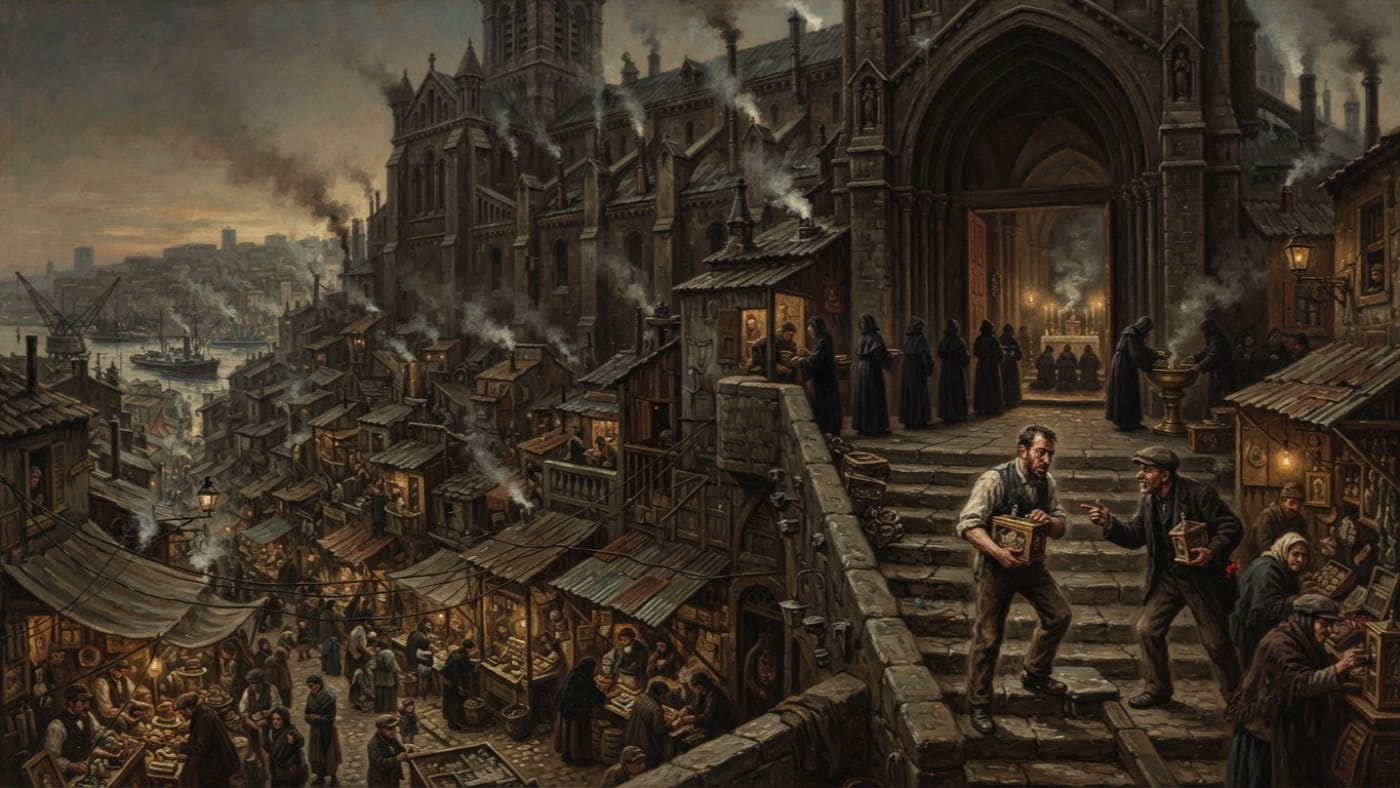
Saint-Victor stands above the old harbour of Marseille like a confessor above a crowded grille, and the grille pays rent. The lanes that descend to the water are lined with wax sellers, rosary-cutters, reliquary polishers, fried-oil stalls, pilgrim hostels, scribal booths and relic dealers, packed so tightly that a woman buying a candle can smell the fish of the man buying a femur. Authenticated fragments, fragments awaiting authentication and fragments that have never troubled an authenticator share the same awnings, the same flies and the same salt wind. The Bureau of Bells tolls the hours over all of them with perfect impartiality. Bronze does not inspect inventory.
The canons have made their peace with this neighbourhood by licensing it. Stallholders lease cathedral-adjacent frontage under parish licence. Pilgrim guides pay to begin their tours in the shade of the west door. The Bureau of Pilgrimage keeps its board by the southern porch, where ship departures, penance schedules, berth changes and lost children share equal authority. And when trade turns sour and a customer's voice carries up the lane, the relic dealer buys a Mass.
I find nothing disgraceful in the arrangement. A cathedral that refused the commerce at its feet would soon be a cathedral without a quarter, and Marseille would build a worse quarter somewhere less supervised. The chapter licenses frontage, admits guides and accepts Masses for the same reason: each keeps the trade within earshot of the altar. Whether the altar carries as far as the trade is another question. The fish carts drown out a great deal.
#On Devotion and Authentication
A Mass is worship. A certificate is evidence. The quarter confuses the two every hour of the day, and the confusion is excellent for business.
The Bureau of Relics establishes what an object is, or tries to, through the tedious sacraments of its office: provenance rebuilt from bills of sale and burial registers, examination, testing, entry in the registry, notarization. Its examiners take delivery at Quai Saint-Lazare, where what comes off the ships is received and judged. The work is slow, it can be bought, and now and then it is dangerous. A rich patron may lean on an examiner, and an examiner may give way. Some relics do what their labels promise. Some do things nobody wanted. Relics keeps its gloves for a reason.
A Mass of Remedial Doubt does none of this. It rebuilds no provenance and notarizes nothing. It grants no Authenticity Writ, changes no classification, lifts no quarantine and overrules no examiner at the Quay. A goat's knuckle carried through a hundred such Masses is still a goat's knuckle, only very thoroughly prayed over. A saint's knuckle sold without one is still a saint's knuckle, whatever the buyer bellows about it in the lane. The Creator knows which is which. Relics would also like to know, and keeps forms for the purpose.
Saint-Victor has long kept devotion and evidence apart under a single roof. A pilgrim refused authentication at the Quay may carry the rejected object uphill to the cathedral for devotional comfort. A canon may put it in the Victor Crypt for a time. A Relics clerk comes to collect it when the stack grows embarrassing. All the way round this circuit nobody agrees on what the object is, and nobody has to. Veneration goes on upstairs, the examination stands at the Quay, and the object keeps its own counsel. The dealer's Mass comes from the same habit of mind. The records set the two practices side by side and never join them. Neither shall I.
Earlier parish pamphlets claimed that "no false relic has ever rested beneath Saint-Victor."
Corrected by the Bureau of Doctrine. False relics have rested beneath Saint-Victor in considerable number. The correction concerns the crypt and its pamphlets. It is reproduced here so that no reader mistakes a Mass said in the nave for a certificate issued at the Quay.
#On the Complaint
Three parties stand in this transaction, and they do not stand on level ground.
The customer has paid for a fragment of sanctity and now doubts it. That doubt can come from several places. The provenance may be uncertain, as provenance in Marseille usually is. The object may be genuine and simply fail to do what the buyer imagined, since saints are not obliged to perform on demand for whoever owns their finger. Or the dealer may be a forger, and the customer was robbed within sound of the cathedral bells. These are three different conditions, and a raised voice in the lane sounds exactly the same for each. Every bastard with a stall will have heard it by vespers.
The dealer has a shop, a reputation on a crowded street, and a customer shouting. He may be honest and wounded. He may be a thief and sweating through his good collar. Either way the Mass costs him less than the quarrel, so he buys it. I applaud any instinct that carries a dispute to the altar. I also observe how convenient it is to answer an accusation by paying for prayer. Prayer cannot be cross-examined, and it has never once returned a verdict against the man who paid for it.
The cathedral accepts the offering and says the Mass. Whose doubt the Mass addresses, whether the customer attends, whether anyone tells the customer, whether any mind changes afterward: the chapter's account is silent on all of it, and I will not fill the silence with a tidy ending.
One further distinction must be kept, though the quarter would rather blur it. Religious unease belongs to the confessor. Evidential doubt belongs to the examiner. A buyer may tremble before the Creator and still be right about the goat. The Bureau of Purity has firm opinions on doubt spoken aloud in public streets, and so do I. A complaint about a purchase remains a complaint about a purchase. In all my years I have never seen a man taken up for asking where his saint came from. I have seen men taken up for less. Never for that.
#On the Present Application
In the survey of A.S. 201, Masses of Remedial Doubt are part of the ordinary business of Saint-Victor, along with the frontage licences, the guides' fees and the board of lost children. Nobody has shown me where the practice began. I will not invent an origin to flatter the cathedral's age, and the cathedral's age does not need the help. It is a present practice of a present quarter: dealers buy the Masses when complaints carry, and a chapter that has learned to keep the market close to the altar says them.
The Bureau of Tithes will want to know what the dealers pay. The Bureau of Relics will want to know what they sold. The Synod, if it ever looks this far down the slope toward the Marseille waterfront, will want to know why the question was put to it. I commend the canons for their pastoral readiness. I advise the dealers that the Creator is not a harbour magistrate and does not settle out of court.
The Mass is said. The knuckle is whatever it was before.