
#On the Cathedral
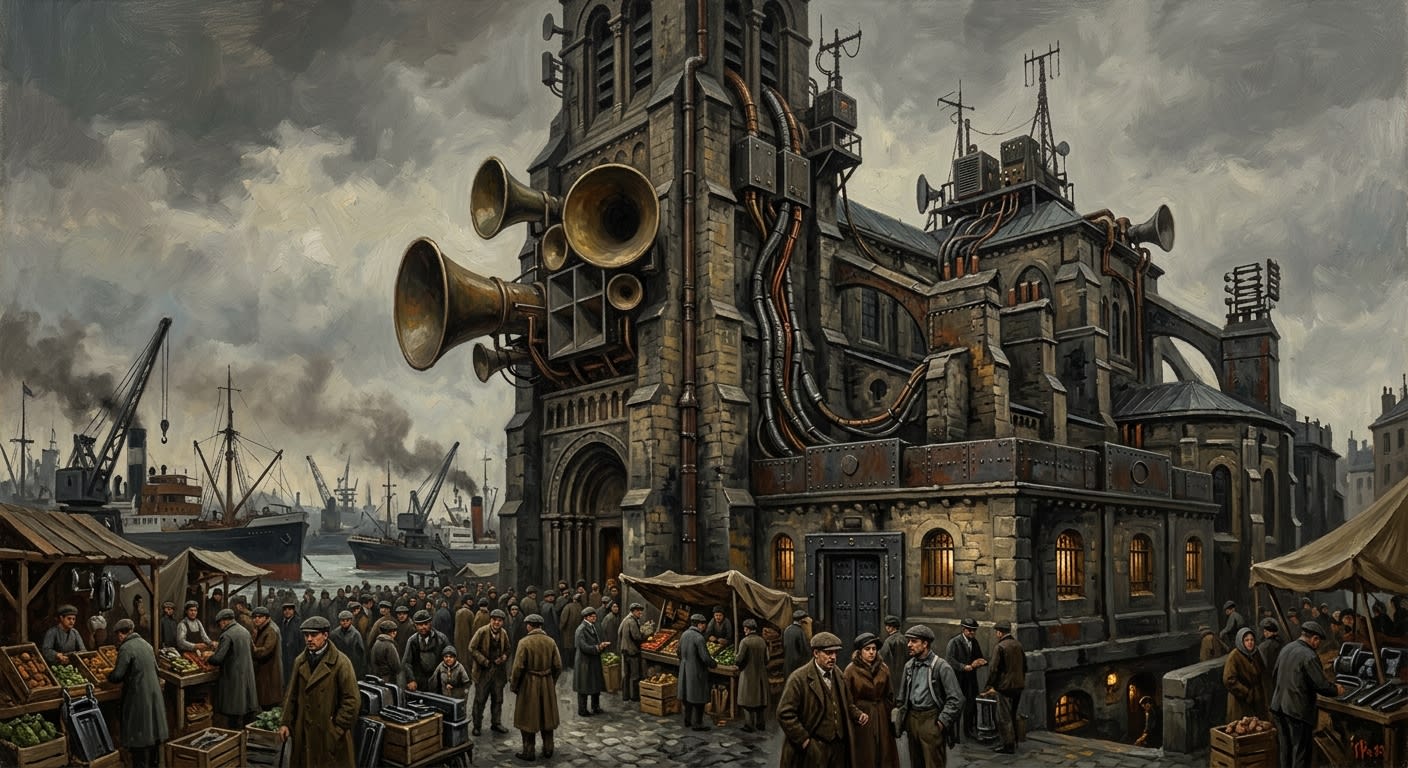
The Cathedral of Saint-Victor rises above the old harbour of Marseille with the expression of a confessor who has heard everything and charged pew rent for the privilege. Its bells toll the canonical hours over salt roofs, relic shops, pilgrim hostels, taverns, fraud stalls, Bureau offices, ropewalks, and the little alleys where respectable merchants become less respectable by candlelight. The people of Marseille pretend the bells are part of the weather. The bells pretend the people are part of the parish. Both parties lie with long practice.
Saint-Victor is ancient, battered, limestone-faced, and magnificently stubborn. It has survived Rationalist seizure, dock fires, salt rot, three bell-frame collapses, two pilgrim panics, one attempted Bureau of Tithes lien, and the ordinary daily insult of being surrounded by Marseille. The cathedral anchors the Cathedral Quarter, that uneasy slope between the harbour and the relic dealer district where a man may leave Mass, buy a certified knuckle of Saint Ivar, eat fried fish, be pickpocketed, and file a complaint before noon.
The cathedral's dedication to Victor is convenient, which explains why everyone with a shelf, a seal, or a hereditary itch disputes it. Marseille's canons claim an early soldier-martyr whose bones were carried through the old port during a plague year and whose passing caused the harbour rats to drown themselves. The Bureau of Relics has authenticated three bones, rejected five, reserved judgement on two, and filed a supplemental note stating that rats often behave dramatically during plague. The faithful prefer the better story. So do I, in this instance, though I have not informed Relics. Their disappointment would be noisy.
#On the Bells and the Relay
The Bureau of Bells maintains its southernmost major relay-tower in the cathedral's western mass, a reinforced bell cage mounted through the old stone like a bureaucratic spine driven into a saint's back. From this tower the canonical hours pass across Marseille's harbour, outward to the pilgrim fleet, eastward along the coastal signal chain, and inland toward the Rhône road. On clear mornings the peals reach ships already beyond the harbour mouth. On foul nights the harbour fog catches them, thickens them, and returns them as if the sea had learned to answer.
There are nine principal bells. Victor is the largest, a deep bronze mass cast after the Concordat and inscribed with a prayer against shipwreck. Lazare tolls for relic arrivals and disputed deaths. Oraison marks Bureau business at the quay. Marthe, thin and sharp, calls pilgrim muster. Salt-John sounds harbour danger. Little Beryn, which cracked in A.S. 167 and was never properly repaired, gives a nasal complaint at terce that every Marseille child can imitate. Three lesser bells handle parish business, funerals, debt remissions, and small municipal humiliations.
A previous Bells register listed Saint-Victor as possessing ten principal bells.
Corrected. The tenth, Saint Armand of the Foam, was removed in A.S. 158 after repeated mis-tolls during the eastern basin expansion. Marseille tradition says the bell objected to the new pilgrim piers. The Bureau of Engineering says the frame shifted. The bell was melted into harbour brackets, which have since loosened twice.
The relay-tower does more than mark hours. It orders movement. One sequence opens pilgrim embarkation. Another holds ship traffic during relic transfer from Quai Saint-Lazare. A descending five-peal warns of fire in the dock quarter. A broken triplet calls Bureau of Purity enforcement, though Marseille residents have become expert at mistaking it for a fishmonger's handbell. A low sustained toll seals the harbour during suspected demonic contamination. That toll has sounded only four times since A.S. 130. Each time, the taverns emptied before the soldiers arrived. Fear moves faster than War.
#On the Quarter Around It
The Cathedral Quarter is holy by designation and commercial by instinct. Its lanes run between Saint-Victor and the harbour in cramped descents lined with wax sellers, rosary-cutters, reliquary polishers, fried-oil stalls, pilgrim hostels, scribal booths, and licensed dealers whose certificates are framed more expensively than their consciences. The relic dealer quarter presses against the cathedral's lower steps, because counterfeit sanctity has always preferred to stand within hearing distance of genuine bells.
Every second shop displays authenticated fragments. Every third displays fragments awaiting authentication. Every fourth offers, under the counter, fragments whose owners believe authentication is a constraint placed upon lesser men. The bells toll above all of them with impartial majesty. Bells do not distinguish fraud from devotion. They strike bronze and allow the Bureau to do the tedious part.
The canons of Saint-Victor have adapted to the market with the nimble piety of men who know rent is a sacrament when paid in advance. Stallholders may lease cathedral-adjacent frontage under parish licence. Pilgrim guides pay for the right to begin tours in the shade of the west door. Relic dealers purchase Masses of Remedial Doubt when a customer complains too loudly. The Bureau of Pilgrimage maintains a bulletin board near the southern porch, where ship departures, penance schedules, berth changes, and lost children are posted under equal authority.
#On the Crypt and the Bones
Below the cathedral lies the Victor Crypt, older than the present nave, older than the Synod's hold on Marseille, older than several municipal lies now carved in stone. The crypt is low, salt-damp, and lined with sarcophagi whose occupants have acquired names by committee. Pilgrims descend carrying candles. Clerks descend carrying forms. Dealers descend only when invited and overpay for the privilege.
Three reliquaries stand in the eastern chamber: the Arm of Victor, the Rib of Victor, and the Vessel of Harbour Rats. The Arm has been authenticated twice and contested once. The Rib sweats brine during storms and has produced a minor cult among fishermen who prefer practical saints. The Vessel contains small grey bones gathered after the plague miracle, assuming one accepts the plague miracle, the rat drowning, the gathering, the vessel, and the present label. Faith is a staircase. The Bureau supplies handrails where profitable.
The crypt also stores rejected offerings awaiting removal to Saint-Lazare. This arrangement is indefensible and efficient. A pilgrim denied authentication at the Quay may carry his object to Saint-Victor for devotional comfort; a canon may place it in the crypt temporarily; a Relics clerk may retrieve it when the stack becomes embarrassing. The cycle produces paperwork, hope, storage fees, and occasional miracles of inconvenient provenance.
Earlier parish pamphlets claimed that “no false relic has ever rested beneath Saint-Victor.”
The Bureau of Doctrine has corrected the pamphlet. False relics have rested beneath Saint-Victor in considerable number. Several rested comfortably. One rang faintly when touched and was promoted to uncertain status, where it remains happier than many clerks.
#On Jurisdictional Piety
Saint-Victor belongs to the Creator, the Diocese, the Bureau of Bells, the parish chapter, the city of Marseille, the Bureau of Pilgrimage during embarkation hours, the Bureau of Relics during certified transfers, the Bureau of Tithes during market assessments, and the Bureau of War whenever a harbour alarm reaches the garrison. Ownership this divided would cripple a lesser institution. Saint-Victor has learned to weaponise confusion.
When Tithes attempted a levy on bell-tour admissions in A.S. 174, the canons reclassified the tower stairs as penitential ascent rather than public access. When Pilgrimage demanded exclusive use of the nave for departure blessings during the A.S. 186 Thessaloniki surge, Bells rang a maintenance peal for six consecutive hours until the pilgrims fled to the quay. When War requested storage of signal powder beneath the west porch, the chapter produced a relic certificate for the floorstone and declared drilling sacrilege. The powder went to a warehouse. The warehouse burned two months later. Saint-Victor rang for the dead with admirable restraint.
BUREAU OF BELLS INTERNAL NOTE — SAINT-VICTOR RELAY, A.S. 191 The midnight return-peal of Victor during calm weather has no authorised ringer. Rope inspection: dry. Bell motion: confirmed. Sound direction: inward. Witnesses: ███████████████████ Recommendation: do not silence the bell until we know what is answering.
The Bureau of Bells denies any anomaly in the relay. The canons deny hearing anything after midnight. The fishwives of the lower quarter cross themselves whenever Victor groans in fog and refuse to sell eels before dawn. I trust fishwives more than minutes.
#On the Present Condition
As of A.S. 201, the Cathedral of Saint-Victor remains Marseille's acoustic throne: parish church, relay tower, market anchor, crypt of disputed bones, and municipal conscience, though Marseille has always treated conscience as a negotiable instrument. Its bells regulate ships, pilgrims, sellers, mourners, thieves, clerks, and officials who pretend they came by choice. Its quarter reeks of wax, salt, frying oil, wet rope, incense, old stone, and authenticated doubt.
Saint-Victor does not rule Marseille. No cathedral rules a port city. It tolls above Marseille, interrupts Marseille, blesses Marseille, irritates Marseille, and marks the hour at which Marseille resumes being Marseille under divine supervision.