
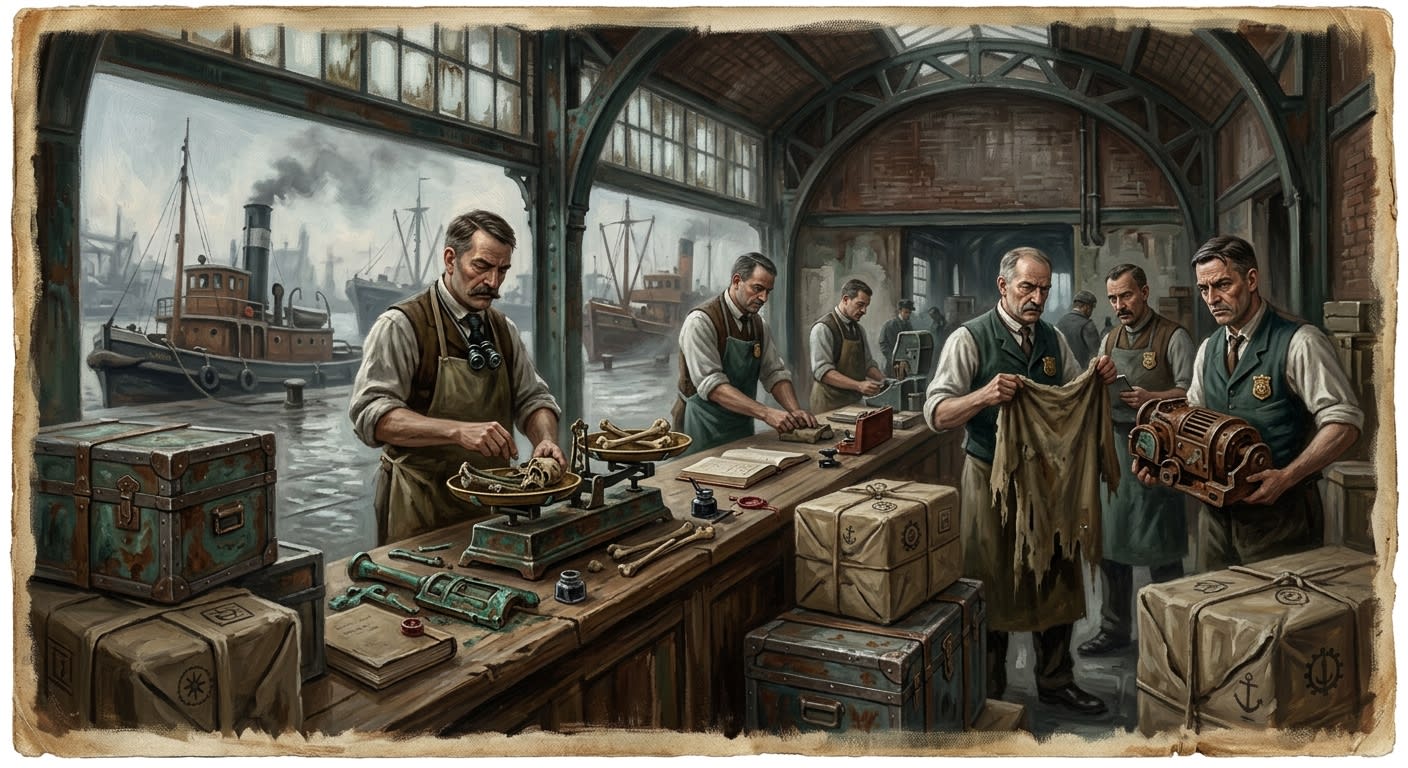
#On the Quay
Quai Saint-Lazare is the narrow strip of Marseille where holiness arrives by crate, sack, phial, reliquary case, sailor's lie, widow's oath, merchant invoice, and occasionally by miracle, though the Bureau prefers the miracles to queue behind the invoices. It lies between the harbour and the relic dealer quarter, close enough to the water that salt crusts the office shutters, close enough to Saint-Victor's bells that every authentication hearing receives unwanted accompaniment, and close enough to the market that a man may sell a saint's tooth before the ink on its rejection dries.
The Bureau of Relics maintains its southern authentication office here. Everything imported from the Iberian shrines, the North African coast, the eastern Mediterranean, the Aegean shrine-circuit, and the lesser chapels that grow along pilgrimage routes like mould on bread must pass across the Quay or be presumed fraudulent, dangerous, untithed, or all three. Bones, teeth, fabric scraps, iron fragments, ash sealed in blue glass, water from disputed springs, finger-rings taken from corpses that may have been saints if one discounts the bite marks — Saint-Lazare receives them, weighs them, smells them, blesses them, doubts them, prices them, and stamps them.
The Quay's name is older than the Synod's control of the harbour. Marseille claims a medieval hospice of Saint Lazarus (Unregistered) stood here, where sailors with fever were washed, blessed, and usually removed before property values suffered. The Bureau of Relics accepts the dedication because Lazarus is administratively convenient: dead, returned, witnessed, contested by fools, and excellent for signage.
#On the Office and Its Counters
The authentication office occupies a three-storey limestone building with green shutters, iron grilles, two public counters, one private counter, six examination rooms, a chapel of Saint Lazarus, a salt-drying loft, a quarantine cellar, and a rear door that every relic dealer in Marseille pretends not to know. The front façade displays the Bureau seal: crossed reliquary tongs beneath a haloed ledger. The halo is bronze. The ledger is larger than the tongs. This is accurate heraldry.
The public counters divide the faithful from the professional liars. Counter One receives private devotional submissions: grandmother's bone, battlefield splinter, oil-stained cloth, spoon that cured a cousin's cough, pebble from a shrine wall, lock of hair allegedly cut from a martyr already represented in the Great Ledger by enough hair to thatch a stable. Counter Two receives commercial consignments from licensed dealers, pilgrim brokers, ship captains, monastery factors, and men who insist the crate is not theirs while holding the bill of lading in both hands.
Earlier harbour guides described the Quai Saint-Lazare office as “adjacent to the relic market.”
Corrected. It is embedded in the relic market like a nail in meat. Adjacency implies distance. Distance would imply innocence.
The private counter serves Bureaus, aristocratic houses, military chaplains, and those merchants whose donations to the chapel roof have achieved sacramental mass. It opens at irregular hours. It closes when anyone asks about it. The Bureau of Relics insists all counters apply identical standards. This is true in the same way all souls are equal before judgement: doctrinally secure, practically postponed.
#On the Work of Authentication
Authentication is a sacrament performed with calipers. The clerk receives the object. The clerk records provenance. The clerk compares seal, material, odour, weight, grain, age, blood memory, oil response, bell reaction, prayer temperature, and the behaviour of the junior assistant assigned to stand nearest the table. If the assistant faints, classification advances. If the assistant weeps in Latin, the object is quarantined. If the assistant begins speaking in a relative's voice, the object is forwarded under armed escort to Strasbourg and the assistant's payroll status becomes complicated.
Most relics are false. This should not scandalise the reader. Most coins are dirty and still purchase bread. The Bureau's work does not discover purity in every object; it decides which impurities may safely circulate under seal. A false relic that comforts an old woman, raises no demon, and pays the proper fee can be pastorally tolerated under Category Four Devotional Misattribution. A true relic without paperwork can empty a street, rupture a chapel floor, or cause a dockside crowd to kneel so suddenly that three smugglers drop their contraband. Truth is dangerous when unfiled.
The examination rooms are painted white to reveal stains. They are repainted monthly. No one has yet explained why Room Four stains upward. The salt-drying loft stores damp consignments from coastal shrines whose custodians believe wax seals protect against seawater, rats, and optimism. The quarantine cellar holds objects awaiting night-bell testing. Cats are not permitted inside after the Saint Cressa whisker incident (Unregistered) of A.S. 184, in which a false whisker caused seven genuine mice to arrange themselves in the shape of the Triune Knot and die.
#On the Dealers
The relic dealers cluster around the Quay because fraud, like devotion, prefers proximity to authority. Their shopfronts display glass cases lined in velvet: finger bones, molars, prayer beads, boot nails, torn scapulars, candle ends, battlefield soil, rust flakes, coffin splinters, and the unspeakable abundance of saintly hair. Every display bears an authentication paper. Every authentication paper bears a seal. Every seal has a history, a fee schedule, and a chance of being false.
The Bureau of Relics has, on at least two documented occasions, purchased its own forgeries back from Marseille dealers at authentication prices. The dealers consider this proof of craft. The Bureau considers it an archival irregularity. I consider it market theology: the false returning to the maker, crowned with profit.
A Bureau of Relics training memorandum once stated that “Marseille counterfeiters lack doctrinal sophistication.”
Withdrawn after the second repurchase incident, when a forged tooth attributed to Saint Beryn (Unregistered) was found to contain a hollow inner tube carrying a perfectly copied micro-script indulgence from a Strasbourg sub-registry that had burned in A.S. 141. The counterfeiter lacked nothing except fear.
Dealers maintain relations with ship captains, monastery porters, retired chaplains, graveyard caretakers, Black Ledger brokers, and widows who know which objects a dead man carried close to the heart. The honest dealers cheat carefully. The dishonest dealers cheat beautifully. The difference matters only when the object begins humming.
#On Jurisdiction and Theft
Quai Saint-Lazare sits inside Marseille's favourite sacrament: contested jurisdiction. The Bureau of Relics claims authority over sacred objects. The Bureau of Tithes claims authority over import value, storage fees, levy schedules, salt exposure, and anything that can be made to resemble revenue by a sufficiently nourished clerk. The Bureau of Pilgrimage claims authority whenever the object arrives with a pilgrim, near a pilgrim, in a pilgrim ship, or in a crate whose owner once considered pilgrimage. The Bureau of War claims any relic with battlefield application, which increasingly means anything sharp, loud, glowing, or portable.
The Harbour-Master signs all four forms when sober and three when busy. The Quay functions because everyone benefits from functioning and because the sea has no patience for stalled paperwork. Ships unload. Clerks argue. Porters carry crates to the office, to the dealer quarter, to the wrong chapel, to the right chapel by the wrong route, and sometimes into alleys from which they emerge richer, paler, or not at all.
SAINT-LAZARE INCIDENT FILE — A.S. 193 Object declared: “bronze reliquary clasp, Iberian, minor.” Actual contents: ███████████████████████████████████ Clerk response: laughter for eleven minutes, followed by confession of crimes not yet committed. Disposition: transferred to Strasbourg under triple seal. Porter disposition: not recovered.
Theft at Saint-Lazare has its own etiquette. No one steals from the quarantine cellar after dusk. No one cuts a Bureau seal without warming the wax first, because cold wax screams. No one sells untested water from disputed springs to pregnant women, after the A.S. 176 Canebière swelling (Unregistered). Thieves are wicked, not stupid. Stupidity dies quickly near relics.
#On the Present Condition
As of A.S. 201, Quai Saint-Lazare remains the busiest southern throat of the Bureau of Relics: salt-crusted, overrun, corrupt in the Marseille manner, useful beyond censure, and dangerous in proportions no annual report will state without being sealed. Its counters open before prime. Its queues form in darkness. Its clerks pray over teeth, weigh ash, sniff cloth, tap bones, test oil, and decide which fragments of holiness may be allowed into commerce without making the harbour kneel.
The Quay has authenticated saints who were frauds, condemned frauds that later healed children, forwarded objects that Strasbourg has never returned, and stamped enough bones to build a chapel from doubt alone. Pilgrims leave comforted. Dealers leave solvent. The Bureau leaves nothing unnumbered if it can help it.