
#On the Current and Its Present Name
"Mercy breeds insolence. Insolence breeds heresy. Ergo, mercy is treason." — Hieromnemon Valerius Drax, marginal note to the survey of Movements and Counter-currents
The Synod has never been unanimous, and anyone who tells you otherwise is a Doctrine clerk on salary or a foreigner. Of all the counter-currents running beneath the marble of the Synod, the Merciful Pragmatists are the weakest and the most tiresome. They are weak because they have never held a Bureau, a bastion, or any seat worth the wax. They are tiresome because they will not die.
Their whole doctrine would fit on a ration chit. Charity should outweigh purity. Bread matters more than ashes. Hospitals should not always double as inquisitorial annexes. Note the word always: the Pragmatists have never had the courage to drop it. The confession screen, the quarantine cordon and the intake ledger may all stay where they are. The Pragmatists ask only to rank them, and to rank every one of them below the bowl. Every heresy begins as a question of precedence.
Today they go about under a harmless label, the Hospitallers of Saint Mildred. Everyone knows they are the same faction. I say so plainly because everyone knows it, though I have never seen a charter, a succession roll or a sealed admission that would let a court say the same. Common knowledge is enough to convict a man at the dinner table. In a court it needs a seal, which is why Purity prefers the dinner table.
#On Kitchens, Wards, and the Annex Question
If you want to know why a soup kitchen should alarm the Bureau of Purity, first stand in a Mercy Ward, as I have, with a handkerchief over your face and a pen in your hand.
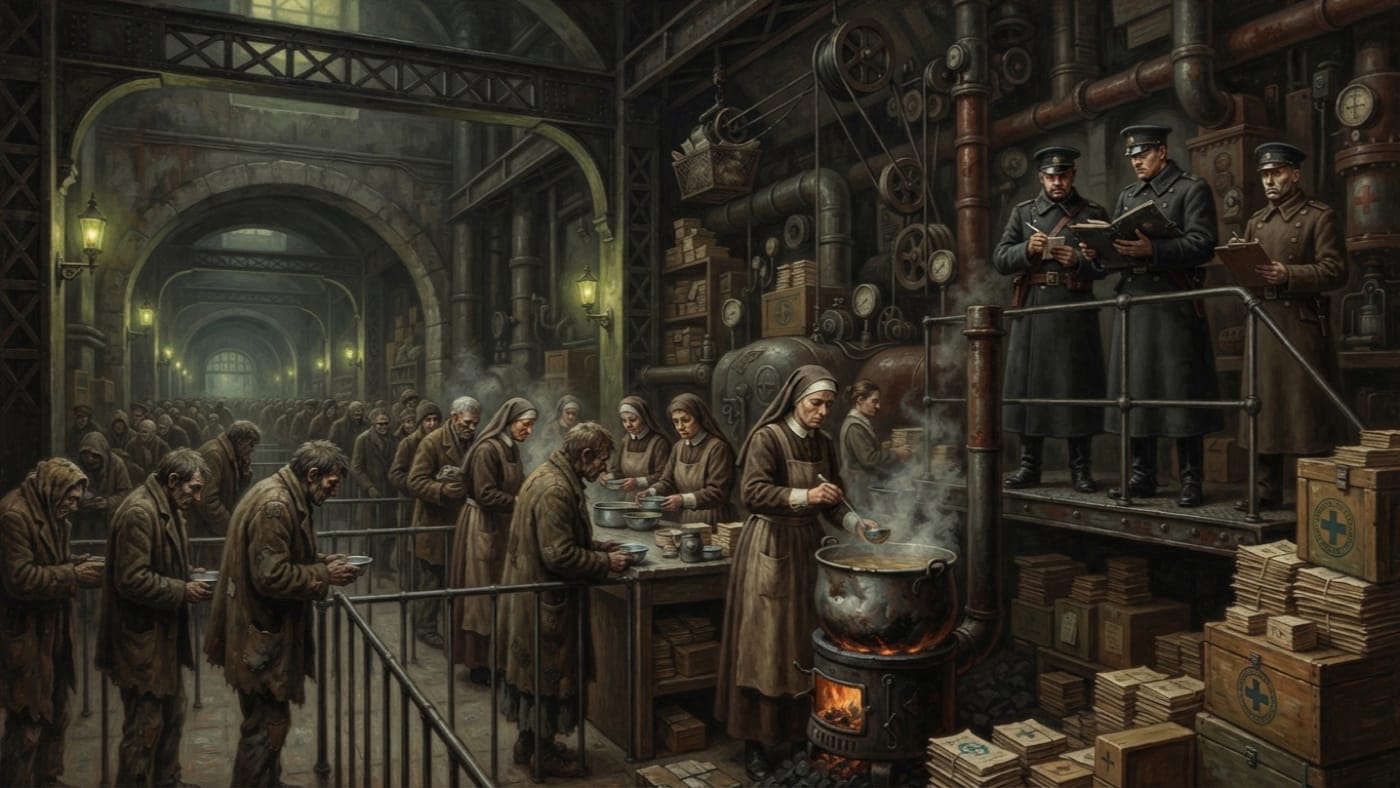
The Bureau of Mercy runs the Synod's hospitals, orphanages, asylums, infirmaries and broth-kitchens. Its Ward-Sisters and Ward-Brothers serve with marked ladles and bind wounds with cloth counted by the inch. Every arrival is tagged at intake: treat, hold, isolate, transfer, release, ossuary. Under the Ledger Laws of A.S. 112, every bowl must be matched to a ration chit by the end of the shift. In every ward from the Line to the coast, the auditor opens with the same question: Where did the extra broth go? A confession taken at the cot goes to the Bureau of Records by tray, and from Records to any desk that has asked for it. Care produces paper, and paper produces cases.
That is the annex. The Pragmatists did not invent the complaint against it. Every ward has its mercy-first hands and its ledger-first hands, and any ward-hand worth her apron has hidden one ladle for a child or a soldier and lied about it afterward. This is custom, and the Ledger forgives custom on alternate audits. I will not enrol every soft-handed Sister in a heresy because she can count one ladle past what the chit allows. The temptation is wide and the faction is small.
The Pragmatist's offence is to argue for the ladle. He stands at the intake desk and says the hungry man should be fed before he is classified. He says the dying woman's whispers belong to her confessor and should never reach Purity's sealed packet, and that a kitchen's business is to empty its pots while the folios wait. Said once, any of this is fatigue. Said with a theology behind it, it becomes a position, and positions can be filed.
#On Purges and New Banners
Naturally, they are purged every decade, only to be reinstated under new banners. I wrote that sentence years ago and I still admire its rhythm. If you hope to build a table from it, with purge years in one column, victims in the next and banners in the last, you will be disappointed. The cycle is my own observation, not a Purity schedule. I have never found a decree that sets the decade, and I suspect nobody wrote one because nobody needed to.
No conspiracy is required. A famine, a plague season or a hard winter on the Line fills the wards past what the measured ladle can serve. Someone has to open a kitchen that asks fewer questions than the Bureau does. The people willing to ask fewer questions are, by temperament, the same people who think fewer questions ought to be asked. The kitchen fills, the bread goes out and the crisis passes. Then the auditors arrive with the arithmetic of the emergency. They find a population fed without classification, confessions never routed and intake tags never written. Purity calls this contamination. It is also why the city did not burn.
So the faction is broken up. Its preachers are silenced and its pots confiscated. A few years later the need comes back, the same hands return to the same work under a different name, and the Synod permits it, because it has no other volunteers for the worst soup lines in the black zones. I call this a pattern I can see from my desk. I have found no policy behind it.
During the famine of 274 A.S., their kitchens fed half of Provence, but only because Purity clerks had not yet arrived to close them.
Withdrawn from my earlier survey. The year cited falls seventy-three years after this survey of A.S. 201, and the Codex does not certify famines it has not yet suffered. No replacement year is given. The half of Provence goes out with the date. The kitchens stay. The figure does not.
#On Public Correction
When the Procession of Tongues began in A.S. 94, all of the condemned were Rationalists. By A.S. 130 that supply had thinned, and the Bureau of Purity widened the rite to take any heresy public enough to deserve public correction. The resulting list names the Ledgerists, the Bell Monists, the unlicensed sermon-speakers, the tavern philosophers who drank past their three-drink exemption, and the Merciful Pragmatists. It does not say when the first of them marched, and I will not pretend that it does.
Purity is proud of the logic, and with some reason. A Pragmatist does his harm with his mouth. He whispers in the broth line that charity outranks purity. He preaches it at the kitchen door. He says it to Sisters whose aching hands have already half-persuaded them. Doctrine sets the order of the virtues, Purity enforces it, and the Order of Saint Ephrath turns the enforcement into a lesson. Once condemned, the Pragmatist is taken to the Chapterhouse courtyard above the Vltava. There his tongue is nailed to an oak tablet carved with the Creed, and he carries his error across the Charles Bridge in Prague for as many hours as his body allows, and a few more after it stops allowing.
I have no name to give you. I have no count of marches, and no tale of rescue by grateful widows armed with ladles. If any such thing happened, it lies in the Ephrath warehouse, filed by year, and I have not gone looking. The tablet bears the Creed, which the man failed to rank above his bowl. It says nothing about the bowl.
Do not confuse these marchers with the Inquisitor-Pragmatists. Those are officers of Purity who would rather correct a district quietly than burn it. Their own article states that they do not love mercy, and they would be insulted to find themselves on this page. The two groups share a name only because the Bureau's vocabulary is small. One kind of Pragmatist carries the warrant. The other kind sometimes carries the tablet.
#On the Present Condition
As of this survey, A.S. 201, the Hospitallers of Saint Mildred are still at their work. They feed and they nurse. As far as I am told, they also keep whatever records the law requires of them, which is the cleverest thing they have ever done. They are tolerated because they are useful and suspected because of who they are. The two judgments sit in different Bureaus, and nobody has ever asked them to meet.
I know what a pamphleteer would make of them: saints with ladles, defying the ledger out of love. I have read such pamphlets, and I have signed the orders that pulped them. The truth is shabbier. The Hospitallers are weak. They have no Bureau and no bastion, and no Archon will speak for them before the High Synod. They persist the way a stain persists on a ward sheet: it survives every boiling because the sheet is too valuable to burn.
I am implicated, as I am in everything worth writing about. I sign Mercy's authorisations every quarter. I have drunk the Bureau's broth and found that it tasted of ash, salt and the honest effort of tired women. The next hard winter will come, as it always does, and someone will open a kitchen that asks fewer questions than mine. I will know whose kitchen it is, and so will everyone else. The bread will go out first and the auditors will follow.