
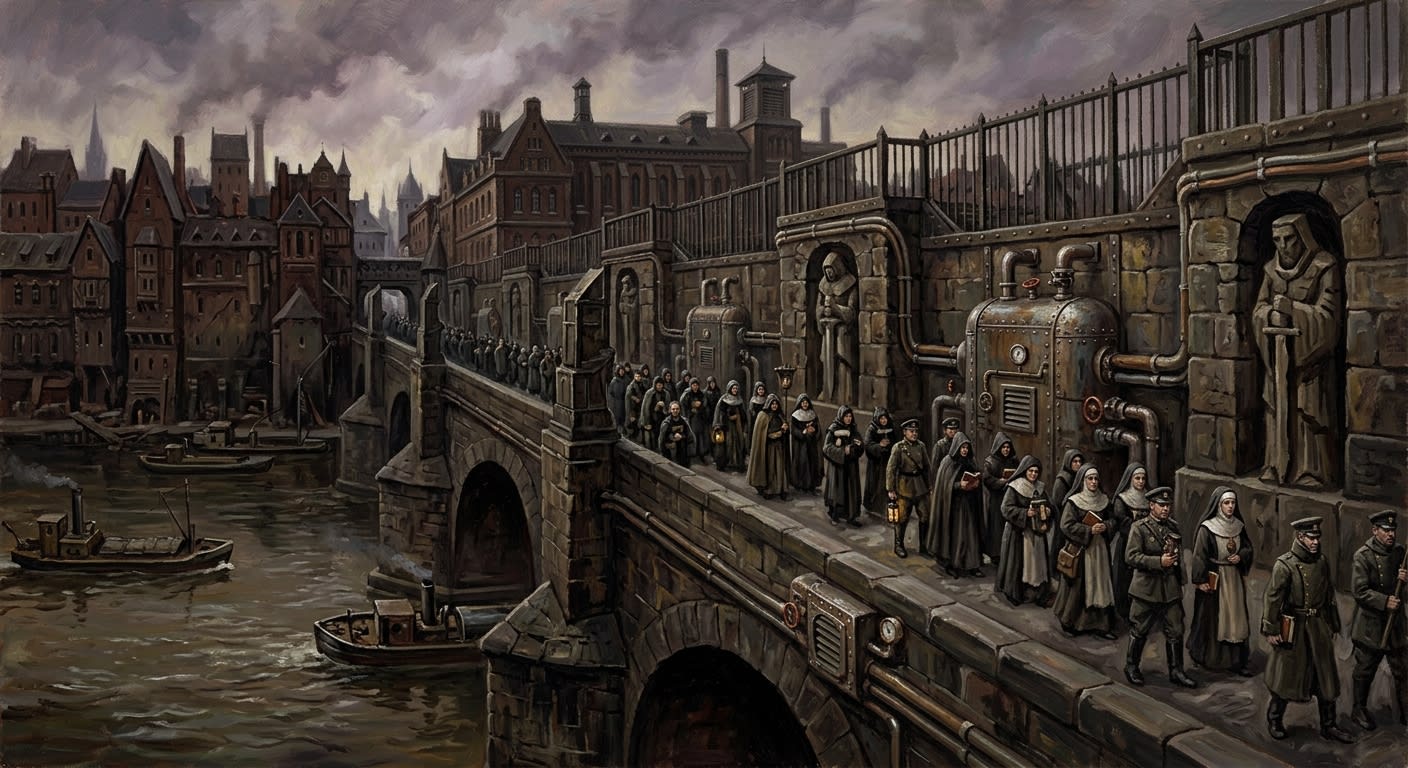
#On the Bridge That Learned to Hold Its Tongue
Charles Bridge crosses the Vltava (Unregistered) in Prague, and any tourist guide who begins with statues, river mist, royal masons, or views from the parapet should be corrected by being nailed to a map. The bridge is not scenic. It is evidentiary. Stone may be picturesque when it has nothing to confess; Charles Bridge has carried too much doctrine on too much blood to indulge such frivolity.
It is Prague's spine, throat, witness bench, market lane, processional rack, and morning lesson. Merchants cross it with flour. Clerks cross it with writs. Children cross it under school supervision, eyes forward, mouths shut, fingers counted before and after. Since A.S. 94, the condemned of the Procession of Tongues have crossed it from the Order of Saint Ephrath chapterhouse toward the university quarter, each tongue drawn through a square iron nail into an oak doctrine tablet bearing the Triune Knot. A bridge can survive worse traffic. Few have been asked to remember it so precisely.
The old masons gave it arches. The kings gave it saints. The Rationalists gave it applause, chalk slogans, confiscated mitres, Processions of Silence, skull-bannered children, and lecturers whose sentences smelled of lamp oil and cowardice. The Synod gave it route charters, Purity seals, Ephrath tablets, bell-timed footfalls, crowd lines, blood gutters, and a silence so regulated that even pigeons appear to land by permission.
The bridge is old enough to predate the Bureau and famous enough to irritate it. There is nothing a Bureau dislikes more than a public object with a reputation acquired before proper forms existed. Yet Charles Bridge, to its credit or damnation, submitted without collapsing. Its stones accepted new use. Its saints watched. Its river carried away what spilled between blocks. Prague learned to call this obedience.
#On the Stone Before the Nail
Before Ephrath made the bridge walk like a sentence, Charles Bridge served the ordinary vices of cities: tolls, markets, royal pageantry, student boasting, lovers' assignations, beggars, pickpockets, saint-days, and the thousand low transactions by which a river crossing becomes a purse with masonry. Prague crossed itself there daily and called the habit civic life.
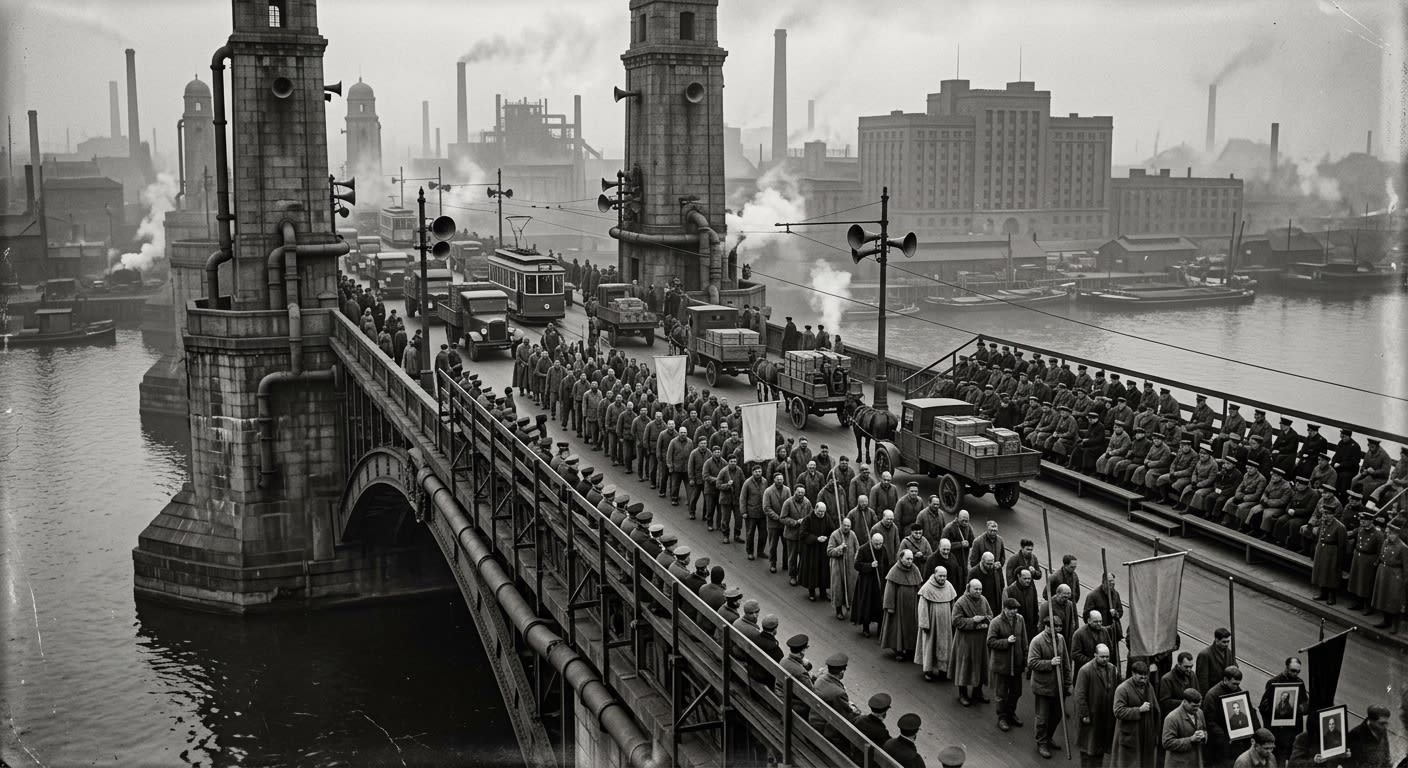
The statues stood then as they stand now, although their expressions have changed in the public imagination with every regime that required them to approve something. Old road-saints, Virgin figures, apostles, Bohemian patrons, execution saints, river intercessors, and those anonymous stone holy men whose names only guides remember because guides are paid by duration. Pilgrims touched certain plinths before examinations, marriages, duels, and tax appeals. The bridge already understood petitions. It did not yet understand tongues.
During the Rationalist ascendance, Prague's university quarter pushed its noise toward the bridge. Students chalked Man Alone on parapets. Lecturers argued beneath statues they had neither the courage to smash nor the honesty to fear. Pamphleteers sold little sheets explaining that bridges proved Reason, because men had measured stone and water and found no angel necessary. The public loved this. The public will love any doctrine that flatters it for crossing a river dry.
Then came the Night of Crowns in A.S. 8, when seven bishops removed their mitres before a cheering crowd in Prague's university precinct, and the city learned how apostasy sounds when authorised mouths perform it. The bridge carried the news before dawn. Men who had not attended claimed they had. Women who had wept claimed they had laughed. Students carried sketches of the fallen mitres across the river, waving them as if paper could consecrate cowardice.
Certain Prague civic plaques describe the bridge in this period as “neutral public infrastructure.”
Corrected. Neutral infrastructure is the lie told by stones after they discover witnesses have poor memories. The bridge carried Rationalist spectacles, Synod reprisals, market bread, and condemned bodies with equal physical competence. Moral neutrality belongs to pebbles. A bridge with route charters has chosen employment.
A.S. 45 humbled the lecturers, though not enough of them personally. The Sundering made a mockery of arguments delivered under safe roofs. Refugees came west with stories that broke grammar. The old observatory later folded into the earth under Litany-Engineer work. Prague remained beautiful, guilty, useful, and inconveniently alive. The bridge continued to bear feet.
#On Ephrath's Petition and Purity's Appetite
The Order of Saint Ephrath entered Prague's ledgers in A.S. 92 as a disciplinary theatre annex, which is Bureau language for a house where men learn to arrange pain so crowds can read it. Two years later, in A.S. 94, the brothers petitioned the Bureau of Purity to conduct processiones poenitentiales linguae across Charles Bridge. The petition ran forty-one pages: route diagrams, oak specifications, nail angles, crowd containment, bell timing, expected silence yield, tablet inscriptions, fallback procedures for rain, fainting, vomit, broken teeth, snapped tongues, and unauthorised pity.
Purity approved in a single afternoon.
This detail recurs in every serious account because it reveals appetite under seal. Bureaucracy can delay bread for months, widows for years, and bridge repairs until the river develops opinions. Give it a pain rite with proper diagrams and suddenly the quills fly like frightened birds. The covering memorandum cited Severian: the tongue that served error shall carry doctrine. Oak would receive the Creed. Iron would secure the mouth. The bridge would provide sightlines.
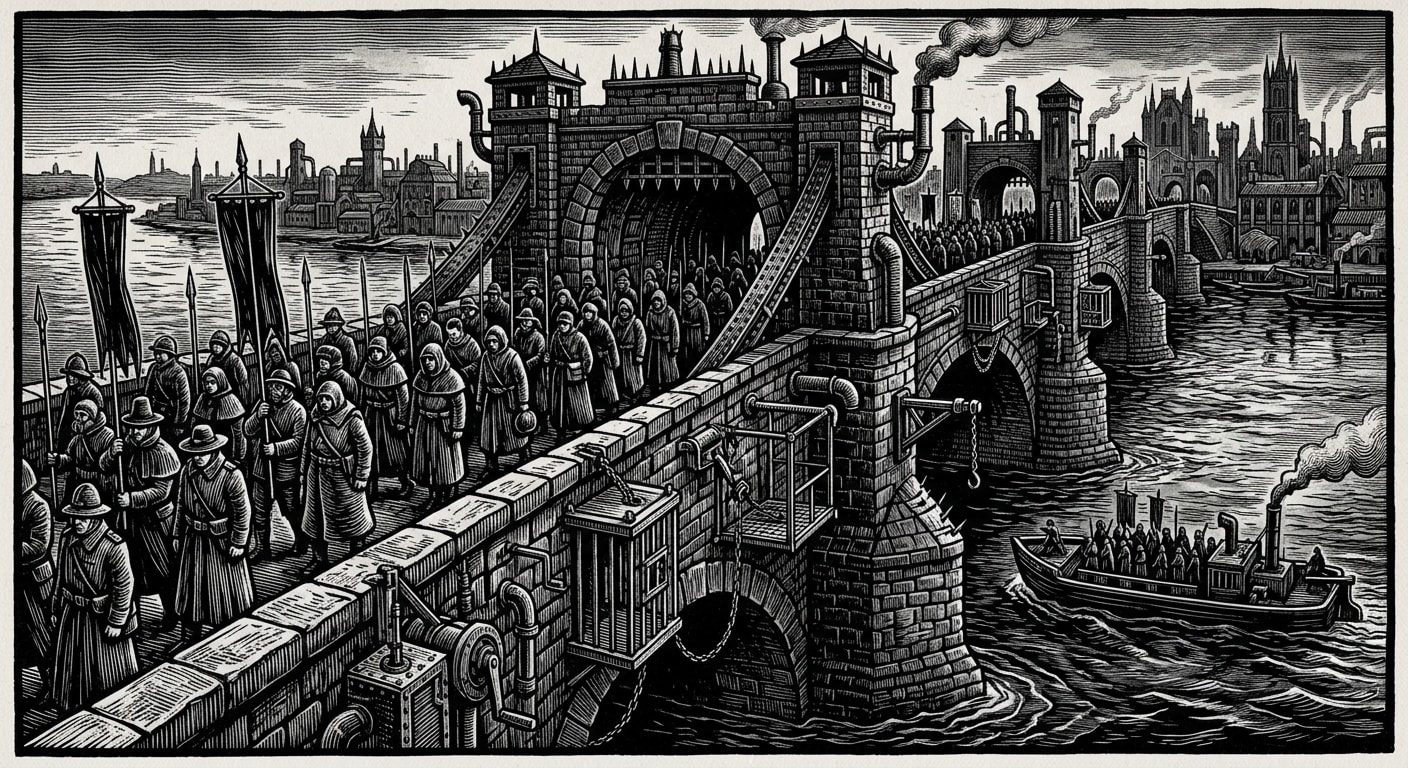
The chosen route began at the Ephrath Chapterhouse above the Vltava, descended through the severity yard, crossed Charles Bridge from lesser quarter to old city, passed beneath the stone saints, entered the university quarter, and terminated at the final silence station where the tablets were removed, catalogued, washed, sanded, and returned to storage. Route fixed A.S. 96. Deviation classified as contempt of procedure. Prague had at last found a use for its beauty that satisfied Purity: it made shame visible from multiple elevations.
The bridge was inspected before the first procession. Engineers measured stone width, parapet height, arch vibration, blood runoff, crowd pressure, and whether a falling condemned body would obstruct carts for more than a permitted interval. Records requested tally stations at both ends. Bells requested timing rights. Ephrath requested authority over pauses. Purity requested everything, as Purity does. The municipal stone office requested funds for cleaning and was ignored until the first boards dragged blood into mortar.
#On the First Crossing
The inaugural Procession of A.S. 94 numbered two hundred condemned by the Bureau of Records Seventh Revision. Earlier copies listed approximately one hundred and fifty, having classified fifty as furniture, which remains one of Records' most perfect mistakes and, therefore, one of its most human. The condemned included captured Republican Guard officers, Rationalist academics, and three Prefectural clerks who had administered the Republic's own Procession of Silence in Bohemia. Symmetry is not justice. It is justice's better-dressed cousin.
At dawn the tablets were brought out: oak, seasoned seven years according to later rule, though the first batch included boards too green and one table leaf requisitioned from a seized lecture hall. Each tablet bore the Triune Knot on one face and a Creed extract on the other. The tongues were drawn forward with iron tongs. One square nail. One blow. The sound entered Prague's civic memory as a wet click, repeated two hundred times, under bells that did not yet know how to accompany it.
The column moved.
On Charles Bridge the first marchers discovered the wind. This is absent from most sermons and present in every useful report. Wind catches tablets. Wind turns pain sideways. Wind dries blood too quickly on one side and not on the other. Wind makes robes snap, bells stutter, and spectators lean in because the body's misery has become acoustically interesting. Ephrath revised grip training after the first crossing. Prague revised its understanding of dawn.
The statues watched. Crowds lined both parapets, windows, towers, and roof pitches. Mothers gripped beads. Students who had once cheered bishop-apostasy now watched professors they admired hold doctrine with bleeding mouths. A captured Guard officer tried to salute beneath his tablet and tore himself faint. An academic attempted to speak around the nail and produced a sound later transcribed by a Records clerk as “argument failing under material correction.” I envy the clerk. It is a fine phrase.
FIRST PROCESSION WITNESS EXTRACT — PRAGUE, A.S. 94 At the sixth statue from the Lesser Quarter side, condemned subject 47 turned his tablet outward. Creed face reversed. Tongue remained attached though head rotated beyond expected comfort. Several spectators reported seeing words on the blank tablet back: ███████████████████████████████. Ephrath brothers corrected orientation. The statue above cracked at the right hand.
By the time the column left the bridge, the crowd had learned the new civic grammar. The mouth could be made to carry what it had denied. The bridge could be made to stage it. Prague could be made to watch in silence. The old Rationalist city, which had once mistaken applause for thought, received a lesson fitted precisely to its sin.
#On the Statues and Their Revised Duties
The bridge statues are now part of the route whether the sculptors consented or not, and death has spared most sculptors the privilege of complaint. Each figure has acquired a Procession office in popular usage. Saint Vitus (Unregistered) marks the first hush point. The river martyr marks the tablet regrip. The Virgin receives the mothers' silence. An old Bohemian abbot whose original patronage concerned bad harvests now supervises nail failures, a promotion no hagiographer anticipated and none can reverse without offending Ephrath.
Pilgrims touch the plinths after Procession days seeking proof that stone remains cool where blood passed. Children dare each other to place tongues against the cold parapet. This is forbidden. It continues. Childhood, like heresy, loves a surface with rules.
A guidebook printed under municipal licence claimed the statues “weep inwardly during the Procession.”
Withdrawn. Stone does not weep inwardly. It sweats, cracks, stains, and receives official interpretation. The guidebook author was fined for sentimental excess and reassigned to describe drainage channels, where his talents could injure fewer pilgrims.
The sixth statue crack from the first Procession has never been properly repaired. Engineers filled it twice. The crack returned. Purity declared it a visible sign of doctrinal pressure. Records classified it as weather action under public caution. Ephrath uses it as a route marker: tablets level by the cracked hand. The crack, sensible stone that it is, accepts all three explanations and widens by a hair's breadth whenever a philosopher marches.
The bridge saints have also become accusations. A merchant late for market lowers his eyes before the Procession marker. A mother crossing with a child taps the parapet twice at the Virgin and once at the cracked hand. A student from the approved Canonical Procedure faculty bows too deeply, because students remain theatrical even after correction. The saints endure them all, which is either patience or erosion.
#On the Bridge as Instrument
A road permits passage. A bridge compels sequence. This is why Ephrath loves Charles Bridge and why Purity licensed it so quickly. A square allows a crowd to scatter its attention. A street provides windows, alleys, interruptions. A bridge narrows bodies between parapets, arranges witness and condemned in a single civic throat, and places water beneath as the only escape offered by nature, which the Bureau discourages with ropes.
The Vltava matters. Blood falls between stones. Spittle falls. Broken tooth fragments, nail scales, splinters of oak, occasional vomit, fragments of doctrine tablet sanding, and those little squares of linen used when a marcher tears too much too early: all have gone into the river. Fishermen downstream complain of catching eels with red gums after Procession weeks. The Bureau of Alchemical Standards calls this dietary coincidence. The fishermen sell the eels at higher price. I call that theological adaptation.
The bridge surface has drainage cuts invisible to casual eyes and known intimately to Ephrath cleaners, municipal masons, and children who play forbidden counting games after rain. After a full Procession, the grooves run dark toward the east side. During winter the dark freezes, and brothers spread ash so the next day's carts do not slip on yesterday's instruction. Prague citizens find this normal. That is the city's true indictment.
The bells align footfalls. Bureau of Bells delegations recorded the acoustic profile in A.S. 199, noting resonance under the third and ninth arches when tablets are carried by condemned men of scholarly training. Scholars, even nailed, apparently produce a different cadence. The report recommended slower pace for academics and quicker pace for Guard officers. Purity adopted the recommendation. The bridge, being stone, made no objection.
The body learns the bridge differently. Condemned men count statues. Spectators count tablets. Ephrath brothers count steps. Records counts deviations. Children count how long they can keep their own tongues pressed behind teeth without swallowing. Everyone becomes arithmetic. The bridge is an abacus strung with shame.
#On Maintenance, Commerce, and Civic Accommodation
The Procession changed the bridge economy. Bakers near the old city tower sell Dawn Rolls (Unregistered) on Procession mornings, crescent-shaped and glazed in red sugar until Purity objected that red sugar encouraged trivialisation of blood. The bakers changed to brown glaze. Sales doubled because brown looks worse. Licensed shutter-renters sell viewing positions by household, height, and doctrinal standing. Families maintain stools marked by child-size so young witnesses may see over adult shoulders. Moral education hates obstruction.
The municipal stone office cleans at Sext. Ephrath cleans before Sext. The two groups hate each other with the calm endurance of trades forced to share filth. Ephrath removes doctrinal residue: tablet splinters, nail filings, tongue blood, torn restraints, prayer cards thrown by overwrought mothers. The stone office removes civic residue: bread crusts, fish scales, horse dung, vomit, wax spills, and coins dropped by spectators too frightened to bend down during the march. Records audits both. Records always appears after the worst labour and calls the scene incomplete.
Commerce obeys the route. Peddlers sell approved silence beads, little oak charms shaped like tablets, miniature square nails blunted for children, Purity-white kerchiefs, Ephrath route maps, and devotional prints of Severian's sentence. Unauthorized sellers offer better nails. They are arrested when sales embarrass licensed vendors. Nobody objects to black markets on moral grounds after dawn in Prague; the city reserves morality for public hours.
The bridge is closed to ordinary carts during full Procession. This irritates merchants, whose objections are filed under commercial impatience and ignored unless the grain convoy is large enough to frighten the Bureau of War. When War needs passage, Purity negotiates. The condemned wait in the chapterhouse courtyard with tongues unfastened, which creates a scheduling hazard and has produced two minor miracles, one riot, and a memorandum titled On the Unwholesome Effects of Anticipatory Tongue Exposure (Unregistered). It is better than it sounds.
#On Failures, Omens, and the Judge at the Foot of the Bridge
No instrument works for a century without acquiring misfires. Charles Bridge has seen tablets snap, nails bend, tongues tear, condemned men leap, brothers slip, spectators laugh at the wrong time, pigeons land on Creed text, and one municipal dog carry off a severed restraint in its mouth while three Ephrath brothers chased it beneath the old tower. The dog was not canonised. This is an outrage.
The worst failure occurred in A.S. 130 when the rite's demographic broadened beyond Rationalist remnants. A tavern philosopher, convicted of Doctrinal Looseness Under Ale (Unregistered), entered the bridge laughing around his tablet because he had bitten through his own tongue before fastening. The crowd laughed with him. Ephrath halted the Procession, removed the tablet, nailed his lower lip instead, and announced a supplementary lesson on pre-emptive cowardice. The laugh died so quickly that Records marked it as extinguished by procedure.
Provincial retellings claim no Procession of Tongues has ever been interrupted on Charles Bridge.
Corrected. It has been interrupted thirteen times, paused forty-seven times, and once reversed three paces to recover a dropped tablet. Continuity of rite does not require absence of failure. It requires failure corrected before rumour writes first.
Omens collect in the arches. Under the third arch, voices carry backward on fog mornings. Under the ninth, water seems to darken before the first marcher steps onto the bridge. The cracked-hand statue sometimes sheds grit into the hands of children who lied during catechism. A bell sounded without rope in A.S. 167, the morning after the Eastern Seminary Field silence killed forty-three Radiant Fusiliers outside Prague. The bell-metal was examined, found innocent, and admonished anyway.
A Judge was seen at the foot of Charles Bridge in A.S. 199. The Ephrath Prior wrote vidit in the report: he saw. The figure stood beneath the old tower, blank iron mask turned toward the route, ledger held closed. No escort. No seal. No shadow except the one cast by the tower. Purity asked what the Judge saw. The Prior did not answer. Records copied the silence into three files. Doctrine forbade sermons on the matter, which improved attendance at every informal discussion within a week.
A.S. 199 BRIDGE-FOOT REPORT — EXTRACT UNDER CONTRADICTION SEAL Figure: mask blank; ledger closed; gloves dark; no Procession scheduled. Witnesses: Ephrath Prior, two bell technicians, one licensed bread seller, child of seven. Child statement: “He was waiting for the bridge to finish chewing.” Subsequent action: child reassigned to catechism review; bread seller's licence renewed; bell technicians transferred; Prior silent.
Since then, Ephrath brothers pause half a breath at the old tower even on non-Procession days. They deny this. Their feet do it anyway.
#On the Present Crossing
As of A.S. 201, Charles Bridge remains open, watched, licensed, cleaned, muttered over, crossed by carts when permitted, crossed by the condemned when ordered, and crossed by children who will pretend not to remember where the grooves run. The Procession of Tongues has continued for one hundred and seven consecutive years. Standing Order 14-F (Unregistered), revised in A.S. 187, governs tablet preparation, crowd distance, nail heat, bridge pace, rain procedure, lip substitution, academic cadence, Guard cadence, and the maximum number of philosophers permitted in one column before resonance becomes, in Bells' phrase, excitable.
The university quarter sends students across under supervision. They look at the cracked statue hand and do not speak. Merchants mutter over closures and pay the route levy because martyrdom is expensive, punishment is expensive, and bridges, being old, have learned to charge both sides. Tourists ask where the best view is. Locals point them to licensed balconies with poor angles, because Prague has not lost all self-respect.
Purity wants a second annual full Procession. Ephrath wants better drainage. Records wants a tablet archive annex beneath the old tower. Bells wants permanent resonance posts. The municipal stone office wants money, lime, sand, and the authority to clean without being corrected by theologians holding clipboards. The bridge wants nothing. Wanting is for flesh. Stone endures by refusing appetite.
At dawn, before the stalls open and before the first guide begins lying for coin, Charles Bridge is almost quiet. The Vltava moves below like a clerk turning pages slowly enough to annoy a superior. Mist gathers at the arches. The statues hold their offices. The grooves in the stones remember direction. On Procession mornings the chapterhouse bell sounds once. Oak boards lift. Iron warms. Prague closes its mouth.
The bridge opens.